NEAR Protocol is the chain co-founded by the guy who co-authored the original Transformer paper at Google. That paper is the architecture behind every large language model on the planet. Illia Polosukhin’s name sits on it. Then he went and built a layer-1 blockchain. Whether that backstory makes you bullish or makes you raise an eyebrow, NEAR has shipped one of the more interesting technical designs in crypto — sharded execution and human-readable account names — and it’s pivoted hard into AI as the second act.
I’ve held NEAR through two cycles and used the chain for everything from staking to testing wallet UX. This is the walkthrough I’d give a friend buying their first NEAR on BitGet. Two of the links below are affiliate. I’ll flag them as we go.
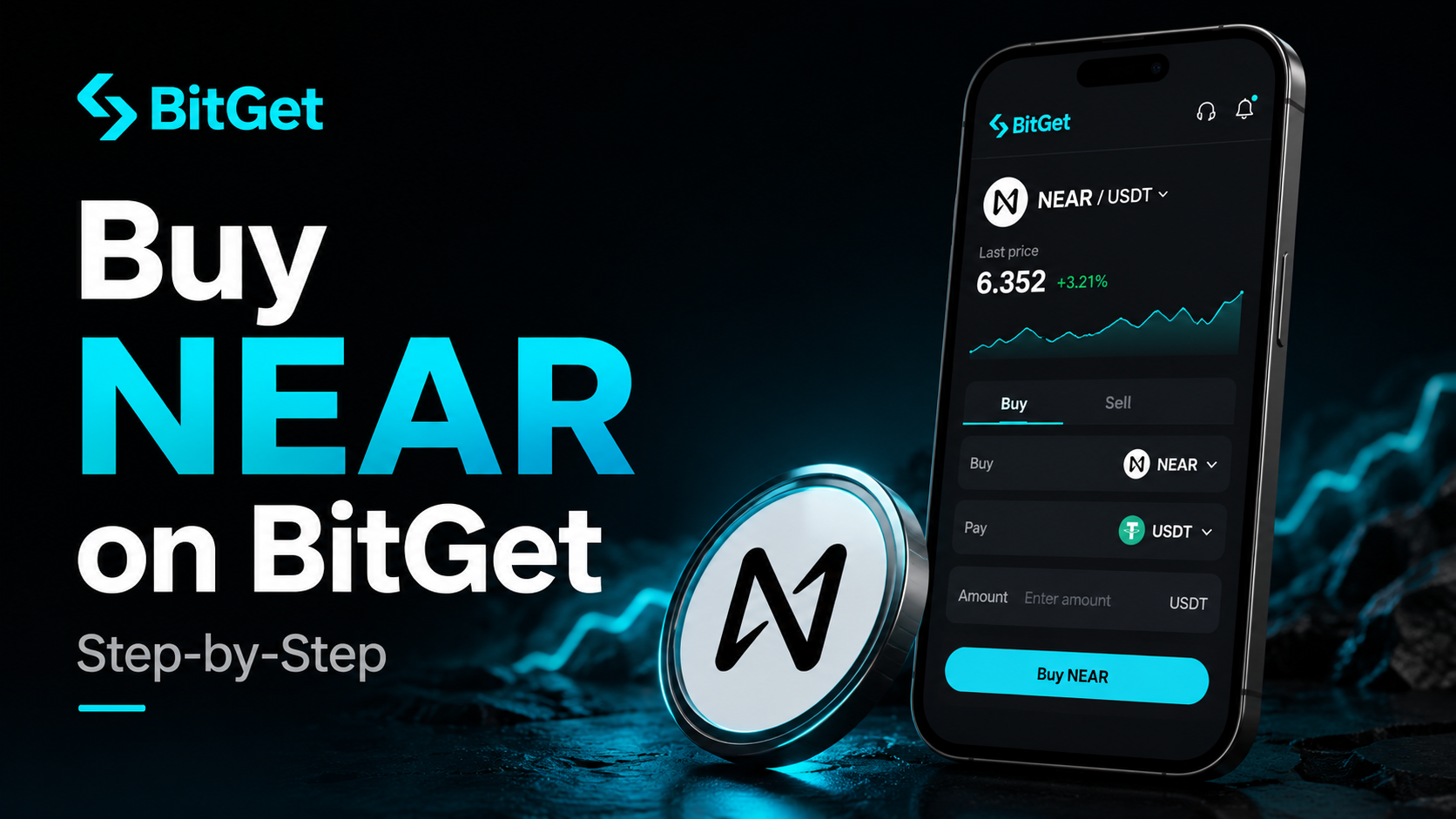
Short answer: To buy NEAR Protocol on BitGet, create an account with email, turn on 2FA, complete KYC (usually same-day), fund the account via card, P2P, bank transfer, or crypto deposit, then place a spot order on the NEAR/USDT pair. Spot fees are 0.10%. Card on-ramp adds 1–3%. NEAR staking returns sit around 9–11% APY. For long-term storage, use a Ledger Nano X — Meteor or the official NEAR Wallet for everyday use. Time from signup to NEAR in your wallet: about 30 minutes.
Open a BitGet account → (affiliate)
Key takeaways
- NEAR is a sharded layer-1 designed for high throughput — the Nightshade architecture splits the network into parallel shards that process transactions independently.
- Account names are human-readable (
alice.near) instead of hex addresses — a usability decision most chains haven’t matched. - Network staking APY sits around 9–11%, paid in NEAR, with a 65-72 hour unbonding window.
- BitGet spot fees are 0.10% maker/taker. Card buys add 1–3%, so P2P or a crypto deposit is cheaper if you can wait.
- KYC usually clears in 1–24 hours. Long-term NEAR belongs on a hardware wallet, not on the exchange.
What NEAR actually is
NEAR is a proof-of-stake layer-1 blockchain that launched its mainnet in 2020. The founding team is Illia Polosukhin and Alex Skidanov. Illia spent time at Google Research and is one of the eight co-authors on “Attention Is All You Need” — the 2017 paper that introduced the Transformer architecture and effectively kicked off the modern AI boom. Alex came from a machine-learning background and worked at MemSQL. Both founders cite AI as the long-term direction they always wanted NEAR to support, which became more obvious when the team rebranded large parts of the ecosystem around “NEAR.AI” in 2024.
The technical pitch has three pieces.
Nightshade sharding. Most chains run all transactions through a single state machine. NEAR splits the chain into shards that process transactions in parallel, then combines the results into a single block. The design started at four shards and is built to expand as demand grows. Real throughput on a single shard sits comfortably above other layer-1s for normal load.
Human-readable accounts. Instead of a 64-character hex address, NEAR accounts have names — alice.near, bob.near, bitget.near. Sub-accounts (like wallet.alice.near) work natively too. It’s the kind of usability decision that sounds small until you’ve sent five transactions and realised you don’t have to copy-paste a hex string each time.
Sub-second finality. Transactions finalise in about 1.2 seconds. Fees are low — typically fractions of a cent for a standard transaction.
The AI pivot is the second story. NEAR.AI is positioning the chain as the settlement and compute layer for AI agents — agents that can hold and spend funds, sign transactions, and operate on-chain. It’s a multi-year bet. Whether it pays off depends on whether AI agents become a real economic category or another narrative that ran hot for a quarter.
Live numbers on price, market cap, and circulating supply sit on CoinGecko’s NEAR page and CoinMarketCap. Total supply is just over 1 billion NEAR, with an inflation rate around 5% — most of that goes to validators and staker rewards. Worth a check before placing the trade.
For the wider context on layer-1 chains and how they differ, the blockchain explained post covers the ground. For the general buying workflow that applies to any token, the how to buy crypto parent guide is the start point.
Why NEAR has a serious user-experience edge
This is the bit most layer-1 posts skip and most chains fail at. UX.
Account creation. You don’t have to fund a wallet before it exists. NEAR’s “implicit accounts” let you receive funds at a generated address, then “activate” the account into a named one when you have a fraction of a NEAR for the registration cost.
Function call access keys. NEAR has the concept of limited-permission keys. A DApp can ask you for an access key that can only call certain functions on certain contracts — not a blanket signing key. The practical effect: you can connect to a game or a DeFi protocol and limit what it can actually do with your wallet without trusting the team to behave.
Recovery options. The official NEAR Wallet supports passphrase recovery, email-based recovery, and hardware wallet integration. Different security trade-offs, all available.
Gas in the receiver’s interest. Smart contracts can be configured so the contract pays the gas instead of the user. That makes onboarding into a NEAR-based app possible without forcing a new user to acquire NEAR tokens first.
None of this matters if the chain doesn’t have users. But it does matter if you’re trying to understand why NEAR keeps showing up in “developer experience” rankings — the design choices are aimed at making blockchain usable by humans who don’t read white papers for fun.
For news on NEAR upgrades and AI ecosystem moves, CoinDesk’s NEAR coverage and the NEAR Protocol foundation site are the places I check.
Why BitGet for buying NEAR
A handful of exchanges list NEAR. Here’s why I’d point a beginner at BitGet for this one.
Deep NEAR/USDT order book. NEAR has good liquidity on BitGet — a $1,000 market order won’t move the price noticeably. For a top-30 asset, that’s the expectation, and BitGet delivers.
Fee table. Spot maker/taker fees start at 0.10% and drop with BGB holdings or volume. The chart price is what you trade against. Full breakdown in BitGet trading fees.
Funding options. Card, bank transfer, P2P, or crypto deposit. Pick what fits your timeline.
Withdrawal works. I move NEAR off BitGet to my Ledger regularly. Confirms in seconds on the NEAR network. Full platform review in BitGet review.
Earn integration. BitGet also offers NEAR staking through its Earn product — covered in the BitGet Earn guide when that goes live. Lower APY than native staking, but no unbonding wait.
Geo limits. BitGet is not available in the US. UK and EU residents are fine. If you’re in the US, look at Coinbase Advanced or Kraken — both list NEAR. Everywhere else, this is the workflow I’d run.
Pre-signup checklist
Five things to have ready before opening the sign-up page.
A photo ID. Passport or driving licence, in date, photo clear. KYC asks for the document plus a selfie.
A live email address. You’ll get 2FA codes, withdrawal confirmations, and security alerts there. Don’t use a burner.
A long password. 16 characters minimum, unique to this account. A password manager makes this painless.
An authenticator app. Google Authenticator, Authy, or 1Password’s TOTP feature. Install it before you create the account. SMS 2FA has been the way most account drains start — covered in 2FA for crypto.
A funding source. Debit card for the fastest first-buy, bank account for P2P, or a wallet with crypto for a deposit.
Storage plan. Decide where the NEAR is going to live before you buy. Trading float on BitGet, long-term holdings on a Ledger Nano X. The hot vs cold wallet breakdown covers the trade-offs.
Step-by-step: BitGet signup
Five steps. About ten minutes if your documents are ready.
- Open the sign-up page. BitGet (affiliate — small fee rebate on top of the standard tier). Enter email and a strong password.
- Verify the email. A six-digit code arrives in under a minute. Paste it in.
- Turn on 2FA. Security Settings → Authenticator. Scan the QR code with your app and save the backup code on paper. Don’t screenshot it onto a cloud-synced phone.
- Run KYC. Identity Verification → upload ID and take a selfie. Most clear in 15 minutes to an hour. Some take longer.
- Add a payment method. Card if you’re going for instant. P2P and bank transfer can be set up when you fund.
Account live. Funding next.
Funding: card vs P2P vs bank vs crypto deposit
Four ways to get money onto BitGet. Each has its own cost-time profile.
| Method | Fee | Speed | Best for |
|---|---|---|---|
| Crypto deposit | Network fee only | 1–60 min | You already hold USDT/USDC/NEAR elsewhere |
| P2P (bank transfer) | 0% (small rate spread) | 5–30 min | Best rate, slightly more steps |
| Bank transfer (third-party) | 0.5–1.5% | 1–3 hours | Mid-size buys |
| Card on-ramp | 1–3% | Instant | First small buy, can’t wait |
Crypto deposit is the cheapest path if you already hold USDT, USDC, or NEAR elsewhere. Send to your BitGet deposit address. USDT on TRC-20 costs about 1 USDT in fees. ERC-20 closer to 8 USDT. Pick the network that matches the wallet you’re sending from.
P2P matches you against another user selling USDT for your local currency. You send a bank transfer, BitGet escrows the USDT until the transfer confirms. Rates land within 0.5% of mid-market.
Bank transfer through third-party on-ramps is the middle ground.
Card on-ramp is fastest and most expensive. Fee is baked into the quote — USDT arrives at 1.5–3% above spot. Fine for testing. Bad as a default.
For NEAR specifically, I’d use card for the first $50, P2P or crypto deposit for everything after.
Placing your first NEAR trade
Funds on the account. Two ways to convert them to NEAR.
Option A: Market order (fast, slightly worse fill)
- Open BitGet. Go to Spot Trading.
- Search for NEAR/USDT.
- On the buy side, pick Market.
- Enter the USDT amount.
- Tap Buy NEAR. Order fills in a second or two.
You pay 0.10% in fees plus a small slippage cost.
Option B: Limit order (slower, better price)
- Open Spot Trading, select NEAR/USDT.
- On the buy side, pick Limit.
- Set your limit slightly below the current ask.
- Enter the USDT amount.
- Tap Buy NEAR. The order sits until price hits your level.
For anything over $100, limit orders save you the spread. The BitGet spot trading guide covers order types in full and BitGet order types breaks down stops and trailing orders.
How much NEAR to buy (position sizing)
NEAR trades with mid-cap volatility. Three rules.
Rule one: NEAR has higher beta than BTC. When Bitcoin moves 5%, NEAR usually moves 8–14% in the same direction. The AI narrative amplifies that during AI hype cycles. A position that feels comfortable in BTC can feel rough in NEAR.
Rule two: split your entry over weeks. Pick a target — say £1,000 over three months — and split into 12 weekly buys. You won’t hit the bottom. You won’t hit the top. You’ll get a reasonable average and stop watching the chart every hour.
Rule three: keep a stablecoin reserve. NEAR has had 80%+ drawdowns. If you go in 100% on day one and price drops 50%, you’ve used your ammo. Keep 30–40% in USDT for the deeper dips.
For a first NEAR buy, start with a pub-round amount. Place the trade, watch for two weeks, see how a 15% drop feels. Scale up if you sleep fine.
This is the section where I’d flag that position sizing and reading charts is a skill you don’t pick up from blog posts. If you want to put the time in, Trade Travel Chill (affiliate) is the trading community I’m part of and the structured education I trust. Optional, useful when you’re ready. The TTC review covers what’s inside.
Storing NEAR: Ledger, Meteor, or exchange?
You’ve bought the NEAR. Where does it live?
Exchange (BitGet)
Fine for active trading float — what you’d be willing to lose without losing sleep. BitGet publishes Proof of Reserves and supports withdrawal at any time. But you don’t hold the private keys. The hot vs cold wallet breakdown covers what that gap means.
Hot wallet (Meteor or NEAR Wallet)
Meteor Wallet is the most-used everyday NEAR wallet. Browser extension and mobile. Clean UX, connects to NEAR DApps, supports staking directly. The official NEAR Wallet (at wallet.near.org) is the alternative — slightly older interface, more conservative feature set, fully supported by the foundation.
Both wallets give you the human-readable account names. You sign up with a name like alanspicer.near and that’s the address you share for receipts.
A hot wallet is internet-connected. Good for small balances you’d actually use. Bad for long-term holding.
Cold wallet (Ledger Nano X)
A Ledger Nano X is a hardware wallet — USB-sized, holds your private keys offline. NEAR is supported through Ledger Live and through Meteor (with the Ledger plugged in). Every send is signed on the device, so even a compromised laptop can’t drain you.
Ledger Nano X costs around £150. Cheaper than the lesson of an exchange failure or phishing hit. Order from the Ledger store (affiliate). Set it up, write the 24-word seed on the included card, store it somewhere fireproof and away from your home computer. The seed phrase storage guide covers backup options that work.
The split I run for NEAR
- Trading float on BitGet: 20% — for active trades.
- Meteor: 10% — for staking and DApp use.
- Ledger long-term: 70% — doesn’t move except to top up.
Full self-custody playbook in how to store crypto safely.
Ready to buy your first NEAR?
Sign-up takes 90 seconds, KYC usually clears the same day, and BitGet has one of the deeper NEAR/USDT books outside the top three exchanges.
Affiliate link. I may earn a commission at no extra cost to you.
NEAR staking: how it actually works
NEAR is proof-of-stake. Holders can delegate their tokens to validators and earn rewards while the tokens sit there. APY sits around 9–11% depending on the validator and the epoch.
The mechanics are simple. You pick a validator from the list (Meteor and NEAR Wallet both have built-in pickers). You delegate your NEAR — the tokens stay in your wallet, just marked as staked. The validator earns block rewards and inflation, and you take your share minus the validator’s fee (typically 1–10%).
The unbonding window is 65 hours to about three days — when you decide to unstake, the NEAR is locked for that period before it can be moved. This is to prevent attackers from instantly unwinding stake during an attack. Plan around it.
Validator choice matters. Pick a validator with a decent uptime track record and a reasonable fee. The official explorer shows validator stats. Don’t just pick the one at the top of the list — the smaller, well-rated validators help with chain decentralisation.
BitGet also offers NEAR staking through its Earn product. Lower APY than native staking, but no unbonding wait. If you want to compare the trade-offs, the crypto staking explained post breaks it down.
Common NEAR beginner mistakes
The errors I see most often.
Sending NEAR over the wrong network. When you withdraw from BitGet, pick the NEAR Protocol network. Some bridges issue wrapped NEAR on other chains — don’t use those unless you specifically need the bridged version.
Trying to send to a NEAR account that doesn’t exist yet. Implicit accounts work, but if you’re sending to a named account that hasn’t been created, the transaction fails. The fix: send to an active named account or use the recipient’s hex address.
Storing on the exchange long-term. Active float yes. Life savings no.
Picking the wrong validator for staking. Some validators charge high fees, some have spotty uptime, some are massive whales that concentrate the chain. Read the stats before delegating.
Falling for “NEAR.AI airdrop” scams. AI narratives draw scammers. Anyone asking for your seed phrase to “claim NEAR.AI tokens” is trying to drain you. The crypto scams guide covers the playbook.
Sharing the seed phrase. No exchange, no wallet, no validator will ever ask for your seed phrase. The phrase lives on paper, at home, and nowhere else.
Skipping 2FA. Enable it the moment you create the BitGet account. Most account drains come from phished credentials hitting accounts without 2FA.
Treating NEAR as a pure AI play. NEAR has an AI narrative and an AI focus area. It’s still a general-purpose layer-1 with DeFi, NFTs, and gaming activity. Don’t size positions assuming the AI story alone moves the price — broad crypto cycles dominate everything in the short term.
Jumping into futures. NEAR perps exist. They are for traders who understand liquidations. The BitGet futures USDT-M post is research, not a buy signal. Six months on spot before derivatives.
One last nudge.
If this walkthrough saved you research time, signing up through my affiliate link costs you nothing and helps keep the lights on.
Affiliate link.
Frequently asked questions
What is the minimum amount of NEAR I can buy on BitGet?
You can buy fractional NEAR from around $1 worth. NEAR is divisible to 24 decimal places (yoctoNEAR is the smallest unit). Most beginners start with $50–$200 to learn the interface.
Do I need to verify my identity to buy NEAR on BitGet?
Yes for full functionality. You can hold and trade limited amounts without KYC, but withdrawal limits are tiny. KYC usually clears in 1–24 hours and unlocks full deposit and withdrawal limits. The KYC explained post covers the process.
Can I buy NEAR Protocol on BitGet with a credit card?
Yes, but it’s a poor default. Card on-ramps charge 1–3% and most credit card issuers add a cash-advance fee or block crypto purchases outright. Use debit, bank transfer, or P2P unless you’re testing the workflow.
What is the cheapest way to buy NEAR on BitGet?
P2P trading or depositing USDT from another wallet. P2P fees are essentially zero with a small rate spread. Crypto deposit only costs the network fee.
Can I stake NEAR after buying it?
Yes. Delegate from Meteor, NEAR Wallet, or Ledger Live. APY sits around 9–11%. Unbonding takes 65 to 72 hours. BitGet also offers NEAR staking through its Earn product at a lower APY without the unbonding wait.
Should I keep my NEAR on BitGet or in a wallet?
Move long-term holdings to a Ledger Nano X. Meteor or NEAR Wallet works as a daily-use hot wallet. Keep an active trading float on the exchange.
Is NEAR a good long-term hold?
Nobody knows. NEAR has working tech, a serious founding team, and an AI pivot that could either be a strong narrative or a wasted positioning bet. Treat it as one position in a diversified portfolio.
What’s the difference between NEAR and Solana?
Both are high-throughput layer-1 chains. Solana uses a single global state and a different consensus mechanism. NEAR uses sharding to scale horizontally. Solana has more current on-chain activity. NEAR has the better account UX. Different bets on the same problem.
Final word
The first NEAR buy teaches you the workflow for every NEAR trade after. Open the account. KYC. Fund cheap. Place a limit order. Move long-term NEAR to a Ledger. Stake what you’re holding for yield.
That’s the short version. Do those five things in order and you’ve already avoided most of the mistakes that catch beginners on a layer-1 buy.
Right — over to you.
One more thing: Buying a token doesn’t mean it will go up. Most altcoins underperform Bitcoin over long enough timeframes. Only buy what you can afford to lose, and never put your rent money in crypto. If a YouTuber tells you a coin will 100x — they’re guessing too.
Related posts
- How to Buy Solana (SOL) on BitGet: Step-by-Step
- How to Buy Avalanche (AVAX) on BitGet: Step-by-Step
- How to Store Crypto Safely: The Self-Custody Guide