I’ve sat across from family members at Christmas trying to explain blockchain three different ways and watched their eyes glaze every time. The problem isn’t them. It’s that almost every explanation starts with “distributed ledger technology” and ends with a buzzword salad. After six years in crypto I’ve learned the only way it sticks is to skip the jargon entirely and start with a village shared ledger. Here’s that version — no buzzwords, no slogans, no “Web 3.0 paradigm”.
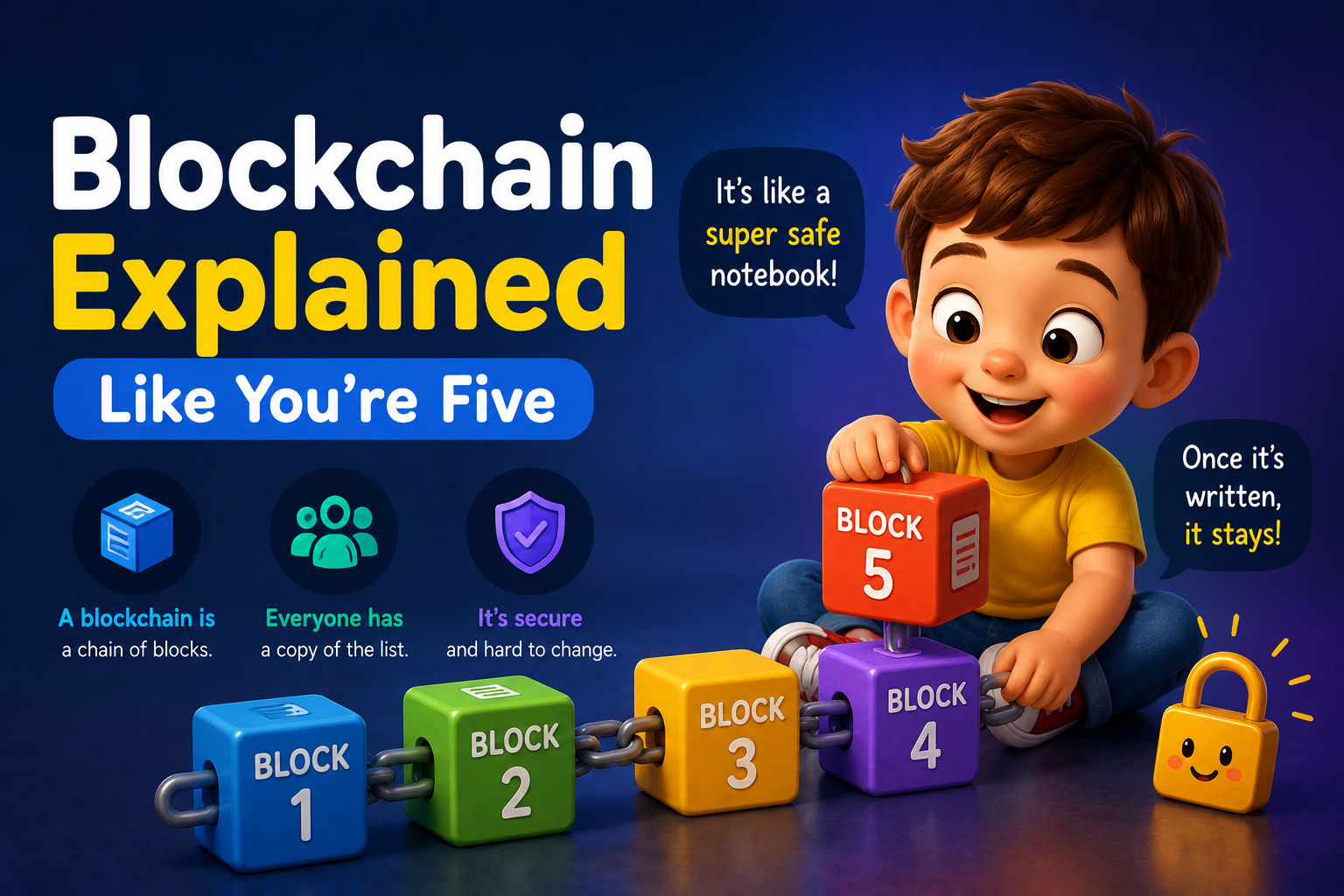
Short answer: A blockchain is a shared record book that lives on thousands of computers at once. Every computer keeps an identical copy. When someone wants to add a new entry — like a payment — every computer checks it, agrees on it, and adds it to their copy at the same time. Once added, entries are linked together cryptographically so they can’t be edited later. The point of blockchain is to keep a trustworthy record without needing one central party to be in charge of it.
Buy crypto on BitGet → (referral link)
Key takeaways
- A blockchain is a ledger that thousands of computers all agree on at the same time.
- New entries (called blocks) are linked to the previous block with cryptographic fingerprints — change one and they all break.
- No central party runs it. The network agrees by consensus, using rules like Proof of Work or Proof of Stake.
- Blockchain matters most when trust, censorship-resistance, or no central party is the goal — not for everything.
- Bitcoin, Ethereum, Solana, and most major crypto run on different blockchains with different trade-offs.
What a blockchain actually is (the village ledger analogy)
Imagine a small village. Everyone in the village knows each other and trades with each other — eggs for bread, work for vegetables, that kind of thing. To keep track of who owes what, the villagers agreed on a system: there’s a big book in the town square, and every transaction gets written in it.
Now imagine the village decides they don’t trust any one person to look after the book. What if the mayor edits an entry to make himself richer? What if someone steals the book overnight?
So they do something clever. They make 100 copies of the book and give one to every villager. Every time someone wants to do a trade, they shout it out in the square — “Alan gave Beth two loaves of bread for one chicken.” Every villager who hears it writes it in their copy of the book.
If someone tries to cheat — say, Alan claims he gave Beth two chickens instead of one — every other villager checks their book, sees the original entry, and rejects the fake one. The truth is whatever the majority of books agree on.
That’s a blockchain. The “book” is the ledger. The “villagers” are the computers running the network. The “shouting in the square” is broadcasting transactions to the network. The fact that no one villager controls the book is what makes it tamper-resistant.
The clever part — the part Satoshi Nakamoto figured out for Bitcoin — was how to do this with millions of strangers across the internet instead of 100 neighbours in a village. That’s where the cryptography comes in.
How blocks are linked (the chain part)
A blockchain isn’t one long list of transactions. It’s organised into “blocks” — batches of transactions that get added together at regular intervals. Bitcoin produces a new block every ten minutes. Ethereum produces one every twelve seconds. Solana aims for sub-second.
Each new block contains:
- A batch of recent transactions
- A timestamp
- A reference to the previous block (a “hash” — a cryptographic fingerprint)
That third part is the key bit. Every block contains the fingerprint of the previous block. If you change a single character in block 500, the fingerprint of block 500 changes. That breaks the reference in block 501. Which breaks block 502. All the way to the most recent block.
In a system where thousands of computers are all keeping the same chain, you can’t quietly edit an old block. Every other computer would see the chain doesn’t match anymore and reject your version.
That’s why it’s called a “block-chain”. Blocks of transactions, chained together with fingerprints, all the way back to the first block ever created (the “genesis block”).
The result: once a transaction is buried under enough new blocks, it’s effectively permanent. To forge it you’d need to redo all the cryptographic work for every block since — and do it faster than the rest of the network is producing new blocks. At Bitcoin’s scale that requires more computing power than the largest tech companies in the world combined.
Why this matters (immutability, no central party)
Three properties drop out of the design above. They’re the whole reason anyone cares about blockchain.
Immutability. Once a transaction is recorded and buried under a few more blocks, you cannot change it. No bank refund, no admin override, no court order to a server. The record is permanent by design.
No central party. There’s no Blockchain Inc. There’s no head office to subpoena, no CEO to threaten, no servers to seize. The network runs because thousands of independent operators agree to follow the same rules.
Public verifiability. Anyone in the world can download a copy of the ledger and check it. You don’t have to trust anyone’s word for what’s in it. You can read it yourself.
Those three properties are useful when you need to keep a record that:
- Nobody — including the people running the system — can change after the fact
- Survives even if specific servers go down or specific companies disappear
- Anyone can independently verify
That’s a narrow but real use case. Money is one obvious fit (this is why Bitcoin works). Property records, voting systems, supply chain tracking, identity systems — anywhere trust in a central party is hard to come by, blockchain has a case.
Where it doesn’t help: anything where you already have a trusted party who’s faster, cheaper, and good enough. Your bank’s ledger works fine for sending money to a friend. A blockchain isn’t going to do it better.
Blockchain vs a database — the real difference
This trips people up. A database is just an organised record of data. A blockchain is also a record of data. So why is one a blockchain and the other “just a database”?
The honest answer: a blockchain is a specific kind of database with specific properties. It’s a database that:
- Runs on many computers simultaneously instead of one central server
- Uses cryptography to make entries tamper-resistant
- Has rules baked in for how new entries get added (consensus)
- Lets anyone (in a public blockchain) read and verify the data
A regular database — the kind your bank, your gym, or Investopedia runs on — has none of those properties built in. There’s one main copy. An admin can edit it. There’s no built-in cryptographic verification. Access is restricted.
Here’s the trade-off. Databases are fast, cheap, and easy to operate. They handle billions of transactions per day with no fuss. Blockchains are slow, expensive, and complicated, but they don’t need anyone to be trusted.
Use a database when: you trust the operator, speed matters, cost matters, and the data is private.
Use a blockchain when: you don’t have a trusted operator, the record needs to be public, censorship-resistance matters, or there’s no single party who should be in charge.
Most things should be databases. A small minority of things should be blockchains. That minority includes Bitcoin, Ethereum, and most legitimate crypto. It does not include 99% of the “blockchain X” pitches you’ve heard from corporate press releases.
Public vs private blockchains
Most of what people mean by “blockchain” is actually “public blockchain”. Bitcoin and Ethereum are public — anyone can download the software, run a node, and view all the data. There’s no permission required.
Private blockchains exist too. Banks and supply chain companies have built networks where only authorised parties can participate. IBM Food Trust and various JP Morgan projects are examples — see IBM’s blockchain primer for the corporate framing.
The question to ask about a private blockchain: why isn’t this just a database with audit logs?
The honest answer in most cases is that it should be a database with audit logs. Private blockchains are usually slower, more expensive, and harder to operate than the database they replace, and they don’t gain the censorship-resistance and decentralisation that make public blockchains useful in the first place.
There are exceptions. Some consortium chains have legitimate use cases where multiple organisations need to share a ledger without trusting each other. But the bar is much higher than “let’s blockchain this” suggests.
When people in crypto talk about blockchain, they almost always mean public blockchains. That’s the part this guide is about.
Consensus mechanisms (PoW vs PoS, plain English)
If thousands of computers all have copies of the ledger, how do they agree on what gets added next? That’s what “consensus” means. There are two dominant approaches.
Proof of Work (PoW)
Used by Bitcoin and a few others. Computers compete to solve a hard mathematical puzzle. The first to solve it gets to add the next block and earn a reward. Solving the puzzle takes huge amounts of computing power and electricity.
Why does this work? Because forging a fake chain would require redoing all that computational work for every block — and doing it faster than honest computers are producing new blocks. At Bitcoin’s scale this requires more energy than entire countries use. It’s economically irrational to attempt.
The cost is real energy use. Bitcoin’s network consumes roughly the energy of a mid-sized country. Critics call this wasteful. Defenders call it the price of security.
Proof of Stake (PoS)
Used by Ethereum (since September 2022 — see what is Ethereum), Solana, Cardano, and most newer chains. Instead of solving puzzles with electricity, validators lock up some of the chain’s native token as a deposit. They’re chosen to add new blocks in proportion to how much they’ve staked. If they cheat, they lose their stake.
PoS uses roughly 99.95% less energy than PoW. Critics argue it’s more centralising — large holders earn more — though PoW also concentrates over time around large mining operations.
There are other consensus models too: Proof of Authority, Delegated Proof of Stake, Proof of History (Solana’s twist). They all answer the same question — how do strangers agree on what gets added next? — with different trade-offs around speed, security, and decentralisation.
For most users, the consensus mechanism is technical plumbing. What matters is whether the chain is secure, decentralised enough, and usable.
What blockchains can do well (and what they can’t)
There’s a useful test for any blockchain pitch. Does the proposed system actually need:
- Many parties with no trusted central operator
- Public, verifiable records
- Censorship-resistance or permanence
If yes to most of those, blockchain is a real fit. If no, a database is fine and probably better.
Things blockchain really does well
- Censorship-resistant payments. Bitcoin can be sent anywhere in the world without anyone being able to block it. This matters more in some countries than others.
- Verifiable digital scarcity. A token on a blockchain has a transparent supply and ownership. Nobody can secretly mint more.
- Programmable money. Smart contracts on Ethereum can move funds based on rules without a trusted intermediary.
- Public verification of large datasets. Anyone can audit a public blockchain. There are no hidden books.
- Cross-border value transfer. Sending USDC to someone in another country takes minutes and costs cents. The traditional banking equivalent takes days and 5%+ fees.
Things blockchain doesn’t do well
- High-throughput, low-latency apps. Bitcoin handles ~7 transactions per second. Visa handles 24,000+. Even fast chains like Solana fall short of major payment networks under stress.
- Anything requiring data deletion. GDPR’s “right to be forgotten” is fundamentally incompatible with public blockchains where data is permanent.
- Private data. Public blockchains are public by design. If your data needs to be private, you shouldn’t be putting it on a public chain.
- Replacing trust where it already works. Most of the “blockchain for X” pitches you’ve heard solve a problem that didn’t exist. Voting, healthcare records, supply chain — these often work fine with databases plus better audit processes.
The honest take: blockchain matters for crypto, for stablecoins, and for a small set of other use cases where censorship-resistance and trustlessness are critical. It doesn’t matter for everything else. The 2017-2021 hype cycle pretended otherwise and embarrassed a lot of people.
Real-world blockchain uses (and the hype cases)
Here’s what’s actually working, separated from what isn’t.
Working
Bitcoin. Sound digital money with a 15-year track record. Roughly $1.5 trillion market cap at the time of writing (check CoinGecko for current). For more context, see what is Bitcoin.
Ethereum. Programmable smart contract platform powering DeFi, stablecoins, NFTs, and L2 chains. Second-largest crypto by market cap.
Stablecoins. USDC and USDT — digital dollars on blockchain rails — move trillions in volume yearly per industry data, often cited by Reuters and similar outlets. They’re the most useful crypto innovation for everyday users.
Cross-border remittances. People in countries with weak currencies use stablecoins to send and receive value, dodging the fees and delays of traditional banking.
Decentralised exchanges (DeFi). Uniswap and similar contracts process billions in volume without a central operator. Imperfect, slow, expensive, but functional and growing.
Hype that didn’t deliver
“Blockchain voting.” Almost every project failed. The cryptography is the easy part — voter identity, anonymity, coercion-resistance, and audit-ability are the hard parts, and blockchain doesn’t help with any of them.
“Supply chain blockchain.” Companies built private chains for tracking goods and almost universally found a regular database with proper audit logs worked just as well.
“NFT real estate.” People tokenised property titles on blockchain and discovered that property law is enforced by governments, not by ledgers.
“Blockchain healthcare records.” Same story — the bottleneck wasn’t the database, it was institutional incentives and regulation.
The pattern: if a problem already has a trusted central operator (a government, a bank, a hospital), adding blockchain doesn’t usually fix it. Blockchain solves the problem of having no trusted operator, not the problem of slow operators.
Common myths (anonymous, free, unhackable)
A handful of misconceptions show up over and over.
“Blockchain is anonymous.” Mostly wrong. Bitcoin and Ethereum addresses are pseudonymous — they’re not your name, but every transaction you make is publicly visible. Chain analysis firms (Chainalysis, Elliptic) routinely deanonymise users by linking on-chain activity to off-chain identifiers like exchange KYC. True privacy coins (Monero, Zcash) exist but are a small slice of the market.
“Blockchain transactions are free.” Wrong. Every transaction pays a fee to incentivise the validators or miners. Bitcoin transaction fees range from cents to tens of dollars depending on congestion. Ethereum mainnet gas can spike from a few dollars to hundreds.
“Blockchain is unhackable.” Wrong. The blockchain itself is very hard to compromise at the consensus layer, but:
– Smart contracts on top of blockchains can be hacked — billions of dollars have been stolen this way
– Exchanges where users hold their funds get hacked regularly
– Individual wallets get drained by phishing, malware, and social engineering
The blockchain doesn’t get hacked. The stuff built on top of and around it gets hacked all the time. For the patterns, see crypto scams guide.
“Blockchain replaces banks.” Mostly wrong. Public blockchains don’t replace the role banks play in lending, custody, fraud resolution, and regulatory compliance for most users. Crypto adds a new financial layer; it doesn’t make the old one obsolete.
“You need to understand the technology to use crypto.” Mostly wrong. You can use Bitcoin or Ethereum without knowing how hashing works, the same way you can drive a car without understanding internal combustion. Understanding the basics protects you from scams, but you don’t need a CS degree.
How blockchain connects to the crypto you buy
The link between “blockchain” and “the crypto you can actually buy” is direct. Every crypto token lives on a specific blockchain.
- Bitcoin (BTC) lives on the Bitcoin blockchain.
- Ethereum (ETH) lives on the Ethereum blockchain.
- USDC, USDT, and most stablecoins live on Ethereum, plus other chains (Tron, Solana, Polygon).
- Solana, Cardano, Avalanche, etc. each have their own blockchain.
When you “buy Bitcoin on an exchange”, you’re really making the exchange’s database say you own some BTC. You don’t have direct control of the Bitcoin on the blockchain until you withdraw to your own wallet.
This is why moving crypto off an exchange matters. Until it’s in a wallet you control — ideally a hardware wallet — your crypto is technically the exchange’s, on their database. If the exchange fails, your balance disappears with it.
The process: buy on an exchange, withdraw to a wallet, store the wallet’s seed phrase carefully. That’s the whole stack, simplified.
For specifics:
- How to buy crypto — the buying side
- How to store crypto safely — the storing side
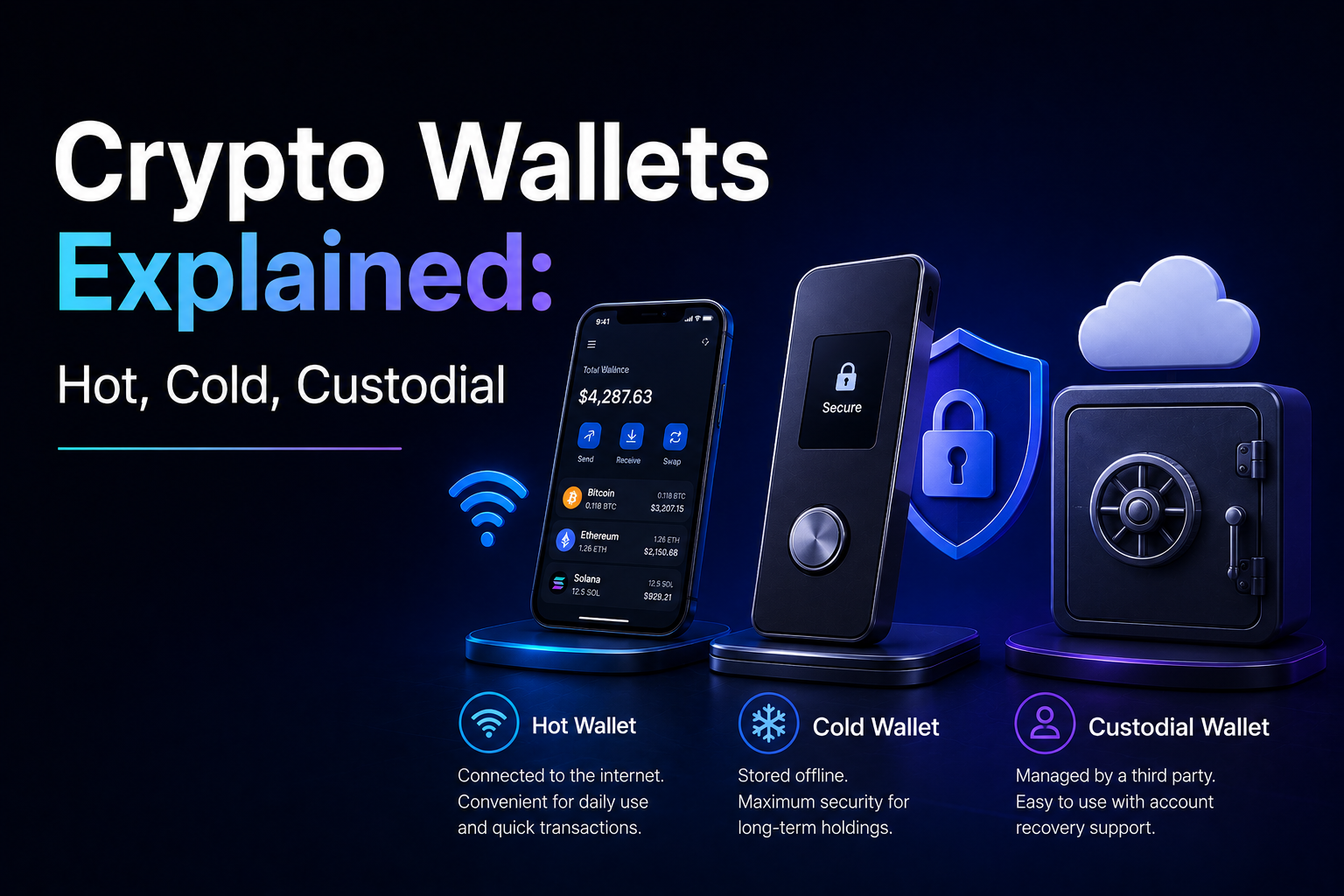
- Crypto wallets explained — the wallet options
- Ledger Nano X review — the hardware wallet I use
- Hot vs cold wallet — the trade-offs
Want to try blockchain for yourself?
The fastest way to learn is to buy a small amount of crypto and try a transaction. BitGet is the exchange I use — sign-up takes 90 seconds, KYC clears same-day.
Affiliate link. I may earn a commission at no extra cost to you.
A note on learning to trade
Understanding blockchain is one thing. Trading the assets that live on blockchains is another skill entirely. If you want to actually learn to trade — not just hold a bag and hope — I’d point you at Trade Travel Chill. It’s the community I’m part of and the one structured education source I’d recommend to retail traders. For the wider comparison, see best crypto trading courses.
Frequently asked questions
What is a blockchain in simple terms?
A blockchain is a shared record book that lives on thousands of computers at once. Every computer keeps an identical copy, and new entries get added through agreement across the whole network. Once added, entries are linked cryptographically and can’t be changed.
Is blockchain the same as Bitcoin?
No. Bitcoin is a specific cryptocurrency. The blockchain is the underlying ledger technology that Bitcoin runs on. Many other cryptocurrencies, like Ethereum and Solana, have their own blockchains.
Why is blockchain considered secure?
Because changing past records would require redoing all the cryptographic work for every subsequent block — and doing it faster than the rest of the network can produce new blocks. At scale, this is economically and practically impossible.
Can a blockchain be hacked?
The consensus layer of a major blockchain is extremely difficult to attack. The stuff built on top — smart contracts, exchanges, wallets — gets hacked regularly, but those failures aren’t blockchain failures.
What is the difference between blockchain and a database?
A database is usually one central record managed by one party. A blockchain is many copies of a record agreed on by a network, with cryptographic links making past entries unchangeable. Databases are faster and cheaper; blockchains don’t need a trusted operator.
Do all cryptocurrencies use blockchain?
Most do. There are a handful of crypto-adjacent projects using other models like directed acyclic graphs (DAGs), but the major ones — Bitcoin, Ethereum, Solana, XRP, Cardano — all use blockchain.
Is blockchain useful for anything other than crypto?
Sometimes. Cross-border value transfer, public audit logs, censorship-resistant content, and a few specific supply chain cases have real fit. Most non-crypto “blockchain for X” projects haven’t delivered.
Final word
A blockchain is a shared, tamper-resistant record book run by a network instead of a company. That’s it. Strip away the buzzwords and the slogans and that’s what you’re left with.
What makes it useful — when it’s useful — is that nobody is in charge. The record persists. Anyone can verify it. That’s a narrow but powerful property.
For most things you do day to day, a regular database is faster, cheaper, and good enough. For a specific set of problems — money that can’t be censored, financial contracts without a middleman, public records that no government can erase — blockchain is the right tool.
If you want to actually understand it, the fastest path is to use it:
- Read what is Bitcoin and what is Ethereum for the two biggest networks.
- Open a BitGet account and buy a small amount of either.
- Withdraw it to a wallet you control — crypto wallets explained covers the options.
- Send some on-chain, watch the transaction on a block explorer like mempool.space or Etherscan. That single experience teaches more than any blog post.
Right — over to you.
Related posts
- What is Bitcoin? Explained Without the Hype
- What is Ethereum? A Plain English Guide
- Crypto for Beginners: The Honest Starting Guide