Bitcoin spent fifteen years being the boring blue-chip of crypto. Slow. Predictable. The thing maxis hold while everyone else chases shinier coins on faster chains. Then in early 2023, a software engineer named Casey Rodarmor put pictures of monkeys on it — and Bitcoin Twitter has been fighting about it ever since.
Ordinals, Inscriptions, BRC-20 tokens, Runes — these are the things people now use Bitcoin for that nobody saw coming. Some of them have made traders very rich. Most have lost people money. Almost all of them have made BTC transaction fees considerably higher than they used to be.
This post explains what’s actually going on, what to do about it if you want exposure, and whether any of it is worth the cost of inscription. Some links here are affiliate. I’ll flag them.
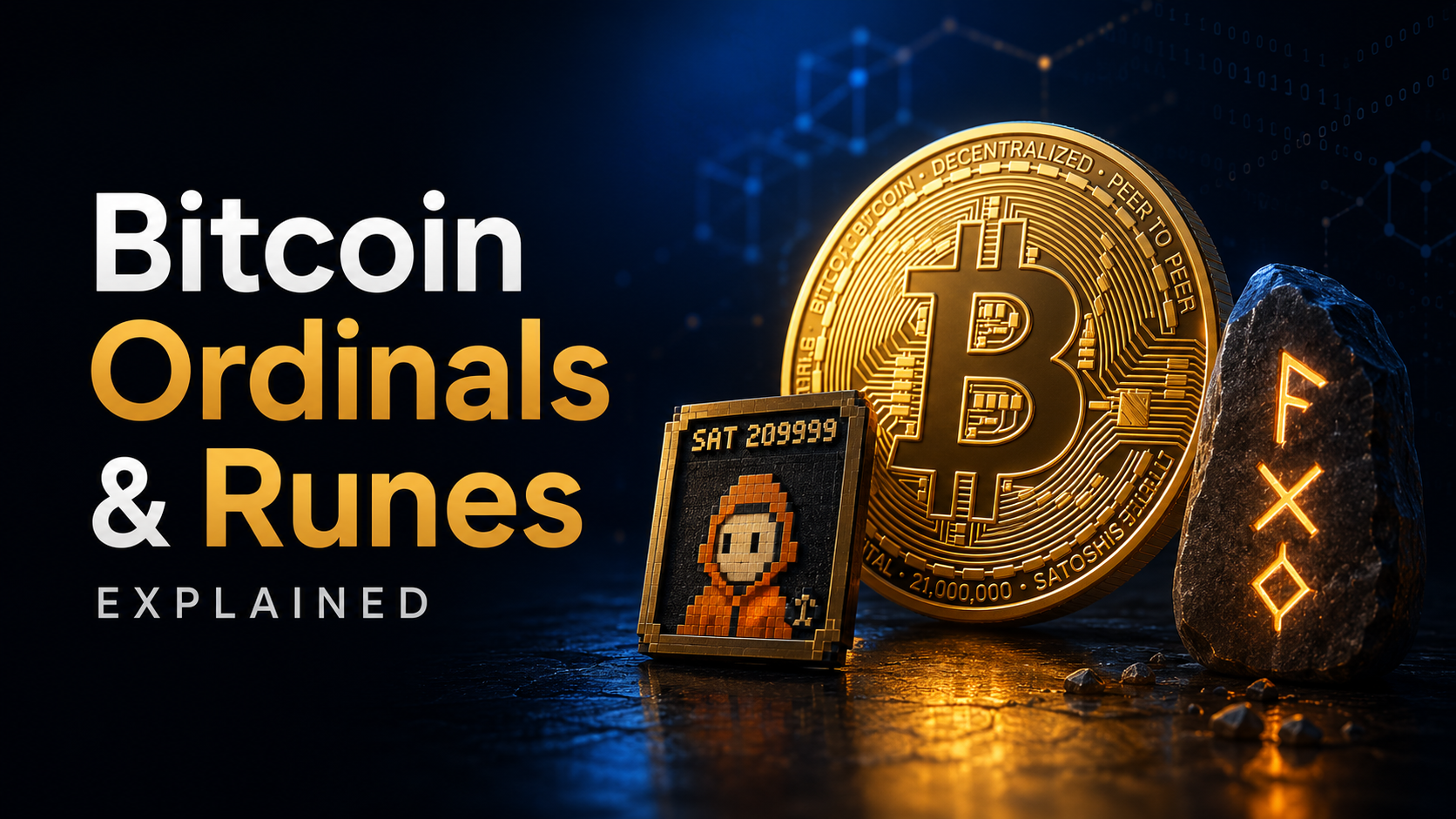
Short answer: Bitcoin Ordinals are a protocol that lets you “inscribe” data — images, text, code — directly onto individual satoshis (the smallest unit of BTC), creating Bitcoin-native NFTs. Runes is a related protocol launched at the April 2024 halving that enables fungible tokens on Bitcoin natively, replacing the cruder BRC-20 standard. Both work without modifying Bitcoin itself, but both push fees higher. They’ve created an entire on-chain economy on Bitcoin that didn’t exist before.
Open a BitGet account → (affiliate link) — where most Ordinals and Runes tokens are tradable as ERC-20-style wrapped versions.
Key takeaways
- Ordinals are a protocol that inscribes arbitrary data onto individual satoshis. Think Bitcoin-native NFTs.
- Inscriptions can be images, text, code, even small video files — all stored on the Bitcoin blockchain.
- BRC-20 was a hacky way to use Ordinals for fungible tokens. Runes (launched at the April 2024 halving) replaced it with something cleaner.
- Marketplaces like Magic Eden, OKX, and Unisat let you trade Ordinals, BRC-20, and Runes. Some major tokens are also listed on centralised exchanges.
- Inscriptions cost real BTC in transaction fees. During peak congestion, inscribing a basic image can cost $20-100+.
What Ordinals actually are (Casey Rodarmor’s protocol)
Bitcoin has 21 million BTC. Each BTC is divisible into 100 million satoshis. That gives us 2.1 quadrillion satoshis total.
The Ordinals protocol does two things:
- It numbers every satoshi. Each satoshi gets a sequence number based on when it was mined. Satoshi #1 was the first ever mined. The Pizza satoshis (the ones used to buy two pizzas in 2010) have specific numbers. Some satoshis have “rare” properties based on their position in the supply.
- It lets you inscribe data onto an individual satoshi. That means attaching an image, text, code, or any other data to one specific sat, which then carries that data forever.
The result: Bitcoin-native NFTs. Without any change to Bitcoin itself.
How it actually works
The technical part: Ordinals uses the “witness” section of Bitcoin transactions, which was introduced by SegWit in 2017 and expanded by Taproot in 2021. Witness data is cheaper than regular transaction data (it gets a 75% discount on block weight), which makes inscribing data onto Bitcoin economically viable.
Casey Rodarmor — a former Bitcoin Core contributor — released the ord client in January 2023, which lets users actually do all this. The genius of the protocol is that it works entirely on top of existing Bitcoin. No fork, no new tokens, no permission needed.
Why this matters
Before Ordinals, Bitcoin was a payment network and a store of value. After Ordinals, Bitcoin became all that plus an NFT platform plus (later) a token issuance platform.
The block size constraint hasn’t changed — Bitcoin still produces a 1MB-equivalent block every ~10 minutes — but how that block space gets used has changed dramatically. Inscriptions can fill up entire blocks. According to Dune Analytics, there have been weeks where Ordinals activity accounted for over half of all Bitcoin transaction fees.
If you’re new to Bitcoin entirely, what is Bitcoin and Bitcoin halving explained are the foundational reads. This post assumes you already understand the basics.
Inscriptions vs NFTs vs Runes
This is where most people get confused. Three things that sound similar are actually distinct.
| Term | What it is | Best comparison |
|---|---|---|
| Inscription | Data attached to a single satoshi via the Ordinals protocol | A Bitcoin-native NFT |
| Ordinal | A satoshi that has an inscription on it | The token holding the NFT |
| BRC-20 | Fungible tokens created using JSON inscriptions | A hacky version of Bitcoin’s ERC-20 |
| Rune | Fungible token created via the Runes protocol | The proper, native version of Bitcoin’s ERC-20 |
So inscriptions are the underlying mechanism, Ordinals are the resulting NFT-like assets, BRC-20 was the early experiment in fungible tokens via inscriptions, and Runes is the cleaner replacement.
Getting these distinct is essential — they’re often lumped together in headlines and that causes confusion when you actually want to trade or hold them.
BRC-20 tokens (ORDI, SATS, FRAM) — and the controversies
BRC-20 was an experiment by a developer called Domo in March 2023. The idea: use JSON-formatted inscriptions to create fungible tokens on Bitcoin. Each inscription contains a tiny piece of JSON that says “deploy this token” or “mint this token” or “transfer this token.”
It’s hacky. The protocol works because indexers (off-chain software) interpret the JSON inscriptions and track balances. Bitcoin itself doesn’t know BRC-20 tokens exist — it just sees inscription data.
The major BRC-20 tokens
- ORDI — The first BRC-20 token. Pure narrative play, no utility. Per CoinGecko, ORDI sustained a top-100 market cap position for stretches of the cycle.
- SATS — The community token. Memetic. Distributed widely.
- FRAM — Various other experimental tokens that came and went.
The pattern: most BRC-20s are pure narrative. The protocol is the meme. Whether any individual token has long-term value is highly debatable.
Why BRC-20 was controversial
Bitcoin maxis hated BRC-20 for the same reason they hated Ordinals — it used block space they thought should be reserved for “real” Bitcoin transactions. The fees from BRC-20 minting frenzies pushed regular Bitcoin transfer fees from a few sats per byte to hundreds of sats per byte. Sending a small amount of Bitcoin became uneconomical for stretches of 2023.
The counter-argument from Ordinals supporters: high fees are good for miners and Bitcoin’s long-term security. After the block reward keeps halving, miners need transaction fees to keep mining. Ordinals and BRC-20 contribute meaningfully to that fee market.
Both sides have a point. The debate is unresolved and likely will be for years.
Runes protocol (April 2024 launch)
Casey Rodarmor — the same person who made Ordinals — created Runes specifically to replace BRC-20. He launched it at the April 2024 Bitcoin halving, which gave it maximum attention.
Why Runes is better than BRC-20
Runes uses the OP_RETURN field of Bitcoin transactions instead of witness inscriptions. That makes it:
- More efficient. Runes transactions use less block space per token operation than BRC-20.
- More UTXO-aligned. Runes respects Bitcoin’s UTXO model rather than fighting against it. That makes wallet support easier.
- Cleaner in design. No JSON parsing required. The protocol is simpler to implement.
The Runes launch at the halving was carefully timed. There was a flood of Rune launches in the first few weeks — many of which had memorable names and ripped 100x before crashing.
Major Runes
A handful of Runes from the launch phase achieved real traction and trade on multiple marketplaces. The market is still maturing — Runes as a category is less than two years old. Expect significant turnover in which Runes matter on any given month.
For market cap context on any of these, CoinMarketCap’s Runes section tracks the major listings.
Why Bitcoin maxis hate Ordinals
This is the part of the story that’s culturally interesting whether or not you care about Ordinals as an investment.
The maxi case against Ordinals:
1. Block space pollution. Every byte of inscription data is a byte not used for a financial transaction. Maxis argue Bitcoin should be optimised for value transfer, not data storage.
2. Fee inflation makes Bitcoin unusable for payments. When inscription waves push transaction fees to $50+, normal users can’t afford to make a $20 payment. For a “peer-to-peer electronic cash system,” that’s a problem.
3. “Dust” attacks. Inscriptions create tiny UTXOs that bloat the UTXO set, making it harder to run a Bitcoin node. The UTXO set sits in node memory — bigger UTXO set, higher node requirements.
4. Slippery slope. If we accept arbitrary data on Bitcoin today, what happens when the data is something more problematic? The protocol has no content moderation.
These are real arguments. Some of them have merit. The pro-Ordinals camp has counter-arguments to all of them — particularly the fee argument, where the response is “high fees are how Bitcoin’s security budget gets paid after the block reward halves to nothing.”
For background on why halvings matter for fees and security, see Bitcoin halving explained and bitcoin dominance for the wider market context.
Why they exist anyway
The technical answer: Casey Rodarmor identified a loophole in how SegWit and Taproot expanded what could be put in Bitcoin transactions, and he built a protocol that uses it.
The economic answer: there’s clearly demand. The amount of money that’s flowed into Ordinals, BRC-20, and Runes in two years is in the billions. People want Bitcoin-native NFTs and tokens. Whether maxis like it or not, the market has voted with its wallet.
The political answer: Bitcoin Core developers can’t stop Ordinals without forking the network. There’s no consensus among miners or developers to soft-fork inscription functionality out of Bitcoin. Some developers have proposed filters that would discourage inscription activity, but they’ve been rejected as censorship.
So Ordinals are here. Permanently. Unless something fundamental changes about how Bitcoin works.
Marketplaces: Magic Eden, OKX, Unisat
If you want to trade Ordinals, BRC-20, or Runes directly on-chain, three marketplaces dominate.
Magic Eden
Originally a Solana NFT marketplace, Magic Eden expanded into Bitcoin Ordinals and now handles a substantial share of all Ordinals trading volume. The UI is the cleanest in the space. The fees are competitive.
If you’re new to Ordinals, Magic Eden is the easiest place to start. It supports both browsing collections and trading individual inscriptions. According to DefiLlama, Magic Eden is consistently the highest-volume Bitcoin NFT marketplace by spot trading volume.
OKX
The OKX exchange has integrated Ordinals and BRC-20 trading directly into its app. That’s convenient if you’re already an OKX user. The downside: you’re trading through OKX’s interface rather than directly on-chain, which means you don’t fully custody the inscription until you withdraw it.
Unisat
Unisat is the power-user marketplace. It’s also a Bitcoin wallet, an inscription tool, and a Runes mint platform. If you want to actually inscribe new content or mint new Runes, Unisat is the default tool.
The downside: the UI is less polished than Magic Eden. The upside: more granular control, lower fees on some operations, broader feature set.
How to buy Ordinals, Runes, and BRC-20 tokens on BitGet
If you don’t want to deal with the on-chain complexity, several Ordinal-themed and Rune-themed tokens are listed on centralised exchanges. BitGet is one of the more aggressive listers in this space.
What’s typically tradable on BitGet (affiliate link):
- ORDI — the OG BRC-20 token, spot pair with USDT.
- SATS — the community BRC-20, spot pair with USDT.
- Selected major Runes — these get added regularly. Check the spot listings.
The advantages of buying these on BitGet rather than on-chain:
- No need for a Bitcoin wallet that supports inscriptions. Phantom and most regular wallets don’t.
- No inscription fees. You’re trading the exchange’s wrapped or held version, not transferring inscriptions.
- Liquidity is much deeper. Centralised exchange spot pairs typically have far more volume than direct on-chain marketplaces.
The disadvantages:
- You don’t actually hold the underlying inscription. You hold an IOU from BitGet.
- You can’t move it to a wallet and use it elsewhere. What you can do is trade in and out for price exposure.
For pure price exposure to the BRC-20 and Runes narrative, the centralised route is simpler and cheaper. For actually owning an Ordinal as a collectible, you need Magic Eden or similar.
If you’re not sure which route is right for you, the simpler answer is usually the centralised exchange. BitGet review covers the platform itself, and how to buy crypto walks through the basics if this is your first time.
Wallet support: Xverse, Leather, Unisat
Regular Bitcoin wallets don’t support Ordinals or Runes natively. You need a specialised wallet.
Xverse
The most polished Ordinals-capable wallet. Browser extension and mobile app. Supports inscriptions, BRC-20, Runes, and regular BTC. The default recommendation for most users entering this space.
Leather (formerly Hiro Wallet)
A more developer-focused Bitcoin wallet that also supports Stacks (a Bitcoin layer-2). Solid Ordinals support. Better if you’re also using other Bitcoin ecosystem tools.
Unisat
Mentioned above as a marketplace. It’s also one of the best inscription wallets — particularly if you actually want to inscribe content or mint Runes yourself.
Ledger compatibility
Critically — all three of these wallets can pair with a Ledger Nano X (affiliate link). That means you can have Ordinals secured by cold storage rather than living in a hot wallet.
Setup is more complex than regular BTC cold storage. The Ledger doesn’t show you the inscription image directly — it just signs the transactions involving inscribed satoshis. Done correctly, your inscriptions are as secure as your BTC.
Full guidance in Ledger Nano X review and the broader how to store crypto safely playbook.
The fee problem (inscriptions cost real BTC)
This is the section nobody tells you about until you’ve already wasted money.
Every inscription requires a Bitcoin transaction. Every Bitcoin transaction has a fee paid in BTC. When the network is congested, those fees can be enormous.
Specifics from my own experience:
- A basic text inscription during low congestion: equivalent to a few dollars.
- A small image (under 100KB) during low congestion: $5-15 equivalent.
- The same image during a major minting frenzy: $50-200 equivalent.
- A larger inscription (video, complex code) during congestion: hundreds of dollars.
These are real costs paid in real BTC. Once paid, they don’t come back.
How to manage fees
Three rules I follow when interacting with Ordinals on-chain:
Rule 1: Watch the mempool. Mempool.space is the default tool. Wait for fees to drop before inscribing or trading.
Rule 2: Don’t inscribe during minting frenzies. When a new Rune or BRC-20 is minting, fees spike. Anything you do during that window costs many multiples of normal.
Rule 3: Batch operations. If you’re going to make multiple moves, consolidate them into single transactions where possible. Each transaction has a base fee.
For pure trading exposure without these complications, central exchanges remain the cleaner route. You miss the cultural ownership but you also miss the fees.
Storage on Ledger
The hardware wallet question is more complex for Ordinals than for regular BTC, but the answer is roughly the same: anything valuable goes on cold storage.
Setup pattern:
- Pair a Ledger Nano X (affiliate link) with Xverse, Leather, or Unisat.
- The wallet UI shows your Ordinals but the Ledger holds the keys.
- Every transaction requires Ledger confirmation.
- Disconnect the Ledger when you’re not actively trading.
The hot-wallet failure mode for Ordinals is worse than for regular BTC. If you sign a malicious transaction in a hot wallet, the attacker can not just drain your BTC but also transfer your inscriptions and Runes. You can lose a five-figure inscription to a phishing scam in seconds.
If you can articulate why a specific inscription is worth keeping, it’s worth the hassle of cold-storing. If you can’t, you probably shouldn’t own it in the first place.
Critical warning: setting up a hardware wallet without a secure backup of your seed phrase means you’ll lose everything if the device fails. Read lost seed phrase before you set anything up.
TTC mention: narrative trading for Ordinals
Ordinals and Runes are pure narrative assets. They have no cash flow, no underlying utility, no defensive moat — what they have is cultural attention and brand recognition within Bitcoin.
That makes them similar to memes in trading dynamics. They run hard during attention spikes (halving event, major influencer attention, new protocol launches) and fade during quiet weeks.
The skill is recognising which narrative phase you’re in and positioning accordingly. That’s hard to do from vibes alone — you need a structured framework for narrative trading.
Trade Travel Chill is the trading community I’m part of, and one of the things that’s actually moved my P&L is structured frameworks for narrative-driven sectors like this. If you want the proper education rather than guessing, see TTC → (affiliate link).
For the broader market context that helps you time narrative bets in any sector, crypto market cycle is the foundational read.
Should you actually care about Ordinals?
This is the section that decides whether the rest of the post matters to you.
The case for paying attention to Ordinals:
- They’ve created a new economy on Bitcoin that didn’t exist before — and it’s growing.
- They’re paying for Bitcoin’s long-term security through fee revenue to miners.
- The cultural significance is real — Bitcoin maxi orthodoxy was just demonstrated to be optional.
- Some collections have actually done well.
The case against:
- Most Ordinals collections, like most NFTs, will go to zero in value.
- Most BRC-20 tokens have no utility and were pure speculation that already peaked.
- The fee market is unpredictable. You can do everything right and lose money to transaction costs alone.
- The space attracts scams. Verification is hard.
My personal position: I hold a small amount of exposure through wrapped tokens on BitGet for the narrative play. I don’t actively trade individual inscriptions because the friction and fees don’t justify it at my position size. If I were a full-time NFT trader I’d probably feel differently.
For context on how Bitcoin Ordinals fits into the broader Bitcoin economy, how long to mine 1 bitcoin covers the mining side, and bitcoin lightning network covers the other major Bitcoin layer for actual payments.
Want exposure without the on-chain hassle?
BitGet lists ORDI, SATS, and major Runes as spot pairs — no inscription fees, no wallet setup. KYC clears the same day.
Affiliate link. I may earn a commission at no extra cost to you.
Frequently asked questions
What are Bitcoin Ordinals in simple terms?
Bitcoin Ordinals is a protocol that lets you attach data — images, text, code — to individual satoshis (the smallest unit of Bitcoin). Each inscribed satoshi works like an NFT. Created by Casey Rodarmor in January 2023.
What’s the difference between Ordinals, BRC-20, and Runes?
Ordinals are the underlying protocol for attaching data to satoshis. BRC-20 was an early attempt to create fungible tokens using JSON inscriptions — hacky but it worked. Runes is the cleaner, native fungible-token protocol that launched at the April 2024 halving.
Are Bitcoin Ordinals legit?
The protocol works as designed and has processed billions of dollars of activity. Whether any specific inscription has long-term value is a separate question. Most NFT-style assets, on any chain, eventually trade near zero.
How much does it cost to inscribe a Bitcoin Ordinal?
Costs vary with network congestion. Low congestion: a few dollars. Moderate: $5-15 for a small image. During major minting frenzies: $50-200+ for the same operation. Always watch mempool.space before inscribing.
Where can I buy Bitcoin Ordinals?
Direct on-chain: Magic Eden, OKX, Unisat are the main marketplaces. As wrapped or exchange-listed tokens: BitGet and other major centralised exchanges list ORDI, SATS, and selected Runes for spot trading.
Can I store Ordinals on a Ledger?
Yes. Pair your Ledger with Xverse, Leather, or Unisat. The wallet manages the inscription metadata while the Ledger holds the signing keys. This is the only secure way to store valuable inscriptions long-term.
Why do Bitcoin maxis hate Ordinals?
Maxis argue Ordinals pollute block space with non-financial data, inflate fees making Bitcoin unusable for payments, bloat the UTXO set, and risk including problematic content on the chain. Each argument has merit; counter-arguments also exist.
Will Bitcoin Core remove Ordinals?
Highly unlikely. Removing Ordinals would require a soft fork that doesn’t have consensus among developers or miners. Some proposed filters could discourage inscriptions but have been rejected as censorship.
Final word
Ordinals proved Bitcoin can do more than just be Bitcoin. Whether that’s good or bad depends on whether you think Bitcoin’s job is to be exclusively peer-to-peer cash or to be a broader settlement layer for arbitrary on-chain assets.
The market has voted. Ordinals, BRC-20, and Runes have processed billions of dollars of activity. The protocol isn’t going away. The question for traders isn’t whether to engage but how much exposure makes sense.
For most retail readers: a small allocation through centralised exchange spot pairs is the simplest entry. For collectors who actually want to own inscriptions, the on-chain route via Magic Eden or Unisat is the way — backed by a Ledger for anything valuable.
That’s the short version.
Right — over to you.
Related posts