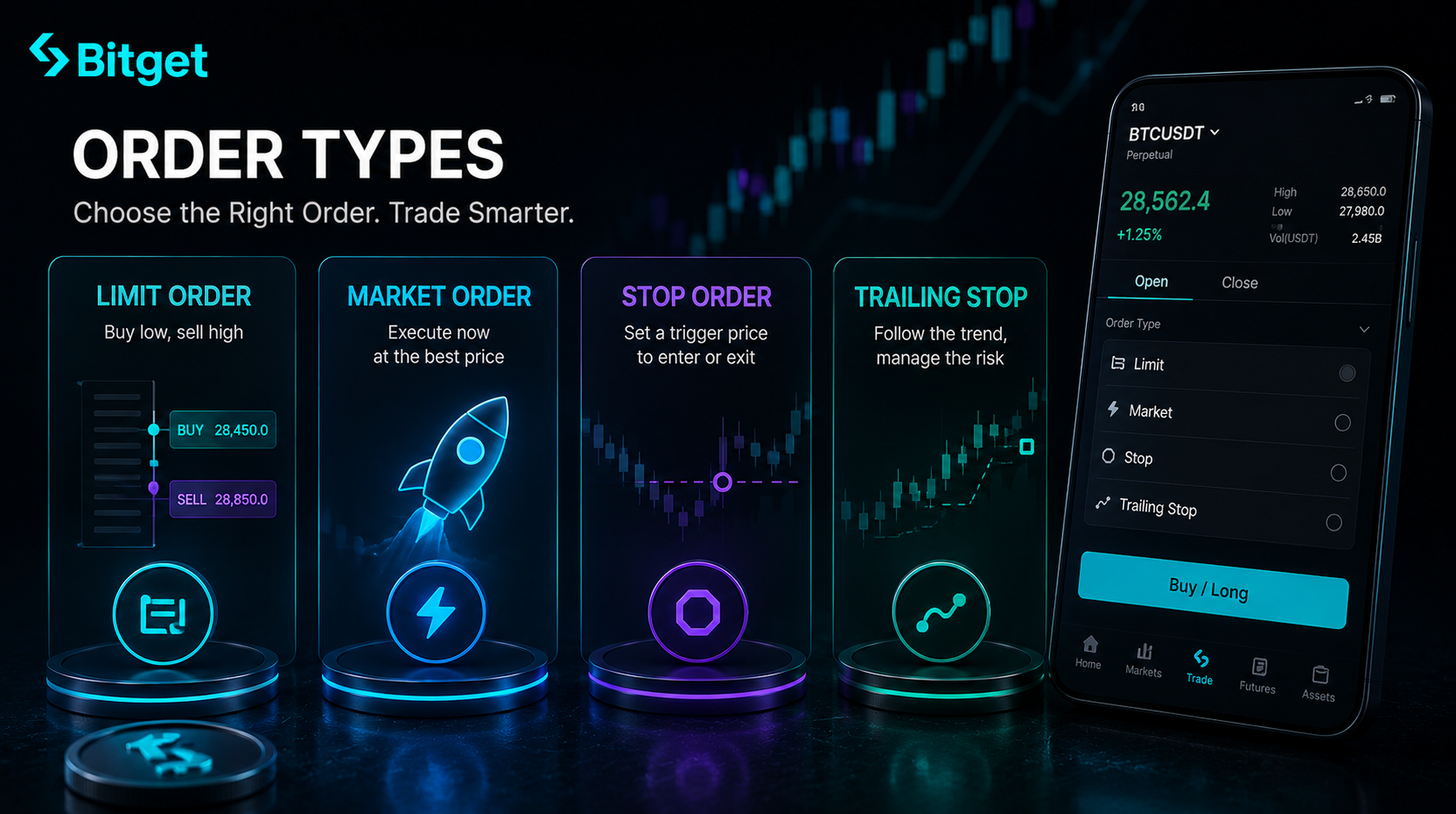
The first crypto trade I ever placed didn’t have a stop loss. I’d watched a YouTuber buy a bag, ride it 40% green, then ride it back to 80% red over the course of a weekend. I copied him on the way in and copied him on the way down. The stop loss I should have set would have cost me $80. The stop loss I didn’t set cost me $1,400.
This is the post that would have saved me that money. Some links in here are affiliate. I flag them when they appear.
Short answer: A stop loss in crypto is an order that automatically closes your trade when price hits a set level, capping your loss. The three best methods to place one are: structure-based (below the last support or above the last resistance), ATR-based (1.5–2× the Average True Range), and percentage-based (a fixed % from entry). Always use a real platform stop, never a mental stop. Place it before you open the trade, not after.
Open BitGet to practice this → (referral link)
Key takeaways
- Trading without a stop loss is gambling. Investopedia frames stops as the single most important risk tool.
- Crypto needs wider stops than equities because volatility is higher and the market trades 24/7.
- “Obvious” stops below round numbers and visible swing lows get hunted regularly by market makers.
- ATR-based stops scale with volatility — the most reliable method I’ve found across market conditions.
- Mental stops fail because humans renegotiate with themselves in real time. Platform stops don’t.
- Position sizing and stops are one decision, not two — covered in detail in the position sizing guide.
Why stops matter more in crypto than equities
Equities trade roughly 6.5 hours a day, Monday to Friday. After hours, you can plan, adjust, sleep. Even Tesla doesn’t crash 25% in a single overnight session.
Crypto trades 24/7. Bitcoin can move 5% in three hours while you sleep. A token can dump 40% on a Saturday morning while you’re at brunch. There is no closing bell to give you breathing room. If you don’t have a stop in the market, you’re betting that you’ll wake up in time. That bet loses regularly.
Three reasons stops matter more here than anywhere else:
Volatility is higher. Bitcoin’s average daily range sits around 3–4%. Mid-cap altcoins do 8–15% daily routinely. A position without a stop can drift 20% underwater before you’ve finished breakfast.
Liquidity is patchier. Below the top 20 tokens, order books thin out fast. A whale exit during a low-liquidity period can wipe 10% in minutes — and without a stop you’re filled at whatever price the next bid sits at.
The market is global. When you’re asleep, somebody else’s news cycle is moving the chart. Asian session, US session, Middle East — different drivers, different reactions, no central authority to slow it down.
If you take one rule from this article: never enter a trade without setting the stop loss in the same click. The trade is the entry plus the stop. If you don’t have the stop, you don’t have a trade — you have a position.
The 4 types of stop loss orders
Before placement, you need to know what type of stop to use. Four common ones.
1. Market stop loss (stop-market)
When the trigger price hits, the order converts to a market order and fills at whatever the next available price is.
Pros: guaranteed execution. The order will fill.
Cons: in volatile moves, the fill price can be significantly worse than your trigger price (slippage).
When to use: most of the time, for most retail traders. Slippage is a small cost compared to not getting filled at all.
2. Stop-limit
When trigger hits, the order converts to a limit order at a price you set in advance. If the market never returns to your limit, the order doesn’t fill.
Pros: no slippage. You get the price you wanted or you don’t get filled.
Cons: in a fast move, the market can blow past your limit and never come back. You’re stuck in a much bigger loss than you planned.
When to use: rarely. Only if you have a specific reason to refuse slippage. The downside (no fill in a crash) is worse than the upside (saving a few basis points).
3. Trailing stop
The stop follows price up (on a long) or down (on a short) by a fixed distance or percentage, ratcheting your protection tighter as the trade works.
Pros: lets you ride trends while protecting profit.
Cons: gets stopped out by normal pullbacks if set too tight. Doesn’t move against you (one-way ratchet).
When to use: in obvious trending moves, or once a trade is up 1R+ and you want to bank profit if it reverses.
4. OCO (one-cancels-the-other)
Pairs a stop loss and a take profit so that whichever fires first cancels the other.
Pros: lets you set the full trade and walk away. No babysitting.
Cons: locks in your exit plan — no ability to scale in or out without cancelling.
When to use: most of my trades. I set entry, stop, target as a single bracket order and walk away. Full breakdown in the BitGet order types post.
Placement methodology: structure-based stops
This is the method I default to. The logic: place your stop where the trade thesis is invalidated, not where it “feels safe.”
If you’re long because price broke above resistance and is now using that level as support, your trade thesis is: “this level holds.” If price slices back through the level, the thesis is dead. Your stop goes just below the level.
How to find structure
- Swing lows on the timeframe you’re trading. The most recent low before your entry candle.
- Round numbers. $70,000 on BTC, $4,000 on ETH, $1.00 on stablecoins-that-shouldn’t-move.
- Prior consolidation zones. If price spent two days ranging between $68,500 and $69,000 before breaking out long, that zone is your structure floor.
- Untested supply/demand zones. Marked on the chart where price reacted strongly previously.
Worked example
Bitcoin is consolidating between $69,000 and $70,500. You see a clean breakout above $70,500 and enter long at $70,650. Your structural stop goes below the recent swing low and below the breakout zone — somewhere around $69,800. That’s $850 of stop distance per BTC.
If price comes back below $69,800, the breakout failed and your reason for being long is gone. The stop is where the thesis dies, not where you can afford the loss.
When structure-based stops fail
Structure-based stops can be too tight in volatile conditions (you get knocked out on a normal wick) or too wide on a trending day (the risk per trade becomes too much for your account).
Combine with position sizing to handle the second case — if the structure stop is wide, reduce the position size to keep risk fixed at 1%. Position sizing detail is in the crypto position sizing post.
For the first case (stops too tight), use ATR-based instead.
Placement methodology: ATR-based stops
ATR (Average True Range) is a volatility indicator that measures the average size of recent candle ranges. ATR-based stops use this to set distance — wider stops in volatile markets, tighter stops in quiet markets.
The formula
Stop distance = ATR × multiplier
Common multipliers:
– 1× ATR — aggressive, more stop-outs
– 1.5× ATR — balanced, my default
– 2× ATR — conservative, fewer stop-outs but bigger losses
Worked example
Bitcoin’s 14-period ATR on the 4-hour chart reads $1,200. You’re long at $70,000. With a 1.5× ATR stop: $70,000 − ($1,200 × 1.5) = $68,200. That’s an $1,800 stop distance.
For a 1% risk on a $5,000 account ($50 max loss), your position size is $50 ÷ $1,800 = 0.0278 BTC. Position size flexes around the volatility-adjusted stop.
Why ATR wins in most conditions
ATR doesn’t care about your bias. It doesn’t care about round numbers. It tells you what the market is actually doing right now. In a quiet range, the stop is tight. In a volatile breakout, the stop is wide. The risk per trade stays at 1% because position size adjusts.
For deeper reading on ATR, Babypips covers volatility-based stops clearly. The principles port directly from forex to crypto.
ATR pitfalls
- ATR uses recent volatility. If volatility spikes suddenly (news event), ATR lags by several candles.
- On low timeframes (1m, 5m), ATR can produce stops too tight to absorb normal noise.
- On illiquid altcoins, ATR can be misleadingly small during quiet periods, then meaningless when price moves.
Use ATR on liquid pairs (BTC, ETH, top 20 alts) on 15m+ timeframes. Below that, structure-based stops are usually safer.
Placement methodology: percentage-based stops
The simplest method. The stop sits a fixed percentage away from entry regardless of structure or volatility.
Common percentages:
– 1–2% — scalping
– 3–5% — day trading
– 5–10% — swing trading
– 10–15% — position trading
When to use
When you can’t read structure yet, or when you’re trading a strategy that doesn’t depend on chart levels (e.g. systematic mean-reversion). Beginners often start here.
When not to use
When the percentage doesn’t match the market. A 2% stop on a quiet day on BTC is sensible. A 2% stop on DOGE during a meme rally is going to get hit by the first wick. Percentage stops ignore context.
Use percentage stops as a default for the first 50 trades. After that, graduate to structure or ATR.
Why “obvious” stops get hunted
Here’s the uncomfortable truth: market makers can see retail stop clusters and trade them.
When 10,000 retail traders all place their stops just below the $69,000 round number on BTC, that cluster of stops creates a pool of forced selling. A market maker (or a coordinated whale) can sell into the market to push price down 0.3%, trigger the stops, buy the cascade of forced selling at a discount, and watch price reclaim the level minutes later.
You see this on the chart as a long wick down — a candle that pierces support, hits stops, and closes back above. The wick is the stop hunt.
How to avoid being hunted
- Don’t place stops at round numbers. $69,000 is hunted. $68,917 is not.
- Don’t place stops at the most visible swing low. It’s the first level everyone sees.
- Place stops one ATR beyond obvious levels. If structure suggests a stop at $68,500, place yours at $68,300 instead.
- Trade higher timeframes. Stop hunts are more common on 1m–15m than on 4h–1D. Higher timeframes filter the noise.
- Reduce position size if you need a wider stop. Better to have a wider stop and a smaller position than the reverse.
Full breakdown of how the market structures these moves is in the liquidity sweeps crypto and market maker manipulation crypto posts. If you want to understand the mechanics from the institutional side, smart money concepts crypto covers the framework.
This is one of the things TTC drills hardest — the TBD System places stops specifically to avoid the zones retail floods into.
How to set stops on BitGet
On BitGet, every spot and futures order panel has stop loss fields built in.
Spot
- Open the BTC/USDT spot pair (or whatever pair you’re trading).
- Click “Limit” to bring up the order panel.
- Enter your entry price and amount.
- Check the “Stop Loss” box (and “Take Profit” if using OCO).
- Enter your stop loss trigger price.
- Choose stop-market (default) or stop-limit.
- Click Buy/Long.
The order goes in as a bracket — entry + stop together. You can’t accidentally enter without a stop because the field is right there.
Futures
Same idea, with an extra step for leverage and margin mode.
- Select USDT-M or USDC-M perpetual pair.
- Choose isolated or cross margin (isolated for risk control as a beginner).
- Set leverage. Start at 2x–5x, not whatever the platform suggests.
- Enter position size and entry price.
- Enter stop loss and take profit.
- Confirm.
The full walkthrough is in the BitGet futures USDT-M post, and the BitGet order types post covers each order type in detail.
If you don’t have an account yet, BitGet sign-up (referral) takes about 90 seconds. KYC usually clears same-day.
Heads up: Stop losses on futures are mandatory. Liquidation can wipe your full margin in a single move. Set stops before you enter the trade. The numbers in this article are examples — they’re not promises.
Trailing stops explained
A trailing stop ratchets behind price as the trade moves in your favour, locking in profit if the trade reverses.
How it works
You enter a long at $70,000 with a 2% trailing stop. Initially the stop sits at $68,600.
Price moves up to $72,000. The trailing stop now sits at $70,560 (2% below the new high).
Price moves up to $74,000. The stop now sits at $72,520.
Price reverses to $72,000. Stop triggers at $72,520 (because price reached it first as price moved down). You exit with a profit.
The stop never moved down. It only moved up. The “trail” is one-way.
When trailing stops fail
- Set too tight: gets stopped on normal pullbacks before the move plays out.
- Set too wide: gives back too much profit on the reversal.
- Used on choppy days: every minor pullback nicks the stop.
I use trailing stops only after a trade is at +1R or more. Before that, I keep the original stop in place. Once profit exists, I switch to a trailing stop to give myself a chance at +2R, +3R outcomes if the trend keeps going.
Some traders use ATR-based trailing stops (stop trails 1.5× ATR behind price) instead of percentage-based. More adaptive, slightly more complex to set up.
Stop loss + take profit ladders
Most platforms let you set a single stop and single target. Better practice: set partial exits at multiple levels.
Example ladder
Long BTC at $70,000. Stop at $69,000 (1R risk).
- Take profit 1: $71,000 (1R) — close 33% of position
- Take profit 2: $72,000 (2R) — close 33%
- Take profit 3: $73,500 (3.5R) — close remaining 34%
After TP1 hits, move stop to breakeven ($70,000). The trade can no longer lose money.
After TP2 hits, move stop to $71,000 (1R locked).
The remaining position runs with a tight trailing stop or fixed target at $73,500.
Why ladders work
- You lock in profit early, reducing emotional pressure.
- You participate in extended moves with the runner position.
- You don’t have to predict the exact top to be profitable.
The drawback: takes more management. Easier to mess up the exits than a single TP. Practice on paper or small size before scaling.
The “no stop, no trade” rule
This is the rule I added to my system after my fifth account drawdown. Simple, absolute: if I can’t define a stop loss before entering, I don’t take the trade.
The rule protects against three failure modes:
Mode 1: “I’ll set it after the trade fills.” You won’t. You’ll watch the chart, you’ll get emotional, you’ll renegotiate. The stop never goes in.
Mode 2: “The chart doesn’t have a clear level.” If you can’t identify a level, you don’t have a trade. Move on. The next setup is always coming.
Mode 3: “The stop would be too far, I’d lose too much.” That’s a position sizing question, not a stop question. Use a wider stop and reduce position size.
The rule has zero exceptions. I’ve broken it three times in five years and each time it cost me. It saves accounts more than any single indicator ever has.
Mental stops vs platform stops (and why mental stops fail)
A “mental stop” is when a trader says “I’ll exit at $68,000 if it hits.” A “platform stop” is an actual order sitting in the order book.
Every trader who relies on mental stops has the same story: the trade hits the mental stop level. They watch. They wait for confirmation. They renegotiate. “I’ll give it one more candle.” Price drops further. “I’ll exit on the next bounce.” Price drops further. By the time they exit, the loss is 3× what they planned.
The reason: when the market is moving against you, your brain produces cortisol. Cortisol impairs the prefrontal cortex (the part responsible for plan execution). You’re trying to execute a disciplined exit with a chemically compromised decision-maker. You lose.
A platform stop doesn’t have a prefrontal cortex. It executes. No drama, no renegotiation. The stop loss is the trade. The trade is the stop loss.
The only exception I make: on very low timeframes (1m scalps), I sometimes use mental stops because the platform fill can be slower than my reaction. Even then, I have a “hard” platform stop sitting 0.5% beyond my mental one as a safety net.
If you want a deeper read on why discipline collapses under stress, Babypips’ trading psychology section covers the neuroscience. And the crypto trading psychology post on this site goes into how to engineer around it.
Why TTC’s framework places stops where it does
Most retail traders place stops where the candle structure tells them to. TTC’s TBD System places stops where the market makers don’t expect them to be.
The methodology comes from Annii Snelleksz — she built TBD by applying forex precision to crypto market structure. The forex world has been dealing with stop hunts and liquidity sweeps for 30 years. Crypto inherited the same behaviour at warp speed, and most retail traders haven’t caught up.
What TBD teaches around stops:
- Where liquidity actually pools (not just visible swing lows)
- How to read order block reactions to set stops the market won’t sweep
- Why the second test of a level is usually safer than the first
- How to combine stop placement with the TBD Indicators to filter low-probability entries
Members get the full curriculum, daily live market updates (First Class), a Discord with 1,000+ traders posting setups, and 1,000+ hours of recorded learning. Pricing: $88/month Business Class, $158/month First Class, 20% off if you pay in crypto. 48-hour money-back guarantee.
The community is where I learned to stop placing stops at $69,000 and start placing them at $68,917. See TTC → (referral)
If you’re comparing courses, the best crypto trading courses post runs through the options.
Common stop loss mistakes
The five I see most often.
1. Setting the stop based on dollar comfort
“I can only afford to lose $100 on this trade, so my stop goes at $69,950 from a $70,000 entry.” That’s a $50 distance. On BTC’s 4h ATR, that stop will get hit by the first normal candle. You set it where you can afford the loss, not where the chart says the thesis is dead.
The fix: define the stop from structure first, then calculate position size from the stop distance. Detail in the position sizing post.
2. Moving stops further away
The trade goes against you. The stop is about to fire. You move the stop further away “to give it room.” This is the same trade twice — you’ve doubled your risk while pretending you haven’t.
The fix: stops only move in one direction — towards profit (trailing stops, breakeven moves). Never away from profit.
3. No stop on “conviction” trades
You’re convinced this trade can’t lose. You don’t set a stop because “you’ll just hold through any wick.” That’s the trade that wrecks accounts.
The fix: no stop, no trade. Even on the highest-conviction setup.
4. Stops too close to obvious levels
Placing your stop $1 below the visible swing low at a round number. You’re shorting the same level a thousand other retail traders shorted. The cluster gets swept.
The fix: at least 0.3% beyond obvious levels, ideally beyond a less-visible secondary structure.
5. Using mental stops on swing positions
Day trades you can babysit. Swing trades you can’t. A mental stop on a swing trade fails the moment the market moves while you’re asleep, in a meeting, or on a plane.
The fix: every swing trade has a platform stop. Always.
For more mistakes that wreck accounts, see crypto trading mistakes beginners make.
What about no-stop strategies?
Some traders argue against stops — DCA accumulators, long-term holders, certain options strategies. Their argument: stops force you out of winning positions on noise.
The argument has merit only when:
- You’re buying with no leverage (spot only)
- You’re holding for years, not weeks
- You’re sized to survive an 80% drawdown without distress
- You have no other use for the capital
For active trading — anything you intend to exit within months — there is no scenario where no-stop trading produces better outcomes over a large sample of trades. The traders without stops survive until they don’t. The math is brutal.
For passive crypto accumulation (DCA into Bitcoin over years), stops don’t apply because you’re not “exiting” — you’re accumulating. Different game entirely. The crypto trading vs investing post draws the line between the two activities.
Want a clean platform to practice stop placement?
BitGet’s order panel makes stops a one-click addition to every entry. Spot or futures. Same interface.
Affiliate link. I may earn a commission at no extra cost to you.
Stop placement by trading style
Different styles, different stop logic.
Day trading
5m to 1h timeframes. Stops typically 0.5–2% from entry, structure-based or 1.5× ATR. Tight stops, fast feedback. Detail in how to day trade crypto.
Swing trading
4h to 1D timeframes. Stops typically 3–8% from entry, structure-based around major levels. Wider stops, longer holds. Detail in swing trading crypto.
Scalping
1m to 5m timeframes. Stops typically 0.2–0.8% from entry, very tight. Most stops are time-based as well as price-based — exit if not in profit within X minutes. Detail in scalping crypto.
Bots
Stops are pre-configured in the bot. Most spot grid bots don’t use a traditional stop loss — they use a stop-loss-zone (exit the whole bot if price exits the range). Detail in are crypto bots profitable.
A note on volatility events
There are moments in crypto where normal stop logic breaks down.
- Major economic announcements (CPI, FOMC)
- Bitcoin halving days
- Major exchange listings or delistings
- ETF approval / rejection days
- Regulatory enforcement actions
On these days, volatility can spike 3–5× normal levels in minutes. ATR is lagging, structure breaks, stops cascade.
My approach during these windows:
– Reduce position size by half
– Widen stops to 2× normal
– Or simply don’t trade
The trader who insists on trading every session is the trader who loses on the sessions where conditions are stacked against them. Discipline includes knowing when not to play.
Quick reference: stop placement cheat sheet
| Setup | Stop method | Typical distance |
|---|---|---|
| Breakout above resistance | Structure (below breakout level) | 1–3% |
| Pullback to support | Structure (below support) | 2–5% |
| Trend continuation | ATR-based | 1.5× ATR |
| Range trade (long at range low) | Structure (below range low) | 1–2% |
| Counter-trend reversal | Structure + ATR combo | Wider, 3–6% |
| Scalp on 1m | Fixed percentage | 0.3–0.6% |
| Swing on 4h | Structure | 4–8% |
Adapt to volatility. Adapt to liquidity. Don’t follow blindly.
Frequently asked questions
Where do I set my stop loss in crypto?
The best methods are structure-based (below the last support for a long, above the last resistance for a short), ATR-based (1.5–2× the Average True Range), or percentage-based (a fixed % from entry). Avoid placing stops at obvious round numbers or directly at visible swing lows — these get hunted.
How do I avoid getting stop hunted?
Place stops slightly beyond obvious levels (one ATR beyond a visible swing low), trade higher timeframes (1h+) where stop hunts are less common, and reduce position size if you need a wider stop. Round numbers like $70,000 BTC are hunted constantly — set stops at $69,800 or $68,917 instead.
What is an ATR stop loss?
An ATR stop loss uses the Average True Range indicator to set stop distance based on current market volatility. The formula is: stop distance = ATR × multiplier (commonly 1.5 or 2). In volatile markets the stop is wider; in quiet markets it’s tighter. This adapts to conditions automatically.
What is the difference between stop-market and stop-limit?
A stop-market order converts to a market order when triggered and fills at the next available price (with possible slippage). A stop-limit order converts to a limit order at a specific price and may not fill if the market moves past it. Stop-market is the safer default for most retail traders.
Are mental stops bad?
Yes. Mental stops fail because traders renegotiate with themselves in real time when the market moves against them. Always use a platform stop sitting in the order book. The only exception is very low timeframe scalping where reaction time may be faster than platform execution.
How much should I risk per trade?
Standard practice is 1% of your account per trade. Beginners should start at 0.5%. The stop loss placement determines position size — see the crypto position sizing post for the full formula.
Can I trade crypto without a stop loss?
You can. You shouldn’t. The traders who trade without stops survive until they don’t. Over a large sample of trades, no-stop trading produces worse outcomes than disciplined stop-loss trading in every measured study.
What is a trailing stop?
A trailing stop moves with price in your favour but never against you. On a long, it ratchets up as price rises, locking in profit. If price reverses by the trail distance, the stop triggers. Useful for capturing trending moves while protecting profit.
Final word
Stops are not the part of trading you get excited about. They’re the part that keeps you in business long enough to find out if you’re any good.
Set the stop before you enter. Place it where structure says, not where you can afford. Never move it further away. Use the platform, not your head.
That’s the whole job. Everything else is fine-tuning.
Right — over to you.
Related posts
- Crypto Trading Position Sizing: The 1% Rule and How to Actually Apply It
- Liquidity Sweeps in Crypto: How Market Makers Hunt Stops
- BitGet Order Types: Limit, Market, Stop, Trailing