The marketing answer is “yes, bots return 5% a month, set and forget”. The truth is messier. Some bots make money. Some bots lose money. Most bot users underperform a simple buy-and-hold on BTC over the same period. The handful of people who profit consistently from bots aren’t doing anything magic — they’re doing five boring things right, and most retail traders skip at least three of them.
I’ve run bots for four years across three different exchanges. I’ve kept the spreadsheets. I’ve watched friends blow up. This post is the actual answer to the question, with the numbers, the trader profile that wins, and the honest reasons most people lose money on a strategy that looks like it should be free money. Some links here are affiliate. I’ll flag them.
Short answer: Some crypto trading bots are profitable, most aren’t, and the difference is mostly the operator — not the bot. Realistic returns for a well-configured grid or DCA bot on majors sit at 0.5–3% per month, which beats sitting in stablecoin savings but trails a strong bull market in spot BTC. Martingale bots and “AI bots” with promised fixed returns lose money over a full cycle. Profitability depends on strategy fit, market regime, fee management, and operator discipline.
Run the bot I run on BitGet → (affiliate)
Key takeaways
- Grid bots and DCA bots have a documented edge in the right conditions. Martingale bots don’t.
- Realistic returns: 0.5–3% per month on well-configured grids; mid-single-digit annualised on DCA.
- Most bot users lose money because of overfitting, wrong market regime, or oversize allocation.
- The bots that win are boring. The bots that look exciting usually blow up.
- Hidden costs (fees, slippage, taxes) can eat 30–50% of gross returns. Plan for them.
- The trader profile that wins runs simple strategies on majors with small allocations and reviews monthly.
The short answer: some are, most aren’t, depends on context
Three numbers to anchor the conversation.
According to BIS research on retail crypto trading behaviour, retail traders systematically underperform during periods of high market volatility. The same trader who buys BTC at $40k and sells at $35k will run a bot, watch it draw down, and turn it off at the bottom.
CoinGecko’s market data shows that BTC spent roughly 60–70% of the last decade in some form of ranging behaviour — the conditions where grid bots earn. Strong directional trends, where bots underperform spot, are the minority of the calendar.
Investopedia’s analysis of algorithmic trading notes that even professional algorithmic strategies have failure rates above 50% when measured over 5+ year horizons. Retail bots are not the exception.
What this means in practice:
- A well-configured grid bot on BTC/USDT, run with discipline, has a positive expected return over a multi-month window. The maths works.
- A retail trader running that same bot has a much higher probability of underperforming because they’ll mess with the settings, turn it off at the wrong time, or oversize it.
The question “are bots profitable” has two answers: yes for the strategy, often no for the person running it.
Why most bot users lose money
The bots aren’t the problem most of the time. The user is. Here’s the breakdown.
Overfitting
The single biggest killer. The user backtests the bot across 6 months of historical data, tweaks the parameters until the backtest shows 40% returns, deploys live, and watches the bot return 2% in the first month.
The backtest was tuned to the past. The future doesn’t match the past. The bot’s settings were optimised for noise, not signal.
The defence is simple: never tune more than 2–3 parameters when backtesting. Always test on out-of-sample data (data the bot wasn’t tuned on). The how to backtest a trading bot post covers this honestly.
Wrong market regime
Grid bots love chop. DCA bots love long horizons. Trend bots love trends. Running the wrong bot in the wrong regime is the second biggest loss driver.
Most users don’t understand which regime the market is currently in. They deploy a grid bot at the start of a trending bull run and wonder why it’s underperforming. The bot is doing exactly what it was designed to do — capturing chop. There just isn’t any chop.
Too much leverage
Futures bots running 10x, 20x leverage. The trader thinks the bot is the strategy. The leverage is the strategy. The bot is just the execution layer.
A 5% adverse move at 20x leverage is a 100% loss. Bots don’t protect you from leverage maths. They amplify it.
Oversize allocation
The “I’m bullish on this bot” mistake. The bot does well for 2 months, the trader scales the allocation from 5% to 25% of float, the bot has a drawdown, the trader is now down 5x what they would have been at the original size.
Bot allocations are sized for the worst case, not the best case. The defence: cap any single bot at 10% of trading float regardless of how good it looks.
Turning the bot off at the worst moment
The bot draws down 8%. The trader panics, turns it off, locks in the loss. Two weeks later the strategy would have recovered.
Bots are designed to ride drawdowns. The whole point of having a rule-based strategy is removing the emotional decision in the moment. The user reintroduces the emotion the moment they intervene.
The bots that actually work
There’s a short list of strategies with a real, documented edge. The rest are noise.
Grid bots in chop
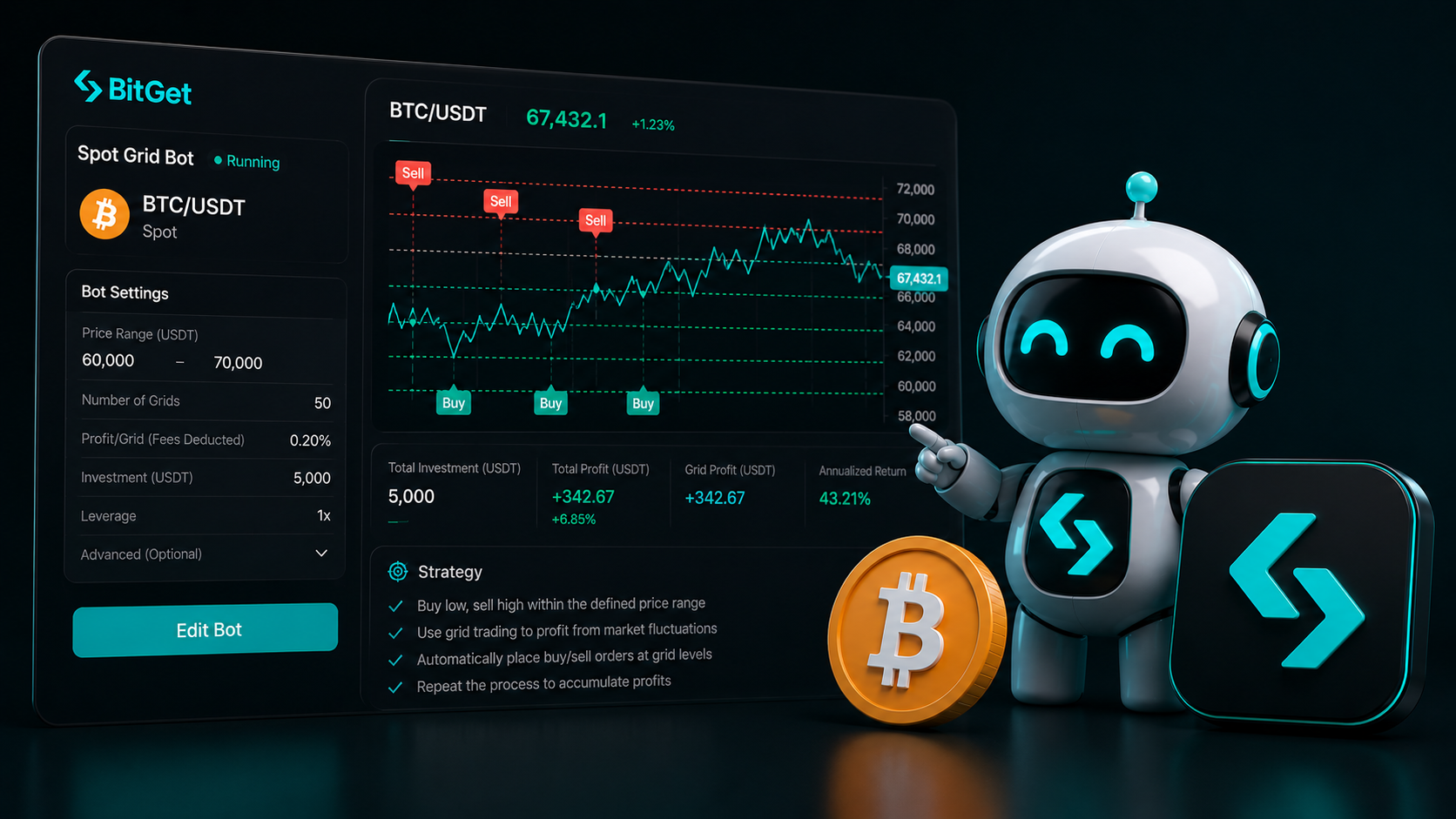
The best-documented bot strategy. Place a ladder of buy and sell orders inside a range; capture the spread as price oscillates.
Works because BTC and ETH spend most of their time chopping inside ranges. Has a positive expected value over months. Easy to backtest, easy to verify live performance.
Returns: 0.5–3% per month on majors during ranging periods. Near zero or slightly negative during sustained trends.
Full breakdown in grid trading explained.
DCA bots on majors
The simplest, dullest, most reliable bot. Buy a fixed amount of BTC or ETH on a fixed schedule.
Works because the underlying assets have appreciated over multi-year windows. The strategy doesn’t try to time anything — it just shows up.
Returns: tracks the underlying minus a small drag. Has produced positive returns in every rolling 4-year window of BTC since 2014.
Full breakdown in DCA bots guide.
Trend-following bots in trends
When the market is trending strongly, a simple trend-following bot (moving average cross, Donchian breakout) can capture the middle 60–70% of a major move.
Works when there’s a trend. Whipsaws to death in choppy markets.
Returns: variable. 20–40% in a strong bull leg. Negative in extended chop.
Lower confidence strategy because regime identification is hard in real time.
What doesn’t work
- Martingale bots. Mathematical certainty of catastrophic loss over a long enough timeline.
- “AI bots” with fixed return promises. Marketing dressed as strategy. The promise of “1% daily” implies the bot beats the best hedge funds in history. It doesn’t.
- Arbitrage bots for retail. Spreads have compressed below the level retail infrastructure can capture profitably. Professional shops with colocated servers eat the available spread.
- Custom indicators on memecoins. The bot doesn’t know the token is going to zero. The trader thinks they’ve found an edge. The chart looks great until the project folds.
Realistic returns: 0.5-3% per month is the honest range
This is the section that gets me unfollowed.
For a well-configured grid bot on BTC/USDT spot, run with sensible position sizing, the realistic monthly return sits between 0.5% and 3%. Average across a year, you’re looking at high single digits to low double digits annualised.
That sounds underwhelming compared to “20% APY” marketing. It is.
It also beats:
- USDT flexible savings (currently 2–4% APY)
- Most savings accounts (sub-5%)
- A held BTC position during sideways markets (zero return)
It loses to:
- A held BTC position during strong bull runs (anywhere from 50% to 200%+)
- Skilled discretionary trading on the same capital (possibly)
- A successful copy trader (highly variable)
Why these are the numbers
A grid bot’s profit per cycle is small. The strategy compounds through frequency. If your grid bot cycles 100 times in a month with a net 0.5% per cycle on $100 per grid, that’s $50 of profit on $5,000 of capital — 1% per month.
The maths is consistent. The variability comes from:
- How active the chop is (more cycles = more profit)
- Whether price stays in the range (if it leaves, the bot stops earning)
- Fee tier and how disciplined the spacing is
There are months at 0.3%. There are months at 3.8%. The average across a year of running has consistently fallen in the 0.5–2.5% per month range for me.
What “beats cash” looks like
Cash in a stablecoin earning 3% APY makes 0.25% per month. A grid bot on the same capital making 1.5% per month makes 6x the return on the same float. Across a $10,000 allocation, that’s $1,500 a year vs $250 a year. Not life-changing, but the kind of return that compounds meaningfully over years.
The honest framing: bots aren’t a path to wealth. They’re a path to slightly better than holding stablecoins on capital that would otherwise sit idle.
Bot strategy vs market regime
The single biggest predictor of bot profitability over a given month is whether the strategy matches the regime.
Ranging market
- Grid bots: outperform.
- DCA bots: tracks underlying, modest returns.
- Trend bots: whipsaw, lose money.
Trending market (up)
- Grid bots: underperform spot (you sold inventory at the bottom of the move).
- DCA bots: keep buying, accumulate at higher prices, fine in the long run.
- Trend bots: outperform if they catch the trend early.
Trending market (down)
- Grid bots: hold inventory at unrealised loss until the range recovers.
- DCA bots: keep buying the dip, which is actually the best entries.
- Trend bots: short or stay flat if designed for both directions.
Identifying regime in real time
This is hard. The honest answer: most retail traders can’t reliably identify regime shifts. The defence is to run a strategy that’s tolerable across regimes (DCA), or a strategy with a clear exit rule when conditions change (grid bot with a stop-loss on range break).
I personally don’t try to time regime shifts. I run a grid bot continuously, set the stop loss, and accept that there will be months where the bot underperforms. The DCA bot runs alongside, accumulating regardless. Combined, the portfolio is reasonably regime-tolerant.
Profitability vs sustainability
There’s a difference between a bot making money this month and a bot that makes money sustainably across years. Mistaking the first for the second is the trap.
Profitability
Month-over-month returns. Easy to measure. Easy to brag about. Easy to over-extrapolate.
The bot returned 8% in March. Therefore, the bot returns 100% annualised. Therefore, $10,000 becomes $20,000 by year-end. Wrong, wrong, and wrong.
Sustainability
Returns across full market cycles, including drawdowns, regime shifts, and tail events. Hard to measure (you need years of data). Hard to brag about (the numbers are smaller). Hard to fake.
A bot’s sustainable return is somewhere around 30–50% of its peak monthly performance over a long enough horizon. The 8% March becomes a 3% average across the year, and that’s still a strong year.
How to measure sustainability
- Run the bot for at least 12 months before drawing conclusions.
- Include the drawdowns in the calculation. Net return, not just the wins.
- Compare to a hold-spot baseline. If the bot underperformed a held BTC position by more than 5% across the year, the bot didn’t add value.
- Account for the work — your monthly review time has an opportunity cost.
Most bots that look great for 6 months stop working in month 7 or 8. That’s why “live performance over 12+ months” is the bar that matters, not “backtest from 2018”.
The 80/20 rule for bot users
80% of bot profits come from 20% of the bots, and the same 20% across most user accounts.
The 20% that works
- A single grid bot on BTC/USDT spot, well-configured, run continuously.
- A single DCA bot on BTC, weekly buys.
- (For more active users) one trend-following bot on majors during clear trending periods.
That’s it. Three bot types on majors. Boring. Consistent.
The 80% that’s noise
- Martingale bots that look like free money until they don’t.
- AI bots with promised returns.
- Bots on memecoins.
- Bots on illiquid pairs.
- Bots with too many tweaked parameters.
- Bots run alongside 10 other bots that the user can’t keep track of.
If you have more than 5 bots running across more than 3 pairs, you’re in the 80%. Cut back.
Why the 80/20 holds
Crypto bots don’t scale linearly. Adding a 4th bot doesn’t add 25% to returns — it adds complexity, attention overhead, and fee drag. The marginal bot is almost always a net negative once you account for the time spent managing it.
The traders I know who profit consistently from bots run 1–3 bots, full stop. The traders who lose money on bots run 6–12.
Hidden costs (fees, slippage, taxes)
The gross return on a bot isn’t the net return. Three costs eat the difference.
Trading fees
On BitGet at 0.10% maker/taker, every round trip costs 0.20%. A grid bot doing 100 cycles per month on $100 per grid trades $10,000 round-trip per cycle, paying $20 in fees per cycle and $2,000 across the month.
If the bot’s gross return was $250 on $5,000 of capital, fees ate $40 of it. Net: $210 instead of $250.
The defence: keep grid spacing well above 4× round-trip fee. Hold a small BGB balance on BitGet for the 20% fee discount.
Slippage
The price you see isn’t always the price you fill at. On low-volume pairs or during volatile moments, fills land a few basis points off the displayed price.
For BTC/USDT on a tier-1 exchange, slippage is typically minimal. For low-cap alts, slippage can exceed fees. Stick to majors and the cost stays manageable.
Taxes
Every closed cycle is a taxable event in most jurisdictions. A bot doing 1,200 cycles a year produces 1,200 disposal events.
The maths is the same as for manual trading — capital gain or loss on each disposal — but the volume is the issue. The defence: export your CSVs monthly, import to a tax tool (Koinly, CoinTracker, CoinLedger), and budget 25–35% of gross profit for tax depending on jurisdiction.
The IRS Notice 2014-21 covers the US treatment. HMRC’s guidance covers the UK.
What’s left after the costs
A bot showing 20% gross annual return on $5,000:
- Gross: $1,000
- Trading fees: −$200
- Slippage (BTC/USDT majors): negligible
- Tax provision (UK example, 20% CGT bracket): −$160 on the gain after allowance
Net to your pocket: roughly $640 on $5,000 = 12.8%. Still beats stablecoin yield. Lower than the headline number that got you to deploy the bot.
Plan for the costs in advance. The disappointment comes from not.
What separates winners from losers
Four years of watching this, here’s the pattern.
The winners
- Run 1–3 bots, not 10.
- Stick to BTC/USDT and ETH/USDT spot.
- Size each bot at 5–10% of trading float.
- Review monthly, not daily.
- Have a clear exit rule and follow it.
- Track everything (CSV exports, monthly P&L, tax provisioning).
- Treat bots as one income stream among several, not the strategy.
The losers
- Run too many bots across too many pairs.
- Chase whatever bot looked best in the last 30 days.
- Oversize allocations after a few good months.
- Tune parameters constantly, never letting the strategy run.
- Have no exit rule, or the rule is “I’ll know when it’s time”.
- Don’t track. Don’t provision tax. Don’t know their net return.
- Bet the house on bots and complain when it doesn’t work.
The split is about discipline, not intelligence. The losers aren’t dumb. They’re undisciplined. The winners aren’t smarter. They’re more boring.
Strategy education and where to learn more
The thing that separates bot users who win from bot users who lose isn’t the bot. It’s the operator’s understanding of why the strategy works.
The community I learn ongoing strategy thinking from is Trade Travel Chill (affiliate). It’s a group of active traders who break down strategies, share setups, and call out what’s working in current market conditions. If you want to actually learn systematic strategy thinking rather than chase the next bot, that’s where I’d point you.
The broader crypto trading bots guide covers the strategy landscape. The how to backtest a trading bot post covers the honest version of testing before you deploy. And the copy trading vs bots post covers when to use automation vs when to copy a human.
Run the bot I run.
My BTC/USDT spot grid bot is published on the BitGet marketplace. Same settings I’ve been running for over a year. Two-click deployment.
Affiliate link. I may earn a commission at no extra cost to you.
How to figure out if a specific bot is profitable
Before you deploy any bot, walk through this checklist.
1. Live track record over 12+ months
Not backtest. Live deployment on real capital. The backtest tells you the strategy could have worked on past data. Live performance tells you it’s working now.
2. Strategy you can explain in one sentence
“Buys when 50-day MA crosses 200-day MA, sells on cross down.” Fine.
“Uses proprietary AI to predict next move.” Not fine. You can’t evaluate what you can’t understand.
3. Maximum drawdown under 25%
A bot that’s drawn down 60% at some point in its history is going to do it again. Your tolerance for that drawdown is the question. Most retail traders can’t sit through it without turning the bot off.
4. Fee assumptions match reality
The bot’s reported returns should be net of fees, not gross. If the operator can’t tell you the fee assumption, the returns aren’t real.
5. The strategy makes sense in current market conditions
A trend bot in a sideways market won’t make money no matter how good the backtest looked. Match strategy to regime, or accept the underperformance.
6. You’d run it manually if you had to
If the bot stopped working tomorrow and you had to execute the strategy yourself, would you understand what you’re doing? If no, you don’t understand the strategy well enough to run the bot.
That’s the filter. Most “profitable bots” being sold to retail fail at least three of those tests.
Ready to start?
A DCA bot on BTC is the simplest profitable bot. BitGet’s is free, native, and takes five minutes to set up.
Affiliate link.
Frequently asked questions
Are crypto trading bots actually profitable?
Some are. Grid bots and DCA bots have a documented edge in the right conditions, returning typically 0.5–3% per month on majors. Most bot users lose money due to user error, not bot failure.
What returns can I realistically expect from a trading bot?
For a well-configured grid bot on BTC/USDT spot, 0.5–3% per month. For a DCA bot, returns track the underlying asset minus a small drag. Anyone promising fixed returns above 3% per month is selling marketing, not strategy.
Why do most people lose money with trading bots?
Five main reasons: overfitting the backtest, running the wrong strategy for the current market regime, oversize allocations after a few good months, turning the bot off during expected drawdowns, and using too much leverage.
Which trading bot is the most profitable?
There is no single “most profitable” bot — profitability depends on market conditions. Grid bots win in chop, DCA bots win on multi-year horizons, trend bots win during clear trends. Martingale bots and AI bots with promised returns rarely win across full cycles.
Can a trading bot replace a job?
Probably not. Realistic returns suggest a $50,000 account on a well-run bot generates $3,000–$8,000 a year net of fees and tax. That’s a useful side income, not a salary replacement.
Do trading bots work in bear markets?
Some do. DCA bots in a bear market accumulate the best entries. Grid bots with a defined range and stop loss can earn modest returns if the bear market chops sideways. Martingale bots tend to blow up in any sustained directional move.
How long should I run a bot before evaluating it?
At least 3 months for early signal, 12 months for a real assessment. Anything shorter is noise. The bot’s performance over the first 30 days tells you almost nothing about long-term profitability.
Are bot returns guaranteed?
No. Any bot or strategy with “guaranteed” returns is either a scam or a misunderstanding. Past performance — even live performance — does not guarantee future returns. The maths of any strategy can stop working if the market regime shifts.
Final word
Bots can make money. Most bot users don’t. The gap is discipline, not intelligence.
If I were starting again today, this is the order I’d do it in:
- Open a BitGet account. Complete KYC.
- Run a DCA bot on BTC, weekly, $50 a week for 3 months. Get used to seeing automated trades.
- Add a small grid bot, BTC/USDT spot, 5% of float, 50 grids, ±15% range. Watch it for 3 months.
- Track everything monthly. CSV exports. Net P&L. Tax provision.
- Only after 6 months of disciplined small-scale running, consider scaling up the strategies that performed.
That’s the honest answer to “are crypto bots profitable”. Some are. Most users aren’t. Be the boring 20%.
Right — over to you.
Related posts
- Crypto Trading Bots: What Actually Works
- Grid Trading Explained
- DCA Bots: The Lazy Trader’s Edge
- Copy Trading vs Trading Bots
- How to Backtest a Crypto Trading Bot
External references
- BIS — Crypto trading and Bitcoin prices
- CoinGecko — Bitcoin historical price data
- Investopedia — Algorithmic trading explained
- IRS Notice 2014-21 — Crypto tax treatment
- BitGet — Trading bot documentation