Every couple of weeks somebody asks me the same question. “Should I copy a trader on BitGet or just run a bot?” Both options sit in the same menu. Both promise to make money for you while you do something else. Both have failure modes that look identical from the outside until the moment your account balance hits zero.
I run both. They do different things. Picking the right one for the right job is the difference between a portfolio that compounds quietly and one that gets nuked because you copied a 50x leverage merchant who’d been lucky for six weeks. This post is the honest head-to-head — mechanics, costs, control, when each one wins, and the hybrid setup I actually use. Some links here are affiliate. I’ll flag them.
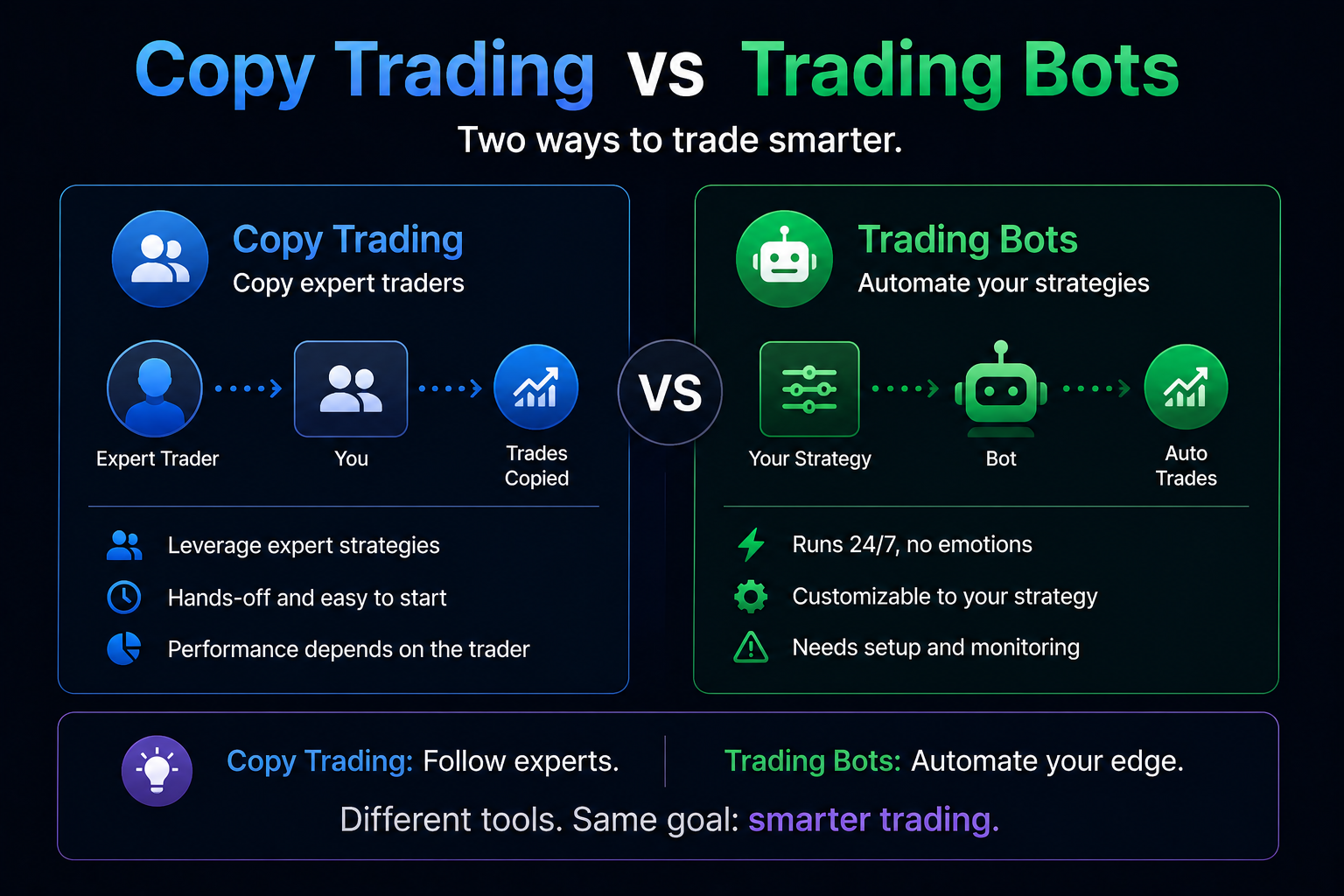
Short answer: Copy trading mirrors the live discretionary decisions of another human trader — you ride their calls in real time. Trading bots execute fixed rules you (or someone else) defined — they don’t make decisions, they follow them. Bots win for systematic strategies on majors; copy trading wins when you want exposure to a specialist’s read of a fast-moving market. Most retail traders should start with a bot and add copy trading later as one allocation among many.
Try the BitGet bot marketplace → (affiliate)
Key takeaways
- Copy trading mirrors a human’s live trades; bots execute fixed code.
- Copy trading carries biographical risk (the human has a bad month); bots carry strategy risk (the regime changes).
- Copy trading costs a profit share (10–30%); bots cost nothing on the exchange itself.
- Bots scale better and run 24/7 without emotional drift. Copy trading scales with the trader’s discipline.
- The hybrid setup I run: bot as the core, one or two copy traders as a small satellite allocation.
- Both can lose money. Both need position sizing discipline.
TL;DR comparison table
| Copy trading | Trading bots | |
|---|---|---|
| Who decides | A human (live, discretionary) | A script (fixed rules) |
| Cost | 10–30% profit share | Free on most exchanges |
| Control | Low — you ride their calls | High — you set the rules |
| Emotional drift | Yes — the trader can tilt | No — bot doesn’t feel |
| Scales 24/7 | Only when the trader trades | Always |
| Risk profile | Trader’s risk × your size | Strategy’s risk × your size |
| Best for | Specialist reads on alts, futures | Systematic strategies on majors |
| Worst for | Lazy traders chasing leaderboard ROI | Markets the bot wasn’t designed for |
| Track record needed | 12+ months, low max drawdown | Live performance, not just backtest |
That’s the speed-read. The rest of the post is the why.
How copy trading actually works
Copy trading lets you mirror another trader’s positions on your own account. They open a long, your account opens a long. They close, your account closes. The position sizes scale to your allocation, but the timing and direction are theirs.
The mechanics on BitGet
- Browse the leaderboard. Filter by ROI, win rate, max drawdown, account age, and AUM.
- Pick a trader. Read their profile, check their history.
- Set your copy allocation. This is the capital your account commits to mirroring them.
- Choose copy mode: fixed ratio (always X% of your float per trade) or fixed amount (a set USDT per trade).
- Click follow. Your account now mirrors their trades automatically.
- Stop following any time. Open positions can be closed automatically when you exit.
The full breakdown is in the BitGet copy trading post.
Where the money goes
Profitable copy traders get a profit share — typically 10% — paid only on profitable trades. If the trader loses, you pay nothing for that period. BitGet handles the accounting; you don’t see invoices.
This is important: the trader has an incentive to make money for you because their fee depends on it. They have a stronger incentive to look profitable in the short term because new followers chase the leaderboard. These two incentives are not the same.
The biographical problem
A copy trader is a person. People have bad days, bad months, bad relationships, bad health. The trader you picked because they returned 80% in six months might be one personal crisis away from revenge-trading the entire account into the floor.
You don’t see this happening in real time. You see green candles, then suddenly a sequence of bad calls, then a big drawdown. The thing that changed wasn’t the market. It was the human.
That’s the fundamental risk of copy trading. You’re not buying a strategy. You’re buying a person’s continued discipline.
How trading bots actually work
A trading bot is a script. It follows fixed rules. The rules don’t tilt. The rules don’t get tired. The rules don’t take revenge after a loss.
The mechanics
You (or the bot’s author) define the strategy:
- A grid bot places orders at fixed price levels inside a range.
- A DCA bot buys a fixed amount on a fixed schedule.
- A trend-following bot enters when moving averages cross and exits on a reverse cross.
- A copy-bot mirrors another bot’s published settings.
The bot runs on the exchange’s servers, 24/7, executing trades exactly as defined. It doesn’t sleep. It doesn’t second-guess. It doesn’t read Twitter and panic.
The full landscape is covered in the crypto trading bots guide.
Where bots fail
Bots don’t blow up because they’re emotional. They blow up because the market regime changed and the strategy doesn’t fit the new regime.
A grid bot designed for chop fails in a strong trend. A DCA bot fails on an asset that goes to zero. A trend bot fails in a choppy range. The bot is fine — the assumption baked into the bot is wrong.
That’s the fundamental risk of bots. You’re not buying a guarantee. You’re buying a strategy’s continued fit with the market.
The advantage
Where a human copy trader can have a bad week and tilt, a bot keeps running the same logic. If the logic was sound, the bot recovers. If the logic was unsound, you can prove that with a backtest before you ever deploy. The how to backtest trading bot post covers the honest version.
Control: you ride someone else’s call vs your rules
This is the conceptual difference and it matters more than most people realise.
Copy trading is delegation
When you copy a trader, you’ve effectively hired them to make decisions with your money. Their entries are your entries. Their exits are your exits. Their leverage is your leverage. If they change their style mid-month, your account changes with them, whether you notice or not.
You can stop following any time. But while you’re following, you’re not running a strategy — you’re running a person.
Bots are mechanical
When you run a bot, the strategy is fixed. You know exactly what it will do in any given scenario because the rules are written down. If you don’t like how the bot behaves in a particular market, you can change the rules — or switch the bot off.
You’re running a strategy, not a person. The strategy doesn’t surprise you. It does exactly what it was designed to do.
Which fits you?
If you have a view on what should happen in the market and want to express it in code, run a bot. If you don’t have a view and want to outsource the decisions to someone who does, copy trade.
Most retail traders don’t have a strong view. That’s fine. The discipline of running a bot teaches you to develop one. The shortcut of copy trading skips that learning curve, which is sometimes worth it and sometimes the reason people get stuck on the leaderboard treadmill forever.
If you want to actually learn to develop your own view rather than copy someone else’s, Trade Travel Chill (affiliate) is the community I’m part of. Education-led, not signals-led.
Costs comparison
Money matters. Here’s what each one actually costs.
Copy trading costs
- Profit share: 10% on profitable trades, paid to the lead trader. Some traders run higher (up to 30%) for “VIP” tiers.
- Standard exchange fees: the underlying spot or futures fees still apply to every trade the copy bot mirrors.
- Spread cost: when you enter at the same time as 500 other followers, the trader’s order pushes the price slightly, so your fill might be a few basis points worse.
Estimated total cost to follow a profitable trader: 0.1–0.2% per round-trip plus 10% of net profit. If the trader returns 30% in a year on your $5,000 copy allocation, you keep $1,350 and they get $150. Not bad if they actually return 30%.
Bot costs
- Exchange fees: standard spot/futures rates. On BitGet at 0.10% maker/taker, that’s 0.20% round trip.
- Subscription fees: zero on native exchange bots. $14–$60/month if you use 3Commas or a third party.
- Profit share on bot copy: 0–30% if you’re subscribing to another operator’s published bot strategy (variable).
The native bot on BitGet costs you only the standard trading fees. Run a grid bot for a year, you’ve paid fees on every cycle but no subscription. Run the same strategy through 3Commas, you’ve paid the same fees plus $500/year in subscriptions.
Which is cheaper
For a $5,000 allocation generating 20% annual return:
- Copy trading: $1,000 gross profit − $100 profit share = $900 net.
- Native exchange bot: $1,000 gross − $0 subscription = $1,000 net (minus the slightly higher fee drag from more frequent trading).
A bot is cheaper in raw fee terms. The trade-off is the bot only works if the strategy fits the market. The copy trader earns their cut by adapting to the market in real time. Pay for what you actually get.
Risk profiles
Different shaped risks.
Copy trading risk
- Trader blow-up: they over-leverage, get liquidated, your copy allocation gets taken with them.
- Strategy drift: they were a swing trader, now they’re scalping, the risk profile changed.
- Tilt risk: bad week, revenge-trade, drawdown.
- Survivorship illusion: the leaderboard you picked from only shows the survivors of the last 90 days.
The defence is filtering. Account age 12+ months, max drawdown under 30%, low leverage in their history. Most leaderboard chasers ignore all three.
Bot risk
- Regime change: strategy was designed for one market condition, market shifts to another, bot stops adding profit or starts losing.
- Configuration error: range too tight, allocation too high, no stop loss.
- Asset risk: the token underneath collapses regardless of the bot strategy.
The defence is backtesting + paper trading + small allocation. Bots are easier to test before you deploy because the rules are explicit. Copy trading you’re committing capital based on an opaque human decision-making process.
Realistic loss potential
In both cases, the maximum realistic loss for a sensibly sized allocation is the full allocation. With leverage involved (copy traders running futures, futures bots), the loss can exceed the allocation.
Never put more than 10% of trading float into a single copy trader. Never put more than 10% into a single bot. If you wouldn’t write off the allocation, it’s too big.
When copy trading wins
There are specific scenarios where copy trading is the right tool.
When you want exposure to a specialist
Some traders really do have an edge on specific markets — altcoin perpetuals, narrative-driven plays, specific chains. A bot can’t read on-chain flow data and decide a token is about to pump on launch. A skilled trader can.
If you want exposure to that kind of read, copying them is the only realistic way for retail. You’re paying for their specialism.
When you’re learning
Following a good trader is one of the fastest ways to understand how a strategy plays out in real markets. You see their entries, watch the outcomes, observe their risk management. Treat it as tuition with a small allocation, not a path to wealth.
When you want active management of a futures float
Bots on futures with leverage are risky to run unattended. A skilled copy trader is managing risk in real time. For active futures exposure, copying someone is often safer than running a leveraged bot.
BitGet futures USDT-M covers the futures product itself. BitGet leverage explained covers the risks if you’re going to touch leverage at all.
When bots win
Bots are the right tool when the conditions favour them.
When the strategy is systematic
Grid trading, DCA, trend following on majors. These are rule-based strategies. A bot is the perfect vehicle. A human running them adds emotion and inconsistency.
When the market is liquid and predictable
BTC/USDT spot. ETH/USDT spot. Top-10 majors with deep order books. The mechanical strategies work because the market behaves consistently enough for the rules to apply.
When you want 24/7 execution
Bots don’t sleep. A copy trader does (or should). If the strategy needs to fire at 3am, the bot fires at 3am. The trader you copied is in bed.
When you want lower costs
No profit share. No subscription on native exchange bots. The fee profile is just the standard exchange rates on each trade.
When the strategy can be tested
You can backtest a bot. You can backtest a strategy. You can’t backtest a human’s discretionary decision-making — past performance is your only proxy and it’s unreliable. The how to backtest a trading bot post covers this honestly.
The hybrid setup I run
This is the actual structure of my automated capital. Take it as one example, not a recipe.
The split
- Core (60%): BTC/USDT spot grid bot. Steady chop capture. Boring, consistent, well-understood.
- Core (20%): BTC and ETH DCA bots. Long-term accumulation. Pure schedule, no market view.
- Satellite (15%): one or two copy traders. Specialist allocations on alts or futures, filtered hard for max drawdown and account age.
- Reserve (5%): cash on the exchange. Available to deploy into the grid bot range adjustment or to size up a new opportunity.
Why this structure
The core bots run reliably without my attention. The DCA bot accumulates regardless of what’s happening. The grid bot earns chop yield on the active float. Together they cover 80% of my automated capital with low-effort, predictable strategies.
The copy trader satellite is where I add active market intelligence. I’m paying someone to read a market I can’t read myself. It’s small enough that if they blow up, my core strategies absorb the hit without breaking the overall thesis.
What I check, and how often
- Daily: nothing. The bots run.
- Weekly: glance at copy trader performance. If a copy trader’s drawdown exceeds 15%, I exit and find another.
- Monthly: reset the grid bot range based on the 90-day band. Top up DCA bot funding. Sweep accumulated coins to cold storage.
- Quarterly: full review. Are the allocations still right? Has the market regime shifted? Time for tax provisioning.
That’s the rhythm. Most of the work happens once a month, in a 30-minute review session.
Start with the bot, add copy later.
The BTC/USDT spot bot I run is published on the BitGet bot marketplace. Same settings, same logic. Two-click deployment.
Affiliate link. I may earn a commission at no extra cost to you.
How to choose: decision tree
If you’re trying to pick one to start with, walk through this.
Question 1: Do you have a market view?
- Yes, and it’s systematic (grid in chop, DCA accumulation, trend on majors) → run a bot.
- Yes, and it’s discretionary (you read alts, you call narratives) → you don’t need either — trade manually.
- No view at all → keep reading.
Question 2: How much capital are you starting with?
- Under $500 → run a DCA bot. Anything else is too small to be meaningful after fees.
- $500–$5,000 → run a grid bot on BTC/USDT plus a small DCA. Skip copy trading at this size — the absolute returns aren’t worth the complexity.
- $5,000+ → hybrid: core bots plus a small copy trader allocation if you want active exposure.
Question 3: How active do you want to be?
- Fully passive → DCA bot, set indefinitely, check quarterly.
- Lightly active → grid bot + DCA bot, monthly review.
- Actively involved → manual trading. Don’t outsource what you want to learn.
Question 4: Are you trying to learn?
- Yes → run a small bot with full understanding. Read the crypto trading bots guide and grid trading explained. Don’t copy trade — you’re skipping the lesson.
- No, you just want yield → bot as the core, copy trader as a satellite, sized small.
That’s the decision tree. The defaults for most readers are: start with a DCA bot, layer in a grid bot once you’re comfortable, add copy trading later if the strategy fits.
Bot copy trading: the new hybrid
There’s a third option that splits the difference between the two, worth mentioning here.
Bot copy trading lets you subscribe to another operator’s published bot strategy. The strategy is fixed code (like a bot), but the operator gets a profit share (like copy trading). The marketplace on BitGet copy trading is the most active I’ve seen.
Why it sits in the middle
- The strategy is mechanical. You can read the rules.
- The performance is auditable. The bot’s live track record is visible.
- The operator’s incentive is to publish a strategy that actually works long term, because their profit share depends on it.
- The risk is lower than human copy trading because there’s no tilt risk — the bot doesn’t have a bad day.
Where it falls short
- The strategy might be over-fit. A bot that looked great in backtest can fail forward.
- The operator might stop maintaining it. A bot that’s not adapted to changing markets degrades.
- The marketplace’s filters bias toward short-term winners.
For most retail traders, a published bot strategy from an operator with a 12+ month track record and low max drawdown is the best middle ground. You get a tested strategy without having to design one yourself, at a cost lower than human copy trading.
Security on whatever you choose
Both copy trading and bots require your trading account to be secure. The same rules apply to both.
- 2FA via app, not SMS. Authy or Google Authenticator. SMS is the single biggest vulnerability in retail crypto accounts.
- Withdrawal whitelist. Set the only addresses your account can withdraw to. If your account is breached, the attacker can’t move funds out.
- VPN on trading device. I use NordVPN (affiliate) on any device that touches my exchange. Public WiFi is the main attack vector for account takeovers.
- Long-term holdings off-exchange. Anything you’re not actively trading goes to a Ledger Nano X — see how to store crypto safely for the full playbook.
A profitable bot or a profitable copy trader doesn’t matter if your account gets emptied. Security comes first.
Pick the easy path: bot first.
If you’re starting from scratch, run the bot I run, watch it for 3 months, and add copy traders later as a satellite allocation.
Affiliate link.
Or open a BitGet account → (affiliate)
Frequently asked questions
Is copy trading better than using a trading bot?
Neither is universally better. Copy trading is right for specialist exposure you can’t replicate (alt narratives, futures with active management). Bots are right for systematic strategies on majors. Most retail traders should start with a bot.
Can I run a bot and copy trading at the same time?
Yes. They use different parts of your account balance and don’t interfere. My hybrid setup uses both — bots for the core 80% of automated capital, copy traders for a satellite 15%.
Which is cheaper, copy trading or bots?
Native exchange bots are cheaper in raw fee terms because there’s no profit share — only standard trading fees. Copy trading costs typically 10% of net profit on top of the underlying fees.
Are copy traders trustworthy?
Some are. Most leaderboard chasers aren’t. Filter by account age (12+ months), maximum drawdown (under 30%), and consistent ROI rather than recent spikes. Treat copy trading as you would hiring a portfolio manager.
Do trading bots actually make money?
Some do. Grid bots in chop and DCA bots on majors have produced consistent returns historically. Martingale bots and “AI bots” with fixed return promises usually don’t. The honest version is in are crypto bots profitable.
What is bot copy trading?
A hybrid: you subscribe to another operator’s published bot strategy. The strategy is fixed code (auditable), but you pay a profit share to the operator. Lower risk than human copy trading because there’s no tilt — the bot doesn’t have bad days.
Should beginners use copy trading or bots?
Bots, specifically a DCA bot on BTC. It’s the simplest strategy, the hardest to mess up, and teaches you how automated execution feels without committing capital to someone else’s decisions.
How much should I allocate to a copy trader?
No more than 10% of trading float per trader. A diversified copy trading allocation might be 2–3 traders at 5% each. Never let a single copy trader hold a position that would seriously hurt if they blew up.
Final word
Copy trading and bots solve different problems. The bot is your steady operator. The copy trader is your specialist consultant. Neither replaces the work of understanding what you actually want from your trading capital.
Here’s what I actually do:
- BTC/USDT spot grid bot, core allocation, runs continuously.
- BTC and ETH DCA bots, long-term accumulation.
- One or two filtered copy traders, satellite allocation, no more than 15% combined.
- Manual trading reserved for opportunities I have a strong view on — not what the bots or copy traders cover.
- Review monthly, rebalance quarterly.
If I were starting again today, I’d run a single DCA bot for 3 months, add a grid bot, watch both for another 3 months, then consider one copy trader. By month nine you’ll have enough data on your own behaviour to know what fits.
Right — over to you.
Related posts
- Crypto Trading Bots: What Actually Works
- BitGet Copy Trading: How It Works
- Grid Trading Explained
- DCA Bots: The Lazy Trader’s Edge
- Are Crypto Trading Bots Profitable?
External references
- Investopedia — Copy trading explained
- BitGet — Copy trading product page
- CoinGecko — Bitcoin market data
- Investopedia — Algorithmic trading