Most traders hate sideways markets. The chart goes nowhere, the screen looks the same on Monday as it did on Friday, and the YouTubers stop posting because there’s nothing to scream about. I love sideways markets. They pay my bills. The reason is a strategy called grid trading, and it’s the closest thing crypto has to a quiet machine that prints small, regular profits while you do something else with your day.
I’ve run grids on and off for the last three years. Some printed. Some didn’t. The ones that printed all followed the same five rules. This post is the honest version of how grid trading actually works, when it makes money, when it doesn’t, and the exact settings I use on BitGet. Some links here are affiliate. I’ll flag them.
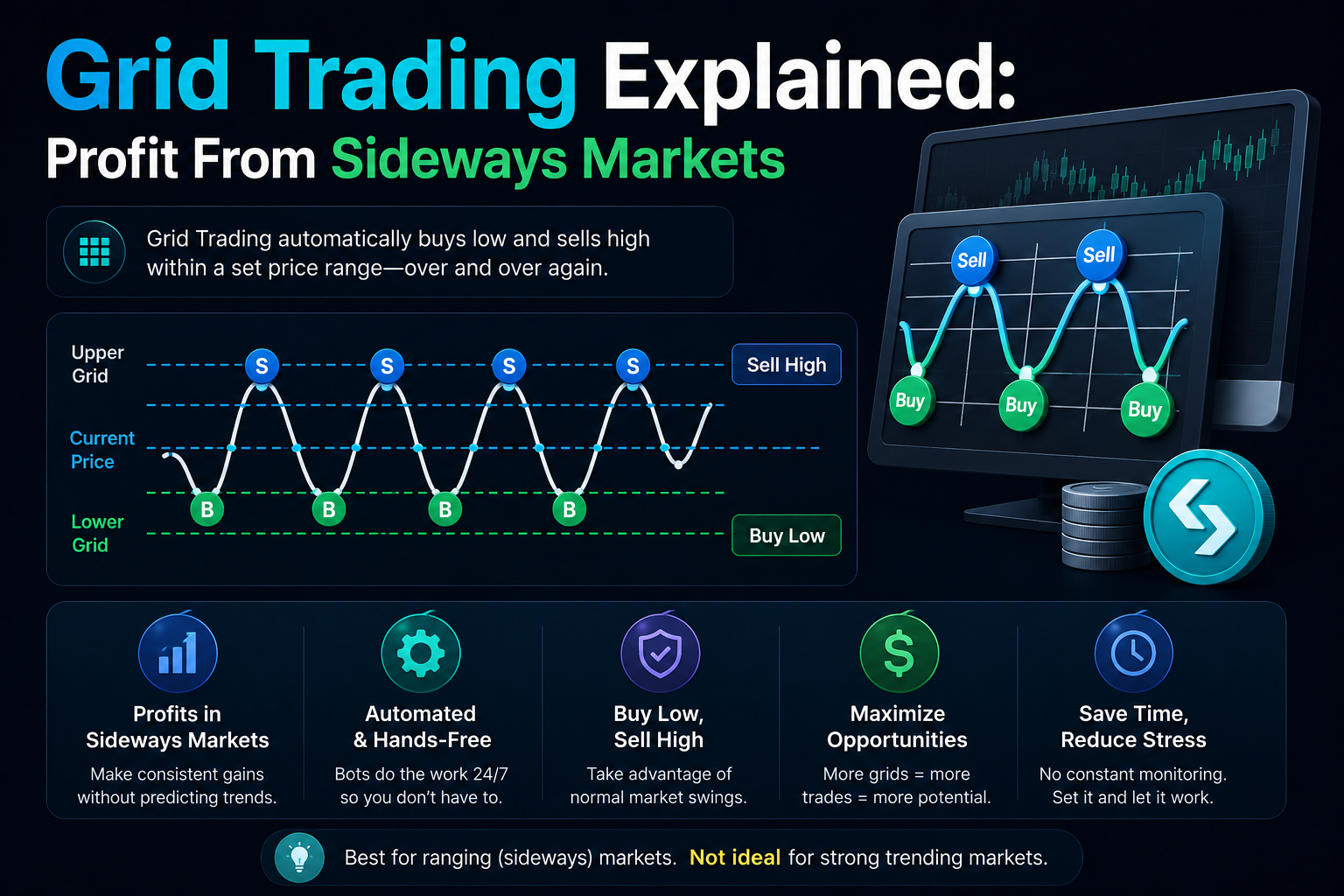
Short answer: Grid trading is an automated strategy that places a ladder of buy and sell orders at regular price intervals inside a defined range. The bot buys at lower grid lines and sells at higher ones as price oscillates, capturing the spread on each cycle. It makes money in sideways chop, loses opportunity cost in strong trends, and works best on liquid major pairs like BTC/USDT. Realistic returns sit at 0.5–3% per month on the allocated capital.
Run the BTC/USDT grid bot I use → (affiliate)
Key takeaways
- Grid trading divides a price range into equal levels and places buy/sell orders at each line.
- The strategy is mean-reverting — it bets price will revisit recent levels, which BTC does about 70% of the time.
- Grid count and spacing decide your profit per cycle vs how often the bot fires.
- The range you pick is the single biggest decision — too wide and the bot rarely fires, too narrow and price escapes.
- Strong directional trends are the enemy. The bot doesn’t blow up, but it stops adding profit.
- Best pairs: BTC/USDT, ETH/USDT, a handful of top-10 alts. Memecoins will eat you alive.
What grid trading actually is
A grid bot is a script that does one thing: place buy and sell orders at fixed price intervals inside a range you set, and rotate inventory between cash and the asset as price moves up and down.
That’s the whole strategy in one sentence.
You give the bot three numbers:
- Upper price — the top of your range.
- Lower price — the bottom of your range.
- Grid count — how many price levels between the two.
The bot does the maths. It divides the range into that many evenly spaced levels, places a sell order at each level above current price, and a buy order at each level below. When price drops to a buy level, it fills. When price rises to the next sell level above, that fills too. Net result: bought slightly lower than sold. Profit per cycle is the gap between adjacent grids, minus fees.
You can read Investopedia’s definition of grid trading for the textbook version. The retail reality is simpler than the textbook makes it sound.
Why this isn’t gambling
A grid bot has no opinion on price direction. It doesn’t predict, doesn’t read news, doesn’t follow indicators. It assumes one thing — that price will revisit recent levels — and gets paid every time that assumption is right.
In a market that chops 70% of the time, that assumption is right 70% of the time. The other 30% you give back some of your gains or sit idle. The expected value over a full market cycle is positive, provided the range is set sensibly and fees are low.
That’s it. No magic. No AI. Just a ladder of orders and the patience to let them fill.
The maths: buy low, sell high, on autopilot
Here’s the formula in plain English.
Profit per cycle = (sell price − buy price) × position size − fees.
Or, more usefully:
Profit per cycle ≈ (grid spacing %) × allocation per grid − (2 × fee rate × allocation per grid)
Say you’ve set a 1% grid spacing on a BTC/USDT bot with $100 allocated per grid line. On BitGet, spot fees are 0.10% maker and 0.10% taker (per the BitGet fee schedule). Each round trip pays you:
- Gross: 1% × $100 = $1.00
- Fees: 2 × 0.10% × $100 = $0.20
- Net: $0.80 per cycle
That’s a small number. But if the bot cycles that grid 50 times in a month, you’ve earned $40 on $100 of capital — 40% on that grid line over the month. The aggregate across 50 grids running in parallel is where the real return comes from.
The compounding factor
Here’s where it gets interesting. Each profitable cycle increases the cash balance on the buy side, which means the next buy can be slightly larger. Over months, the bot’s effective allocation grows. The compounding is small per cycle but consistent.
This is why grid bots get more interesting the longer you run them, not less. Months 1–3 are slow. Months 6–12 start to show what the strategy actually does.
A worked example with real numbers
BTC at $80,000. You set:
- Upper: $90,000
- Lower: $70,000
- Grids: 40
- Allocation: $4,000 ($100 per grid)
Spacing per grid: ($90,000 − $70,000) / 40 = $500 per grid, which is 0.625% at the middle of the range.
If BTC chops between $75,000 and $85,000 for the next month and triggers each grid twice on average, you’d see roughly:
- Cycles: ~40
- Profit per cycle (after fees): ~$0.42
- Total: ~$17 on $4,000 = 0.42% monthly
That sounds low. It is low for a single tight chop. The actual returns I see on BitGet sit in the 0.5–3% per month range across the bot’s lifetime, because BTC’s real-world ranges are wider, the bot compounds, and active chop periods compress months of cycles into weeks.
Why grid bots work in chop
The strategy was designed for ranging markets. That’s not marketing — it’s the maths.
In a sideways market, price oscillates around a mean. Every oscillation triggers grid lines on the way up and on the way down. The bot collects the spread between adjacent levels on every cycle. The more chop, the more cycles, the more cumulative profit.
CoinGecko’s BTC historical data shows that even across the strongest bull years, BTC spends 60–70% of weeks in some form of ranging behaviour. Strong uptrends and downtrends are short-duration events. The long, boring middle is where grid bots earn.
The behavioural advantage
A grid bot also fixes the single biggest psychological bug in retail trading: you don’t buy the dips. The bot does. It buys at $79,500 when you’d be hesitating, sells at $80,200 when you’d be greedy for more. The discipline is mechanical.
Six months of running a grid bot taught me more about systematic execution than three years of manual trading did. If you want to actually learn this — not just read about it — I’d point you at Trade Travel Chill (affiliate). It’s the community I’m part of and the one structured education source I trust on systematic strategy.
Why grid bots lose money in trends
The same logic that makes grids work in chop is what breaks them in trends.
When price walks out of your range in one direction, the bot has either:
- Sold all its inventory at the top of the range (in an uptrend) — now sitting on cash watching the move keep going. Opportunity cost.
- Bought all the way down to the bottom of the range (in a downtrend) — now holding 100% of the asset with no exit. Unrealised loss.
Neither case is a wipeout. The bot doesn’t blow up. But you stop earning, and in a strong trend the underperformance versus simply holding spot can be 10–20%.
The honest trade-off
A grid bot trades upside in trends for steady gains in chop. If you think the next six months will be a screaming bull run, don’t run a grid — buy spot and hold. If you think it’ll be a six-month sideways grind between two levels, the grid bot eats well.
Nobody knows which it’ll be. The defence is to size the bot at 5–10% of trading float, not 50%. You’re not betting the house. You’re collecting yield on idle capital while the rest of your portfolio does whatever it does.
Grid count and spacing: how to choose
This is where most people overthink it.
Grid count
More grids = smaller profit per cycle, but more cycles. Fewer grids = bigger profit per cycle, but you wait longer for each fill.
A useful range:
- 20–40 grids: wide spacing, big profit per cycle, slow cadence. Good for choppy days, less good for tight chop.
- 40–80 grids: medium spacing. The Goldilocks zone for most major pairs.
- 80–150 grids: tight spacing, micro profits per cycle, high frequency. Only viable on very liquid pairs where fees don’t eat the spread.
I run 50 grids on BTC/USDT. It’s a compromise that works across most market conditions.
Spacing
Grid spacing is just (range) / (grid count). What matters is whether the spacing is bigger than 2× the fee rate. If your spacing is 0.15% and your fees are 0.10% on each side, you’re paying 0.20% to capture 0.15%. The bot will run, the trades will fill, and the wallet will shrink.
Rule of thumb: minimum spacing = 4× the round-trip fee. On BitGet at 0.10% maker/taker, that’s 0.80% minimum spacing per grid. Anything tighter and you’re paying to play.
Picking the range: the std-dev method
The single biggest decision in grid trading is the range. Get this wrong and nothing else matters.
I use a method based on rolling volatility. Here’s the version that works without breaking out a spreadsheet.
Step 1: Pick the lookback
Use the 90-day high and low of your chosen pair. Pull it from TradingView, CoinGecko, or the BitGet chart. 90 days is long enough to include some chop and trend, short enough to reflect current market conditions.
Step 2: Pad it
Add 5–10% on each side. If the 90-day high is $90,000 and the 90-day low is $70,000, your range is roughly $63,000 to $95,000 after padding. This gives the bot room before price exits.
Step 3: Sanity check against current price
Your current price should sit somewhere in the middle 60% of the range, not at the edge. If BTC is at $89,000 and your upper is $95,000, you’re already most of the way through the range — the bot will sell out fast and sit on cash. Re-pad the range or wait for a pullback before deploying.
Step 4: Reset every 30 days
The range you set 90 days ago isn’t the right range today. I review and reset my grid bots monthly. Sometimes I keep the same range. Sometimes the band has shifted up or down and I redeploy.
This is the “set and forget but check it once a month” version. Pure set-and-forget with no re-ranging is how grid bots eventually go quiet.
Spot grid vs futures grid
There are two flavours of grid bot on most exchanges, including BitGet.
Spot grid
The bot trades the spot pair. You hold real BTC at the bottom of the range, real USDT at the top. No liquidation risk. No leverage. The worst case is “I now hold more BTC at a lower average price than I started” — which, if you’re long BTC anyway, is not a disaster.
This is what I run. It’s the version I’d point any beginner at.
Futures grid
Same logic, but on perpetual futures with leverage. Higher capital efficiency, you only need to post margin instead of the full position size. But: liquidation risk if price moves hard against you, funding payments on every cycle, and the upside isn’t worth the downside for retail traders running unattended bots.
I don’t run futures grids. The maths is fine on paper. The reality of waking up to a liquidation notice because you were running 5x leverage during a flash crash is not fine.
If you want the deeper comparison, the BitGet spot grid bot post covers the spot side, and the BitGet futures USDT-M post covers what futures actually are before you go anywhere near a leveraged grid.
Best pairs for grid bots
Not all pairs are bot-friendly. Here’s the short list of what works.
Tier 1: BTC/USDT
The anchor. Deepest liquidity on any exchange, including BitGet, where BTC/USDT does billions in daily volume. The most mean-reverting major in crypto. The pair I default to.
Tier 2: ETH/USDT
Second-deepest liquidity. Slightly more volatile than BTC but still has long-range periods. Good for diversification across two grids.
Tier 3: Top-10 large caps
SOL, XRP, BNB, ADA. Workable but more volatile. Use wider ranges and lower allocations. Watch the bot more often.
Avoid
Memecoins. Low-cap alts. New listings. Anything that’s pumped 200% in the last month. The grid bot won’t blow up — but the underlying token might, and the bot will dutifully accumulate bag at the bottom while the project quietly dies.
The rule I follow: if I wouldn’t hold the asset for 12 months unhedged, I won’t run a grid on it. The bot is just an accumulation pattern. The underlying still has to be something you want to hold.
If you’re new to picking pairs, how to buy crypto and how to buy bitcoin are the starting points.
A real example with numbers
Let me walk through a concrete setup, end to end.
The setup
- Pair: BTC/USDT spot on BitGet
- BTC current price: $80,000
- 90-day high: $88,000
- 90-day low: $72,000
- Padded upper: $94,000
- Padded lower: $66,000
- Grids: 50
- Allocation: $5,000
The maths
- Range width: $94,000 − $66,000 = $28,000
- Spacing per grid: $28,000 / 50 = $560
- Spacing % at current price: 560 / 80,000 = 0.70%
- Fee per round trip: 0.20% (0.10% × 2)
- Net profit per cycle: 0.70% − 0.20% = 0.50% × $100 per grid = $0.50
Estimated returns
If BTC chops inside the range and triggers each grid line an average of 2 times per month:
- Cycles per month: ~100
- Net profit: ~$50 on $5,000 = 1% per month
- Annualised: roughly 12% before tax, with no leverage and no liquidation risk
That’s the realistic baseline. Some months come in higher because the chop is denser. Some come in flat because BTC trended out of the range.
The actual results I’ve seen
Over 12 months of running this exact strategy on BitGet, I averaged around 1.5% per month after fees, with two months negative (BTC broke out of the range and stayed out for 6+ weeks each time) and one outlier month at 4.2% during a particularly choppy summer.
That’s the honest range. Not 20% monthly returns. Not 0.1% either. Steady, low-stress, single-digit annualised double-digit return on a portion of float that would otherwise sit idle in USDT savings earning 4%.
The detailed walkthrough including screenshots is in the BitGet BTC/USDT spot bot post.
Copy the bot directly → (affiliate)
Run my exact grid setup.
My BTC/USDT spot grid is published on the BitGet bot marketplace. Same range logic, same grid count, same allocation rules. Two-click deployment.
Affiliate link. I may earn a commission at no extra cost to you.
Risk management with grids
A grid bot is safer than most automated strategies, but “safer” is not “safe”. Here’s the discipline.
Position sizing
No single grid bot gets more than 10% of trading float. No single asset (BTC, ETH, etc.) gets more than 20% across all bots and manual positions combined.
If a bot is doing well and you’re tempted to “let it ride” with more capital, that’s exactly when to leave it alone. Grid bots reward patience, not greed.
Stop losses on the range
Every grid bot needs an exit rule for when price walks out of the range. Mine is:
- If BTC closes below the lower band on the daily timeframe for 2 consecutive days, exit the bot and redeploy after the next consolidation.
- If BTC closes above the upper band, take the cash, wait for a pullback, reset the range higher, redeploy.
The bot doesn’t know to do this. You have to set the rule and check it.
The “what if it goes to zero” test
For every grid bot, ask yourself: if the underlying went to $1 right now, would I be ruined? If yes, you’re allocated too much. The defensive case for a grid bot is “the underlying is something I’d hold long-term anyway”, and that has to be true.
Tax
Every grid cycle is a taxable event in most jurisdictions. A bot doing 100 cycles a month produces 100 taxable disposals. Export your CSV monthly, run it through Koinly or CoinTracker, and budget for the tax bill as you go. The IRS treats crypto as property — see IRS Notice 2014-21 for the US treatment. UK’s HMRC is similar.
I budget 25–35% of gross grid profit for tax depending on jurisdiction and bracket. The numbers above all become a lot less impressive after that adjustment.
Strategy education and where to learn more
A grid bot is one strategy. The real edge is understanding when to use it, when to switch it off, and what to combine it with.
The community I’m part of for ongoing strategy education is Trade Travel Chill (affiliate). It’s a group of active traders who break down strategies, share setups, and call out what’s working in current market conditions. If you want to actually learn systematic strategy thinking — not just read posts about it — that’s where I’d point you.
The wider crypto trading bots guide covers the other automation strategies that pair well with grids. And are crypto bots profitable is the honest answer to the question everyone asks before they deploy.
For security on whatever device you’re running the bot from, I use NordVPN (affiliate) on any device that touches my trading account. Public WiFi is where account takeovers happen.
Common mistakes I see beginners make
After watching enough people deploy their first grid bot, the same handful of mistakes come up over and over.
Setting the range too tight. Beginners pick a range based on the last week’s chart and the bot triggers once and sits idle. Use the 90-day band, not the 7-day band.
Setting the range too wide. The opposite mistake — picking a range so wide that price never gets near the edges and the bot only ever uses the middle 20% of the grids. You’re getting the same capital efficiency as a much smaller bot.
Too many grids on a low-fee budget. Cramming 200 grids into a 10% range means each grid’s spacing is smaller than your fee rate. The bot trades constantly and you lose constantly. Always check spacing > 4× round-trip fee.
Running it on a memecoin. The bot doesn’t know the token is a memecoin. The token goes to zero. The bot accumulates bag the entire way down. You wake up to a bot full of worthless tokens. Don’t do this.
No exit rule. The bot runs, the range breaks, the bot keeps trying to trade an environment it wasn’t designed for. Set the exit. Stick to it.
Adding capital when the bot is losing. The Martingale instinct applied to your strategy choice. If the bot is bleeding because the market regime changed, doubling down doesn’t fix it. Cut and redeploy when conditions return.
Skip the setup work.
The BTC/USDT spot grid I’ve been running is live on the BitGet bot marketplace. Subscribe, deploy, done.
Affiliate link.
Or open a BitGet account first → (affiliate)
Frequently asked questions
What is grid trading in simple terms?
Grid trading places a ladder of buy and sell orders at regular price intervals inside a defined range. The bot buys at lower grid lines as price drops and sells at higher grid lines as price rises, capturing the spread on each cycle.
Is grid trading profitable?
It can be, in sideways markets on liquid pairs with fees below the grid spacing. Realistic returns for retail traders sit at 0.5–3% per month on allocated capital. Strong directional trends reduce or eliminate returns temporarily.
Is grid trading risky?
Less risky than most automated strategies because there’s no leverage on a spot grid and no liquidation. The main risks are opportunity cost in strong trends and holding bag at the bottom of the range if the underlying drops below it.
What is the best pair for a grid bot?
BTC/USDT is the default for most retail traders — deepest liquidity, most mean-reverting major, lowest slippage. ETH/USDT is the strong second choice. Avoid memecoins and low-cap alts.
How much money do I need for grid trading?
Most native bots have minimums under $100. A realistic learning allocation is $500–$2,000. Smaller amounts work but the per-cycle profit becomes too small to feel meaningful.
Can grid trading lose money?
Yes. In strong directional trends the bot stops earning and can hold inventory at unrealised loss. Choosing a tight range that price quickly exits also produces losses. Choosing a low-quality asset can produce total losses if the token crashes.
How many grids should I use?
For BTC/USDT, 40–60 grids is the sweet spot. More grids work on tighter ranges with low fees; fewer grids work on wider, more volatile pairs. Always check that grid spacing is at least 4× your round-trip fee.
When should I turn off a grid bot?
When price closes outside the range on the daily timeframe for 2+ days, when the market regime has clearly shifted to strong trend, when your stop loss triggers, or when the underlying asset’s fundamentals change.
Final word
A grid bot isn’t going to make you rich. It’s going to make you a steady, boring, single-digit monthly return on capital that would otherwise sit idle. That’s worth more than it sounds.
Here’s what I actually do:
- Run a single BTC/USDT spot grid on BitGet at all times. Range based on 90-day band, 50 grids, 5–10% of trading float.
- Reset the range every 30 days.
- Exit if BTC closes outside the lower band on the daily for 2 days.
- Layer on an ETH/USDT grid as a side bet, smaller allocation, same rules.
- Track everything. Tax provision monthly.
That’s the playbook. No leverage. No memecoins. No 20% monthly returns. Just the quiet work of capturing chop while the rest of the portfolio does whatever it does.
Right — over to you.
Related posts
- Crypto Trading Bots: What Actually Works
- BitGet BTC/USDT Spot Bot: My Settings
- DCA Bots: The Lazy Trader’s Edge
- Are Crypto Trading Bots Profitable?
- BitGet Spot Grid Bot: Setup and Strategy
External references
- Investopedia — Grid trading definition
- CoinGecko — Bitcoin historical price data
- BitGet — Trading bot documentation
- BitGet — Spot trading fee schedule
- IRS Notice 2014-21 — Crypto tax treatment