Every couple of months somebody DMs me a screenshot of a bot that’s “doing 18% a week, set and forget, no risk”. The screenshot is real. The bot is real. The “no risk” is a lie wrapped around a Martingale strategy that’s one bad weekend away from a margin call. I’ve watched it kill more retail traders than leverage has.
I’ve run trading bots on and off since 2021. Grid bots, DCA bots, copy bots, a couple of AI things I regret. Some printed money. Some did not. This post is the honest version — what actually works, what looks like it works until it doesn’t, and how I actually use bots today. A few links here are affiliate. I’ll flag them as they come up.
Short answer: Crypto trading bots can be profitable in the right market conditions — grid bots make money in sideways chop, DCA bots accumulate at scale, and trend-following bots ride momentum — but they are not a free money machine. Martingale and “AI bots” promising fixed daily returns blow up. The best setup for most retail traders is a simple BTC/USDT spot grid bot on a regulated exchange like BitGet, with a defined range and a real stop loss. Rule of thumb: if the bot only makes money in a bull market, it’s not a bot, it’s a bet on the bull market.
Try the BitGet BTC/USDT spot bot → (affiliate)
Key takeaways
- A trading bot is just a rule-following script — its quality is the quality of the rules, not the branding.
- Grid bots and DCA bots are the two strategies that survive across market cycles. Most others don’t.
- Martingale bots double down on losing positions. The maths kills you in any sustained trend.
- The platform you run the bot on matters as much as the bot. Native exchange bots beat third-party tools on uptime and fees.
- I run a BTC/USDT spot grid bot on BitGet. Set the range, set the grid count, deploy. Real numbers further down.
- No bot replaces risk management. Position sizing, stop losses, and range limits are still your job.
What is a crypto trading bot?
A crypto trading bot is a program that places buy and sell orders on an exchange according to a defined rule set. That’s it. There’s no magic. There’s no “AI” in the cinematic sense. There’s a script, an exchange API, and a rule that says “if X then Y”.
The rules can be simple:
- “Place a buy order every Monday for $100 of BTC” — that’s a DCA bot.
- “Place buy orders every 1% below the current price and sell orders every 1% above” — that’s a grid bot.
- “If the 20-day moving average crosses the 50-day moving average, go long” — that’s a trend-following bot.
Or complicated:
- “Track the order book of three exchanges, identify mispricings, route trades to capture the spread” — that’s an arbitrage bot.
- “Use a neural net trained on five years of price data to predict the next 4-hour move” — that’s an “AI bot”, usually a glorified moving average dressed up in marketing language.
The point is the bot does what you’d otherwise do manually, but it does it 24/7, without emotion, without missing the alert at 3am, and without revenge-trading after a loss.
Why people use bots
Three real reasons:
One. Time. The market doesn’t sleep. You do. A bot trades while you don’t.
Two. Discipline. You will not buy the dip at 4am after a 12% candle down. The bot will, because it doesn’t feel anything. Unemotional execution is half the edge in trading.
Three. Scale. You can run the same rule across ten pairs simultaneously without losing track. A human can hold maybe three trades in their head at once. A bot can hold a hundred.
The fake reasons most beginners use bots:
- “I don’t have to learn trading.” Yes, you do. The bot encodes a strategy. If you don’t understand the strategy, you don’t know when to turn the bot off.
- “Free money.” See: every Martingale bot that ever ran longer than three months.
If you’re brand new to all this, start with crypto for beginners before deploying a bot. The bot only works if you understand what it’s doing.
Are crypto trading bots actually profitable?
Yes and no. Here’s the honest version.
Yes, in the right conditions
Grid bots make money in sideways markets, in the range you’ve set, when fees are low. DCA bots make money over long time horizons in assets that appreciate. Trend-following bots make money when there’s a trend long enough to ride. Arbitrage bots make money when there’s a spread that exceeds fees. Copy bots make money when the copied bot is actually profitable.
I’ve personally run a BTC/USDT spot grid bot that returned around 18% over six months of mostly sideways chop. That’s compounded daily by hundreds of tiny in-and-out trades, each capturing the bid-ask difference inside the range.
That’s not a meme number. That’s just the maths of the strategy working in the right environment.
No, in the wrong conditions
The same grid bot would have bled badly in a one-way trend. If BTC had broken out above my upper range and never come back, all my BTC would have been sold at the top of my range and the bot would have been sitting on USDT watching the move. If BTC had broken down below my lower range, I’d be holding bag at the bottom with nowhere to sell.
A DCA bot in a long bear market accumulates a loss until the next bull cycle. A trend-following bot in a choppy market dies by a thousand small losses. An arbitrage bot stops working when the spread compresses.
Every bot has conditions where it works and conditions where it doesn’t. The honest question isn’t “do bots work?” — it’s “does this bot work in the current market?”
The actual answer
A well-configured grid bot or DCA bot, run on a low-fee exchange, within a sensible price range, with proper position sizing — that bot will likely make money over a multi-year window because crypto markets spend most of their time chopping inside a range.
A poorly configured Martingale bot, AI bot, or “guaranteed 5% daily” bot — that bot will lose all of your money eventually. The only question is which month.
Don’t believe anyone, including me, who says “bots make money”. The honest version is: “this specific strategy, on this specific market, with this specific risk setup, has a positive expected return.”
What are the main types of crypto trading bots?
There are about a dozen archetypes. Here are the ones you’ll actually see on platforms.
Grid bots
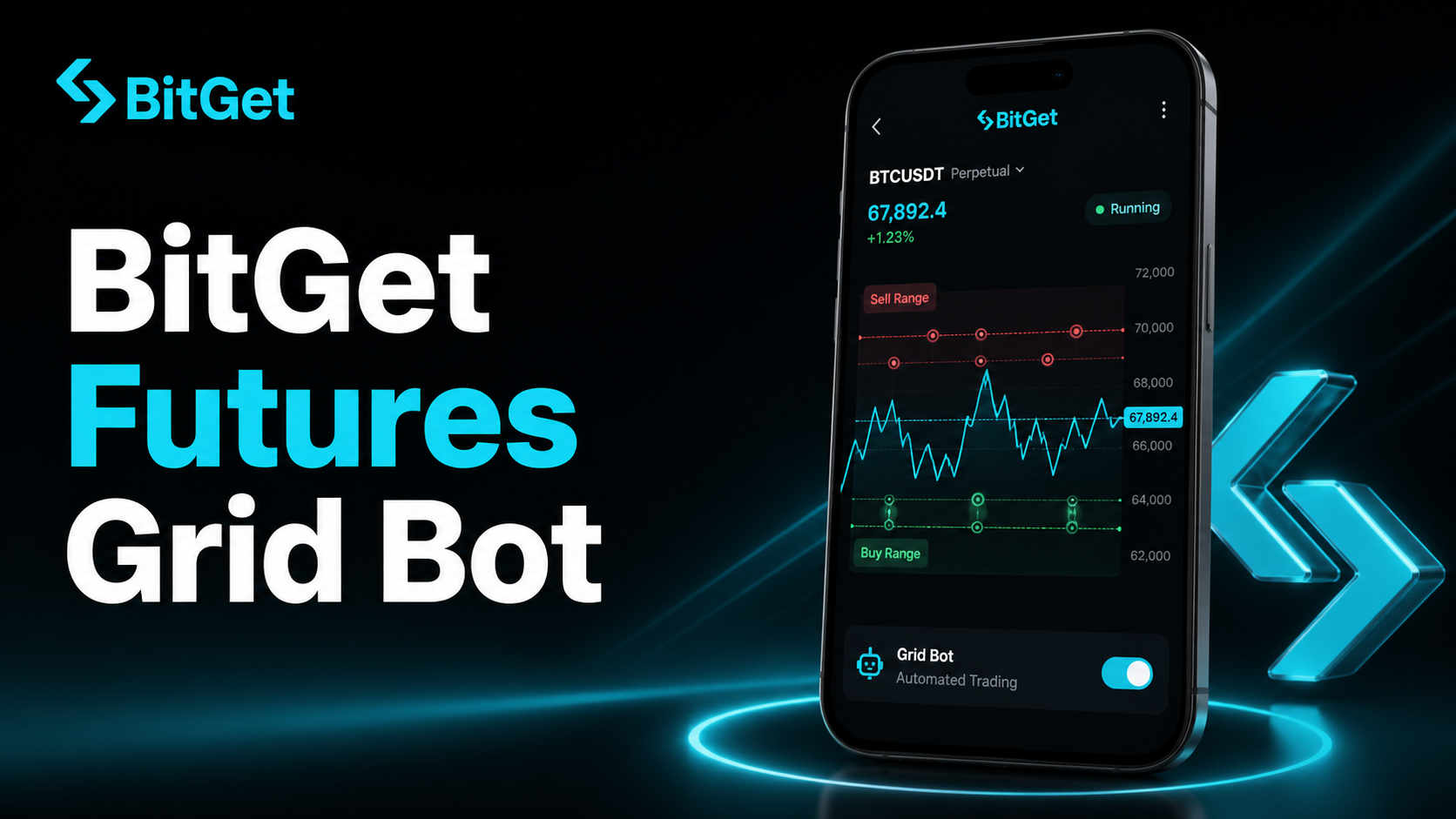
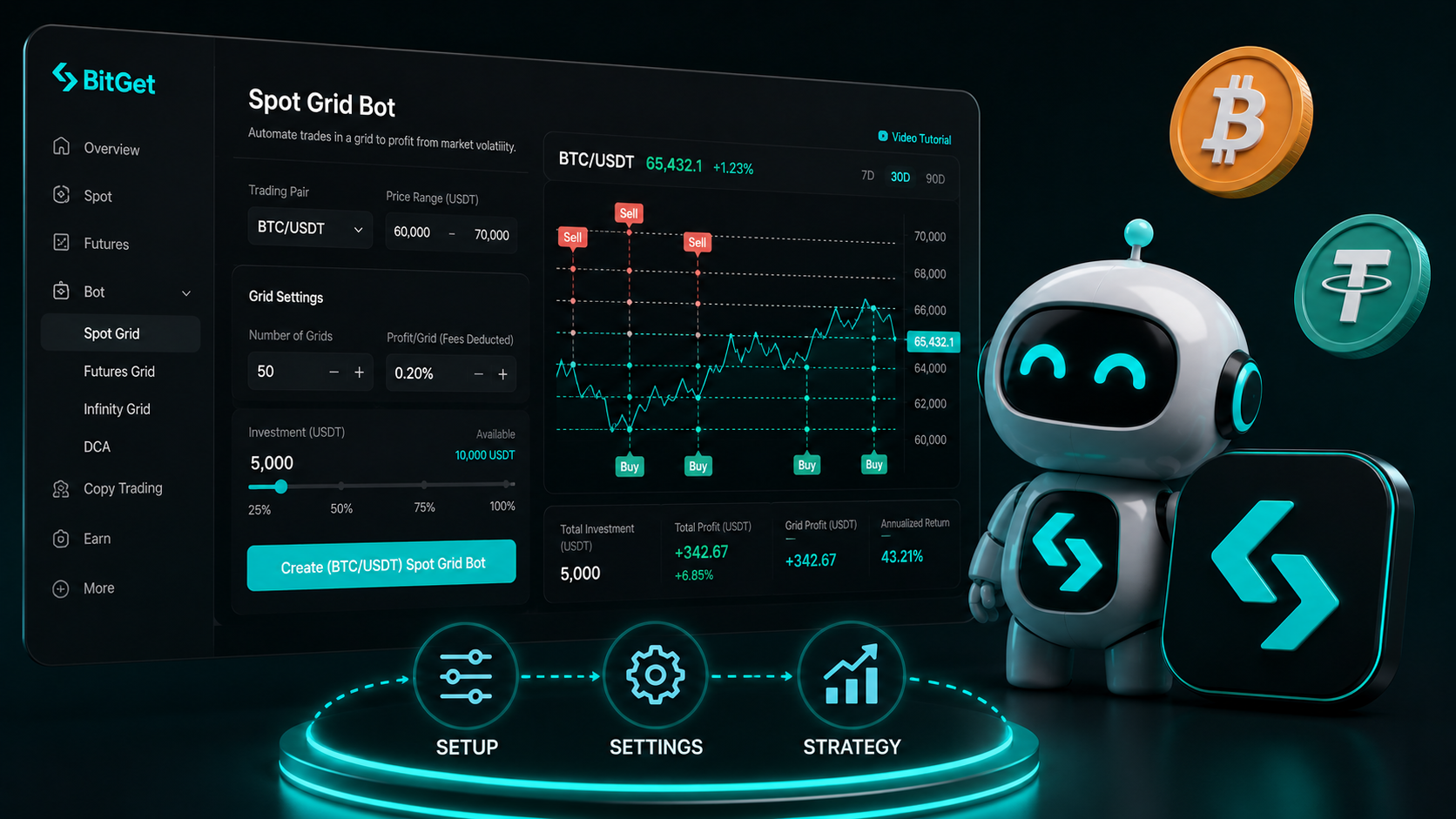
A grid bot places a series of buy and sell orders at regular price intervals inside a range. As the price oscillates inside that range, it sells higher and buys lower, capturing the spread on each cycle.
Works best in: sideways, choppy markets.
Breaks in: strong directional trends out of the range.
This is the bot I actually run. More on the setup below and in the BitGet spot grid bot deep dive.
DCA bots
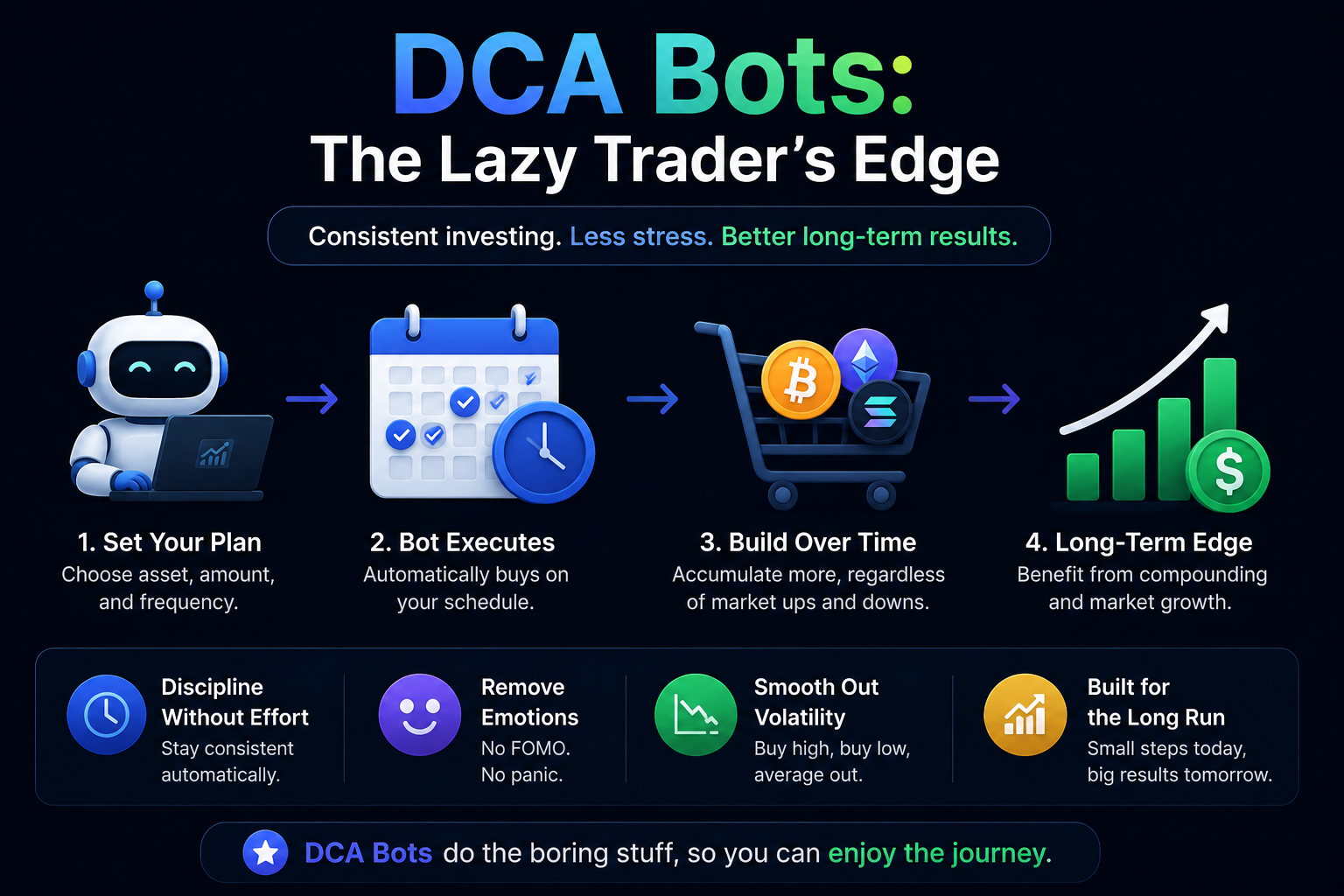
A DCA (dollar-cost-averaging) bot buys a fixed amount of an asset on a fixed schedule, regardless of price. It’s the lazy trader’s edge.
Works best in: any asset you have multi-year conviction on.
Breaks in: assets that go to zero (so pick wisely).
DCA isn’t sexy. It works.
Trend-following bots
Trend bots use technical signals (moving averages, Donchian channels, RSI thresholds) to enter when a trend appears and exit when it reverses. They aim to catch the middle of moves, accepting that they’ll miss the top and bottom.
Works best in: strong, persistent trends (post-halving bull runs, major selloffs).
Breaks in: choppy, range-bound markets — they get whipsawed.
Martingale bots
A Martingale bot doubles the position size every time a trade goes against it, betting on mean reversion. Mathematically, this works until you run out of capital or hit a limit. In a sustained trend, you do both.
Works best in: nothing, really.
Breaks in: any market that trends for longer than your bankroll. Every bull run. Every collapse.
I do not run a Martingale bot. I tell people not to. If it sounds like a free money strategy when explained, that’s because the explainer hasn’t talked about the catastrophic loss case.
Arbitrage bots
Arbitrage bots exploit price differences between exchanges, between trading pairs (triangular arbitrage), or between spot and futures (funding rate arbitrage). They’re the most technical of the lot and the spreads have compressed dramatically as crypto has matured.
Works best in: niche pairs, new listings, illiquid windows.
Breaks in: well-arbitraged majors where the spread is smaller than fees.
For most retail traders, the operational complexity isn’t worth the marginal returns. The pros who do it run colocated servers and they’re not telling you their setup.
AI bots
Most “AI trading bots” sold to retail are not AI in any meaningful sense. They’re a mix of technical indicators run through a neural net or random forest. Marketing dresses it up. The strategy underneath is usually some flavour of trend or mean reversion.
Some legitimate hedge funds do use ML on order book data and macro signals. Those funds do not sell their bots to retail.
If a bot is described as “AI” with a fixed monthly return promise — walk away. If it’s described as “AI” with no clarity on what it does, the answer is whatever the marketing department needed to write to get a click.
Copy bots (bot copy trading)
A newer category. Bot operators publish their strategies on a marketplace; subscribers run the same bot with a profit share (typically 10–30%) paid to the operator. The strategy is fixed, transparent, and tied to the operator’s reputation.
Works best in: people who want bot exposure without learning the strategies themselves.
Breaks when: the operator changes the strategy or stops maintaining it.
The BitGet bot copy trading product is the most active marketplace I’ve seen. Different from human copy trading because the strategy is fixed code, not a discretionary trader.
How do grid bots actually work? (And when should I use one?)
The grid bot is the workhorse of crypto trading. If you only ever run one bot, this is probably it.
The mechanics
You define three things:
- Upper price — the top of your range.
- Lower price — the bottom of your range.
- Grid count — how many price levels between the two.
The bot divides the range into the grid count and places a sell order at each level above the current price, and a buy order at each level below.
As the price oscillates inside the range:
- Price goes down → triggers a buy at the lower grid.
- Price comes back up → triggers a sell at the next grid up.
- Net effect: you bought slightly lower than you sold. Difference = profit.
Repeat thousands of times. Each individual profit is small. Aggregated over months, it adds up.
A real-world example
Say BTC is at $80,000. You set a grid:
- Upper price: $90,000
- Lower price: $70,000
- Grid count: 40
That gives you a $500 spacing between grids. If BTC drops to $79,500, the bot buys a small amount. If BTC bounces to $80,000, the bot sells that same amount and pockets the difference (minus fees). It’s doing this at every grid line in both directions, constantly.
Over six months of BTC chopping between $70k and $90k, the bot will execute hundreds or thousands of these little cycles. The compounding effect is what makes the strategy work.
When grid bots win
- Sideways, range-bound markets (BTC after major moves often spends months in this state)
- Low-fee environments where small profits per trade aren’t eaten by trading costs
- Pairs with reliable volume so orders fill quickly
When grid bots lose
- Strong directional trends where the price exits the range and stays out
- Low-volume pairs where orders sit unfilled
- Setups with too tight a range (price exits quickly) or too narrow a grid count (not enough cycles)
My settings on BTC/USDT
For the BTC/USDT spot bot I run, the settings I’ve landed on after a year of testing:
- Range: roughly ±15% from the current price, adjusted every 30 days
- Grid count: 40–60
- Allocation: 5–10% of trading float
- Stop loss: if price closes below the lower band on the daily timeframe, the bot exits and I redeploy after the next consolidation
The detailed walkthrough is in the BitGet BTC/USDT spot bot post. You don’t need my exact numbers — you need a sensible range and a stop-loss rule.
DCA bots: the lazy trader’s edge
The DCA bot is the simplest bot you’ll ever run, and it might be the best one for most people.
What it does
It buys a fixed amount of a chosen asset on a fixed schedule. $100 of BTC every Monday at 9am. $50 of ETH every Friday after work. $25 of SOL every other Tuesday. Whatever.
That’s it. It doesn’t look at price. It doesn’t look at volume. It buys.
Why it works
It removes the single biggest psychological mistake retail traders make: trying to time the market.
You don’t buy the top because you’re terrified. You don’t sell the bottom because you’re panicked. You just keep buying small amounts on a schedule, and over a long enough time horizon in an asset that appreciates, you accumulate a position at a respectable average price.
Historically, DCA into BTC over any 4-year window has produced positive returns. Even windows that included the 2018 and 2022 collapses.
When DCA wins
- Long time horizons (3+ years)
- Assets with secular growth (BTC, ETH, the index of top 10 by market cap)
- Disciplined execution — no skipping the buy on red days “because it might go lower”
When DCA loses
- Short time horizons (less than 18 months in volatile assets)
- Assets that go to zero (most altcoins, eventually)
- Skipping the buys when the market is scary (which is exactly when DCA produces its best entries)
How to actually set it up
Most exchanges, including BitGet, have native DCA bots in the Earn or Trading Bot section. Set the asset, set the amount, set the schedule. Fund the account. Walk away.
The advanced version is to combine DCA with a value-averaging tilt — buy slightly more when price is below a moving average, slightly less when above. Diminishing returns versus the simple version, and easier to overthink than to execute.
If you’re new to buying crypto in the first place, how to buy crypto is the starting point.
Why do Martingale bots blow up?
Because the maths is a trap that pays you small amounts until it doesn’t.
The mechanic
A Martingale bot enters a trade. If the trade goes against it by X%, it doubles the position. If it goes against it again, it doubles again. And again. The theory is that eventually the price mean-reverts, and when it does, the doubled-up position closes at a profit large enough to wipe out all the previous losses.
This works on paper because in any range-bound market, the price does eventually mean-revert. The bot keeps printing small profits and looks like magic.
The catastrophic case
Now imagine the trade goes against it for ten consecutive moves. Position size doubled ten times is the position size multiplied by 1024. If the bot started with $100 and doubled ten times, you’d now need $100,000 to keep doubling. You don’t have it. Margin call. Liquidation. Account wiped.
It doesn’t take ten doublings. In leveraged Martingale setups, it takes four or five to wipe an account in a strong directional move. SOL during the November 2022 collapse. LUNA during the May 2022 collapse. Pick your fire.
The honest version
A Martingale bot is selling you small consistent profits in exchange for a low-probability, total-loss event. The expected value over a long horizon is approximately zero — minus fees. Every Martingale system in any market (Vegas, forex, crypto) has been mathematically demonstrated to be a losing strategy in expectation.
It works until it doesn’t. It always doesn’t, eventually.
I watched a friend lose four months of trading profit in one weekend running a Martingale bot on SOL during a sustained downtrend. The screenshot trail of green that preceded it didn’t help him on the Monday.
If you want the longer breakdown of why, the BitGet Martingale bot section of the main review covers it. The product exists on BitGet because demand exists. Demand exists because people don’t understand the maths.
What is bot copy trading?
A newer category, worth its own section because it’s growing fast and the model is meaningfully different from human copy trading.
How it works
A bot operator builds a strategy — typically a grid, DCA, or trend-following setup with their own twist. They publish it to a marketplace on the exchange. You subscribe. The same bot now runs on your account with your funds, executing the same trades.
The operator gets a profit share — usually 10–30% — paid only when the bot is in profit. If it loses, you pay nothing on that period.
Why it’s different from human copy trading
Human copy traders are discretionary — they make decisions in real time, change their style, take losses badly, and sometimes blow up. Their performance is biographical: it’s a story about them.
Bot copy is mechanical. The strategy is fixed code. It does the same thing on Tuesday as on Friday, regardless of whether the operator’s having a bad week. The performance is mechanical: it’s a property of the strategy, not the person.
That makes bot copy easier to evaluate. You can look at the backtest. You can see the live performance over time. You can read the strategy description and decide if you agree with the logic.
The risks
- The operator may stop maintaining the bot. If markets change, the strategy that worked for two years can quietly become a losing one.
- The marketplace’s filters reward short-term performance, which biases the leaderboard toward strategies that just got lucky.
- Some operators publish over-fit backtests — strategies that look great historically because they were tuned to the historical data, but fail forward.
The defence is the same as for human copy trading: filter by live track record (not backtest), filter by max drawdown, filter by account age, and start with a small allocation.
BitGet copy trading covers the broader product. Bot copy is a subset that’s worth a look if you want strategy diversification without coding.
Where should I actually run my bots?
The platform you run a bot on matters as much as the bot itself. Fees, uptime, slippage, API reliability, and security all live at the platform layer.
The three options
Native exchange bots (BitGet, Binance, Bybit, OKX). The bot runs inside the exchange itself. Lowest fees. No third-party API to break. No external service to pay. You’re trusting the exchange not to mess with the bot, which is the same trust you already give them for spot and futures.
Third-party services (3Commas, Pionex-style aggregators). You connect the third party to your exchange via API keys. The third party places trades on your behalf. More strategies, more flexibility, sometimes a slicker UI. Adds a subscription cost (often $20–$60/month) and an additional point of failure (their service goes down, your bot stops).
DIY bots (Python scripts on a VPS). You write the strategy yourself, run it on a cloud server, connect to the exchange via API. Maximum flexibility, maximum responsibility. You’ll spend more time on infrastructure than on the strategy.
My take
For 90% of retail traders, native exchange bots are the right answer. Lower fees, fewer moving parts, no monthly subscription. The strategies available natively cover the realistic use cases — grid, DCA, trend, copy.
I run the BitGet bot suite because it covers what I need without a third-party stack. If you want a comparison of the main exchanges that offer native bots, the best crypto exchanges post breaks it down.
Comparison: BitGet vs 3Commas vs Pionex
| Feature | BitGet (native) | 3Commas | Pionex |
|---|---|---|---|
| Bot types | Grid, DCA, Martingale, AI, Copy | Grid, DCA, custom signal | Grid, DCA, Martingale, Arbitrage |
| Monthly cost | Free | $14–$60+ | Free |
| Exchange access | BitGet only | Multi-exchange | Pionex only |
| Native security | Same as exchange | Adds API key risk | Same as exchange |
| Bot copy marketplace | Yes (active) | Limited | No |
| Fees on bot trades | Standard BitGet spot/futures | Standard exchange + sub | Slightly higher than BitGet |
| Backtesting | Basic | More detailed | Basic |
3Commas is more flexible but adds a recurring cost and a third-party security layer. Pionex is a closed ecosystem — you can’t use the bots elsewhere. BitGet’s native suite covers the use cases most people need with no subscription and no external API trust.
Why I lean BitGet for bots
Three reasons:
One. Fees. Standard BitGet maker/taker rates apply to bot trades. No subscription on top.
Two. The bot copy marketplace is the most active I’ve seen. If you want exposure to strategies without building them, it’s a fast way in.
Three. No API key risk. Every third-party bot service requires you to issue API keys, which creates a permanent attack surface if the service is breached. Native bots remove that.
What’s the BTC/USDT bot I actually run?
The bot I keep coming back to is a BitGet spot grid on BTC/USDT. Boring. Predictable. Profitable.
The setup
- Pair: BTC/USDT
- Range: roughly ±15% from current price, reset every 30 days
- Grid count: 50
- Allocation: 5–10% of trading float
- Stop loss: if BTC closes below the lower band on the daily timeframe, the bot exits
The logic
BTC spends a meaningful portion of its time chopping inside a range, especially between major catalyst events (halvings, ETF flows, macro news). A grid bot inside that range captures the chop as profit, each cycle adding incrementally.
When BTC trends hard, the bot underperforms holding spot — I either exit early or accept that I’m capping my upside in exchange for steadier returns. That’s the trade.
Real numbers
Over the last full 12 months I tracked, the bot returned a net positive in the high single digits as a percentage of allocated capital, after fees. That’s not a moonshot. It’s consistent, low-effort yield on a portion of float that would otherwise sit idle.
The exact percentage shifts month to month, and there were two months where the bot returned slightly negative due to a brief breakout from the range. The full walkthrough with screenshots is in the BitGet BTC/USDT spot bot post.
Try the BTC/USDT spot bot → (affiliate)
Run the bot I run.
If you want the BTC/USDT spot bot I’ve been running on BitGet — same settings, same logic — it’s live on the marketplace. Subscribe, deploy, done.
Affiliate link. I may earn a commission at no extra cost to you.
How do I backtest a trading bot?
Backtesting is running the bot’s rules against historical price data to see how it would have performed. It is essential. It is also misleading. Both things are true at once.
The basics
Most native bot platforms include a basic backtester. You set the bot parameters, pick a date range, and the platform shows you the simulated PnL. The output usually includes:
- Total return
- Maximum drawdown
- Win rate
- Number of trades
- Sharpe ratio (sometimes)
That gives you a first-pass sanity check. If a strategy can’t make money against the last six months of data, it’s probably not going to make money next month either.
Where backtests lie
- Overfitting. If you tune the parameters to maximise historical returns, you’ve optimised for the past, not the future. A grid bot that returned 40% in backtest at a specific range and grid count probably won’t replicate forward.
- Survivorship bias. Backtests run on assets that still exist. The assets that went to zero don’t appear. Real markets include both.
- Slippage and fees. Many backtests assume instant fills at the displayed price. Real fills include slippage, partial fills, and fee drag. Always add a fee assumption higher than the actual rate to be conservative.
- Regime shifts. A bot that worked in 2021’s bull run can fail in 2022’s collapse. Backtest across multiple market conditions.
The honest workflow
- Backtest across at least 12 months, including a bull, a bear, and a chop period if possible.
- Walk-forward test — backtest on the first 9 months, then check performance on the next 3, simulating live deployment.
- Paper trade the bot live for 2–4 weeks before committing real capital.
- Start with a small allocation when you go live. Don’t deploy 50% of your float on day one.
If the bot survives all four stages and you still believe in the strategy, then scale up. Most strategies don’t make it past stage 3.
How do I do risk management with bots?
This is the section that separates traders who survive from traders who blow up.
Position sizing
The single most important rule: never allocate to a bot what you can’t afford to lose.
For grid bots, the realistic worst case is “price exits the range and stays out” — meaning you’re holding 100% of the asset at the bottom of your range with no exit. Size the allocation so that even that worst case is recoverable.
A reasonable rule for retail: no single bot gets more than 10% of trading float. No single strategy across multiple bots gets more than 25%.
Stop losses
Every bot needs a stop. Even grid bots, especially grid bots.
The stop can be:
- Price-based: “If BTC closes below $X on the daily, exit the bot.”
- Drawdown-based: “If the bot’s unrealised loss exceeds 8% of allocation, exit.”
- Time-based: “If the bot hasn’t closed a profitable cycle in 14 days, review and possibly exit.”
Pick one. Encode it. Stick to it.
Range limits
For grid bots specifically, the range you set is itself a risk management tool. Too wide, and the bot rarely triggers. Too narrow, and the price exits the range immediately.
A sensible rule: set the range to roughly ±10–20% from current price, based on the asset’s typical range. Review and reset every 30 days.
Asset selection
Bots amplify whatever is happening on the underlying asset. A grid bot on a stable, blue-chip asset like BTC behaves predictably. A grid bot on a memecoin that pumps 200% then dumps 95% will destroy you, no matter how well the bot is configured.
Stick to majors for bots until you’ve earned the right to do otherwise. BTC, ETH, and a handful of top-10 alts are the realistic universe for retail bot trading. Anything outside that is a leveraged bet on the underlying, dressed as a bot strategy.
Drawdown discipline
The hardest rule. When the bot is down 5%, don’t increase the allocation to “average down” the bot itself. That’s Martingale logic applied to your strategy choice, and it ends the same way.
When a bot loses, the question is: was this within expected drawdown for the strategy, or is the strategy broken? If it’s broken, you exit. If it’s expected, you wait. Don’t double the bet.
What are the tax implications of running bots?
Your accountant will thank me for this section.
A trading bot generates a lot of taxable events. In most jurisdictions, every buy and sell is a disposal. A bot doing thousands of cycles a month produces thousands of taxable events.
The maths is the same as for manual trades — capital gain (or loss) on the difference between buy and sell price, denominated in your local fiat. The volume is the problem.
How to handle it
- Export the trade history regularly. Most exchanges, including BitGet, let you export full CSV trade history. Do it monthly.
- Use a crypto tax tool. Koinly, CoinTracker, CoinLedger, Accointing — pick one. They handle bulk import of bot trades and calculate gains automatically. Trying to log thousands of trades manually is a path to madness.
- Watch out for wash sale rules where they exist (US has these; UK has the 30-day rule). Some jurisdictions disallow loss claims if you re-buy within a window. Grid bots constantly trigger this.
- Funding payments on futures count as income in most jurisdictions. If your bot trades futures, this is a separate line item.
- Staking and earn rewards count as income at the value they were credited at.
A rough rule
If you’re running bots seriously, budget 10–15% of profits for accounting overhead in the first year — software, possibly an hour of accountant time, and the time you spend reviewing the output. It’s worth the cost. Tax mistakes on bot volume can add up fast.
If you live somewhere with no crypto tax (UAE historically, parts of Southeast Asia), check current rules — they’ve been shifting. Where I am, every cycle reports. I budget for tax as I go.
When should I turn a bot off?
A question that doesn’t get asked enough.
Turn it off when:
- The market regime has changed. Your grid bot was tuned for chop; the market started trending strongly. Exit, don’t ride it down.
- Your stop loss triggered. The whole point of setting the stop was to remove the decision in the moment.
- You don’t understand what the bot is doing anymore. Maybe you tweaked the settings six times. Maybe the strategy author updated the bot. If you can’t explain it, you can’t run it.
- The expected return no longer justifies the risk. Fees changed. The market matured. The edge eroded. Bots have lifespans.
- Your total exposure is too high. If multiple bots have grown to dominate your float, scale down.
Don’t turn it off when:
- It’s just drawn down a small amount within expected range. Bots have drawdowns. That’s not a signal.
- A loud Twitter account told you to. Outside noise is not a strategy input.
- You’re bored. Bots are supposed to be boring. That’s why they work.
How do I get started with bots if I’m new?
The shortest realistic path:
- Open an account on a low-fee exchange with native bots. I use BitGet — sign-up takes 90 seconds, KYC clears the same day.
- Fund a small starting amount. $200–$500 is enough to learn. Don’t deposit your savings to “test”.
- Start with a DCA bot on BTC or ETH. Set $50/week. Watch it for a month. Get used to seeing trades execute automatically.
- Add a small grid bot on BTC/USDT once you understand how the order placement works. Use the smallest allocation the platform allows.
- Track everything. Spreadsheet, app, whatever. Note what worked, what didn’t, what surprised you.
- After 3–6 months of small-scale running, consider scaling up the strategies that actually performed.
That’s the playbook. No shortcuts. No “AI bot” subscription. No 50x leverage. Just steady learning at small size until you can answer “why is this bot making or losing money right now” without guessing.
If you also want a longer-term passive income angle, how to earn passive income in crypto covers staking, Earn products, and other strategies that complement bots.
Ready to deploy?
The BTC/USDT spot bot I run is live on the BitGet bot marketplace. Same settings I use. Two-click deployment.
Affiliate link.
Or sign up to BitGet first → (affiliate)
Frequently asked questions
Can crypto trading bots make me rich?
No. They can make you steady incremental returns on the right asset in the right market. Anyone selling “get rich quick” with a bot is selling a story, not a strategy. Realistic bot returns for a retail trader are mid-single-digit to low-double-digit percentages annually over time.
Which crypto trading bot is best for beginners?
A DCA bot on BTC or ETH on a major exchange. It’s the simplest bot to understand, the hardest to mess up, and works over multi-year horizons. Set a small weekly amount, fund the account, and let it run.
Are crypto trading bots legal?
Yes, in most jurisdictions. Running a bot on your own account is treated the same as manual trading — your gains are taxable, your losses are claimable (where rules allow), and there’s no licence requirement. Running a bot service that takes other people’s money to trade may require licensing — that’s a different question.
Do I need to know how to code to run a trading bot?
No. Native exchange bots on BitGet, Binance, Bybit, and others give you a UI to configure the bot — no coding required. Coding is only needed if you want to write a custom strategy from scratch.
How much money do I need to start?
Most native bots have minimums under $50. A realistic starting allocation for learning is $200–$500 — enough to see real trades, small enough that mistakes are tuition, not catastrophe.
Can a trading bot run while I sleep?
Yes — that’s the main reason to use one. Bots run 24/7 on the exchange’s servers, executing trades according to the rules you set, regardless of whether you’re online.
What’s the difference between a trading bot and copy trading?
A trading bot follows a fixed rule set you (or someone else) defined. Copy trading mirrors the live decisions of another trader, who is making discretionary choices in real time. Bots are mechanical; copy trading is biographical.
How do trading bots handle market crashes?
It depends on the bot. A grid bot inside its range continues to operate; a grid bot outside its range stops adding profit and holds inventory. A DCA bot keeps buying through the crash, often picking up the best entries. A Martingale bot tries to average down and frequently blows up. Trend-following bots ideally short or exit. Always know the answer to “what does this bot do in a 30% crash” before deploying it.
Final word
Bots are a tool. Not a strategy, not a guarantee, not a substitute for understanding what you’re doing.
The bots that work are boring. Grid bots in a range. DCA bots on solid assets. Copy bots from operators with a real track record. The bots that look exciting are usually the ones that blow up.
If I were starting again today, this is the order I’d do it in:
- Open a BitGet account, complete KYC.
- Run a DCA bot on BTC for 60 days. Get comfortable seeing automated trades.
- Layer on a small grid bot, range ±15% from current price. Allocate 5% of float.
- Track outcomes monthly. Adjust the grid quarterly.
- Only after 6 months of steady running, consider scaling up or adding bot copy strategies.
That’s the actual playbook. The rest is noise.
Right — over to you.
Related posts
- BitGet BTC/USDT Spot Bot: My Settings
- BitGet Spot Grid Bot: Setup and Strategy
- BitGet Copy Trading: How It Works
- BitGet Review: The Crypto Exchange I Actually Use
- Best Crypto Exchanges Tested and Ranked
External references
- CoinGecko — Bitcoin historical price data
- BitGet — Trading bot product documentation
- Investopedia — Dollar-cost averaging explained