The first time I saw a “passive income” offer in crypto it was a 480% APY pool on a chain I’d never heard of. The second time it was a 22% USDT savings rate that quietly disappeared three months later. The third time it was a friend telling me he’d lost a year of profits to a “set and forget” bot that wasn’t set and definitely didn’t forget.
Passive income in crypto is real. It is also where most beginners give back the gains they made trading. This is the long version of what I actually run, what I avoid, and how to tell the difference. Some of the links below are affiliate or referral. I flag them as they appear.
Short answer: Realistic passive income in crypto comes from a stack of small, boring yields — staking majors (3–7%), lending stablecoins on a tier-1 exchange (2–8%), running a spot grid bot in a sideways market, copy trading a vetted operator, and pulling small income from mining-as-a-service or DePIN devices. Aim for 5–12% blended. If anyone offers you 30%+ on stables, walk away.
Open a BitGet account → (referral link) — it’s where my staking, savings and bots all live.
Key takeaways
- Realistic blended passive crypto yield is 5–12% per year. Anything above 20% on stables is a red flag.
- Stake majors (ETH, SOL, ATOM, DOT) through an exchange or self-custody — 3–7% APY with low admin.
- Spot grid bots earn in sideways markets and lose in trends. Pick the asset and range carefully.
- Mining and DePIN can pay daily, but the hardware (or rented hash) needs to outlast the bear.
- Tax is the silent killer of “passive” income — every reward and every bot trade is a taxable event in most jurisdictions.
What “passive income in crypto” actually means
Let me kill the bad version first. Passive income in crypto is not “deposit money, do nothing, get rich”. If anyone is selling you that, they’re either lying or about to.
The honest version: passive income in crypto is a set of yields you earn for either putting up capital, securing a network, or providing some other resource (compute, bandwidth, hash rate). You earn while you’re not actively trading. The “passive” part means low day-to-day admin — not zero work and not zero risk.
The yields that compound for years come from boring sources. Staking the chains that survive every cycle. Lending stablecoins to traders who pay funding. Running well-set bots inside ranges they can handle. Mining at a cost basis below the BTC price.
The yields that look incredible in month one and zero out by month nine come from leveraged loops, new chain incentives that get cut, and yield farms paying you in tokens that drop 90% before you can unstake.
Pick the first list. Ignore the second. The rest of this post is how.
The mental model I use
Before every passive income decision I ask three questions.
- Where is the yield coming from? Network rewards, borrower fees, trading fees, block rewards, ad revenue, customer subscriptions. If I can’t name the source in one sentence, I don’t deploy.
- What’s the worst-case capital outcome? Full loss? Partial loss? Locked for 90 days? If the answer is “I don’t know”, I don’t deploy.
- What does it cost me in tax and time? A 12% APY that triggers a taxable event every block reward isn’t a 12% APY net. A 6% yield that ticks once a month often beats it.
If a product passes all three, it joins the stack. If it fails one, it doesn’t.
The biggest mistake people make (chasing APY)
The single biggest mistake I see is people sorting products by APY descending and clicking the top one.
The yields at the top of every leaderboard are the ones with the highest risk of going to zero. New chain incentives, leveraged farms, “boost” campaigns with a two-week window, structured products with hidden downside, and lending platforms running on undisclosed counterparty risk. The yields at the top of the leaderboard are exactly the ones that wiped people out in 2022 — Celsius at 17%, BlockFi at 8%, Anchor on UST at 19.5%.
The 20% USDT pool that hit the top of every aggregator in 2021 was UST. It zeroed. The 17% APY savings product that had its own glossy app was Celsius. It zeroed. The “risk-free” 10% lending on the most-Googled platform was BlockFi. It zeroed.
Real yield on stables is somewhere between the US Treasury rate and 3% above it, in normal markets. That’s roughly 2–8% in 2026. If you see double that on USDT or USDC, the risk is hidden somewhere in the product — you just can’t see it yet.
I sort passive income products by source of yield first and APY last. If the source is “network consensus” or “trading fees from borrowers”, I read the small print. If the source is “incentive tokens we’re emitting”, I leave the tab.
Staking explained — realistic returns
Staking is the simplest passive income in crypto and the one most beginners should start with.
The short version: proof-of-stake networks pay you to lock tokens that help secure consensus. The chain pays in its own token. You earn while your stake is active.
Realistic APYs as I write this:
| Chain | Token | Typical APY | Lock-up | How |
|---|---|---|---|---|
| Ethereum | ETH | 3.0–3.5% | None (liquid staking) | On-exchange or via Lido/Rocket Pool |
| Solana | SOL | 6.5–7.0% | ~2-day unstake | On-exchange or native wallet |
| Cosmos | ATOM | 14–16% (high inflation) | 21-day unbond | Keplr wallet, native |
| Polkadot | DOT | 10–13% | 28-day unbond | Polkadot.js, native |
| Cardano | ADA | 2.5–3.0% | None | Yoroi/Daedalus, native |
| Avalanche | AVAX | 6–7% | 14-day lock | Core wallet, native |
The high APYs on ATOM and DOT look juicy. Remember those chains have higher token inflation — so a chunk of that APY is just the chain printing more supply. Real yield (APY minus inflation) is more honest. For ETH it’s roughly 1.5%, SOL it’s roughly 2%, ATOM it’s negative in some periods.
That’s not a reason to avoid staking. It’s a reason to understand what the number means.
Staking on an exchange vs self-custody
You can stake from an exchange account in two clicks. You can also stake from a self-custody wallet with about ten minutes of setup. The trade-off:
- Exchange staking is easy. The exchange takes a cut (typically 10–25% of rewards). You don’t have to handle validator selection, slashing risk, or unbonding periods. Your tokens sit in the exchange’s custody. If the exchange goes down, your stake is at risk.
- Self-custody staking keeps you in control of the keys. Slightly higher APY because no platform cut. You’re responsible for picking a validator, monitoring uptime, and handling lock-up periods.
For ETH and SOL I split mine — some on the exchange for liquidity (I might want to trade it), some self-custodied for the long-term bag. For ATOM and DOT, native every time, because the unbonding periods are so long that exchange custody doesn’t add convenience.
If you’ve never staked, BitGet’s on-chain staking is the easiest first step. Two clicks, no validator setup. Just understand you’re paying for that convenience in rewards.
What can go wrong
Slashing — a validator misbehaves or goes offline and a small slice of stake is destroyed. On most chains this is sub-1% in worst case, and exchange-staking platforms typically eat the loss themselves. Real risk for self-custody, minor risk on exchange.
Token price — your APY is in the staked token. If SOL drops 60% while you’re earning 7% APY, you’re down 53%. Stake what you’d hold anyway. Don’t stake to “earn yield” on a token you wouldn’t otherwise buy.
Lock-ups — ATOM, DOT, AVAX have unbonding windows. If a crash hits while you’re locked, you watch it happen. Size accordingly.
Lending and savings products (BitGet Earn and similar)
The second-simplest passive income source: lend your crypto and get paid interest. The interest comes from people borrowing — traders who want leverage, market makers, institutional desks.
On a tier-1 exchange the lending product looks like a savings account. Pick a token, pick flexible (withdraw any time) or fixed (locked for 7/30/60/90 days), see the APY, deposit.
Realistic rates on stables in 2026:
- Flexible USDT/USDC savings: 1–4% APY
- 30-day fixed USDT: 4–7%
- 90-day fixed: 6–10%
- Promo rates (new user, capped TVL): 8–15% — these end fast
Realistic rates on BTC and ETH savings: 0.5–2.5%. The reason is supply and demand — most BTC and ETH holders want to hold, not borrow, so there’s less rate pressure.
I keep my mid-term hold in flexible USDT savings. It’s the boring lever. 3% on a five-figure stack is rent money. I move it back to spot when I see a buy I want to take.
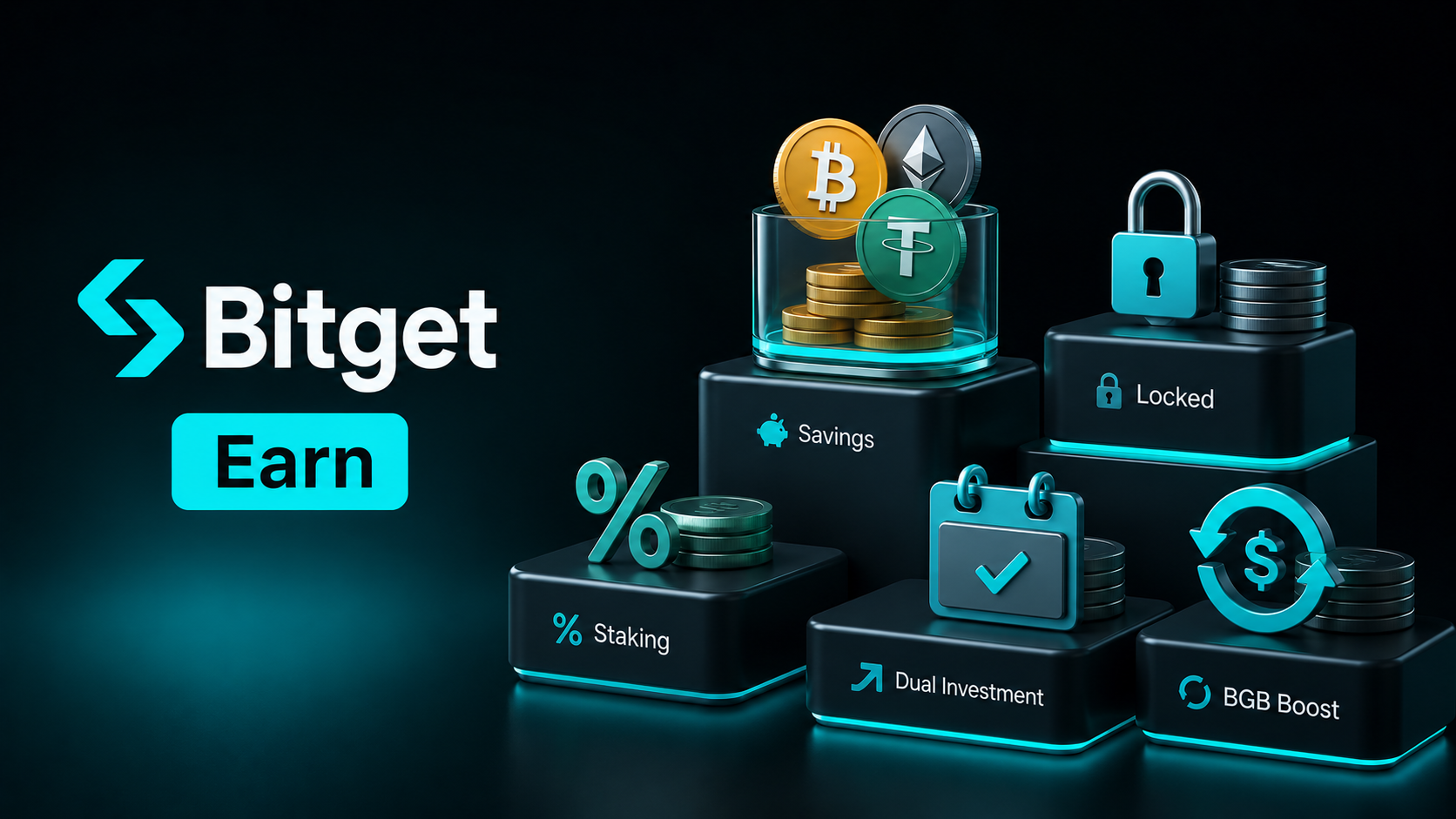
The full breakdown of every Earn product is in BitGet Earn products explained. Notable categories beyond plain savings:
- Launchpool — stake BGB or USDT for a short window, earn newly listed tokens. The token sometimes lands and rallies, sometimes lands and dumps. Free-ish income if you weren’t going to do anything else with the BGB.
- Dual Investment — a structured product that forces a buy or sell at a target price. Sounds high-yield. Is actually directional. Used well it auto-buys dips. Used badly it leaves you holding the wrong side.
- Shark Fin — capped-return structured product. Works in narrow ranges. Loses in trends.
Lending and savings products are how I think about the bulk of my non-trading capital. They’re not exciting. They keep working in any market.
Tier-1 exchange vs DeFi lending
The other lending option is DeFi — Aave, Compound, Spark, etc. On-chain, transparent, no custodian. The trade-off:
- DeFi lending has on-chain transparency. You can see the collateral. Rates are usually lower than CeFi for stables (1–4% on Aave), sometimes higher for niche tokens.
- CeFi lending is more convenient. Rates are sometimes higher. Counterparty risk is the platform itself.
Don’t mix the two in your head. DeFi yield needs a wallet, gas, smart contract risk, and confidence in protocol audits. CeFi yield needs trust in the exchange. Pick which risk you can live with.
Liquidity providing in DeFi (and impermanent loss)
This is where the wheels fall off for a lot of beginners. Let me explain it once.
Liquidity providing means depositing two tokens (usually paired like ETH/USDC) into a pool on a DEX. Traders swap through that pool and pay a fee — typically 0.05–1.0%. You earn a share of those fees pro-rata to your share of the pool.
The catch is impermanent loss. When the relative price of the two tokens moves, the pool automatically rebalances — selling the one going up and buying the one going down. If you withdraw after a big move, you have less in dollar terms than if you’d just held both tokens outside the pool.
A worked example. You put $1,000 of ETH and $1,000 of USDC into a 50/50 pool. ETH price doubles. You’d think your $1,000 of ETH is now $2,000, total pool $3,000. Wrong. The pool sold your ETH for USDC as the price climbed. Total is now about $2,828. You “lost” $172 vs holding — that’s the impermanent loss.
The fees can offset the impermanent loss. They sometimes don’t. The blunt rule:
- Stable/stable pools (USDC/USDT, USDC/DAI) — almost no impermanent loss. Yields are low (1–4%) but predictable.
- Stable/major pools (ETH/USDC, BTC/USDC) — meaningful IL when the major moves. Need high fee volume to offset.
- Major/major pools (ETH/BTC) — IL exists but is smaller because the two tokens correlate.
- Volatile/volatile pools (any random altcoin pair) — IL can wipe you out faster than the yield can pay.
I provide stable/stable liquidity occasionally. I don’t touch the rest. The yields aren’t worth the headache for the size I’d put in.
If you want to try LP’ing, do it with a small amount you’d accept losing entirely, on a major DEX (Uniswap, Curve), in a stable/stable or stable/major pool. Read the protocol’s docs and understand which fee tier you’re entering. Track your position weekly. If the maths is hurting your head, you’re not ready yet.
Yield farming — why most fail
Yield farming is liquidity providing plus extra incentive tokens. The DEX pays you in its own governance token on top of the trading fees. Headline APYs look enormous (50–500% wasn’t unusual in 2021).
The reason most yield farmers lose money over a full cycle isn’t the smart contract risk (though that’s real). It’s three other things stacked together:
Reward token dump. The token you earn as the yield is sold by farmers the moment it lands. You’re earning a token whose price is being suppressed by your own selling. Six months in, the headline 200% APY is paid in a token that’s down 90%, and your actual realised yield is single digits.
Impermanent loss compounds. The pool you’re providing into has volatile tokens. The longer you stay, the more IL you accumulate. The longer you stay, the worse the reward token does. You’re squeezed from both sides.
Gas and tax friction. Each “harvest” of rewards is a transaction. Each harvest is a taxable event in most jurisdictions. Each harvest costs gas. After fees and tax, a 200% headline yield is often 30% net at best, and that’s the lucky scenario.
The farms that work over multiple years are run by people who actively manage them — rotating between protocols, harvesting selectively, hedging the reward token. They make it look passive. It is not. I treat yield farming as active trading dressed up. I avoid it as a passive strategy.
If you want exposure to DeFi yield without farming, look at lending markets (Aave, Compound) and stable LP positions. Lower headline numbers. Higher chance of being net positive a year in.
Mining without buying hardware (the GoMining approach)
I’m not going to set up a mining rig in my garage. Most readers aren’t either. The electricity costs in the UK alone make home Bitcoin mining a loss-making activity outside niche cases.
The middle ground is cloud mining and mining-as-a-service products. You don’t own the hardware. You own a share of the hash rate, and the operator runs the machines somewhere with cheap energy. The product credits you BTC daily for your share.
The version I’ve used is GoMining (affiliate link). Here’s the honest take from running a small position:
- The yield is paid in BTC, daily, to a wallet you control or to your account on the platform.
- The “hash power” is tokenised as an NFT, so you can sell your position on the secondary market if you want out.
- The break-even depends on the BTC price, network difficulty, and the operator’s electricity cost. In a bull cycle, payback is fast. In a bear cycle, it stretches.
- The single biggest variable is electricity cost. Operators that own their power (or lock in long-term PPAs) can stay profitable when difficulty rises. Operators paying market rates get squeezed.
The thing to understand: cloud mining is BTC accumulation with a higher payback profile than just buying BTC outright at the cycle high. It is not BTC accumulation cheaper than the spot price across all market conditions. If BTC drops and difficulty rises, your payback window extends. The full breakdown is in the GoMining review.
Two general rules for any cloud mining product:
- Only deploy what you’d spend on BTC anyway. Mining is a slow accumulation strategy. If BTC moons, you’d have been better off just buying spot. If BTC chops sideways for two years, mining accumulates and spot doesn’t. The expected value across a full cycle is roughly even — the variance is the trade-off.
- Pick operators with disclosed energy costs and on-chain reporting. If the operator can’t tell you what they pay per kWh, the product is opaque. If the operator doesn’t publish hash rate verifiable on-chain, the product is more opaque.
Mining is a small slice of my passive stack — single-digit percent. It does its job: it accumulates BTC without me touching the buy button.
DePIN — earning crypto from devices and bandwidth
DePIN stands for Decentralised Physical Infrastructure Networks. The idea: a network needs a physical resource (bandwidth, compute, sensors, storage), and instead of building it centrally, the protocol pays small operators in tokens for contributing.
The flagship examples by 2026:
- Helium — pays operators for running a wireless hotspot covering a small radius
- Filecoin — pays operators for storing files
- Akash — pays operators for compute capacity
- Render — pays GPU operators for rendering jobs
- Grass — pays you a token for sharing your unused internet bandwidth
Grass (referral link) is the easiest DePIN to start with because the resource is literally idle bandwidth on a laptop you already own. Install the extension or the desktop app. It sells your unused bandwidth to AI training companies and pays you in the GRASS token.
The income from Grass on a single laptop is small — single-digit dollars per month at typical rates. It scales with multiple devices and longer uptime. Some people run it across a small fleet of cheap mini-PCs.
The economics for any DePIN product depend on:
- Token price — your yield is in the network’s token. If the token tanks, your income shrinks even if your hardware contribution doesn’t change.
- Network rewards schedule — most DePIN tokens have an emissions schedule that decreases over time. Early operators earn more per unit than later ones.
- Demand for the resource — Grass needs AI companies buying bandwidth. Helium needs people roaming. Filecoin needs storage demand. If demand dries up, the token softens and rewards compress.
I treat DePIN as found money rather than primary yield. If a laptop’s running anyway, sticking Grass on it costs nothing. If I had to buy hardware specifically to earn DePIN tokens, the maths gets shakier.
Two things to avoid:
- Buying expensive specialised hardware for one DePIN project. The hardware obsolesces, the project might fade, the token might not.
- Mistaking high “expected token rewards” for income. The expected token rewards are paid at the future token price, not today’s. Discount accordingly.
For a beginner who wants to dip into passive income with zero upfront cost, Grass on a laptop you already own is the lowest-effort entry point in crypto. It’s not life-changing money. It’s the equivalent of finding a few quid down the back of the sofa each month.
Trading bots as passive income
Trading bots are the in-between option — more passive than active trading, less passive than staking. They run themselves once set, but they need monitoring and the occasional reset.
The bot I run is a BitGet BTC/USDT spot grid bot. The mechanics are simple: you set a price range (say BTC between $58,000 and $72,000), divide it into a grid of buy and sell levels, and the bot buys at the lower levels and sells at the upper ones automatically as the price oscillates inside the range.
What the spot grid bot is good at:
- Sideways markets. If BTC ranges between two levels for weeks, the bot collects multiple small profits per day.
- BTC and major pairs. Liquidity is deep, spreads are tight, the bot fills cleanly.
- Set-and-monitor passive income. Once you’ve tuned the range, it takes minutes a week to check on.
What it’s bad at:
- Strong directional trends. If BTC rips through your upper range, all your stack is in USDT and the bot stops buying. If it crashes through the lower range, you’re stuck with a stack of BTC bought at higher prices.
- New tokens and volatile alts. The grid blows up if the price gaps outside the range overnight.
- Unattended for months. Markets shift. The range that worked in May won’t work in November. Tune it at least once a quarter.
Realistic returns from a well-set spot grid bot on BTC/USDT in a range-bound market: 1–4% per month, before tax. Across a year that’s 12–50% but the year averages out around 8–20% because markets aren’t sideways forever. Some months are positive, some are flat, the bad months are when the price exits your range.
Full guide in crypto trading bots — what actually works.
The other native bot options worth knowing:
- DCA bot — buys a fixed amount at fixed intervals. Less profitable than grid in chop. More resilient in trends. Real “set and forget” for accumulation.
- Futures grid — same idea on perpetuals. Higher returns potential, can lose more than your initial capital because of leverage. Not for beginners.
- Martingale — avoid. Doubles down on losses. Wipes accounts in trending markets.
The bot I’d start with as a complete beginner is a DCA bot on BTC. The bot I’d add second is a spot grid on BTC/USDT in a tight range with a small allocation. Everything else, learn first, deploy later.
Copy trading as passive income
The most passive of the active strategies. You pick a trader on a leaderboard, you allocate capital to copy them, the platform mirrors their trades into your account proportionally.
BitGet has the largest copy trading network in crypto by AUM and trader count. BitGet copy trading covers the full setup. The short version of how to actually pick:
- Sort by max drawdown, not ROI. The leaderboard rewards traders who hit a lucky streak. The traders worth copying are the ones whose worst loss is small. I filter for max drawdown under 30%.
- Filter for account age over 12 months. A 60-day track record tells you nothing. A 12-month track record tells you they’ve survived at least one bad week.
- Look at win rate AND average win/loss size. A 90% win rate sounds great until you find out the 10% losses are 5x the average wins. Net profit is what matters.
- Start with a small allocation. Copy 1% of your portfolio for three months. See how it actually trades. Then scale or stop.
The honest expectation: most copy traders aren’t worth following. Of the dozen I tested over six months, three were consistently profitable, and one of those got cocky and blew up in month seven. Selection is harder than the leaderboard suggests.
The new variant — Bot Copy Trading — lets you copy a bot strategy rather than a human trader. Lower variance because the strategy is fixed. You pay 0–30% profit share to the strategy publisher. Better for risk-averse copying.
Either version, treat copy trading as a small slice of your passive stack, not the whole thing. The maximum drawdown event for copy trading is usually a sudden, large loss when a trader you trusted blew up. Cap allocation accordingly.
How I structure my own passive stack (5-step)
This is what I actually run. Not what to copy. What to model from.
Step 1 — Cash reserve in flexible USDT savings
Roughly 40% of my non-trading capital sits in flexible USDT savings on BitGet, paying ~3%. It’s the dry powder. It’s accessible within minutes. It earns enough to cover platform fees and a slice of the bear-market hibernation.
Step 2 — Staked majors
Around 25% staked across ETH (liquid, on-exchange), SOL (mix of exchange and Phantom wallet), and a small ATOM position via Keplr. APYs blended around 4–5%. The point is to earn the yield on tokens I’d hold anyway, not to add tokens for the yield.
Step 3 — Spot grid bot allocation
About 15% in a spot grid bot on BTC/USDT. Range adjusted quarterly. Returns averaged around 1–2% per month over the last year. Some months negative when the range broke, some months 3%+ when BTC chopped.
Step 4 — Mining and DePIN
Around 5% across a GoMining position and Grass running on two devices. Small income each month, paid in BTC and GRASS respectively. The Grass income is functionally free because the devices were already running. The GoMining yield offsets some of my exchange fees.
Step 5 — Cold storage (the “do nothing” yield)
Around 15% on the Ledger. Earns nothing. Loses nothing to platform risk. It’s the foundation under the rest of the stack. The reason I can run aggressive(ish) positions in steps 1–4 is that step 5 is locked away cold. If everything else goes wrong, this is what’s left.
For the playbook on this part see how to store crypto safely and the Ledger Nano X review.
That stack blends roughly 5–8% APY across a typical year, with one or two months of zero and one or two months above 10%. It’s not life-changing. It’s a rent payment, plus exposure to the asset class growing under it.
Tax implications (the part nobody mentions)
This is the section the staking-evangelist YouTubers skip. Most passive income in crypto is taxable, and “passive” doesn’t mean “tax-free”.
The rough principles in most jurisdictions (UK HMRC, US IRS, most of EU):
- Staking rewards count as income at the value received at credit time. Then a capital gain (or loss) when you eventually sell.
- Savings/lending interest counts as income at the value received. Same disposal rules on sale.
- Mining rewards (including cloud mining payouts) count as income at credit time. Same on sale.
- Bot trades each count as a disposal of one asset and acquisition of another. Hundreds of taxable events per month is normal.
- Copy trading entries trigger taxable events as they execute, because they’re real trades placed in your account.
- Yield farming reward tokens count as income on receipt. Each “harvest” is a tax event.
- Liquidity providing depends on jurisdiction — some treat entry/exit as disposals, others don’t. Check your local rules.
The practical implication: you can’t ignore tax with passive income. A 10% APY that triggers hundreds of taxable events through a bot might net 6–7% after tax. A 4% APY paid monthly through staking might net 3.2%. The “lower” yield is sometimes the better net result.
Two things that save sanity:
- Use a crypto tax tool. Koinly, CoinTracker, CryptoTaxCalculator. Pick one. Connect every wallet, every exchange. Let it do the maths.
- Export quarterly. Don’t wait until tax season to find out your CSV exports have changed format. Quarterly exports catch issues while they’re still small.
The HMRC, IRS, and most European tax authorities now have visibility into major exchanges through information-sharing agreements. The era of just not reporting is over. Budget for tax the same week the reward credits.
Want the platform where most of this happens?
Staking, savings, the spot grid bot, copy trading — they all live on one BitGet account. Sign-up takes about 90 seconds.
Affiliate link. I may earn a commission at no extra cost to you.
Risk-tier breakdown for every passive source
A quick reference table for the strategies covered. Yields blended across a full year, before tax.
| Strategy | Realistic APY | Capital risk | Admin |
|---|---|---|---|
| Flexible stable savings | 1–4% | Low (platform risk) | None |
| Fixed stable savings | 4–10% | Low (platform + lock-up) | None |
| Major staking (ETH/SOL) | 3–7% | Medium (token price) | Low |
| Stable/stable DeFi LP | 1–4% | Low-medium (smart contract) | Low |
| Spot grid bot (BTC/USDT) | 8–20% | Medium (range break) | Quarterly tuning |
| Copy trading (vetted) | 0–30%, wide variance | Medium-high (trader blowup) | Monthly review |
| Cloud mining | -10% to +20% depending on cycle | Medium (BTC + difficulty) | None |
| DePIN (Grass on laptop) | $1–10/month per device | Very low | Install once |
| Yield farming | 0–200% headline, often single-digit net | High (IL + token + contract) | Active |
| High-APY new chain incentives | Anything | Very high (token to zero) | Active |
Sort by capital risk ascending, not APY descending. That’s the whole game.
Mistakes I’ve made (so you don’t have to)
A short list, because the lessons cost real money.
Chasing a 40% USDT promo without reading the small print. APY dropped to 5% after the first week. The lock-up was 60 days. I locked in 5% when flexible was at 4%, paid in fees on the move, and learned to read the campaign expiry date first.
Putting too much in a single staking pool on a chain that halved. Earned 9% APY in a token that lost 60% of its dollar value. Net result: down 51% on the position. The yield was real. The asset risk dwarfed it.
Running a spot grid bot through a strong trending market. Set the range during a chop period, didn’t update it when BTC broke out, watched the bot allocate everything to one side at the top and then sit useless for two months. Quarterly review or it’s not a passive bot — it’s a slow loss.
Copying a leaderboard trader because his ROI was 800%. He’d had a great quarter on ETH. The next quarter he ran 75x leverage into earnings and got liquidated. I lost 23% of the copy allocation before I could cut. Now I sort by drawdown, never ROI.
Treating Launchpool token rewards as “free money”. I forgot to sell promptly on three different campaigns. The tokens dumped from launch. Free money has to actually be taken before it’s worth anything.
Every one of those mistakes is in the framework above. If you read the rules and follow them you skip my school fees.
Ready to start a passive stack?
The fastest first step: open a BitGet account, deposit a small amount, park half in flexible USDT savings, stake the rest. Five minutes of work, yield ticking from day one.
Affiliate link.
Frequently asked questions
Can you really earn passive income from crypto?
Yes, but with caveats. Staking, lending, mining and bots all generate real yield. Realistic blended returns sit in the 5–12% APY range. Anything claiming 30%+ on stables is either subsidising returns short-term, hiding risk, or about to fail.
What is the safest way to earn passive income in crypto?
Flexible stablecoin savings on a tier-1 exchange and staking majors like ETH or SOL. Both have low admin and modest, predictable returns. The biggest residual risks are platform failure and token price drops.
How much can I make staking crypto?
Realistic staking APYs in 2026: ETH 3–3.5%, SOL 6.5–7%, ATOM 14–16% (offset by inflation), DOT 10–13%. Subtract platform fees if staking through an exchange. Subtract token inflation for the “real” yield number.
Is crypto passive income taxable?
In most jurisdictions, yes. Staking rewards, lending interest, mining payouts, and bot trades all create taxable events. Use a crypto tax tool like Koinly or CoinTracker and export your transaction history quarterly.
What’s the difference between staking and yield farming?
Staking secures a proof-of-stake blockchain in return for the chain’s native token. Yields are typically 3–15% and risk is mostly token price. Yield farming provides liquidity to a DEX in return for trading fees plus extra incentive tokens. Headline yields are higher but real returns are usually much lower after impermanent loss, reward token dump, and tax.
Can I earn crypto without buying any?
Yes, partially. DePIN projects like Grass pay you small token rewards for sharing internet bandwidth from a device you already own. Some “learn and earn” programmes on exchanges pay small token rewards for completing quizzes. Faucets pay tiny amounts. None of these will replace a wage, but they’re zero-capital entry points.
How much should I put into passive income strategies?
There’s no fixed answer. The framework I use: never have more on any single exchange than I’d accept losing in a platform failure. Hold the long-term bag cold. Allocate small percentages to higher-yield strategies (bots, copy trading) and the bulk to lower-yield safer ones (savings, staking).
Are crypto trading bots really passive?
Mostly. A spot grid bot or DCA bot needs initial setup, then runs itself, with a quarterly check on the range and market conditions. Call it 5–10 minutes of admin a week once it’s running. Not zero work, but a lot less than active trading.
Final word
Passive income in crypto isn’t the magic money machine the YouTube ads promise. It’s a slow accumulation engine if you build it right and a fast wipeout if you chase yield without source.
Start small. Pick two strategies you understand. Run them for three months. Add a third. Track everything. Pay your tax. Don’t put more on any one platform than you’d lose to a black swan.
If I were starting again today, the order I’d do it in: open a BitGet account, park funds in flexible USDT savings, stake a small SOL or ETH position, set up a tiny BTC/USDT spot grid bot, install Grass on a laptop, top up a Ledger with anything I plan to hold over 12 months.
That stack earns yield without keeping me up at night. The boring stacks compound. The exciting ones zero out.
Right — over to you.
Related posts
- BitGet Earn Products Explained
- Crypto Trading Bots: What Actually Works
- How to Store Crypto Safely: The Self-Custody Guide