Most crypto narratives go through three stages. First nobody knows what the acronym means. Then everyone pretends they always did. Then it either delivers on the hype or quietly disappears. DePIN is somewhere between stages two and three right now. Half the people I talk to about it think it’s a synonym for “passive income from your laptop”. The other half think it’s the AI-era replacement for AWS. It’s neither, exactly. Here’s what DePIN actually is, the projects that matter, what you can realistically earn, and the bits you should treat with healthy scepticism.
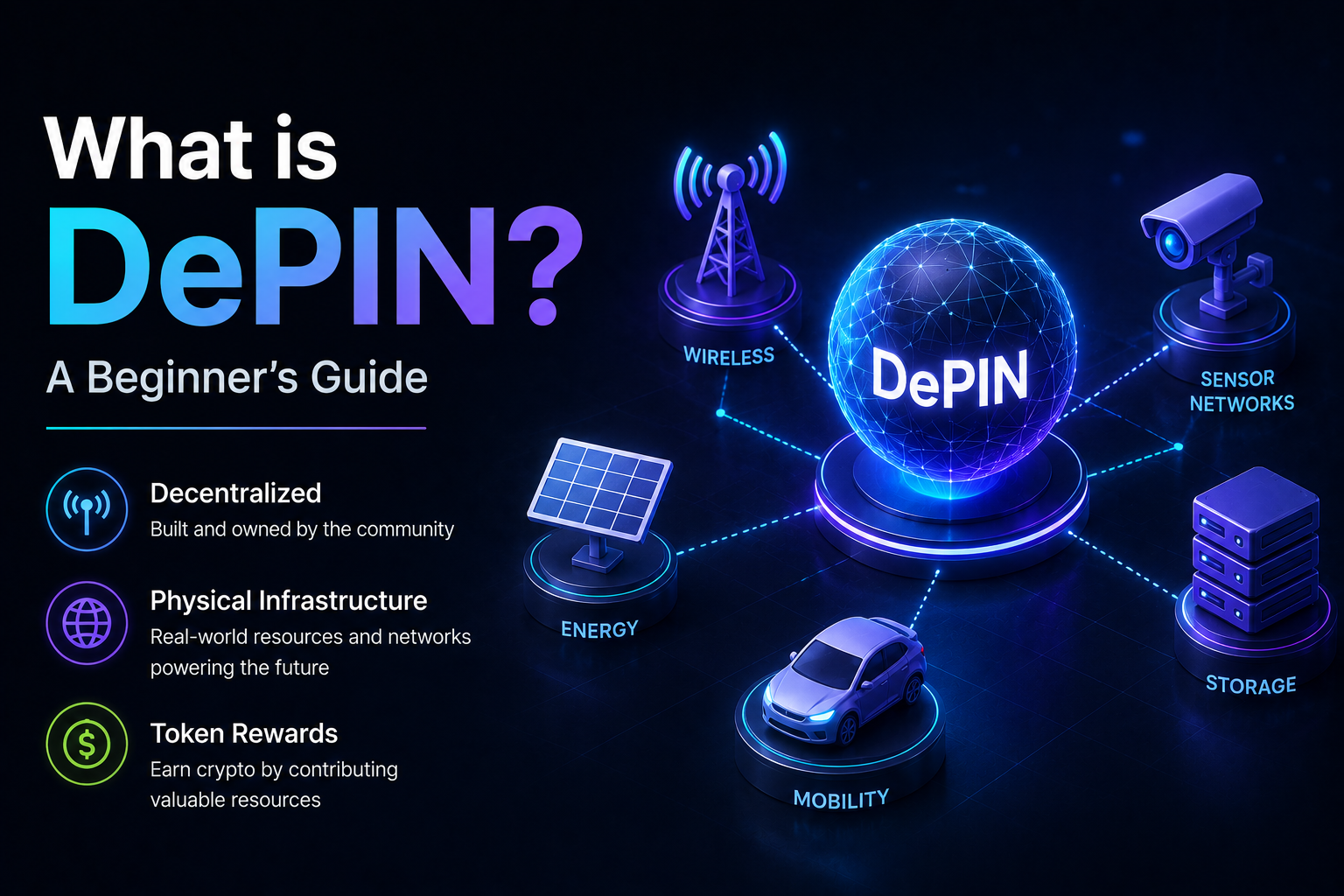
Short answer: DePIN stands for Decentralised Physical Infrastructure Networks. These are crypto projects that pay people in tokens to contribute real-world physical resources — bandwidth, storage, compute, wireless coverage, mapping data, or sensor readings — instead of building that infrastructure with corporate capital. Top projects include Filecoin (storage), Helium (wireless), Render (GPU compute), Akash (cloud compute), Hivemapper (mapping), and Grass (residential bandwidth). The category had a combined market cap of roughly $40-50 billion in 2024 according to industry trackers, and Messari and others have called it one of the largest growth sectors in crypto.
Try Grass — the easiest DePIN entry point → (referral link)
Key takeaways
- DePIN turns crypto tokens into the payment rail for physical infrastructure. Users contribute resources (bandwidth, GPUs, storage, hotspots) and earn tokens. End buyers pay for the resource in fiat or tokens.
- The category spans five rough sub-types: compute, wireless, storage, energy/sensors, and mapping/data.
- Top projects by market cap include Filecoin, Helium, Render, Akash, Theta, IoTeX, Hivemapper, and Grass. New launches happen monthly.
- For end users, DePIN is one of the easiest ways to earn small amounts of crypto from existing hardware (laptop, phone, home connection).
- The risks are tokenomics-driven: most DePIN tokens have multi-year unlock schedules that put constant sell pressure on the price.
What DePIN actually means
DePIN is short for Decentralised Physical Infrastructure Networks. The category name came out of a Messari research report in 2023 and has since become standard.
Stripped of the buzzwords, the idea is this: instead of a single corporation raising billions of dollars to build cloud storage, wireless coverage, GPU compute farms, or mapping data, a token-based network pays distributed individuals to provide the same resources from hardware they already own (or can buy cheaply).
The model only works because of three converging things.
One. Most physical infrastructure has high marginal costs at the centralised tier (think Amazon, Google, T-Mobile) but very low marginal costs at the edge — your laptop and home internet are sitting idle most of the day already.
Two. Tokens give the network a way to pay early contributors before there’s revenue. The token value comes from speculation about future network demand. Contributors earn tokens now and bet on the network being big later.
Three. Blockchains can coordinate large numbers of small contributors trustlessly. A million individual node operators don’t need to know each other; they just need to follow the protocol and get paid.
That’s the whole thesis. Whether it works depends on whether real buyers eventually pay real money for the service, in volumes large enough to justify the token’s market cap.
The Messari State of DePIN report and DePIN.ninja market dashboard are the two most useful free resources for tracking the category. They publish project lists, market caps, and revenue data. DePIN.ninja tracked the sector at around $40-50 billion in combined market cap during 2024, with on-chain protocol revenue running into the hundreds of millions annualised.
Why DePIN matters: the AWS-replacement thesis
The big-picture argument for DePIN goes like this.
A handful of cloud providers — AWS, Google Cloud, Azure, Cloudflare, Akamai — currently capture an enormous share of global compute, storage, bandwidth, and CDN revenue. These businesses generate gross margins in the 60-80% range because the underlying infrastructure has scale economics that nobody else can match.
The DePIN bet is that a distributed network of small operators can collectively provide a substantial part of the same services at lower cost. The savings come from three places: smaller margins (because token-paid operators are happy with thinner cash returns), shared marginal costs (you’re not building data centres for this — you’re using spare home compute), and zero billing overhead (the protocol just settles in tokens automatically).
If even 5-10% of cloud workloads migrate to DePIN-based alternatives over the next decade, the addressable market is enormous. That’s the bull case.
The bear case is equally simple. Cloud providers offer reliability, security, support, and integrated tooling that no decentralised network can match. Most enterprise customers will pay the premium for that reliability. DePIN networks will serve edge use cases — content delivery, archival storage, batch compute — but won’t dent the main cloud business. In that world, the tokens get traction but don’t justify large valuations.
Reality will sit somewhere in between. Some categories of DePIN (storage, CDN, render compute) have clearer paths to real revenue than others (consumer wireless, mapping). The category as a whole is real but heterogeneous.
The 5 DePIN categories
Most DePIN projects fit one of five buckets. Knowing the buckets helps you compare projects sensibly.
1. Compute networks
Sell access to GPUs and CPUs for AI training, rendering, batch processing.
Projects: Render (RNDR) for GPU rendering of 3D content, Akash (AKT) as a marketplace for general cloud compute, io.net for AI training compute, Bittensor (TAO) for distributed AI inference.
The AI boom has driven serious demand for GPU compute. Render and io.net both saw real customer revenue grow significantly through 2024. This is the most demand-driven sub-category right now.
2. Wireless networks
Provide cellular, IoT, or wifi connectivity from distributed hotspots run by community members.
Projects: Helium (HNT/MOBILE) for the consumer cellular network and IoT, Pollen Mobile for similar, Wayru for community wifi in emerging markets.
Helium pivoted from IoT to consumer cellular in 2023. Real user numbers are modest but growing. The token has had a volatile trajectory as the network model evolved.
3. Storage networks
Distributed storage and CDN, competing with AWS S3 and Cloudflare.
Projects: Filecoin (FIL) for cold storage and CDN, Arweave (AR) for permanent storage, Storj (STORJ) for cloud storage, Sia (SC) for similar.
Filecoin and Arweave both have real enterprise customers. The total storage and active deals data shows ongoing growth. This is one of the more mature DePIN sub-categories.
4. Energy and sensor networks
Tokenise energy production, sensor data, or other physical metrics.
Projects: WiFi Map, DIMO for vehicle data, Atmotube for air quality, Glow for solar energy production.
Smaller and more experimental than the other categories. Some of the most interesting long-term bets sit here but with very little track record.
5. Bandwidth and data networks
Sell residential bandwidth or curated data.
Projects: Grass (GRASS) for residential bandwidth for AI training, Theta (THETA) for video streaming, Hivemapper (HONEY) for crowdsourced mapping data.
This is the category most accessible to retail users — install an app, earn tokens. The Grass review goes deep on the user experience.
Top DePIN projects worth knowing
Quick rundown on the highest-profile names. None of this is investment advice — just context on what each project does.
Filecoin (FIL)
The pioneer of decentralised storage. Launched in 2020 after a $257M ICO. Provides cold storage and CDN services. Storage providers commit physical drives and earn FIL for storing data. Real enterprise customers, real on-chain deal volume, slowly building a CDN business on top.
The token has been disappointing for early investors — high initial valuation, large emissions schedule, slow revenue ramp. But the underlying network is one of the more mature DePIN projects.
Helium (HNT / MOBILE)
Started as an IoT network in 2019. Pivoted to consumer cellular in 2023 after IoT didn’t get the traction the team hoped for. Users buy hotspots and provide coverage; Helium Mobile customers pay $20/month for service.
Subscriber numbers have grown but remain modest compared to incumbents. The token economics have changed multiple times. The Hotspot Miner sector saw a lot of speculative hardware purchases in 2021-2022 that didn’t pay off as expected.
Render (RNDR)
GPU compute marketplace for 3D rendering and AI inference. Render has real paying customers — VFX studios, AI labs, AAA game developers needing burst rendering capacity. The token tracks demand reasonably well, though it’s volatile.
This is one of the DePIN projects with the clearest direct line to revenue.
Akash (AKT)
Open marketplace for cloud compute. Akash lets anyone rent out spare server capacity; anyone can deploy containerised workloads on cheap distributed compute. Real customer base for cost-sensitive workloads, ML training jobs, and crypto infrastructure (validators, RPC nodes).
Smaller than Render but in the same compute bucket, with broader use cases.
Hivemapper (HONEY)
Crowdsourced mapping data. Drivers install a Hivemapper-supported dashcam, drive their normal routes, and earn HONEY tokens proportional to the new road coverage they capture. Big-name customers (Lyft, mapping companies) have purchased data.
One of the harder DePIN models because it requires hardware purchase. Earnings per driver vary wildly by route coverage. Strong technology, narrower use case.
Grass (GRASS)
Residential bandwidth sharing for AI training data. Install an extension, earn tokens, AI companies pay to use your IP as a residential proxy. Launched in 2024. One of the highest-profile recent DePIN launches.
The easiest DePIN entry point because there’s no hardware purchase and the install takes 5 minutes. Full review here.
Theta Network (THETA)
Decentralised video streaming and content delivery. Users share spare bandwidth and storage to deliver video content. Has been around since 2018, with partnerships across the video industry.
Older than most DePIN projects, with a more established footprint.
Bittensor (TAO)
Distributed AI model marketplace. Subnets specialise in different AI tasks (vision, language, prediction) and validators evaluate model performance. TAO has had explosive price action tied to the AI hype.
Real novel architecture, real research and development, very speculative token.
io.net
AI training compute marketplace. Aggregates spare GPU capacity from data centres, crypto miners, and independent operators. Real demand from AI labs needing training capacity outside of the big cloud providers.
Newer than Akash and Render but moving fast.
How to earn from DePIN (the two paths)
Two ways to participate. Pick based on time, capital, and risk tolerance.
Path A: run a node
You provide the underlying resource and earn tokens for the work your hardware does.
Bandwidth nodes — install Grass or similar, no hardware purchase, very modest earnings ($5-$20/month per node).
Storage nodes — provide drive space to Filecoin or Storj. Requires technical setup and reliable hardware. Earnings depend on demand for storage in your region.
Compute nodes — provide GPU or CPU compute to Akash, Render, or io.net. Higher technical bar, higher earnings if your hardware is in demand.
Wireless nodes — buy a Helium hotspot or similar. Hardware costs $200-$1,500 depending on the device. Earnings vary wildly by location.
Mapping nodes — install a Hivemapper dashcam in your vehicle. Earnings depend on how much new road coverage you capture.
The economics across these vary enormously. Bandwidth is low-effort, low-reward. Compute can pay well if you have idle GPUs. Wireless is the highest-risk because hardware costs are upfront and recoup depends on actual local demand for the service.
Path B: buy and hold the tokens
If you believe the category will keep growing, you can buy DePIN tokens directly without running any nodes.
The advantage: capital efficient, no hardware or technical setup, easy to diversify across multiple projects.
The disadvantage: most DePIN tokens have large emissions schedules that act as ongoing sell pressure. Early investors in many of these projects are still underwater. Token prices have been weak in extended bear cycles.
For most retail users, a hybrid approach makes sense — run one or two easy nodes (Grass is the obvious entry), hold a small allocation of tokens for projects you believe in, and don’t overweight the category. The passive income crypto primer covers how DePIN fits alongside staking, lending, and bot strategies.
Grass — the simplest entry point
If you’ve never participated in DePIN before, Grass is the natural place to start.
The reasons it’s a clean entry: no hardware purchase, no technical setup, runs on existing devices, takes about 5 minutes to install, and the economics are easy to verify because the dashboard shows your earnings in real time.
The downsides: the dollar income is modest ($5-$20 per month per device) and the GRASS token is volatile.
Here’s the basic setup if you want to try it:
- Sign up at Grass (referral link — gives you a 5% earnings boost).
- Install the Chrome extension on a desktop or laptop you leave on most of the day.
- Install the mobile app on a phone you use anyway.
- Leave them running. Withdraw GRASS periodically. Sell on BitGet or hold based on your view of the token.
That’s the lowest-effort DePIN experience. After a few months you’ll have a feel for what the daily earnings look like, what affects them, and whether you want to add more bandwidth-sharing services or expand into other DePIN sub-categories.
The detailed Grass review covers earnings, risks, and stacking strategies in depth.
GoMining — the BTC mining DePIN angle
Worth mentioning separately because it’s one of the more interesting hybrid DePIN models.
GoMining is not strictly classed as DePIN by some industry trackers (and is by others). The model: tokenised slices of Bitcoin mining hardware as NFTs, with real BTC payouts from actual mining operations. You don’t run hardware yourself — the underlying machines are in industrial facilities — but you own a tradeable claim on the hash power.
This sits in the grey zone between cloud mining and DePIN. It shares the DePIN DNA — distributed ownership of physical infrastructure paying out in tokens (or in this case BTC). It differs in that there’s no node you personally operate.
For BTC stackers who like the idea of accumulating BTC through hash power without buying ASICs, it’s an interesting structure. The economics are sensitive to BTC price, mining difficulty, and the platform’s electricity costs. The full GoMining review covers the maths in detail.
DePIN token risks
Five risks that affect the category as a whole. Important to internalise before you build a position.
Token unlock schedules
Most DePIN tokens were launched with low circulating supply at launch. The remaining supply unlocks over multi-year vesting schedules — to team, investors, ecosystem fund, and ongoing node rewards. That creates persistent sell pressure on the token price.
For some projects, daily new emissions are several percent of circulating supply. The token has to find new buyers to absorb that issuance every day just to keep the price flat. CoinDesk and other industry publications have written extensively about how this dynamic has held back DePIN token performance.
Hype cycles vs revenue cycles
DePIN tokens tend to pump when there’s a narrative boost — AI demand for storage, a high-profile partnership, a new project launch. They tend to drift down between hype cycles even when real network usage is growing.
This means the token price often moves independently of network fundamentals. You can hold a token in a network with growing real revenue and still be down 50% over a year.
Centralisation creep
Many DePIN networks talk about decentralisation but operate with significant centralisation in practice — most nodes run by a small number of large operators, governance dominated by team and early investors, software development concentrated in the founding team.
This isn’t always a problem but it does mean the “decentralised” branding is sometimes more marketing than reality. Compare actual node distribution and governance participation to the marketing claims before deciding what to believe.
Hardware obsolescence (where applicable)
For DePIN projects requiring hardware (Helium hotspots, Hivemapper dashcams, mining ASICs), hardware obsolescence is a real cost. Newer versions of the device earn more and depreciate faster. Buyers of last year’s hotspot or dashcam often see earnings drop materially as newer hardware joins the network.
Regulatory uncertainty
The legal status of token-paid infrastructure work is still developing. Are node operators contractors? Investors? Service providers? Different jurisdictions are reaching different conclusions. Some categories (residential bandwidth, mapping, wireless networks) touch on existing regulation that DePIN hasn’t been forced to fully comply with yet. Future regulation could materially affect economics.
The risks aren’t dealbreakers. They’re factors that explain why DePIN token performance has been mixed even as the category as a whole has grown.
DePIN vs cloud — the real comparison
The fair comparison isn’t “DePIN replaces AWS”. It’s “where does DePIN win on price or features, and where does it not?”
| Major cloud providers | DePIN networks | |
|---|---|---|
| Reliability | 99.99%+ SLA | Variable, no enforceable SLA |
| Security | Enterprise-grade, audited | Depends on protocol design |
| Cost | Premium | Usually 30-70% cheaper |
| Integration | Mature tooling, APIs, support | Improving but immature |
| Latency | Optimised global edge | Variable by node geography |
| Support | 24/7 enterprise support | Community / discord |
| Customer base | Enterprise + retail | Mostly tech-forward retail |
DePIN’s natural winning use cases: cost-sensitive workloads, censorship-resistant storage, decentralised AI training, applications where regulatory compliance differences matter, content delivery to edge networks.
DePIN’s natural losing use cases: mission-critical enterprise workloads, applications requiring guaranteed SLAs, anything that depends on enterprise support, regulated industries that need vendor compliance certifications.
Reality is that both will coexist for a long time. Cloud providers will keep most enterprise revenue. DePIN will carve out 5-15% of certain categories at the margins. The DePIN tokens that survive will be those where the network found a defensible niche, not those that tried to be a general AWS killer.
DePIN tax — rewards are income, tokens are assets
If you earn tokens from DePIN participation, the tax treatment usually mirrors staking and mining rewards.
Income on receipt. When you receive DePIN tokens (Grass earnings, Helium HNT, Filecoin FIL, whatever), most jurisdictions treat that as income at the token’s fair market value on the day of receipt. UK (HMRC), US (IRS), Canada, Australia, and most of the EU follow this.
Capital gains on disposal. When you sell, the difference between the value at receipt and the value at sale is a capital gain or loss.
Hardware costs and electricity are deductible in some jurisdictions if you’re operating as a trade or business — in most jurisdictions, individuals can’t deduct these against the income unless they meet trade-business thresholds.
Keep records. Use a tool like Koinly or CoinTracker that can ingest DePIN earnings. For high-volume nodes (bandwidth, mining), you’ll have hundreds or thousands of micro-transactions — manual tracking is impossible.
Tax treatment varies enough by country that anything more than nominal earnings deserves a conversation with an accountant who understands crypto.
Learning to evaluate new sectors
This applies to every new crypto category that comes through, not just DePIN.
The trap most retail traders fall into is the same every cycle. A narrative emerges. A few projects in the category pump 5-10x. Twitter and YouTube get loud. Late buyers pile in at the top. The category corrects 70%. The narrative is declared dead. A small number of survivors quietly build for the next cycle and pump again later.
The way to avoid being the late buyer is to evaluate sectors on more than narrative. Specifically:
- Is real revenue growing, or is it just speculation?
- What are the actual node economics — are operators making money or subsidising the network?
- What does the token unlock schedule look like?
- Is the team executing or pivoting every quarter?
- Are the customers identifiable real entities, or is it all crypto-native circular flow?
That’s the framework. Most of what I learned about thinking this way came from being part of the Trade Travel Chill community. It’s the structured education group I’m part of and the one place I’d point anyone wanting to get better at evaluating new crypto sectors. Not a tipster service — people working out the same questions together.
If you want to actually develop this muscle rather than just read posts about it, that’s the recommendation.
Want the easiest DePIN entry?
Grass is the no-hardware, 5-minute-install way to start earning DePIN tokens. Sign up through the link for a 5% earnings boost.
Referral link. I may earn a small reward.
How to start with DePIN
If you’re brand new to the category and want to test the water, here’s the order I’d suggest.
- Install Grass. Five minutes. Costs nothing. After a month you have real data on what the earnings feel like.
- Watch the dashboard for 30 days. Get a sense of how earnings vary by uptime, location, and time of day.
- Read the wider category. Look at DePIN.ninja for market data, Messari reports for project profiles, BitGet listings for tokens you can buy if you want exposure beyond running nodes.
- Decide if you want token exposure. Don’t put more than a small percentage of a portfolio into DePIN tokens. The category is volatile and many projects will not survive.
- Consider GoMining if BTC accumulation is your goal. The GoMining review covers when this makes sense and when it doesn’t.
- Track tax obligations from day one. Income on receipt — keep records.
For most people, that’s the right depth. A bigger commitment (hotspot hardware, Helium nodes, dedicated storage servers) makes sense only if you’ve done the maths on your specific local economics and you’re confident the maths works.
Want exposure to DePIN tokens?
BitGet lists most major DePIN tokens including GRASS, FIL, RNDR, AKT, HNT and more. Sign-up takes 90 seconds.
Referral link.
Frequently asked questions
What does DePIN stand for?
Decentralised Physical Infrastructure Networks. The term was popularised by Messari research in 2023 and has become standard. It covers crypto projects where token holders contribute physical resources (bandwidth, storage, compute, hotspots, sensors) and earn tokens in return.
Is DePIN profitable?
Modestly, for retail users. Realistic earnings from bandwidth sharing like Grass sit at $5-$20 per month per device. GPU compute can pay more if you have idle high-end hardware. Helium hotspot economics vary heavily by location. Token holders have had volatile experiences — some projects have appreciated, many have underperformed.
What are the best DePIN projects?
By market cap and traction at time of writing: Filecoin (storage), Render (GPU compute), Helium (wireless), Akash (compute), Theta (video CDN), Bittensor (AI), Grass (bandwidth), and Hivemapper (mapping). New projects launch monthly.
Is DePIN safe?
The technology is generally safe. The risks are economic — token volatility, hardware obsolescence (for hotspot/dashcam projects), regulatory uncertainty, and persistent sell pressure from token emissions schedules. Different sub-categories have different risk profiles.
How is DePIN different from regular cloud computing?
Cloud providers like AWS centralise the infrastructure in their own data centres and charge for access. DePIN distributes the infrastructure across many independent operators paid in tokens. DePIN is usually cheaper for users but offers less reliability and support than enterprise cloud.
Can I earn DePIN tokens without any hardware?
Yes. Bandwidth-sharing services like Grass require only an existing internet connection and a browser extension or mobile app. Storage and compute services usually require hardware. Hotspot networks like Helium require a hardware purchase.
Do I pay tax on DePIN earnings?
In most jurisdictions, yes. Token rewards are typically treated as income at fair market value on the day received. Capital gains tax applies when you sell. Hardware costs and electricity may be deductible if you operate as a trade or business — varies by country.
What’s the difference between DePIN and DeFi?
DeFi is decentralised financial services — trading, lending, derivatives, stablecoins — running on smart contracts. DePIN is decentralised physical infrastructure — bandwidth, storage, compute, wireless networks — coordinated through tokens. Both use crypto rails but DePIN involves physical resources while DeFi is purely digital.
Final word
DePIN is the most interesting bridge between crypto and the physical economy that we’ve seen so far. The category isn’t a fad — there’s real demand for distributed infrastructure, real revenue going through the underlying networks, and a genuine cost advantage for some use cases.
What it isn’t is easy money. Most DePIN tokens have underperformed expectations because token supply outpaces revenue growth. Most node operators earn modest amounts that don’t justify dedicated hardware purchases. The category will produce some big winners over a decade. Most projects in it now will not be the winners.
If I were starting again, this is how I’d approach DePIN:
- Install Grass to get a feel for the category. Costs nothing.
- Read DePIN.ninja, Messari reports, and the wider industry coverage.
- Hold a small basket of DePIN tokens (FIL, RNDR, GRASS, HNT) on BitGet if you want exposure to the category.
- Avoid expensive hardware purchases (Helium hotspots, dashcams) unless you’ve run the local economics carefully and your situation actually fits.
- Keep DePIN as a small slice of a broader crypto portfolio — staking, BTC accumulation, and stablecoin yield should still be the bulk of any passive-income strategy.
- Track tax from day one. Income on receipt.
That’s the playbook. DePIN is interesting. It’s also a sector where the gap between narrative and reality is wide. Stay sober about both.
Right — over to you.
Related posts
- Grass Review: Earning Crypto From Spare Internet
- GoMining Review: BTC Mining Without Buying Hardware
- How to Earn Passive Income in Crypto Without Getting Rugged