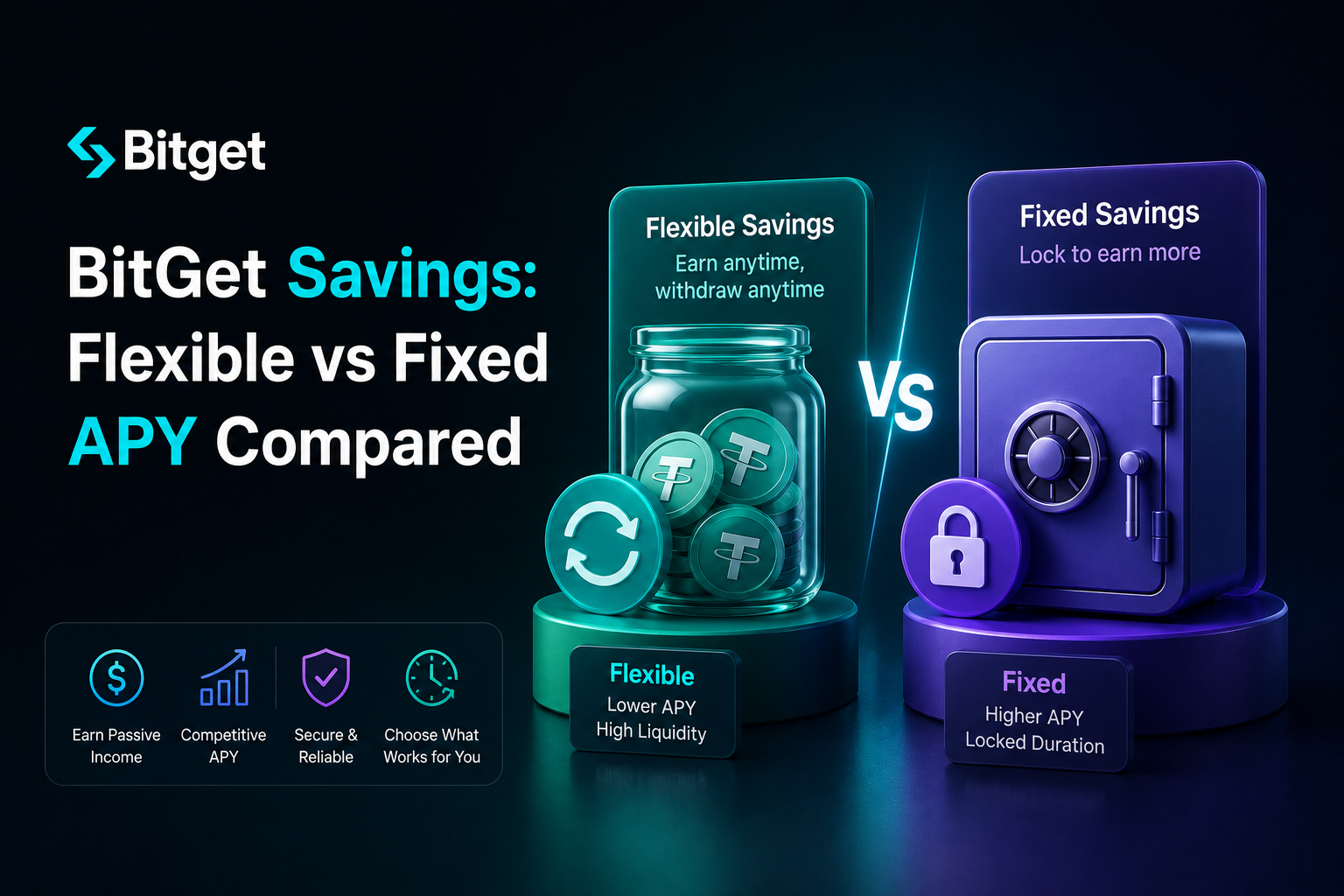
There’s a stretch in every trader’s life where the market does nothing for six weeks and your USDT sits in spot earning the same yield as a sock under the bed. That’s the gap BitGet Savings was built to plug. Park stables or coins, collect interest, pull it back when something interesting prints. The pitch is simple. The numbers behind it are not. This is the honest breakdown — what you actually earn, where the catches are, and when I use it versus when I don’t. Some links here are affiliate. I’ll flag them when they appear.
Short answer: BitGet Savings is a yield product where you deposit crypto and earn daily interest. Flexible Savings credits roughly 1–8% APY on USDT depending on tier, withdraw any time. Fixed Savings locks you in for 7, 14, 30, 60 or 90 days for higher rates — typically 5–15% on stables during promotional windows. It’s safer than DeFi farming but it is still custodial. Interest is taxable in most countries.
Open a BitGet account → (affiliate)
Key takeaways
- Flexible Savings on USDT pays around 1–8% APY depending on amount tier and promo state.
- Fixed Savings on stables can hit 12–15% during launch promos, but the lock-up is real.
- Interest credits daily to your spot account — you can withdraw or reinvest.
- This is not a Ledger replacement. It’s a custodial yield product. Counterparty risk applies.
- In most countries Savings interest counts as income, not capital gain. Track it.
What BitGet Savings actually is
BitGet Savings is the Earn product where you deposit a token and BitGet pays you interest on it. The platform takes that liquidity and routes it into margin lending — traders who borrow stables or coins to short, long, or arbitrage pay a borrow rate, and a share of that rate gets passed back to you. That’s the engine. Same model that powers Binance Simple Earn, OKX Simple Earn, and historically Celsius and BlockFi before they collapsed.
The official product page lives on the BitGet Savings dashboard — the headline numbers there are live and change daily as borrowing demand moves.
Two flavours.
Flexible Savings. You deposit, you earn, you can withdraw whenever. APY moves daily. Suited to capital you might need for a trade.
Fixed Savings. You commit for a set window — 7, 14, 30, 60 or 90 days are the common ones. APY is higher and locked at deposit. Suited to capital you’ve already decided to park.
I use both. Different jobs. Different rules. The rest of this post is the comparison.
Flexible vs Fixed: the table that matters
Real ranges I’ve seen over the last 18 months across the main assets. Numbers shift with promos and market conditions — treat as the realistic band, not a guarantee.
| Asset | Flexible APY | Fixed 30-day APY | Fixed 90-day APY | Notes |
|---|---|---|---|---|
| USDT | 1.5% – 8% (tiered) | 4% – 10% | 6% – 14% | Promo windows push the top end higher |
| USDC | 1.0% – 6% | 3% – 8% | 5% – 12% | Slightly lower than USDT in normal conditions |
| BTC | 0.5% – 2% | 1% – 3% | 1.5% – 4% | Low because BTC borrowing demand is low |
| ETH | 1% – 3% | 2% – 4% | 3% – 6% | A bit better than BTC, more lending depth |
| BGB | 2% – 5% | 4% – 8% | 6% – 12% | Native token, gets promo treatment |
Two things to spot in this table.
Stables out-earn coins by a wide margin. That’s because traders borrow stables to long, not BTC. So lending stables sits at the top of the yield stack.
Fixed always beats flexible. The premium for locking 90 days versus staying liquid is roughly 4–6 percentage points on USDT in a normal market. That’s the price BitGet pays you for stable liquidity it can plan against.
Realistic APYs on USDT, BTC and ETH
Headline rates are the marketing. Real rates are what credits to your account at 00:00 UTC every day.
USDT
In a calm market the live flexible APY on USDT sits between 2.5% and 5% across all amount tiers. The promo-driven spikes — the kind that hit the BitGet homepage banner — typically run 10% to 14% on a 30-day fixed for a few weeks at a time, then settle back. The tiered ladder means the first slice of your deposit earns the highest rate, and rates drop on each slice above the cap.
A worked example with a $50,000 USDT flexible deposit:
- First $500 at 8% APY
- Next $4,500 at 5% APY
- Next $45,000 at 3.5% APY
Blended APY: roughly 3.7%. Daily interest: about $5.07. Monthly: $152. Not life-changing on its own but the difference between that and a 0% spot wallet over a year is meaningful capital.
BTC
Flexible BTC pays in the 0.5% to 1.5% band most of the time. Fixed 90-day pushes it to about 2% to 4%. The reason it’s low: nobody borrows BTC to short BTC in size — they short the perp instead, and the funding payment lives in a different bucket. Borrow demand for spot BTC is thin so the yield reflects it.
If you’re sitting on Bitcoin you want to hold long-term, Savings is not where I’d park it. A Ledger Nano X and a sealed seed phrase is the better answer. Self-custody beats a 1% yield on someone else’s balance sheet every time.
ETH
ETH sits in the middle. Flexible runs 1% to 3%. Fixed 90-day pushes to around 4% to 6%. ETH has actual lending demand from leveraged restaking strategies and short positions, so the rate looks a bit healthier than BTC. Still well below what you’d earn on a native staking position.
For comparison: native ETH staking via a validator currently pays around 3% to 4% post-Shapella, before any restaking points. On-chain liquid staking (Lido, Rocket Pool) sits similar. BitGet ETH Savings competes when the promo windows hit and underperforms native staking the rest of the time.
The crypto staking explained post covers the broader picture on staking versus lending-based yield.
How interest compounds and credits
The mechanics are simpler than DeFi farming. Two rules to internalise.
Rule one: interest accrues hourly, credits daily. Every hour, BitGet calculates the interest you’ve earned at the live rate for that hour. At 00:00 UTC, the total of those hourly slices lands in your spot account as cash. No claim button, no gas fee, no manual step.
Rule two: compounding is opt-in. The daily credit lands in spot. If you want it to compound, you need to subscribe it back into the Savings product. There’s an auto-subscribe toggle that does this for you (covered below). Without it, your interest sits idle in spot earning zero.
A worked example. $10,000 USDT flexible at a blended 4% APY.
- Day 1 interest: $1.10. Hits spot at midnight.
- Day 2 interest: still $1.10 (no compounding).
- After 365 days at simple interest: $400 earned.
- With daily auto-compound: $408 earned. About 2% more.
Compounding matters more at higher rates and over longer windows. On a 12% fixed product compounded daily for 90 days, the lift is closer to 3%. Still not the magic the calculators on YouTube promise — interest compounding is just the small slope that gets less small the longer you stay on it.
The auto-subscribe feature
Auto-subscribe is the toggle that turns BitGet Savings from a chore into a habit.
Switch it on for a Flexible Savings product and any credit that lands in your spot — daily interest, manual top-ups, trading profit — gets automatically subscribed into the same Savings product. You set a minimum threshold (typically 1 USDT or 0.0001 BTC) and the platform handles the rest.
I run auto-subscribe on flexible USDT. Reasons:
- I keep a stables buffer for buying dips. The buffer should earn yield while it waits.
- I trade in and out of positions. Realised profit hits stables, then auto-subscribes within an hour.
- Manual subscribing means I’d forget. Auto means the money is never lazy.
I don’t run auto-subscribe on Fixed Savings because each fixed deposit is a separate lock-up — auto-subscribe a new fixed lock every day and you end up with a maturity calendar you can’t read.
You’ll find the auto-subscribe toggle on each Savings product page once you’ve subscribed at least once. Default is off.
BitGet Savings vs DeFi alternatives
The honest comparison. DeFi can pay more. DeFi can also blow up.
| Factor | BitGet Savings | Aave / Compound | DeFi farms / new pools |
|---|---|---|---|
| Typical USDT APY | 3% – 6% (flexible) | 4% – 8% (variable) | 10% – 40%+ |
| Counterparty risk | BitGet solvency | Smart contract + protocol | Smart contract + token risk |
| Custody | Custodial (BitGet holds keys) | Non-custodial | Non-custodial |
| Effort | One click | Wallet, gas, approvals | High — frequent rebalancing |
| Gas cost | Zero | $5–$50 per tx on mainnet | Variable, often punishing |
| Liquidity | Instant (flexible) | Mostly instant | Often locked or impermanent |
| Worst case | Exchange collapse | Smart contract drain | Rug + token to zero |
The way I think about it: BitGet Savings is the “buffer earning yield” layer. Aave is the “I want a non-custodial blue-chip yield” layer. DeFi farming is the “I want to gamble for higher yield” layer. They’re not interchangeable. I use the first two. I avoid the third unless I’m fine writing the deposit off.
If you want the broader passive income picture across all of these, the passive income crypto hub covers each route in depth. The blockchain explained post covers the fundamentals if you’re new to how DeFi lending actually works.
Authority sources worth a read: the Aave Risk Documentation breaks down how their lending pools handle bad debt. The Compound Finance docs cover the same ground from a different angle. Both are required reading before you commit serious capital to either.
BitGet Savings vs Ledger cold storage
This isn’t really a comparison. They do different jobs.
Ledger is for the long-term bag — the BTC and ETH you bought with conviction and want to hold for three years plus. The trade-off is zero yield and zero counterparty risk. Your keys, your coins.
Savings is for the working capital — the stables you trade with, the rotation float, the dip-buying buffer. The trade-off is small yield in exchange for trusting BitGet to stay solvent.
The honest split I run:
- Long-term holds: Ledger. Roughly 60% of total stack.
- Trading float: spot wallet on BitGet. Roughly 15%.
- Mid-term buffer: BitGet Savings flexible. Roughly 25%. Earns while it waits.
The buffer slice is the one where Savings earns its keep. If I’m holding $10,000 in stables for the next correction, 4% APY beats 0%. If I’m holding 1 BTC for five years, 1% APY isn’t worth the custody risk.
The how to store crypto safely guide goes step by step through self-custody, and the hot vs cold wallet breakdown covers the wider trade-off. The ledger nano x review covers the device I actually use, and seed phrase storage is the next step nobody skips.
If you want a hardware wallet to handle the long-term slice, here’s the one I use: Ledger Nano X (affiliate). One-time purchase, holds keys forever.
The risks nobody talks about
Five risks. The product page mentions none of them.
One: custody risk
BitGet holds the keys. Your USDT in Savings is a claim on BitGet’s balance sheet, not crypto in your wallet. If BitGet ever has a Celsius-style insolvency event, the queue for withdrawals would close and your “savings” would be a bankruptcy claim. Proof of Reserves helps — BitGet publishes monthly Merkle tree audits and you can verify your balance is included via the BitGet Proof of Reserves page. It’s not insurance though. It’s evidence.
Two: APY changes mid-deposit
Flexible APYs change daily. The 8% you subscribed at could be 3% by Friday if borrowing demand drops or BitGet adjusts the tier. Fixed rates are locked — that’s the trade-off you pay the liquidity premium for.
Three: tier caps
Most flexible products have a tier ladder. The first $500 might earn 8%, the next $4,500 earns 5%, and everything above earns 3.5%. The headline rate on the homepage is the top-tier rate. Your blended rate on a $50,000 deposit is materially lower.
Four: terms changes
BitGet can change the terms of a product on the next subscription window. Existing fixed deposits run to maturity at their original rate. Existing flexible deposits move to the new rate immediately. Read the email when product terms update — it happens roughly twice a year.
Five: token de-pegging
USDT and USDC have de-pegged before. USDT briefly hit $0.95 in 2018 and again briefly in 2022. USDC hit $0.87 during the Silicon Valley Bank weekend in March 2023. If you’re earning 5% APY on USDT and USDT loses 5% of its peg, you’re flat for the year. Stablecoin risk doesn’t vanish because you put it in a yield product.
If you want the wider risk picture, the crypto scams guide covers the related ground on what to watch out for across the Earn category.
Tax: interest is income
This is the section your accountant wishes you’d read.
In most jurisdictions — the UK, the US, Canada, Australia, most of the EU — Savings interest counts as income at the moment it credits to your account, valued at the spot price on the credit date. Not when you withdraw. Not when you swap to fiat. The moment it lands.
That has two consequences.
Bookkeeping. You need a daily log of credits. BitGet exports this as a CSV from the Reports section. Pull it quarterly into Koinly, CoinTracker or whatever tax tool you use. Don’t try to reconstruct a year’s worth of daily credits in April.
Cash budgeting. If you earn $5,000 in Savings interest in stables and never withdraw it, you still owe tax on $5,000 of income. Some people get caught here — they leave everything in Savings, then face a tax bill they need to liquidate to cover. Budget the tax the same quarter the credits arrive.
Authority reading: the UK HMRC cryptoassets manual covers the UK treatment of lending and staking rewards in detail. The IRS digital assets page covers the US side. Both have changed materially in the last three years — check the current version before you file.
For day-to-day record-keeping, Koinly’s crypto tax guide is the cleanest plain-English summary I’ve found.
When BitGet Savings makes sense
Three scenarios where I actually use it.
Scenario one: the dip-buying buffer. You’ve decided you want stables ready to buy if BTC drops 20%. That capital is going to sit somewhere for weeks or months. Flexible Savings turns a 0% buffer into a 4% buffer with no lock-up. Withdraw the moment your alert fires.
Scenario two: between trades. You closed a position. Realised profit hit your spot wallet. The next setup is days away. Auto-subscribe parks it in flexible, earns interest, and pulls it back when you click into a new trade. Friction-free.
Scenario three: the planned hold. You’ve decided to hold $10,000 USDC for the next 90 days regardless of what happens. Fixed 90-day at 8% APY beats flexible at 4% by enough to be worth the lock. You’re already committed to the time horizon — capture the premium.
The unifying theme: Savings earns its keep when you’ve already decided the capital is going to sit somewhere for a while. It’s the wrong tool for capital you might need urgently or for capital you intend to self-custody long-term.
When BitGet Savings is the wrong call
Three scenarios where Savings is the wrong product.
Scenario one: long-term BTC bag. A 1% yield on BTC in Savings doesn’t justify the custody risk of holding it on an exchange for five years. Cold wallet. Every time.
Scenario two: you need the money in a week. Fixed locks you out. Flexible is fine but the friction of subscribing/unsubscribing for a one-week parking spot rarely pays. Just leave it in spot.
Scenario three: the headline APY is over 20% and it’s not a promo. When the rate is too good, something else is going on. Read the small print. Most of the time it’s a structured product like Shark Fin or Dual Investment dressed up in Savings clothing — different risk profile, different rules.
Trader’s note: earning yield is the easy part
Here’s the thing nobody mentions in the Earn product pages. Earning 5% APY on stables is easy. Holding the discipline to redeploy that capital well is the hard part. If you’re parking USDT in Savings to wait for a dip, you need a plan for what you do when the dip arrives — entry price, position size, stop level, target.
That second skill — knowing what to actually do with the buffer when it’s time to deploy it — isn’t something a yield product teaches you. If you want to actually learn it, Trade Travel Chill (affiliate) is the community I’m part of. Structured education, real traders, no shilling. It’s the one place I’d point a newer trader who’s done the basics and wants to get sharper about deployment.
Want to try BitGet Savings?
Sign-up takes 90 seconds. KYC usually clears the same day. Earn starts paying within an hour of your first deposit.
Affiliate link. I may earn a commission at no extra cost to you.
How BitGet Savings stacks up against siblings
Savings is one product in the BitGet Earn stack. The others worth knowing about:
- BitGet PoolX — year-round staking pools, earn newly listed tokens in exchange for staking BGB or stables.
- BitGet Launchpool — same idea, time-limited, usually higher yields during launch.
- BitGet Shark Fin — structured product with capped upside, capital protection in a range.
- BitGet Dual Investment — high APY in exchange for selling at a target or buying at a floor.
- BitGet Launchpad — early-stage token sales, separate from Savings.
- BitGet Earn products — the parent overview that maps all of these against risk and yield.
Savings sits at the boring end of that list. Lowest risk, lowest variance, no token lottery upside. That’s the trade-off. If you want higher yield with conditional outcomes, the structured products are where you go. If you want stability, Savings.
My current Savings setup
For full transparency, here’s the actual split I run on Savings as of writing.
- USDT flexible with auto-subscribe on: about 60% of my stables float. Earning a blended ~3.8% APY.
- USDC 30-day fixed: about 20% of stables. Locked at 6.5%. Maturity dates staggered every 10 days so something is always coming free.
- ETH 90-day fixed: small slice, around 5%. Locked at 4.2% — beats native staking by enough to be worth it given I was already going to hold the ETH.
- No BTC in Savings. That sits cold.
The rotation: as fixed deposits mature, they auto-credit to spot. I review the live rates, decide whether to re-lock or move into a higher-yielding product. Takes me about 15 minutes a month.
If I had to boil the playbook down in one sentence: park stables you don’t need, lock the part you’re sure of, never put long-term coins in Savings.
Ready to set up Savings?
Open an account, deposit any amount of USDT, and you can be earning interest within minutes. Flexible withdraws any time.
Affiliate link.
Frequently asked questions
What is BitGet Savings?
BitGet Savings is a custodial yield product. You deposit a supported crypto asset and earn daily interest, paid out at midnight UTC each day. Two product types: Flexible (withdraw any time, variable rate) and Fixed (locked for 7 to 90 days, higher fixed rate).
Is BitGet Savings safe?
It is custodial, which means BitGet holds your assets. BitGet publishes monthly Proof of Reserves and runs a $400M+ Protection Fund. There is no major hack or insolvency to date. The risk is exchange-level: if BitGet were to fail, your Savings balance would be a creditor claim, not a recoverable asset. That’s why long-term coins belong on a hardware wallet.
What APY can I realistically earn?
Flexible USDT: typically 2.5% to 5% blended across normal market conditions. Fixed 30-day USDT: 4% to 10%. Fixed 90-day USDT: 6% to 14%. BTC and ETH pay lower because borrowing demand is lower. Promo windows push the top end higher for a few weeks at a time.
Does interest compound?
Not automatically. Interest credits to your spot wallet daily. If you want compounding, turn on auto-subscribe — it sweeps the credit back into the same Savings product the next morning. Without it, interest sits idle in spot.
Can I withdraw my Fixed Savings early?
Some Fixed products allow early redemption with a forfeit of all accrued interest. Others don’t allow early exit at all. The terms are shown at subscription. If liquidity matters, use Flexible.
Is BitGet Savings interest taxable?
In most jurisdictions yes, as income at the time of credit valued at the spot price. The UK HMRC, US IRS, Australian ATO and most EU tax authorities treat lending-style yield this way. Export your credit history quarterly and feed it into your tax tool of choice.
What’s the difference between Savings and Staking on BitGet?
Savings is lending — you lend your assets to traders who borrow them, and earn the borrow rate. Staking is on-chain — you commit assets to secure a Proof of Stake network and earn block rewards. Different mechanism, different risk profile, similar yields for stables-equivalent positions.
Final word
BitGet Savings does one job well: it turns idle capital into slightly-less-idle capital with one click. It is not a replacement for cold storage, it is not a high-yield play, and it is not insurance.
What it is: the boring product that earns its keep on the stables you were going to hold anyway.
If I were starting again today, here’s the order I’d set it up in: open a BitGet account, deposit a small amount of USDT, subscribe to flexible Savings, turn on auto-subscribe, watch the daily credits for a month to get a feel for the rate, then layer in fixed lock-ups on capital you’ve already decided to commit.
That’s the short version.
Right — over to you.
Related posts
- BitGet Earn Products: Every Product Compared
- BitGet PoolX: Year-Round Staking Rewards
- How to Store Crypto Safely: The Self-Custody Guide