Most people open the BitGet Earn tab, see a list of 30 products with eye-watering APYs, and either deposit everything into the first one or close the tab in panic. Both reactions are wrong. The Earn menu has six useful products, three that are situationally useful, and two I wouldn’t touch with someone else’s money.
I’ve run capital through every single one of them over the last 18 months. This is the honest breakdown — what each product does, what it actually pays, and which ones earn a slot in my rotation. Some links are affiliate. I’ll flag them.
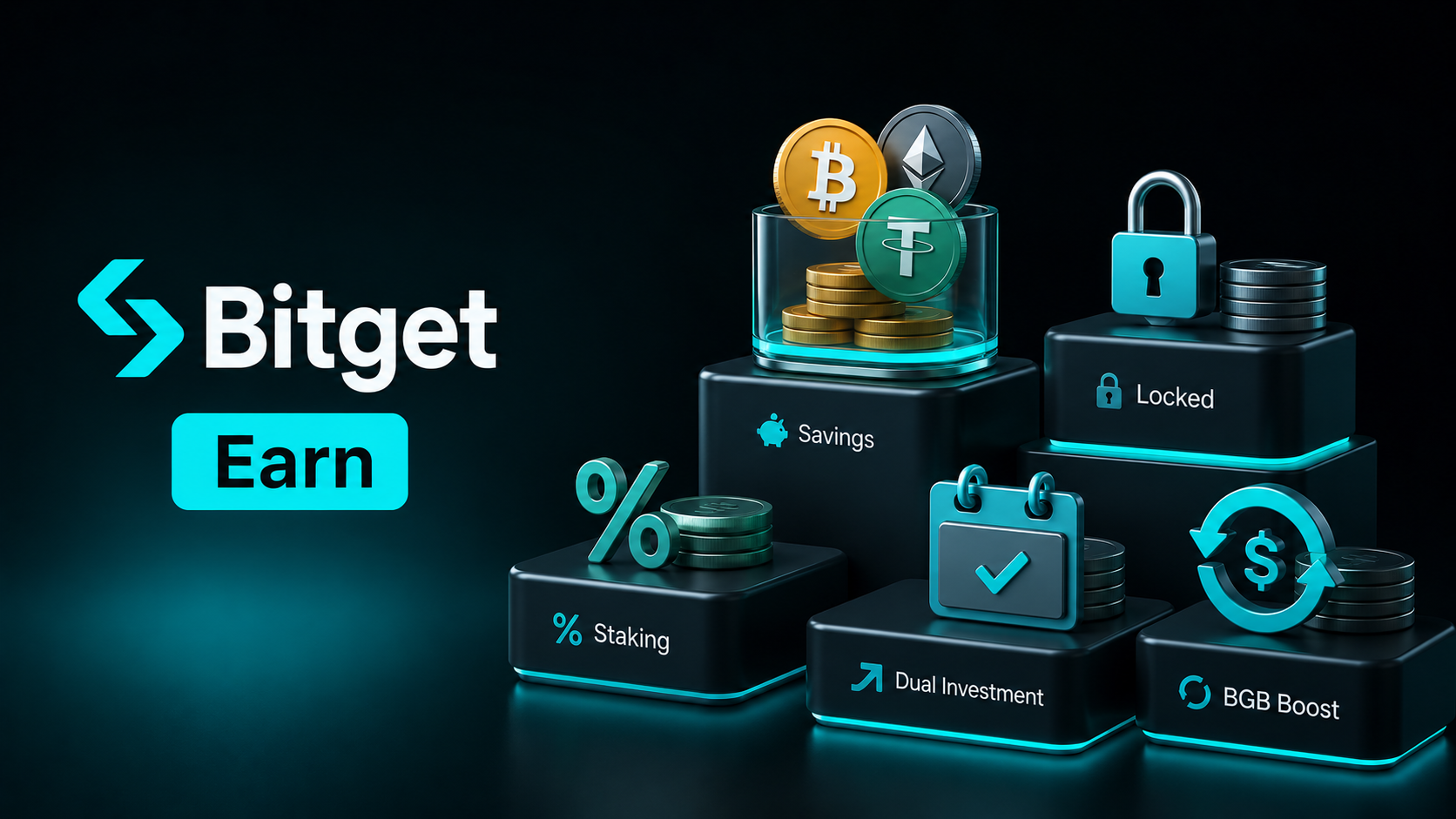
Short answer: BitGet Earn is the passive income wing of the exchange, covering Savings (flexible and fixed), Launchpool, PoolX, Shark Fin, Dual Investment, Smart Trend, and on-chain staking for major PoS chains. Realistic APYs range from 1–4% on flexible stables to 8–15% on locked promos and Launchpool, with structured products carrying higher headline rates and conditional risk. My rotation: flexible savings, PoolX, on-chain ETH staking.
Open BitGet Earn → (affiliate)
Key takeaways
- BitGet Earn has six product families: Savings, Launchpool, PoolX, Shark Fin, Dual Investment, Smart Trend, plus on-chain staking.
- Realistic flexible APY on USDT sits around 2–4%. Fixed promos can hit 10–15% on small caps with lock-ups.
- Launchpool and PoolX are the highest expected-value products if you already hold BGB.
- Shark Fin and Dual Investment look like savings but they’re structured products with conditional outcomes.
- Earn rewards are taxed as income in most jurisdictions — separate from disposal tax on selling the underlying.
What BitGet Earn is
BitGet Earn is a section of your BitGet account that lets you put idle crypto to work without leaving the exchange. You don’t bridge anything, you don’t connect a wallet, you don’t sign transactions. You click a product, pick an amount, agree to the terms, and the yield accrues to your spot account.
Under the hood, the products fall into three buckets:
- Lending products. You lend your crypto to BitGet (or its margin desk) and earn interest. Savings sits here.
- Reward pools. You stake one token to earn a different token. Launchpool and PoolX sit here.
- Structured products. You take on a market-conditional risk in exchange for a higher headline yield. Shark Fin, Dual Investment, and Smart Trend sit here.
The buckets matter because they have very different risk profiles. A flexible USDT savings product paying 3% is not the same animal as a Dual Investment product paying 60% APR. People confuse the two and end up holding the wrong asset at the wrong moment.
If you’re brand new to all of this, start with crypto for beginners before deciding what to deposit where.
Savings — flexible vs fixed
The simplest Earn product. You deposit a token, you earn interest, you withdraw when you want (flexible) or after a set period (fixed).
Flexible savings
Money in, money out, any time. Interest accrues hourly and pays daily to your spot account.
| Asset | Typical APY | Notes |
|---|---|---|
| USDT | 2.0–4.0% | Promotional tiers stack on top — first 500 USDT often pays higher |
| USDC | 1.5–3.5% | Slightly lower than USDT |
| BTC | 0.5–1.5% | Low because BTC borrow demand is thin |
| ETH | 0.8–2.0% | Higher than BTC, lower than stables |
| BGB | 1.0–3.0% | Plus Launchpool eligibility (covered below) |
Tiered rates are common — the first chunk of capital earns the headline APY, and the rate steps down on larger deposits. Read the small print before you deposit a five-figure stack expecting the headline rate on all of it.
Fixed savings
You lock for 7, 14, 30, 60, 90, or 180 days. The rate is higher than flexible but you can’t withdraw early without forfeiting interest.
Realistic fixed APYs:
- USDT 30-day: 4–8%
- USDT 90-day: 6–10%
- Mid-cap altcoin 30-day promo: 10–20% on first listing windows
The 30-day USDT product is where most of my “I’m waiting for a buy zone” capital sits. The trade-off is liquidity — if I want to deploy that capital into a sudden dip, I’m watching from the sidelines until the lock ends.
Which I use
Flexible USDT for short-term cash. Fixed USDT 30-day for capital I know I’m not touching that month. I skip fixed BTC and ETH unless the promo APY is exceptional, because tying up volatile assets for a low yield costs me more in opportunity than the yield pays.
For a wider view of yield strategies including non-exchange routes, the passive income in crypto post covers the whole map.
Launchpool — free tokens for BGB staking
This is one of the highest expected-value products on the platform, and the reason a small BGB stack is worth holding.
How it works
A new token gets listed on BitGet. Before it goes live, the team allocates a chunk of supply to a Launchpool reward. You stake BGB (or sometimes USDT, ETH, or another asset) into the pool for a defined window — typically 5–10 days — and you earn the new token pro-rata to your stake.
When the window closes, your BGB unlocks automatically and the new token lands in your spot account. You can sell it immediately, hold it, or transfer it.
What it actually pays
It varies hugely. Some Launchpools have paid the equivalent of 50%+ APR on the BGB staked. Others have paid less than 5% because the listed token tanked at launch. The expected value is positive across the long run if you participate in most pools, because the cost is just the opportunity cost of BGB during the staking window, and BGB isn’t going anywhere fast in 5 days.
My approach
I hold a small BGB position (enough for fee discounts on my trading volume, no more). When a Launchpool launches, I stake the full BGB position. When the window closes, the new token sells the same day unless the chart looks like something worth holding.
Treat the new tokens as airdrops — free money you sell to fund trading capital, not bags you marry. Most listed tokens lose 30–60% of their launch value within the first month.
When to skip a Launchpool
When the token is a vapourware meme, when the project has been pre-pumped on social before listing, or when the staking window is over 14 days and you’d rather have BGB liquid for something else. I skip maybe 1 in 5.
PoolX — year-round Launchpool
PoolX is Launchpool’s persistent cousin. Same mechanic — stake one token to earn another — but the pools rotate year-round instead of being tied to specific token launches.
What’s different
- Pools refresh continuously. Several active at any time.
- Lock periods are typically shorter (1–7 days).
- Reward tokens are usually established projects rather than fresh listings.
- APYs are lower than Launchpool but more predictable.
What it pays
Typical PoolX APYs run 3–15% depending on the staked asset and reward token. The pools paying high APY usually require staking a volatile altcoin. The pools paying low APY usually accept stablecoins.
A common pattern: stake USDT to earn a Layer 1 token at 5–8% APR. Lower upside than Launchpool, but the predictability is useful for capital you’d otherwise leave idle in flexible savings.
My approach
I rotate one slice of my stablecoin float through PoolX whenever a pool offers a token I’d hold anyway. I avoid pools paying high APY on tokens I don’t want — the APY looks great until you’re stuck holding a bag of an asset you didn’t choose.
Shark Fin — structured product
Now we leave the simple yield products and enter the conditional ones. Pay attention.
How it works
Shark Fin is a structured product with three possible outcomes based on where the underlying asset’s price ends up at expiry:
- Inside the range: you earn the high “shark fin” APY (often 20–80% APR equivalent).
- Above the upper barrier: you earn a lower minimum APY (typically 1–3%).
- Below the lower barrier: you earn the same lower minimum APY.
You pick the product based on whether you think BTC (or another underlying) will stay inside a range during the contract period.
What it actually pays
The headline APYs look spectacular — 60% APR on a 7-day product is not unusual. The expected return is much lower because in two of the three outcomes you only earn the minimum.
If you’re directionally neutral on the market for the next 7 days and you’d happily hold the underlying at either barrier, Shark Fin is a way to earn meaningful yield on a sideways view. If you have a strong directional view, this is the wrong product.
My approach
I use Shark Fin sparingly. Once or twice a quarter when I’m convinced BTC is range-bound and the barriers are wide enough that the max-APY outcome is realistic. The other 90% of the time I leave it alone.
If you don’t fully understand barriers, ranges, and conditional payoffs, do not put real money into Shark Fin. The marketing makes it look like savings. It isn’t.
Dual Investment — high APY with a catch
This is the product that traps the most people. The headline APY is enormous. The mechanic is brutal.
How it works
You deposit one asset (say USDT). You agree to a target price for another asset (say BTC). At expiry:
- If BTC is above your target price: you “win” — you get your USDT back plus the headline yield.
- If BTC is at or below your target price: you “lose” — your USDT is converted to BTC at the target price, plus the yield.
Or the reverse: deposit BTC, set a sell target. At expiry, either you keep BTC plus yield, or you sell BTC at the target plus yield.
What it pays
Headline APRs of 40–200% are common. Note these are APR, not realised return — on a 7-day product, a 100% APR pays roughly 1.9% over the week.
The trap
People deposit USDT into a Dual Investment hoping for the high APY, never imagining the alternative outcome. Then BTC dumps, their USDT gets converted to BTC at the target price (which is above current market), and they’re underwater on day one of holding an asset they didn’t want to buy at that price.
The same trap runs in reverse with BTC deposits — you wake up to find your BTC sold at a target price that’s now far below where the market traded after a pump.
When to use it
Dual Investment makes sense when you’re already planning to do the conversion. If you’d buy BTC at $80,000 anyway, depositing USDT into a Dual Investment with an $80k strike gives you a small yield bonus on top of the buy you were going to make. Same logic for selling.
The mistake is treating it as savings. It is a conditional limit order with a small yield kicker, not a high-yield savings product.
My approach
I use it when I have a specific buy or sell level I want anyway. Maybe once a month. I avoid the “look at this 200% APR” marketing entirely.
Smart Trend — auto-invest
Smart Trend is BitGet’s auto-invest product. You set a plan to buy a chosen asset on a schedule (daily, weekly, monthly) with a fixed amount each time.
How it works
- Pick the asset (BTC, ETH, or a basket).
- Pick the source (typically USDT).
- Pick the frequency and amount.
- Smart Trend executes the buys automatically.
What it does well
It removes the decision fatigue of trying to time entries. Dollar-cost averaging into BTC or ETH on a schedule has outperformed most retail traders’ active strategies historically.
For most people who aren’t going to actively trade, a Smart Trend BTC/ETH DCA running monthly will beat the result of trying to time the market with the same capital. It’s not exciting. That’s the point.
What it doesn’t do
It doesn’t optimise entries. It doesn’t pause during obvious tops. It doesn’t accelerate during obvious dips. It’s a dumb schedule, and the value of a dumb schedule is that you don’t override it when you’re emotional.
My approach
I run a small monthly Smart Trend into ETH for the long-term Ledger pile. The amount is small enough that it doesn’t compete with my trading capital. The discipline is the value.
If you’re looking at trading bots more broadly (grids, copy, signal-based), the crypto trading bots guide covers the whole space.
On-chain staking (ETH, SOL, ATOM)
BitGet runs on-chain staking pools for major Proof-of-Stake chains. You deposit, BitGet stakes on your behalf, you earn the network reward minus a small commission.
What it actually pays
| Chain | Typical APR | Lock | Notes |
|---|---|---|---|
| ETH | 2.5–3.5% | None on flexible, 1–14 days unstake | The standard ETH staking yield |
| SOL | 5–7% | Standard SOL unstake delay applies | Reasonable on-chain rate |
| ATOM | 8–12% | 21-day unstake delay | High APR, long lock |
| DOT | 10–14% | 28-day unstake delay | Highest rate, longest lock |
| ADA | 2–4% | Short | Lower than most because there’s no slashing |
The headline numbers are network rates, not BitGet bonus rates. BitGet skims a commission off the top — usually 5–15% of the reward — which is how the on-chain staking product makes money.
When it makes sense
If you already hold a PoS asset and you weren’t going to stake it elsewhere, BitGet staking is a one-click option. No node setup, no wallet management, no slashing risk on your end.
When to skip
If you can stake the same asset directly from your own wallet (Ledger Live supports ETH, SOL, ATOM, DOT), the direct route avoids the BitGet commission. The trade-off is convenience versus a small yield uplift.
For long-term ETH, I prefer to stake from a Ledger via Ledger Live or a non-custodial liquid staking protocol. For short-term staking I want to be able to unwind quickly, BitGet’s flexible option is fine.
BitGet Earn vs Ledger — which to use
This is the question I get asked most. The answer is “both, for different purposes”.
Use BitGet Earn for
- Active trading capital that’s between positions
- Short-term parking of stablecoins (flexible savings, PoolX)
- Tokens you’re considering selling within 30 days
- Launchpool farming where the new-token reward justifies the BGB lock
Use Ledger for
- Long-term BTC and ETH bags you don’t plan to touch for 12+ months
- Any single asset position above what you’re willing to lose in an exchange failure
- The staking products you can run directly from Ledger Live (ETH, SOL, ATOM, DOT)
- The “if everything goes to hell I still have this” reserve
The split I run
Roughly 15% trading float on BitGet, 25% in BitGet Earn for short-term yield, 60% on Ledger cold storage. Adjust based on your own risk tolerance. The full storage playbook is in how to store crypto safely and the hardware wallet rationale is in Ledger Nano X review and hot vs cold wallet.
The rule: if you’d lose sleep over an exchange failure wiping your entire BitGet balance, your balance is too big.
If you want to compare BitGet’s Earn ecosystem to its biggest competitor’s, the BitGet vs Binance breakdown covers the head-to-head.
Want to start putting idle crypto to work?
BitGet Earn lives inside your normal account. Sign up, complete KYC, deposit, and you’re one click from the flexible savings rates above.
Affiliate link. I may earn a commission at no extra cost to you.
The ones I avoid and why
I told you there were a couple I wouldn’t touch. Here’s why.
Anything advertising 100%+ APR on stables
If a BitGet Earn product offers triple-digit APR on a stablecoin product, it is almost always a structured product (Shark Fin, Dual Investment) in disguise, or a tiered product where the headline rate applies to the first 100 USDT and the rest pays 3%. Read the terms or skip.
Lock-ups longer than 90 days on volatile assets
If you lock BTC or ETH for 180 days at a low single-digit APY, the cost of being unable to deploy that capital during a market move is greater than the yield. A 30% market move makes that 4% lock-up feel painful very fast.
Promotional pools without a published rate after the promo ends
Some products advertise “first 7 days at 15% APY” with no public rate after day 7. You agreed to a lock-up. The post-promo rate could be 0.5%. Always check what you’re committing to past the promo window.
Niche altcoin staking on illiquid chains
Some Earn products stake obscure tokens on chains with thin liquidity. The published APR can look great until you try to sell the rewards and discover the order book has a 3% spread on a 10 BTC sell. The yield doesn’t make up for the slippage.
For higher-yield passive income that doesn’t sit on an exchange at all, see GoMining review for the BTC accumulation angle.
Tax on Earn rewards (income vs disposal)
This is the section that bites people who don’t read past the headline APY.
Income tax on rewards
In most jurisdictions — UK, US, Canada, Australia, most of the EU — Earn rewards are taxed as income at the moment they’re credited to your account. The taxable value is the fair market value of the reward token at the time of receipt.
That means if you earn 100 USDT in flexible savings, you owe income tax on 100 USDT worth of fair market value. If you earn 10 BTC worth of a new token from a Launchpool when the token was worth $0.20, you owe income tax on $2 of value, even if you never sell.
Capital gains tax on disposal
Separately, when you eventually sell or trade the reward token, you owe capital gains tax on the difference between the value at receipt and the value at sale. If your Launchpool reward was credited at $2 of value and you sold for $10, you owe income tax on the $2 plus capital gains on the $8 uplift.
What this means in practice
- Track the value of every reward at the time it lands. The BitGet export covers this.
- Don’t be the person who earns thousands in Launchpool rewards across a tax year and forgets to declare them.
- Crypto tax tools (Koinly, CoinTracker, others) handle the maths if you feed them your CSVs quarterly.
I am not your accountant. This is general information. Talk to a tax professional in your jurisdiction before deciding how to treat anything.
For the wider how-to on getting set up to earn in the first place, how to buy crypto covers the path from fiat to spendable BitGet balance.
My actual BitGet Earn rotation
Here’s what I run, in order of capital allocation.
- Flexible USDT savings. Default home for short-term capital. 2–4% APY, instant withdrawal.
- Fixed USDT 30-day. For capital I’m sure I won’t deploy that month. 4–8% APY.
- PoolX rotations. When the reward token is something I’d hold anyway. 3–15% APR.
- Launchpool farming. Whenever a new pool launches and the project isn’t obvious vapourware. Variable, often high.
- Smart Trend ETH DCA. Small monthly amount into ETH for the long-term Ledger pile.
- On-chain ETH staking. For the chunk of ETH that lives on BitGet during active trading. Direct staking from Ledger for the cold-storage ETH.
That’s six products. The rest of the Earn menu I either use occasionally (Shark Fin, Dual Investment, when the setup is right) or don’t touch.
How to actually use BitGet Earn (step-by-step)
If you’ve never used the Earn menu, here’s the walkthrough.
- Log into BitGet and click “Earn” in the top menu.
- Pick a product category — Savings, PoolX, Launchpool, Shark Fin, Dual Investment, Smart Trend.
- Browse the active products. Each shows the APR, the asset accepted, the term, and any limits.
- Click a product. Read the full terms including minimum and maximum stake, lock period, post-promo rate (if applicable), and reward distribution schedule.
- Enter your stake amount. The product confirms the expected return.
- Tick the terms checkbox and confirm. Your spot balance moves to the Earn position immediately.
- Track in the Earn tab. Active positions show accrued rewards in real time. Withdrawn rewards land in your spot account on the schedule defined by the product.
That’s the loop. Most products are one-click in and one-click out (where applicable).
Ready to put your USDT to work?
Open BitGet, complete KYC, and flexible USDT savings is two clicks away. No setup. No bridges. No drama.
Affiliate link.
Frequently asked questions
Is BitGet Earn safe?
BitGet Earn carries the same custody risk as the rest of the exchange — your funds are held by BitGet, not by you. The platform publishes monthly Proof of Reserves and runs a $400M+ Protection Fund. Specific products carry additional risk: structured products like Shark Fin and Dual Investment have conditional outcomes that can leave you holding an asset you didn’t intend to. Read the BitGet review for the full safety breakdown.
What is the minimum deposit for BitGet Earn?
It varies by product. Most flexible savings accept any amount above a low minimum (often 1 USDT or equivalent). PoolX and Launchpool minimums depend on the specific pool. Structured products usually require a minimum of 100–500 USDT equivalent.
Are BitGet Earn rewards taxable?
In most jurisdictions yes — Earn rewards are taxed as income at the value received, with capital gains tax due on any uplift when you later sell. Check the rules in your jurisdiction and use a crypto tax tool to track rewards.
What’s the difference between Launchpool and PoolX?
Launchpool ties to specific new token listings — you stake during a launch window and earn the newly listed token. PoolX runs continuously with rotating reward tokens, typically established projects rather than fresh listings. PoolX is more predictable, Launchpool has higher upside on hits.
Can I lose money in BitGet Savings?
In flexible and fixed savings, no — the yield is paid in the asset you deposited, and you receive your principal back. The risk is custody risk (BitGet itself failing) plus opportunity cost (your locked capital can’t be deployed). Structured products like Dual Investment and Shark Fin can leave you with a different asset than you deposited, which is a different risk class.
Does BGB earn rewards just by holding?
Not by sitting in your spot wallet. To earn, you need to stake BGB into a specific product — most commonly Launchpool, PoolX, or a flexible BGB savings product. Holding BGB does give you fee discounts on trading and access to Launchpool eligibility.
Which BitGet Earn product has the highest APY?
Headline APYs are highest on Dual Investment (sometimes 200%+ APR equivalent) and Shark Fin (often 60%+ APR). These rates apply only in specific market conditions. The highest realistic yield without conditional risk is usually fixed-term USDT promotions, which can hit 10–15% APR on smaller deposits.
Final word
BitGet Earn is a useful set of tools wrapped in marketing that pushes the products with the highest headline APY toward people who shouldn’t be in them. Flexible savings and PoolX are the workhorses. Launchpool is the free-money lottery if you already hold BGB. On-chain staking is fine if you don’t want to manage your own validator.
Structured products are not savings. Read the small print before you click confirm on anything paying triple-digit APR.
That’s the short version. The rest is reading the terms and matching the product to what you actually want from your capital.
Right — over to you.
Related posts
- BitGet Review: The Crypto Exchange I Actually Use
- How to Earn Passive Income in Crypto Without Getting Rugged
- How to Store Crypto Safely: The Self-Custody Guide