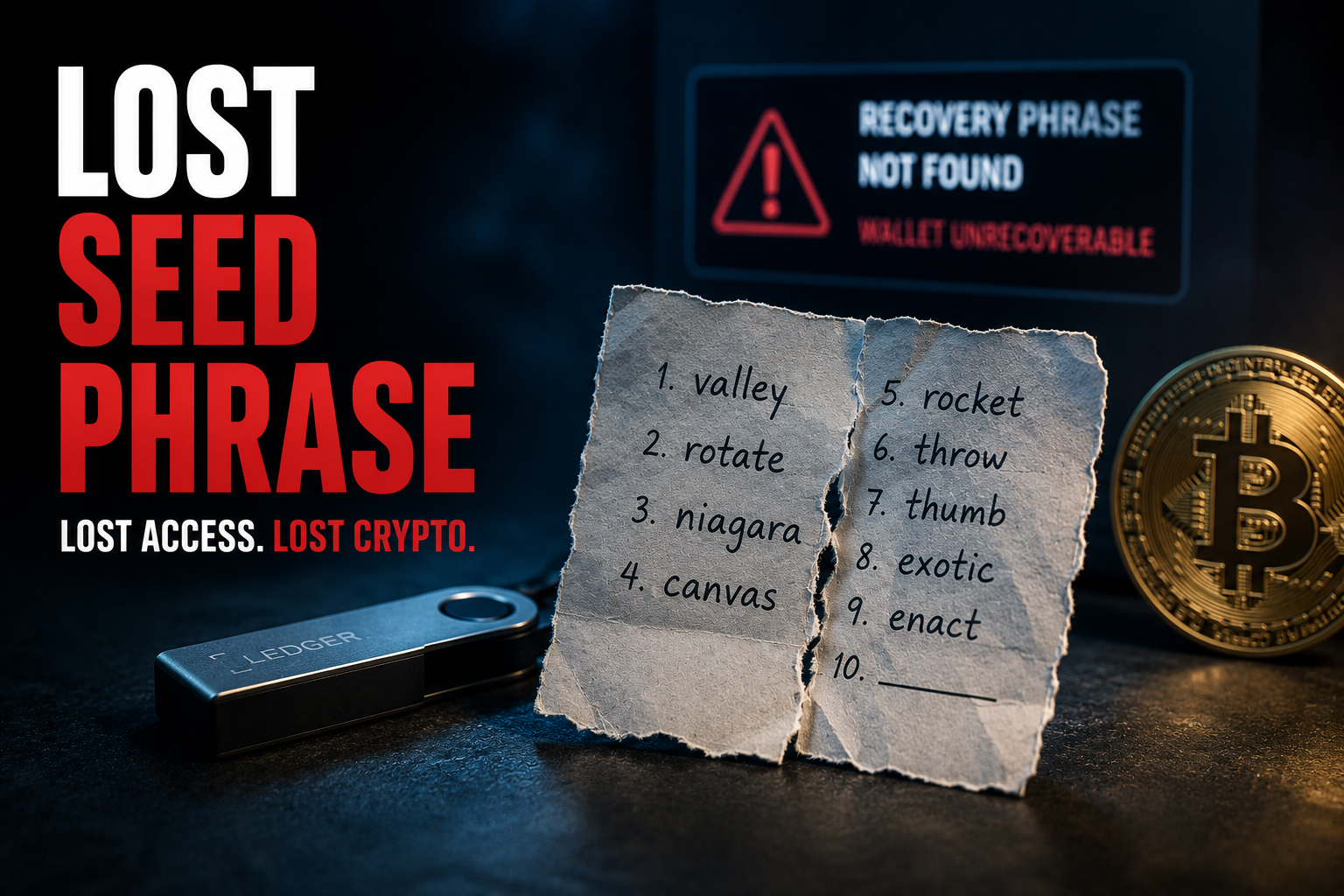
There’s a story most British crypto people know. A bloke in Newport, South Wales, threw away an old hard drive in 2013. On it was a wallet with 8,000 Bitcoin. He’s spent over a decade trying to convince the local council to let him dig through their landfill. The Bitcoin is still there. The council still says no.
That hard drive is the most famous seed phrase mistake in crypto history. Yours doesn’t have to be on a list like it. Here’s how to store a seed phrase so you actually have it when you need it — and nobody else does.
Some links are affiliate. Flagged when they appear.
Short answer: Write your seed phrase on metal (not paper), store it in at least two geographic locations, never store it digitally (no photos, no cloud, no password manager, no encrypted text file), and consider a BIP39 passphrase or Shamir Backup for added security. Test your backup at least once before relying on it. My setup: two metal plates, two cities, plus a Shamir split for the long-term bag.
Hardware wallet to generate the seed → (affiliate)
Key takeaways
- A seed phrase is the master key to your wallet. If someone has it, they have everything.
- Paper backups burn, flood, fade, and get thrown out by accident. Metal survives all of that.
- Never store a seed phrase digitally — no photos, no cloud notes, no password manager, no encrypted text files.
- Geographic split (multiple physical copies in different places) defends against fire and burglary at one location.
- BIP39 passphrase or SLIP-39 Shamir Backup adds layers without adding single points of failure.
What a seed phrase actually is
A seed phrase is a list of 12 or 24 words from a fixed 2,048-word dictionary, defined by the BIP39 specification. Those words deterministically generate every private key your wallet will ever produce.
That’s the bit most beginners miss. Your seed isn’t just the key to one wallet — it’s the key to every Bitcoin address, every Ethereum address, every Solana address that wallet has ever shown you or ever will show you. It’s a master key with infinite branches.
This means two things in practice:
- If you have the seed, you can restore the entire wallet on any compatible device.
- If anyone else has the seed, they own everything in the wallet, forever, regardless of what the device is doing.
The hardware wallet is a fancy holder for the seed. The seed itself is the asset.
The Ledger Academy has a good explainer on how BIP39 works if you want the maths.
Why paper is not enough
The default behaviour when you set up a Ledger or Trezor is: write the 24 words on the little recovery card that came in the box. Stick it in a drawer.
That’s better than nothing. It is not good enough.
Paper fails in predictable ways:
- Fire. House fires reach 800°C+. Paper is gone at 230°C.
- Flood. Burst pipes, leaky roofs, floods — paper turns to mush. Ink runs.
- Faded ink. Cheap pens and thermal paper fade in years, not decades.
- Kid with a crayon. Or a partner who “tidied up.” Or a dog. Or you, drunk, looking for a phone charger and chucking the wrong drawer’s contents.
- Theft. A burglar who sees a recovery card knows exactly what it is.
If you’ve been in crypto more than a year and your seed is on a piece of paper in a drawer, you have a single point of failure with a half-life shorter than the crypto cycle.
Metal seed storage options
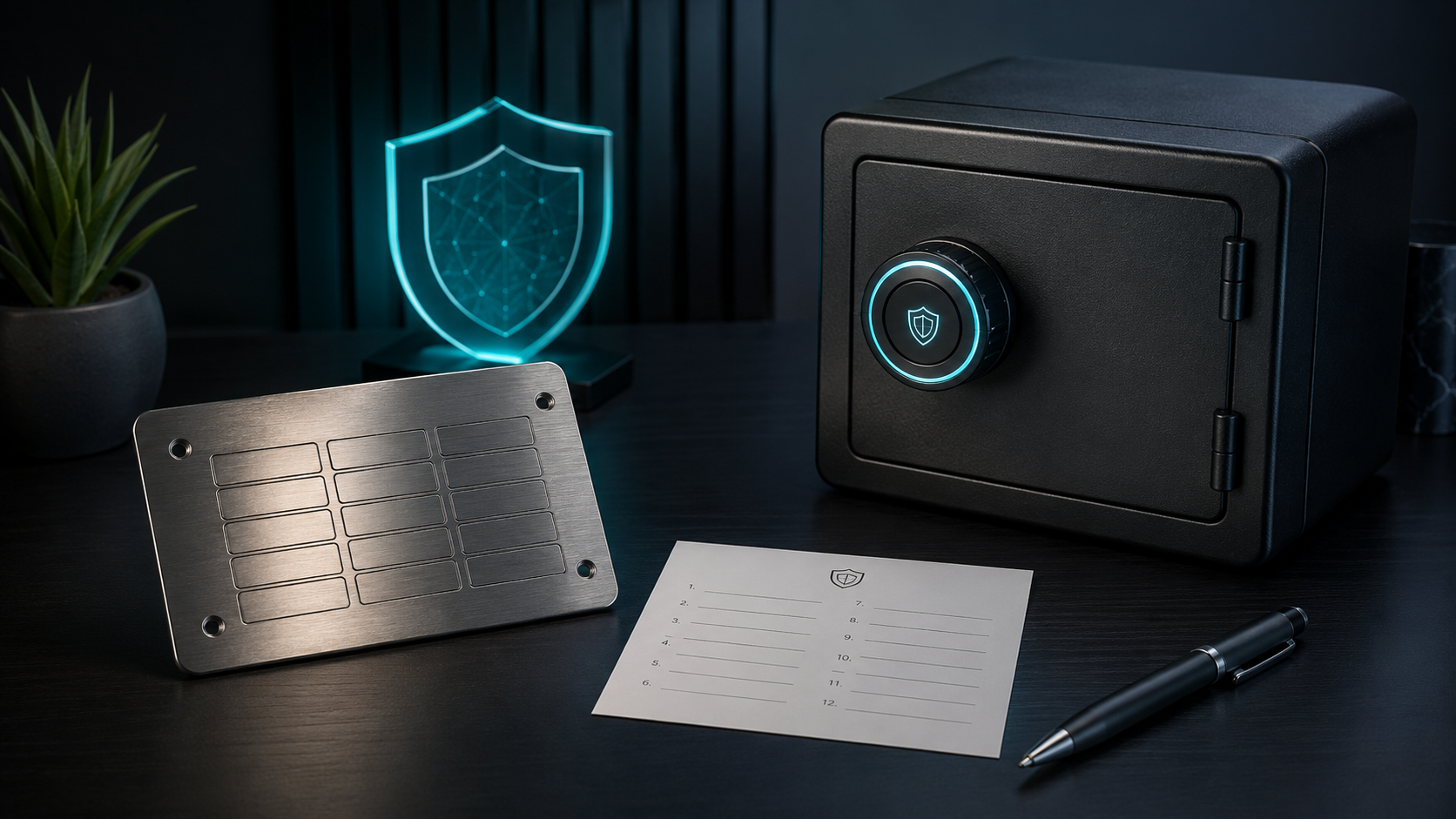
Metal plates are designed for this exact job. They’re fire-resistant, waterproof, and don’t fade. There are a few formats — pick one and commit.
Cryptosteel Capsule
A stainless steel tube with little metal letter tiles you slot in to spell out your 24 words. About £80–£100. Survives 1,200°C, full submersion, drops, pressure. Used by Coinbase and Trezor as their recommended backup.
Pros: actually fireproof at extreme temperatures, compact, easy to verify.
Cons: assembly is fiddly the first time, smaller capacity means you only get the first 4 letters of each word (which is enough — BIP39 words are uniquely identifiable by 4 letters).
Billfodl (now Privacy Pros Stronghold)
Stainless steel slate with slot-in letter tiles. Around £70–£80. Same concept as Cryptosteel but in a flat-pack form factor.
Pros: easier to assemble, easier to hide flat.
Cons: bulkier than the capsule, less compact for travel.
Stamp Seed
A blank titanium plate plus a set of letter stamps and a hammer. You literally stamp each letter into the metal. £50–£70 for the plate, plus the stamp kit.
Pros: cheapest titanium option, the most “won’t ever be undone” of the formats.
Cons: time-consuming, mistakes are permanent, you need a stable surface and an hour.
Other options I’ve tried
- Cryptotag — beautiful titanium plates, expensive (£200+), overkill but indestructible
- SafePal Cypher — cheaper steel washer system, fine for a backup of a backup
- DIY — a stainless steel washer set from a hardware store and a metal stamping kit will do the same job for £30 if you’re handy
What I use
Two Cryptosteel Capsules. One at home in a fire-rated document safe. One at a family member’s house across the country. The home one is the working copy I’d actually grab in an emergency. The remote one is the disaster-recovery copy in case the house is gone.
The capsule format suits me because I want the backup to be small enough to grab and run if I have 30 seconds.
Geographic split
One copy in one place is two coin flips away from disaster. The pattern that actually works is:
- Copy A: at home, in a fire safe rated for at least 30 minutes at 850°C
- Copy B: at a different physical location — family member’s house, bank safe deposit box, business premises
Two copies, two locations, both metal. If the house burns, copy B survives. If you’re burgled, copy A is in a safe and copy B doesn’t exist as far as the burglar knows.
Don’t do this
- Two copies in the same room (a fire takes both)
- Two copies in the same building (a flood or fire takes both)
- A copy at home and a copy “with a friend” if you don’t trust the friend with your entire wallet (they have the seed)
Bank safe deposit box?
Yes if your jurisdiction protects them well. No if you think the bank could be ordered to seize the contents during a financial crisis. UK and Swiss safe deposit boxes are generally safer than US ones from a regulatory perspective, but practices vary.
The point is: if you can pay £30 a year for a deposit box at a respectable storage facility, it’s one of the cleanest “second location” options going.
BIP39 passphrase (the 25th word)
This is the upgrade most people don’t know exists.
A BIP39 passphrase is an extra word (or sentence, or string of characters) you add to your seed phrase. Your hardware wallet asks for it on setup or in advanced settings. When you enter the passphrase, the wallet derives a completely different set of addresses than the seed alone would.
Practical implication: someone who steals just your 24 words doesn’t get into the wallet you actually use. They get into whatever “decoy” wallet the seed-without-passphrase generates — which can be empty or hold a small amount as a honeypot.
How to use it well
- Pick a passphrase you can remember without writing it down (a memorable sentence, not “P@ssw0rd1”)
- Store the passphrase separately from the seed — never in the same physical location
- If you’re going to write it down, store it in a third location, not with either seed copy
- Test the passphrase before relying on it — restore the wallet from seed + passphrase to a different device and confirm the addresses match
The trade-off
If you forget the passphrase, your funds are gone. Forever. The hardware wallet can’t help. The seed alone won’t unlock the right addresses. This is why most people don’t use it, and why most who do use a memorable sentence rather than random characters.
For high-value cold storage, the passphrase is worth it. For day-to-day wallets, the risk of forgetting outweighs the security benefit.
Shamir Backup explained
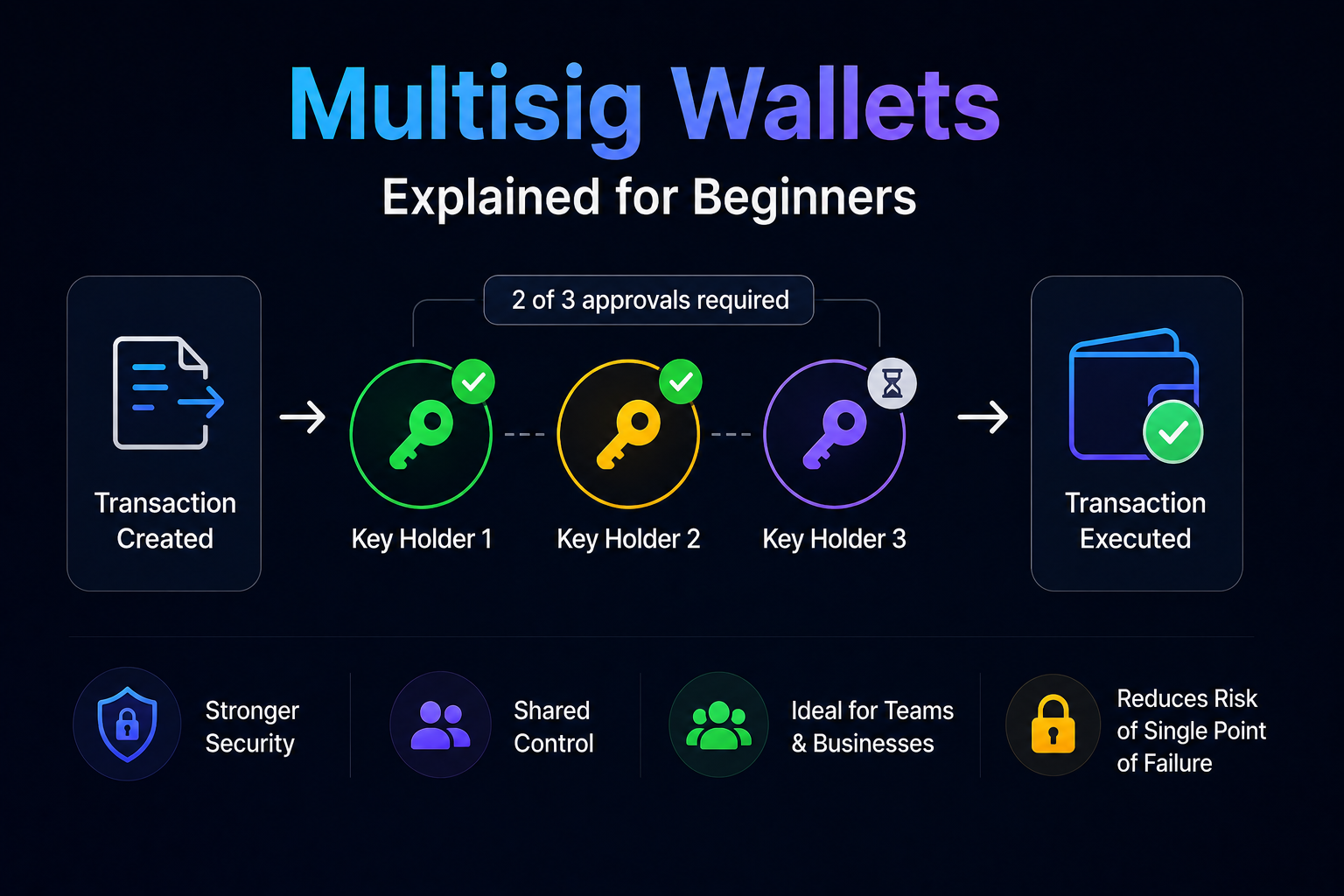
Shamir’s Secret Sharing (SLIP-39) splits your seed into multiple “shares” — typically 3, 5, or 7 — where any subset above a threshold can reconstruct the original seed. A 3-of-5 split, for example, means any 3 of the 5 shares are enough to recover, but 2 are not.
Trezor supports Shamir natively. Ledger doesn’t (yet). Some software tools can split an existing BIP39 seed into Shamir shares offline.
Why it’s useful
- Inheritance: Give one share each to five trusted people. Any three can reconstruct it if you’re gone. No single person has the whole thing.
- Geographic redundancy without single-point exposure: Store five shares in five locations. Lose any two and you’re still fine. A burglar at any one location gets nothing.
- Coercion resistance: Nobody can be threatened into giving up “the seed” because no single person has it.
The catch
- More complex to set up and verify.
- Requires Trezor or a separate Shamir tool — not native to Ledger.
- More physical objects to manage (5 plates instead of 2).
For most people, two metal plates in two locations is enough. For an inheritance plan or a large holding, Shamir is the next level up.
What to NEVER do
The list of things people have lost crypto to. Don’t be on this list.
Don’t photograph your seed phrase
A photo lives on your phone. The phone backs up to iCloud or Google Photos. Now your seed is on a cloud server that has been breached at scale before and will be again. Apple and Google employees can technically access it. Law enforcement can subpoena it.
The exact same applies if you take a photo of your seed card “just to send to yourself.”
Don’t store it in a password manager
Even an encrypted password manager like 1Password or Bitwarden. The seed phrase is the master key to all your crypto. A password manager is the master key to all your passwords. You do not put one master key inside another master key.
If your password manager is compromised (it has happened — see the LastPass breaches reported by Reuters in 2022), the seed goes with it.
Don’t store it in an encrypted text file
“It’s encrypted, so it’s safe.” It’s encrypted with a password that is now the new seed. The password you used is probably also in your password manager. See above.
Don’t email it to yourself
Email lives on email servers. Email servers get hacked. Your email password gets phished. Don’t.
Don’t store it in cloud notes (iCloud Notes, Google Keep, Evernote)
Same issue as photos. Anything that syncs leaves your control.
Don’t type it into a “recovery website”
No exchange, wallet provider, or legitimate company will ever ask you to type your seed phrase into a website to “verify” anything. Any site asking for your seed is a scam. The full scam playbook is in crypto scams guide.
Don’t tell anyone the words
Not your partner if you don’t trust them with all your money. Not your accountant. Not “support.” Not your IT-literate son. The number of people who should know your seed phrase is one: you.
For inheritance, use Shamir Backup so no single other person has the full seed.
Inheritance — passing the seed on safely
The morbid bit nobody plans for. If you got hit by a bus tomorrow, can your family access your crypto?
For most crypto holders, the honest answer is no. The funds sit in a hardware wallet with a seed nobody else knows, and the family has no idea where the seed is or what to do with it.
Options
1. Sealed letter with a lawyer
A sealed envelope with instructions, given to a solicitor, opened on your death. Risks: the lawyer is a third party, the envelope can be lost or opened.
2. Shamir Backup with trusted parties
3-of-5 Shamir split. One share with your partner, one with a parent, one with a sibling, one with a lawyer, one in a deposit box. Any three together can reconstruct it. No single person can access it alone.
3. A simpler “letter of last instructions”
A document in your safe that tells the executor: “There is a hardware wallet in X location. The recovery sheet is in Y location. Contact Z to help with the recovery process.” Combined with a metal backup in a second location, this is the lowest-friction option.
Don’t
- Don’t write the seed into a will. Wills become public after probate.
- Don’t email a lawyer the seed.
- Don’t text it to a family member.
A real inheritance plan takes an afternoon to set up and means your family doesn’t lose a six-figure bag to a forgotten drawer.
The system I actually use
For reference. Not advice — this is what fits my situation.
Day-to-day trading wallet
- Lives on the exchange. No seed phrase to back up (the exchange holds the keys).
- Small float, sized to what I’d lose without losing sleep.
- The BitGet review covers the exchange I use.
Active multi-coin wallet
- Ledger Nano X — order from Ledger directly (affiliate)
- Seed written on a Cryptosteel Capsule
- One capsule at home in a fire-rated safe
- One capsule at a family member’s house in a different city
- No BIP39 passphrase on this wallet — the trade-off isn’t worth it for an active wallet
- I confirmed both backups work by doing a dry-run restore on a spare Ledger before going live
Long-term Bitcoin cold storage
- Trezor Safe 5 with Shamir Backup, 3-of-5 split
- Five metal plates, five locations (home, parent, sibling, lawyer, deposit box)
- BIP39 passphrase on top, memorised, not written anywhere
- I have never made a withdrawal from this wallet. It exists to be untouched for years.
The principle
Tiers. The day-to-day money is easy to access and small. The active wallet is moderately protected. The long-term bag is overprotected to the point of being annoying — which is exactly what I want.
The hot vs cold wallet post explains the tiering principle in more detail.
Testing your backup
The biggest failure mode of all of this: you set it all up perfectly, you store the metal plates correctly, you do the geographic split — and you never actually test that the backup works.
Years later, when you need it, you discover you stamped one letter wrong on plate B. The wallet doesn’t restore. Your money is locked.
The test
- Set up your hardware wallet and seed.
- Wipe the device (factory reset).
- Restore from your metal backup. Confirm the wallet shows the same addresses.
- Wipe again. Restore from the second backup. Same check.
- Now deposit funds.
The order matters. Test the backup before you trust it. The 30 minutes this takes is the single highest-leverage time investment in your crypto security.
For Shamir setups, test that any valid threshold combination of shares restores correctly.
Learning to handle the trading side without losing the bag
A seed phrase backup keeps your crypto safe. Learning to trade well is what stops you spending it badly. If you want education from a community that doesn’t sell pump groups, the one I’m part of is Trade Travel Chill (affiliate). Structured trading education, real curriculum. Personal recommendation.
For the wider security playbook, how to store crypto safely is the pillar post and crypto scams guide covers the attacks you’re defending against.
The right tool for the job.
A hardware wallet generates the seed offline. The seed never touches an internet-connected device. That’s the whole point.
Affiliate link. I may earn a commission at no extra cost to you.
Frequently asked questions
What’s the safest way to store a seed phrase?
Metal storage in at least two geographic locations, with no digital copies anywhere. For larger holdings, add a BIP39 passphrase or use Shamir Backup to split the seed across multiple shares.
Can I store my seed phrase in a password manager?
No. A password manager is connected to the internet and protected by a single password that can be phished. Your seed phrase should never exist in any digital form.
Is it OK to write my seed phrase on paper?
It’s better than nothing but not enough. Paper burns, floods, fades, and gets thrown out. Metal storage is the standard for anything you’d be upset to lose.
What is a BIP39 passphrase?
An optional extra word added to your 24-word seed phrase that derives a completely different wallet. It protects against someone finding just your seed phrase — they’d get a decoy wallet, not your real one.
What is Shamir Backup?
A method of splitting your seed phrase into multiple shares where a threshold of them can reconstruct the original. For example, 3 of 5 shares are needed. Trezor supports it natively.
Should I take a picture of my seed phrase as a backup?
Never. Photos sync to cloud services that can be breached, subpoenaed, or accessed by employees of the cloud provider. Once your seed is digital, you’ve broken self-custody.
Where should I keep my second seed phrase copy?
Somewhere physically distant from the first. A family member’s house in a different city, a bank safe deposit box, or a business premises. The point is fire or burglary at one location shouldn’t affect the other.
How often should I test my seed phrase backup?
Once at setup is essential. After that, retest annually or after any change to your storage setup. The test costs nothing and is the only way to know your backup actually works.
Final word
The seed phrase backup is the single most important thing you’ll do as a self-custody crypto holder. Everything else — the hardware wallet, the exchange, the 2FA, the VPN — is layered on top of a backup that either works or doesn’t.
Get the metal. Pick two locations. Test the restore. Then forget about it for years, secure in the knowledge that the worst day of your life still doesn’t take your crypto with it.
The man in Newport is still trying to dig up his landfill. Don’t be him.
Right — over to you.
Related posts