Every time someone in a Telegram group brags about “earning 20% on my crypto”, they usually mean one of three things: they’re staking a token nobody outside their group has heard of, they’re farming a yield that will halve next month, or they don’t actually know where the money is coming from. Real staking pays. It’s just nowhere near as exciting as the marketing pretends. This is what staking actually is, what the realistic APYs look like across the major coins I’ve held, and the bits the YouTubers conveniently leave out — slashing, lock-ups, and the tax bill that lands the moment your rewards drop.
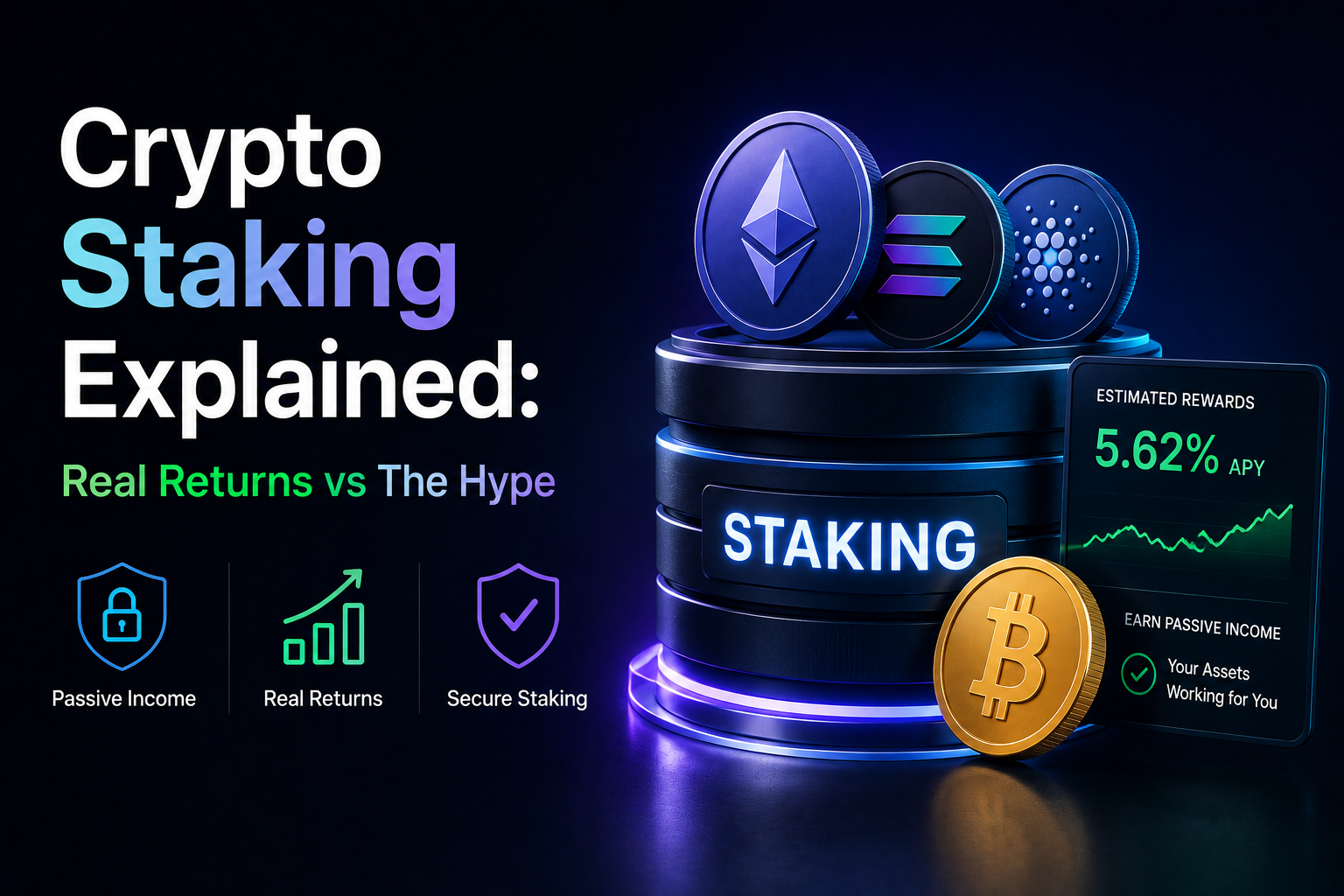
Short answer: Crypto staking is locking up Proof-of-Stake tokens to help secure a blockchain in exchange for newly issued tokens as a reward. Realistic APYs sit at roughly 3-4% for Ethereum, 6-7% for Solana, 3% for Cardano, 10-15% for Polkadot, and 15-20% for Cosmos at the time of writing. You can stake on an exchange like BitGet (easy, custodial, no slashing risk to you), or self-custody via Ledger Live, Lido, or a validator (more control, your funds, your responsibility). The yield is real. The risks are real too — lock-ups, slashing, token-price falls, and tax on every reward.
See BitGet Earn staking products → (referral link)
Key takeaways
- Staking only exists on Proof-of-Stake (PoS) blockchains. Bitcoin can’t be staked — it uses Proof of Work.
- Ethereum’s real staking yield sits around 3-4% per year. Anyone offering you 15%+ on ETH is either lying or running a yield-farming structure with extra risk.
- Centralised staking through an exchange is the easiest entry — usually no minimum, no lock-up, but you trust the exchange to not blow up.
- Self-custody staking through Ledger Live or Lido keeps your keys in your hands but exposes you to slashing, lock-ups, and protocol risk.
- Every staking reward is income on the day you receive it in most jurisdictions, including the UK and US. Even if you never sell, you owe tax on the rewards.
What crypto staking actually is
Staking is how Proof-of-Stake blockchains stay secure.
On Bitcoin, miners burn electricity to win the right to add a block. On Ethereum after The Merge in September 2022, that job got handed to validators — computers that put a deposit of ETH on the line and propose new blocks in exchange for rewards. If a validator behaves, it gets paid. If it tries to cheat or stays offline, it gets slashed — meaning the network burns part of its stake.
When you stake your tokens, you’re either running a validator yourself or you’re delegating your tokens to someone else’s validator. Either way, your tokens count toward the security of the chain. In return, the protocol pays you new tokens out of its issuance schedule, plus a slice of transaction fees on most chains.
That’s the whole idea. You lock up tokens, the network is more secure, you get paid for the privilege.
Why staking is not the same as savings interest
Banks pay you interest because they’re lending your deposits out at a higher rate. Staking pays you new tokens because the protocol mints them. There’s no borrower on the other side. The yield is essentially inflation paid back to people who help secure the network.
That has two implications most beginners miss.
One — if you’re not staking, you’re being diluted. Other holders staking and earning new tokens means your share of the total supply slowly shrinks every year. On a chain like Ethereum with around 4% issuance going to stakers, the non-staking holders are losing roughly 4% of their relative position annually.
Two — the dollar yield depends on the token price as much as the APY. A 6% APY on a token that drops 50% in fiat is a worse outcome than a 0% yield on a token that goes flat. The APY number on its own tells you almost nothing about whether you made money.
The Ethereum.org staking documentation is the most honest plain-English explainer the protocol itself publishes. Read it once if you plan to stake ETH directly.
Why staking pays (the validator economics)
This bit matters because it tells you where the upper and lower bounds on yield come from.
Validators get paid in two ways. First, block rewards — the protocol mints new tokens on a fixed schedule and hands them to the validator who proposed the block. Second, transaction fees — every transaction in the block pays a small fee, and the validator pockets some or all of it (on Ethereum, most fees are burned, but priority tips go to the validator).
The total yield available to all stakers in a year is roughly: (annual block rewards + annual transaction fees going to validators) divided by (total tokens staked). The more people staking, the more that pie gets sliced. The fewer people staking, the higher each staker’s share.
That’s why staking APYs tend to drift down over time as more tokens get staked. On Ethereum, when staking opened in late 2020 with very few validators, yields were close to 20%. Once 30% of total supply was staked, yields settled around 3-4% where they sit today.
Solana, with around 70% of supply staked, pays around 6-7% net. Cardano, with around 60% of supply staked, pays around 3%. Cosmos, with high inflation by design, pays 15-20% but the token price absorbs that inflation in different ways depending on the cycle.
The point is: APY numbers aren’t promises. They’re the output of a formula that moves as supply, staking rates, and network activity all shift.
Staking Rewards and CoinGecko’s staking dashboard both publish real-time APYs across major chains. Bookmark them. The marketing on exchanges sometimes lags reality by weeks.
Realistic APYs by coin (the honest table)
Here’s the actual range you should expect across the major stakeable coins. Numbers move week to week — these are rough current ranges, not guarantees.
| Coin | Realistic net APY | Lock-up / unbonding | Slashing risk | Min stake (self-custody) |
|---|---|---|---|---|
| Ethereum (ETH) | 3-4% | ~1-5 days exit queue | Yes (up to 100% in extreme cases) | 32 ETH solo / no min on Lido |
| Solana (SOL) | 6-7% | ~2-3 days (1 epoch) | No slashing yet — penalties only | No min |
| Cardano (ADA) | 2-3% | None (instant unstake) | No slashing — soft penalties | No min |
| Polkadot (DOT) | 10-15% | 28 days | Yes | 250 DOT min for direct nomination |
| Cosmos (ATOM) | 15-20% | 21 days | Yes | No min |
| Avalanche (AVAX) | 5-8% | 2 weeks minimum | No slashing — uptime penalties only | 25 AVAX min |
| Polygon (MATIC/POL) | 4-5% | 3-4 days | Yes | No min |
| Tezos (XTZ) | 4-5% | None | No slashing — uptime penalties | No min |
A few things worth flagging.
Ethereum’s yield includes MEV (maximum extractable value) tips when validators capture them. Solo stakers and well-run pools usually earn 0.5-1% extra on top of the base reward. Custodial exchange staking often skims this out as fee. The headline number on an exchange might be lower than what a validator with MEV-Boost earns.
Cosmos’s 15-20% APY looks great until you look at ATOM’s price chart. The high inflation is paid in tokens that are also being printed faster than demand absorbs them. The dollar-equivalent yield over a 3-year window has often been negative.
Polkadot’s APY is calculated assuming you stake into the active validator set. If you sit in the waiting set you earn nothing. If you nominate the wrong validator, you also earn nothing. The 10-15% range is only for active stakers paired with reliable validators.
The lesson here: the headline APY is not the yield. The yield is the APY minus the token price drift minus any slashing event minus any inactivity periods.
Centralised staking vs self-custody staking
This is the choice everyone faces. The trade-off is the same one as choosing an exchange vs a hardware wallet.
Centralised staking (BitGet, Coinbase, Kraken, etc.)
You deposit your tokens to the exchange. The exchange runs validators or pools your tokens with other users. They take a cut (usually 10-25% of the reward) and pass the rest to you.
Pros: no minimum amount, no technical setup, no slashing risk for you (the exchange wears that), often shorter or no unbonding period because the exchange handles liquidity internally, easy to compound back into trading capital.
Cons: you’re trusting the exchange not to fail. You don’t actually own your staked tokens — you have a claim on the exchange. If the exchange goes down (FTX-style), your staked balance is part of the bankruptcy.
This is how I stake the active portion of my portfolio. I run a small amount of ETH staking through BitGet because the convenience matters more than squeezing the extra 0.5% from a self-custody setup. The BitGet Earn products page has the full list of stakeable assets and current APYs.
Self-custody staking (Ledger Live, Lido, native wallets, solo validator)
Your tokens never leave your control. You either run your own validator (hardcore) or you delegate to a validator from inside a self-custody wallet.
Pros: you keep your keys. No exchange counterparty risk. You earn closer to the raw protocol yield with no exchange fees. You’re contributing to actual decentralisation.
Cons: you wear slashing risk directly. You handle lock-ups and unbonding. You need to pick validators carefully — a bad one can underperform or get slashed. Minimum amounts can apply (32 ETH for solo Ethereum staking, 25 AVAX for Avalanche, etc.).
I do this with my long-term ETH bag. The wallet I use is a Ledger Nano X — Ledger Live has native staking integrations for ETH (via Lido and others), Polkadot, Cosmos, Tezos, Solana, and a few more. The full self-custody playbook is in how to store crypto safely.
Liquid staking — the middle ground
Liquid staking protocols like Lido, Rocket Pool, and Marinade let you stake without locking up. You deposit ETH, get stETH back (a token that represents your staked ETH plus accrued rewards), and you can sell or use the stETH at any time.
This solves the lock-up problem at the cost of an extra smart-contract risk layer. If Lido’s smart contracts have a bug, your stETH might depeg from ETH. If the validator set Lido uses gets slashed at scale, your stETH takes a hit.
I’ll cover this in detail further down. The short version: liquid staking is convenient but it’s not free. You’re trading lock-up risk for smart-contract risk.
Lock-ups and unbonding periods (the hidden cost)
The unbonding period is the time between deciding to unstake and actually being able to move your tokens. It’s the cost of admission.
| Chain | Unbonding period | Notes |
|---|---|---|
| Ethereum | ~1-5 days | Variable, depends on exit queue |
| Solana | ~2-3 days | One epoch |
| Cardano | None | Instant unstake |
| Polkadot | 28 days | Long for a reason — security |
| Cosmos | 21 days | No partial early exit |
| Avalanche | 14 days | Minimum, can be longer if you chose longer lock |
| Polygon | 3-4 days | Plus checkpoint delay |
| Tezos | None | Instant |
Two things to think about.
One — the price can move 30% in 21 days. That’s the real cost of a long unbonding period. If you stake Cosmos and the market turns, by the time your tokens unlock you might have lost more on the price than you earned in staking yield. This is why a lot of Cosmos stakers are permanently underwater on a fiat basis even though their ATOM stack keeps growing.
Two — exchanges hide the unbonding period most of the time. They run an internal float so you can withdraw “staked” balances on demand. That works until enough people try to withdraw at once and the float runs out. Coinbase had this issue during the 2022 crash with stETH redemptions. Always read the small print on “flexible” staking products.
The BitGet Earn products breakdown covers which staking tiers have lock-ups vs flexible withdrawal. The flexible ones pay lower APY for a reason.
Slashing risk: the part most posts skip
Slashing is when the protocol confiscates a chunk of a validator’s stake as punishment for bad behaviour. The two trigger conditions are usually:
- Double-signing — proposing two conflicting blocks. This is treated as an attack on the chain. Penalty: a significant chunk of stake, sometimes 100% in extreme cases.
- Going offline — failing to participate in attestations or block production. Penalty: smaller, usually a few percentage points of stake.
On Ethereum, slashing has happened. The largest single slashing event so far hit around 75 validators in a single coordinated incident in 2024 that took out roughly 2,400 ETH between them — covered in CoinDesk’s reporting on validator client diversity issues. Most slashing is much smaller — a single validator going offline for a few hours might lose 0.01 ETH. But the tail risk is real.
If you delegate to a validator (either via self-custody or centralised), the slashing applies to that validator’s whole pool — including your delegated share. The exchange usually wears it on their book (because they staked your tokens against their own balance sheet), but contractually you might still bear part of it. Read the terms.
For solo Ethereum staking, slashing is the main reason most people don’t bother running a validator from a Raspberry Pi at home. You need redundancy on the hardware, software, and internet side, or one outage during a critical attestation period and you’re paying for your mistake.
The practical takeaway: if you’re staking through an exchange like BitGet, the exchange wears the slashing risk. If you’re self-custody staking via Ledger Live and a delegated validator, you wear it — pick a validator with a long uptime record and a stake spread across multiple clients.
Liquid staking tokens (stETH, mSOL, jitoSOL) explained
Liquid staking is the biggest innovation in the staking ecosystem post-2022. It solves the “my tokens are locked” problem by giving you a tradeable receipt for your stake.
Here’s how it works with Lido and Ethereum, the largest example.
You deposit ETH into the Lido smart contract. Lido stakes that ETH across roughly 30 different professional validators. In return you receive stETH (staked ETH) — a token that represents your share of the staked pool plus the rewards earned over time.
The price of stETH is roughly pegged to ETH but it rebases — your stETH balance increases daily as the rewards accumulate. Or, in the wrapped version (wstETH), the balance stays fixed but each wstETH increases in ETH-equivalent value over time.
The clever bit is you can do anything with the stETH that you can do with ETH. Sell it, use it as collateral on Aave or Spark, swap it for stablecoins, deposit it into a curve pool for extra yield. Your staked position keeps earning the underlying ETH yield even while the receipt token is doing something else.
The risks of liquid staking
Three big ones.
Smart contract risk. Lido’s contracts hold billions of dollars. A bug or exploit could take them down. Lido has been audited extensively but no contract is exploit-proof.
Depeg risk. stETH should trade at roughly the same price as ETH plus accrued rewards. During the 2022 Luna/3AC collapse, stETH depegged to as low as 0.94 ETH because forced sellers needed liquidity faster than the redemption queue allowed. The peg held in the end, but anyone who panic-sold ate the spread.
Centralisation risk. Lido has historically held over 28% of all staked ETH at points. Some in the Ethereum community see this as a long-term threat to chain decentralisation. There’s no specific failure mode tied to this, but it’s a concentration risk worth knowing about.
For Solana, the equivalents are mSOL (Marinade) and jitoSOL (Jito). Both work the same way and carry similar trade-offs.
I hold a chunk of wstETH on a Ledger as part of my long-term ETH bag. The convenience of being able to move or use it without a 5-day unbonding queue is worth the smart contract risk to me. Your tolerance might be different.
Staking pools vs solo staking
For most coins, you have three options.
Solo staking. You run your own validator on your own hardware. Pros: maximum yield, no third party, you support decentralisation directly. Cons: high technical bar, you wear all slashing risk, often a minimum amount (32 ETH for Ethereum).
Pool staking. Multiple users pool tokens into a single validator setup run by a node operator. Pros: lower minimum, easier setup, slashing risk is mutualised. Cons: you trust the pool operator, fees of 10-25%.
Liquid staking pool. Same as pool staking but with a receipt token you can use elsewhere. Pros: capital efficiency, no lock-up. Cons: smart contract risk, depeg risk, pool fees.
For 90% of retail crypto users, pool staking via an exchange or liquid staking via Lido/Rocket Pool is the right answer. Solo staking is only worth it if you have 32+ ETH, a stable internet connection, redundant hardware, and an interest in running infrastructure.
The crypto for beginners primer covers wallet and exchange basics if you’re still working out which step to take first.
Tax: staking rewards are income on the day you receive them
This is the section most beginners skip and then get a nasty surprise on come tax season.
In the UK, the US, Canada, Australia, and most EU jurisdictions, staking rewards are treated as income at the fair market value of the token on the day you received it. Not the day you sold it. Not when you eventually convert to fiat. The day the reward landed in your wallet.
That means if you stake ETH and earn 0.001 ETH per day, you have a tiny income event every day, summing up across 365 days into a real tax bill. If ETH was at $3,000 on the day of one reward and $4,000 on the day of the next, the income value is calculated at the price on each individual date.
Then when you eventually sell the tokens, you have a separate capital gains event based on the difference between the value when you received the reward (your cost basis) and the value when you sold.
This creates a record-keeping nightmare if you stake actively. Tools like Koinly, CoinTracker, and Recap can usually pull staking history directly from exchanges and major liquid staking protocols. For self-custody staking you may need to export validator data manually.
A few specifics worth knowing.
HMRC (UK) treats most staking rewards as miscellaneous income, subject to your marginal income tax rate. There’s an allowance of £1,000 per year of trading/miscellaneous income before tax kicks in. Above that, you owe whatever your tax band charges. CGT applies separately on disposal.
IRS (US) treats staking as ordinary income on receipt, taxed at your marginal rate. The 2023 Jarrett v. United States case briefly suggested staking rewards might not be taxable until disposal, but the IRS has continued to treat them as income on receipt. Don’t bet against the IRS on this.
Most EU jurisdictions follow income-on-receipt rules with various allowances and holding period rules. Germany has historically had a one-year holding rule that exempts long-held crypto from CGT — confirm the current rules before assuming.
The practical action: keep records. Use a tax tool. If you’re earning anything meaningful from staking, talk to a crypto-aware accountant in your country. Reuters has covered the growing tightening of crypto tax enforcement across major jurisdictions in recent years — this is not an area to wing it.
How to actually start staking
Two paths. Pick based on how much hand-holding you want.
The easy path — centralised exchange staking
This is what 80% of beginners should do.
- Open an exchange account. BitGet is the one I use. Sign-up is about 90 seconds, KYC usually clears same day.
- Buy the token you want to stake. Use spot trading, not futures. The BitGet spot trading guide covers the basics if you’ve not done it before.
- Move to the Earn section. Find the staking product for your token.
- Choose flexible (no lock-up, lower APY) or fixed-term (locked, higher APY).
- Confirm. Rewards start accruing within a day or two.
That’s it. Zero technical setup. The exchange handles validator selection, slashing risk, and reward distribution. They take a cut — usually 10-20% of the underlying yield — and you trust them not to blow up.
The BitGet Earn products breakdown covers each staking variant currently offered.
The self-custody path — Ledger Live + delegated validators
This is what I do with my long-term ETH and DOT bags.
- Get a Ledger Nano X. Set it up properly — seed phrase on paper, never on a phone or photo. The how to store crypto safely guide goes step by step.
- Open Ledger Live. Install the relevant chain apps (Ethereum, Polkadot, Cosmos, Solana, etc.).
- Move your tokens to your Ledger from the exchange. Confirm the address twice. Send a test amount first if it’s a large balance.
- In Ledger Live, find the staking section for your chain. Pick a validator. Look for: long uptime record, low commission (5-10% is typical), reasonable total stake (not too concentrated), and ideally client diversity for Ethereum.
- Confirm the delegation on the Ledger device. Done.
The yield is slightly higher than centralised (no exchange skim) but you wear the slashing risk and unbonding period directly. Pick validators carefully.
A note on learning to think about yield
This bit applies whether you’re staking, lending, or running a bot. The best lesson I’ve learned from being part of the Trade Travel Chill community is this — you have to think about yield in real terms, not headline terms. A 15% APY on a token that drops 30% is a worse outcome than a 0% return on stablecoins. Most retail traders learn this the hard way over a few cycles.
If you want to actually learn to think about yield and trade properly, TTC is the structured education community I’m part of and the one I trust. It’s not a tipster group — it’s people working out the maths together. Worth a look if you’re past the basics and want to get sharper.
Want to stake without the technical setup?
BitGet Earn lists every major stakeable token with current APYs. No minimum amount, flexible or fixed term, rewards credit daily.
Referral link. I may earn a commission at no extra cost to you.
Common staking mistakes I see retail traders make
Five mistakes that show up over and over. I’ve made most of them myself.
Chasing the highest APY
A 50% APY on an unknown chain is almost always either a Ponzi structure, a token that’s being hyper-inflated to make the APY look good, or both. The real rule of thumb: if the APY is more than 2x the inflation rate of major stable chains (so above ~15-20% as of now), something is wrong. Read the tokenomics. Find out where the yield is coming from. If you can’t explain it in one sentence, don’t stake there.
Staking on chains you don’t actually want to hold
If you wouldn’t buy a token at current price, you don’t want to stake it either. The yield doesn’t compensate for a 60% drawdown. Choose what to stake based on what you want to own. The yield is a bonus, not a reason.
Forgetting about lock-ups in volatile markets
Polkadot’s 28-day unbonding. Cosmos’s 21 days. Avalanche’s 14. These are dangerous in fast-moving markets. If you think a bear is starting, by the time your tokens unlock you might have lost 40%. Decide the lock-up tolerance before staking, not during the crash.
Not picking validators carefully (self-custody)
A delegated validator that goes offline costs you yield. One that gets slashed costs you principal. Pick validators with a long uptime record, reasonable commission, and a stake size that doesn’t dominate the chain. Reuters and CoinDesk have both covered cases where popular pools went down and took retail stakers with them.
Ignoring the tax bill
Staking rewards are income on receipt. Even if you never sell, you owe tax on the rewards at the moment they land. People stake for a year, get a respectable APY, then get a tax bill they can’t pay because they spent the gains. Set aside fiat for tax — or pull staking rewards into stablecoins periodically and ringfence the tax portion.
Staking vs other passive income approaches
Quick head-to-head on the alternatives.
| Staking | Lending (Aave, BitGet Savings) | Liquidity provision (Uniswap) | Mining (GoMining) | |
|---|---|---|---|---|
| Typical yield | 3-15% | 1-8% | 5-30% | 5-10% (BTC) |
| Lock-up | Variable | Mostly flexible | Flexible | NFT-bound |
| Token risk | Yes | Stablecoins lower | Impermanent loss | BTC + platform |
| Slashing | Yes | No | No | No |
| Smart contract risk | If liquid staking | Yes (DeFi) | Yes | Centralised |
| Best for | Long-term holders of PoS coins | Idle stablecoins | Active LPs | BTC accumulators |
For most beginners, staking on an exchange is the easiest entry. For BTC stackers, GoMining is one option. For yield on stablecoins without crypto-price exposure, BitGet Savings is hard to beat. The full landscape is covered in passive income crypto.
My actual staking setup
For full transparency, here’s what I run. Not advice, just my position.
- Long-term ETH stack. About 70% of my ETH is on a Ledger, delegated to a validator via Lido (so it’s wstETH in practice). I get the yield, I keep the keys, I can move it any time.
- Trading float ETH. About 30% stays on BitGet for active trades. I sometimes have a portion in BitGet’s flexible staking when I’m not deploying it.
- DOT and ATOM. Small bags, both staked self-custody via Ledger Live to validators I’ve watched for over a year. The 21-28 day unbonding doesn’t bother me because I’m not planning to sell.
- Solana. Staked via the Solflare wallet to a validator with strong uptime. Smaller position. The 2-3 day unbonding is fine.
- Stablecoins. Sit in BitGet Savings flexible. Not technically staking but the yield is comparable and there’s no token price risk.
The total staking yield across the lot averages around 5-6% blended. Nothing dramatic. It compounds quietly in the background while my actual returns come from trading and BTC appreciation.
That’s how I think about it — staking is the bond layer of a crypto portfolio. Not where you make most of the money, but where you stop being lazy with what you already own.
Ready to start staking?
If you don’t already have an exchange, BitGet is the one I use for staking, spot, and bots. Sign-up takes 90 seconds.
Referral link.
Frequently asked questions
What is crypto staking in simple terms?
Crypto staking is locking up a Proof-of-Stake token to help secure the blockchain in exchange for newly issued tokens as a reward. You either run a validator yourself or delegate your tokens to someone else’s. The yield comes from protocol-issued rewards plus a share of transaction fees, paid in the same token you staked.
Can you stake Bitcoin?
No. Bitcoin uses Proof of Work, not Proof of Stake. You can’t stake BTC natively. Some platforms offer “Bitcoin staking” products but these are usually lending arrangements or wrapped-BTC yield farms, not staking. If a service claims to pay BTC staking rewards, read the fine print — the yield is coming from somewhere else.
Is staking safe?
The cryptography is safe. The risks come from token price falls, lock-up periods, slashing (if self-custody), smart contract bugs (for liquid staking), and exchange failure (for centralised staking). Pick based on which of those risks you’re most comfortable with.
How much can you actually earn from staking?
Realistic APYs sit between 3% and 20% depending on the coin. Ethereum pays around 3-4%. Solana around 6-7%. Cosmos 15-20% but with high inflation absorbing most of the headline rate. Anything above 20% on a major coin should make you suspicious.
What’s the best coin to stake?
Depends on what you want to hold for the long term. Ethereum is the safest large-cap staking option. Solana pays more and is more volatile. Polkadot pays well but with a 28-day lock-up. Don’t pick based on APY alone — pick based on what you actually want exposure to.
What is slashing in crypto staking?
Slashing is when a Proof-of-Stake network confiscates part of a validator’s stake as punishment for bad behaviour — usually double-signing or extended downtime. If you delegate to a validator, slashing applies to your share too. Centralised staking on an exchange usually shields you from slashing.
Do I pay tax on staking rewards?
In most jurisdictions including the UK, US, Canada, Australia, and most of the EU — yes. Staking rewards are typically income on the day you receive them, at the token’s fair market value. Capital gains tax applies separately when you eventually sell. Keep records and use a crypto tax tool.
How long does it take to unstake crypto?
Depends on the chain. Ethereum: 1-5 days. Solana: 2-3 days. Cardano and Tezos: instant. Polkadot: 28 days. Cosmos: 21 days. Avalanche: 14 days. Exchanges sometimes offer “flexible” staking with instant withdrawals by running an internal float — that works until too many people withdraw at once.
Final word
Staking is one of the few things in crypto that does what it says on the tin. You lock tokens, you earn tokens. The maths is transparent. The risks are knowable. The yields are real.
What it isn’t, is a way to get rich. The headline APYs hide the real story — the token-price drift, the lock-up cost, the slashing tail risk, and the tax bill. Anyone offering 50% APY on a major coin is either lying or running a scheme. Anyone telling you staking is “free money” hasn’t held a position through a 70% drawdown.
If I were starting again, this is the order I’d do it in:
- Buy and hold the tokens you want long-term exposure to.
- Move the long-term portion to a Ledger.
- Stake whatever portion you can lock up via Ledger Live or a trusted exchange.
- Keep stablecoins in a separate yield product to ringfence tax money.
- Track every reward for tax purposes from day one.
That’s the playbook. Staking is the boring, compounding background to a portfolio. Make peace with the boring and the boring pays.
Right — over to you.
Related posts
- How to Earn Passive Income in Crypto Without Getting Rugged
- BitGet Earn — Every Product Explained
- Ledger Nano X Review: The Wallet I Actually Use