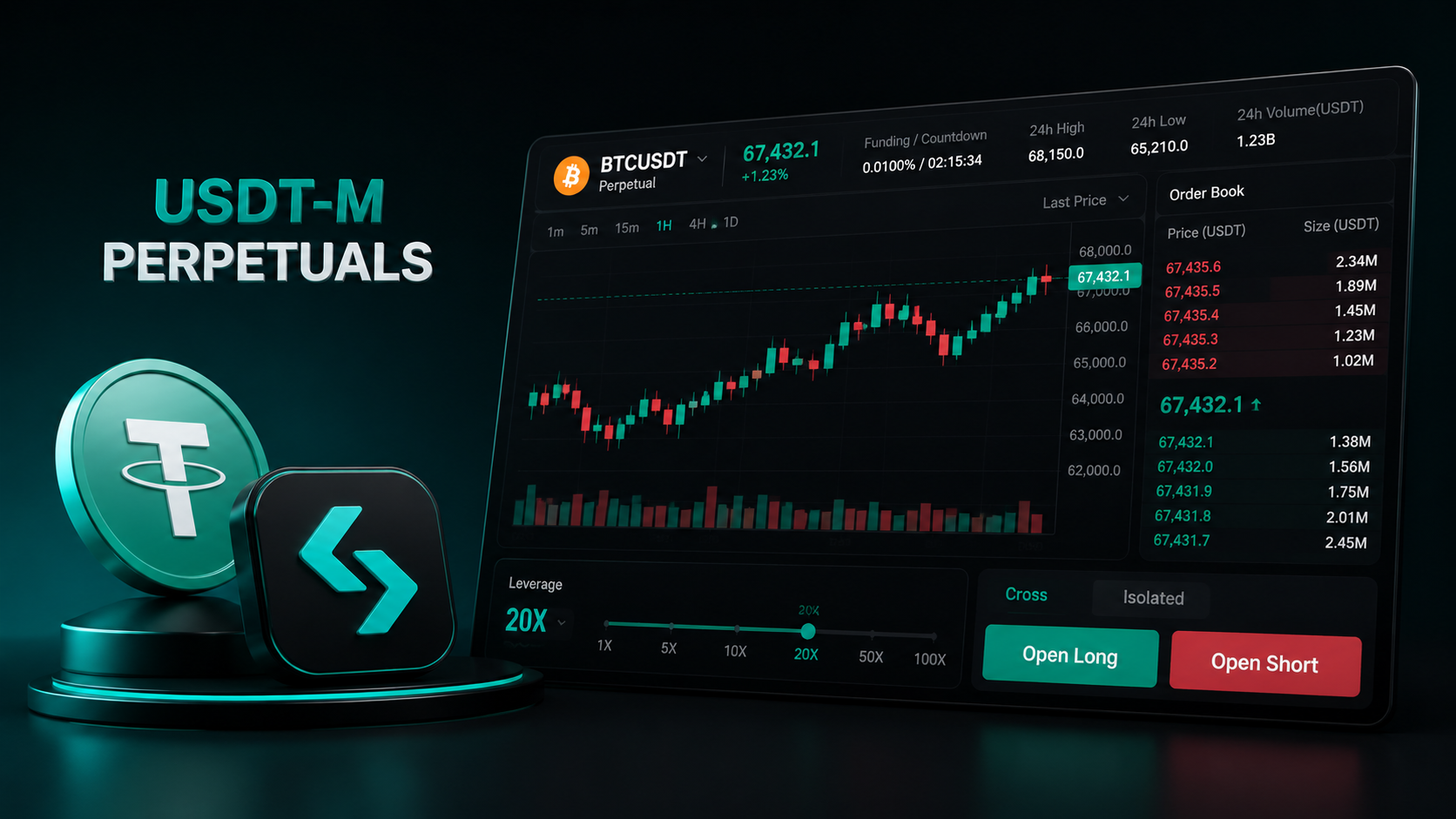
The first time I opened a Coin-M position on BitGet I made $40 of profit and somehow had less BTC in my wallet than when I started. The PnL screen said green. The wallet said I’d lost coin. That’s the moment Coin-M futures click — or completely break your brain. Most traders skip them because USDT-M is simpler. The ones who don’t skip them are usually long-term BTC holders who’ve worked out something the rest of the market hasn’t.
This post is the honest write-up of what BitGet Coin-M futures actually are, how the PnL maths works, where delivery contracts differ from perpetuals, and the real reason anyone uses them. Some of the links are affiliate. I’ll flag them.
Heads up: Coin-M futures use leverage and your PnL is paid in the coin you trade. A wrong-side move can wipe your margin in minutes. If you’re new to crypto, skip this and stick to spot trading first. The numbers here are examples, not promises.
Short answer: BitGet Coin-M futures are inverse perpetual and delivery contracts where the margin and PnL are denominated in the underlying coin (BTC, ETH, etc.) instead of USDT. You post BTC as collateral, you win or lose in BTC. They’re built for traders who already hold the coin and want to hedge, accumulate more of it, or take directional exposure without converting to stablecoins. BitGet offers Coin-M with up to 125x on BTC and ETH pairs.
Open BitGet Coin-M trading → (referral link)
Key takeaways
- Coin-M futures use the underlying crypto as collateral and pay PnL in that same crypto, not in USDT.
- They suit traders who already hold BTC or ETH and want to grow that bag, not their dollar bag.
- BitGet runs both Coin-M perpetuals (no expiry) and Coin-M delivery contracts (quarterly expiry, settled in coin).
- Funding rates on Coin-M can run opposite to USDT-M during strong trends — sometimes paying you to hold the position.
- BitGet’s futures market clears over $20 billion in 24-hour volume across all contracts according to its official fees page, with BTC pairs the dominant share.
What are Coin-M futures and how do they differ from USDT-M?
Coin-M futures are inverse contracts. That’s the technical name and it confuses people the first time they read it. Inverse means the quote currency and the margin currency are flipped versus a normal USDT-M trade.
On a USDT-M BTC perpetual, you post USDT as margin, the contract is quoted in USDT per BTC, and your PnL settles in USDT. Simple linear maths.
On a Coin-M BTC perpetual, you post BTC as margin, the contract is still quoted in USD per BTC, but your PnL settles in BTC. That’s the inverse bit. The maths to work out how much BTC you win or lose for a given dollar move isn’t linear — it depends on the entry price.
The practical implication: if you’re long BTC on Coin-M and BTC goes up, you make BTC. If you’re short BTC on Coin-M and BTC goes down, you also make BTC. Either way, you’re growing your BTC stack.
That’s the whole point. Coin-M is a tool for people who think in coin, not dollars. If your goal is “I want more BTC by the end of the year”, Coin-M lets you take directional bets without ever leaving the BTC ecosystem.
If you’ve not used futures at all yet, read the BitGet futures USDT-M guide first. USDT-M is where everyone should learn the mechanics. Come back here when the maths on linear contracts feels boring.
Why use Coin-M futures (BTC-denominated PnL)?
There are three real use cases. Anything outside of these and you’re probably better off on USDT-M.
Use case 1: long-term BTC accumulators
You already hold BTC. You think the long-term trend is up. You want to grow your BTC stack faster than just hodling, but you don’t want to sell any to free up trading capital.
Open a Coin-M long with a small portion of your BTC as margin. If BTC pumps, you earn extra BTC. If it dumps, you lose some — but you were going to hold through the dump anyway, so the opportunity cost was always there.
Use case 2: hedging without conversion
You hold 5 BTC. You think there’s a 30% chance BTC drops 20% in the next two weeks but you don’t want to sell because the tax event would be painful. Open a small short on Coin-M perpetual. If BTC drops, the short profits in BTC, offsetting some of the spot loss. No conversion, no sell event, no tax trigger in most jurisdictions until you close the position.
Use case 3: capturing funding rate divergence
During strong bull trends, USDT-M perpetuals usually run positive funding — longs pay shorts. Coin-M perpetuals on the same pair can sometimes run differently because the trader base is more skewed toward long-term holders. There are weeks where Coin-M funding favours longs while USDT-M funding penalises them. Patient traders watch this gap.
Outside these three, USDT-M is just easier. Most retail traders should default to USDT-M and only touch Coin-M once they’ve worked out what they’re actually optimising for.
How do delivery contracts differ from perpetuals?
BitGet runs Coin-M in two flavours: perpetuals and quarterly delivery contracts.
Perpetuals
No expiry date. The position stays open as long as your margin survives. The contract price tracks the spot price via the funding rate — every 8 hours, the funding payment between longs and shorts pulls the perpetual price back in line with spot.
If you’ve traded any perpetual before, this is the same mechanism. The only difference here is that funding pays out in BTC, not USDT.
Delivery contracts (quarterly futures)
These expire on a fixed date — usually the last Friday of March, June, September, and December. At expiry, the contract settles to the spot price index and your position closes automatically. You receive (or pay) the difference in BTC.
No funding rate on delivery contracts. Instead, the contract price often trades at a premium or discount to spot — this is called contango or backwardation. The premium reflects the market’s view on where price will be at expiry.
When to use each
Use perpetuals when:
– You don’t have a specific time horizon
– You want to adjust the position size frequently
– Funding is favourable to your side
Use delivery contracts when:
– You’re betting on a specific event (post-halving, ETF approval, regulatory deadline)
– You want a fixed cost (the premium) rather than ongoing funding payments
– You don’t want to babysit funding rate flips
I rarely use delivery contracts personally. They’re useful for traders with very specific time-bound theses. Perpetuals cover 95% of what most traders need.
How do funding rates work on Coin-M?
The funding rate mechanism is the same in principle as USDT-M but the payment currency is different.
Every 8 hours, BitGet calculates the funding rate based on the gap between the perpetual contract price and the spot index. If the perpetual trades above spot, longs pay shorts. If it trades below, shorts pay longs.
On Coin-M, the payment is denominated in the underlying coin. A 0.01% funding rate on a 1 BTC notional position means 0.0001 BTC changes hands every 8 hours.
A few things to know:
Funding can be a profit or a cost. If you’re a long on a contract that pays positive funding to shorts (because the perpetual is above spot), you pay funding every 8 hours. That’s real BTC out of your margin. Over a month of holding, this can eat a significant chunk of your position.
Funding rates vary by pair. BTC and ETH pairs usually run between -0.01% and +0.03% per 8 hours. Smaller altcoin Coin-M pairs can spike to 0.5% or higher during squeezes.
Watch the funding history before opening. BitGet shows the last 30 days of funding rates on each contract page. If the average has been strongly against your direction, you’re paying for the privilege of being in the trade.
For the full picture on how leverage and funding interact, the BitGet leverage explained post breaks down the maths in detail.
What are the margin requirements on Coin-M?
Margin works the same way as on USDT-M but the unit is the underlying coin instead of stablecoins.
Initial margin is what you need to open a position. At 10x leverage on a 1 BTC notional position, you post 0.1 BTC.
Maintenance margin is the minimum margin you must hold to keep the position open. When your account margin drops below maintenance, you get a margin call. Below liquidation, the position closes automatically.
BitGet runs a tiered margin system on Coin-M. Smaller positions get the highest leverage allowance. Larger positions step down through tiers. For BTC Coin-M:
| Notional position size (BTC) | Max leverage |
|---|---|
| 0–50 | 125x |
| 50–250 | 100x |
| 250–1,000 | 50x |
| 1,000–5,000 | 20x |
| 5,000+ | 10x |
The reason for the tier system: at huge position sizes, liquidating the position would move the market and create cascading liquidations. Lower leverage caps protect the order book.
You can choose cross margin or isolated margin per position. Cross margin uses your entire Coin-M account balance as collateral — useful for multi-position strategies but a wrong-side move on one position can eat the margin on the others. Isolated margin walls off each position with its own collateral pool. I default to isolated for everything except hedge positions.
For a deep dive on the trade-offs, read the BitGet margin trading walkthrough.
How do you open a Coin-M trade step by step?
Six steps. Start small the first time. The maths is the part that catches you out.
- Fund your Coin-M account. Go to Assets → Transfer. Move BTC from your Spot account to your Coin-M Futures account. Coin-M accounts are separate from USDT-M accounts — you need BTC there specifically.
- Pick the contract. Go to Futures → Coin-M. Choose the perpetual (e.g. BTCUSD) or the delivery contract (e.g. BTCUSD-Q quarterly).
- Set leverage. Click the leverage selector. Start at 2x or 3x. Don’t go above 5x until you’ve held a position for a full week and watched the funding drag.
- Choose margin mode. Isolated for first trades. Cross only once you understand the risk.
- Place the order. Choose order type (limit, market, stop-limit), enter the position size in contracts. 1 contract on BTC Coin-M = $100 of notional. So 100 contracts = $10,000 notional, which at $60,000 BTC is around 0.167 BTC of exposure.
- Set stop loss and take profit. Mandatory. Use the bracket order interface to attach both at the same time. Never open a Coin-M position without a stop.
That’s the mechanics. The hard part is the maths on the PnL, which is the next section.
What does a real Coin-M trade look like (BTC long example with PnL maths)?
Let’s run through one. Numbers are illustrative.
Setup:
– BTC spot price: $60,000
– I open a long on BTCUSD Coin-M perpetual
– Notional position size: $30,000 (300 contracts)
– Leverage: 10x
– Margin required: $3,000 / $60,000 = 0.05 BTC posted as collateral
Scenario A: BTC rises to $66,000 (+10%)
On a USDT-M perpetual at 10x, a 10% price move = 100% return on margin. Clean linear maths.
On Coin-M it’s not linear. The PnL formula is:
PnL in BTC = Notional × (1 / Entry Price – 1 / Exit Price)
For our trade:
PnL = 30,000 × (1/60,000 – 1/66,000) = 30,000 × (0.0000166667 – 0.0000151515) = 30,000 × 0.0000015152 ≈ 0.04545 BTC
At $66,000 that’s worth about $3,000. So you made roughly $3,000 worth of BTC on $3,000 of BTC margin. About 91% return on margin.
Notice the asymmetry. A 10% price move did not give you 100% return on margin like it would on USDT-M. The inverse maths bends in favour of shorts and against longs as price rises.
Scenario B: BTC drops to $54,000 (-10%)
PnL = 30,000 × (1/60,000 – 1/54,000) = 30,000 × (0.0000166667 – 0.0000185185) = -0.0555 BTC
At $54,000 that’s a loss of about $3,000. About 111% loss on margin — you’ve been liquidated before reaching this level if you’re at 10x leverage without adding margin.
The asymmetry again. The same 10% move costs you more in absolute BTC terms than it gains you. That’s the inverse contract behaviour.
This is why understanding the maths matters. People who treat Coin-M like USDT-M get surprised both directions. The BTC return on big up-moves is smaller than they expect, and the BTC loss on big down-moves is larger.
For the broader context on how trade sizing should account for these mechanics, Investopedia’s primer on inverse futures is a clean reference.
What risks are specific to Coin-M futures?
Three risks that don’t apply (or apply less) on USDT-M.
1. Margin currency price risk
Your margin is denominated in BTC. If BTC drops 30%, your margin balance drops 30% in dollar terms even if you have no position open. Cross margin accounts on Coin-M can liquidate just from BTC price action against the collateral. You need to monitor margin level in both directions.
2. Non-linear PnL maths
Covered above. Many traders set position sizes based on a linear assumption and discover the asymmetry too late. Always work the maths before opening a position. BitGet’s order entry shows estimated liquidation price — check it.
3. Lower liquidity than USDT-M
USDT-M perpetuals are where the volume is. Coin-M perpetuals are thinner. Slippage on market orders during fast moves is more painful. Always use limit orders when possible, and assume liquidation cascades on Coin-M can run further than expected because order book depth recovers more slowly.
On top of all that, the standard futures risks apply: liquidation, funding drag, fat-finger errors, and the psychological cost of running a position that swings against you for days.
If account security is on your mind, public WiFi is the silent killer. I use NordVPN on any device I trade from — public networks are where account takeovers happen.
Want to trade Coin-M on the platform I use?
BitGet has the deepest Coin-M order book outside of Binance. Sign-up takes 90 seconds. KYC usually clears the same day.
Affiliate link. I may earn a commission at no extra cost to you.
Coin-M vs USDT-M comparison table
The side-by-side. Read it twice.
| Feature | Coin-M | USDT-M |
|---|---|---|
| Margin currency | BTC, ETH, etc. (underlying coin) | USDT, USDC |
| PnL settlement | In the underlying coin | In stablecoin |
| PnL maths | Non-linear (inverse) | Linear |
| Max leverage (BTC) | Up to 125x | Up to 125x |
| Contract types | Perpetual + quarterly delivery | Perpetual only |
| Funding rate | Yes (paid in coin) | Yes (paid in USDT) |
| Best for | Long-term coin holders, hedgers | Active traders thinking in dollars |
| Liquidity | Lower | Higher (deepest markets) |
| Tax events | Settle in coin (different jurisdiction treatment) | Settle in stable |
| Beginner-friendly | No | Yes (relatively) |
If you’re optimising for clean maths and the deepest liquidity, USDT-M wins every time. If you’re optimising for BTC accumulation or hedging without selling, Coin-M is the right tool.
For traders comparing exchanges on this specifically, BitGet vs Binance and BitGet vs Bybit cover the Coin-M depth differences in detail.
Where to learn this properly
Reading a blog post is the start. Trading Coin-M with real money against people who do this for a living is a different problem.
If you actually want to learn this, I’d point you at Trade Travel Chill — it’s the community I’m part of and the one structured education source I trust. It covers futures mechanics, position sizing, and the psychology of holding losing positions without doing something stupid. Most retail traders skip the education step and pay for it later in liquidations.
The free resources I rate alongside that: CoinGecko’s derivatives education hub for general grounding, the official BitGet futures docs for fee specifics, and CoinDesk’s market data section for live funding rate history across the major venues.
If you want the broader list of where I learned this stuff, the best crypto trading courses post covers the paid options I’ve taken.
Then the simulator. BitGet has a demo trading mode for futures — use it for at least two weeks before placing a Coin-M trade with real money. The interface is the same, the maths is the same, only the money is fake. There’s no upside to skipping this step.
Common Coin-M mistakes I see and have made
The three I see most often.
Treating Coin-M like USDT-M. New Coin-M traders set position sizes by dollar amount and expect linear PnL. They get a smaller win on a 10% up move than they expected and a bigger loss on a 10% down move. Always work the inverse maths first.
Ignoring the BTC price risk on margin. Your collateral is BTC. If BTC drops 20% in a week and you have no positions open, your buying power dropped 20%. People who keep their entire futures account in BTC during chop get squeezed on both ends — position margin and account margin.
Holding Coin-M positions through funding when funding is against them. A 0.05% funding rate paid three times a day is 4.5% per month. That’s a lot of BTC out of a leveraged position over time. Always check funding history before holding for more than a few days.
I’ve made all three. The third one cost me the most — held a long for six weeks during a sideways market with funding running consistently against me. Closed flat on price but down 4% in BTC. That’s the silent cost of Coin-M that nobody talks about.
Ready to try Coin-M futures?
Start in demo mode. Work the maths on three trades before you switch to live. BitGet’s the platform I use for this.
Affiliate link.
Frequently asked questions
What’s the difference between Coin-M and USDT-M futures?
Coin-M futures use the underlying coin as margin and pay PnL in that coin. USDT-M uses USDT as margin and pays PnL in USDT. Coin-M maths is non-linear (inverse). USDT-M maths is linear. Coin-M suits long-term coin holders. USDT-M suits dollar-thinking traders.
Why would I trade Coin-M instead of USDT-M?
Three reasons. You already hold BTC and want to grow your BTC stack. You want to hedge a spot position without selling. You spot a funding rate divergence that favours your side. Outside those, USDT-M is easier.
Are Coin-M delivery contracts the same as quarterly futures?
Yes. BitGet calls them delivery contracts. They expire on the last Friday of March, June, September, and December and settle to the spot price index in the underlying coin. No funding rate — the price premium or discount reflects the market’s view on expiry price.
What leverage can I use on BitGet Coin-M?
Up to 125x on BTC and ETH Coin-M perpetuals for small position sizes. The cap steps down as position size grows. Most retail traders should stay between 2x and 10x.
Is the PnL on Coin-M better than USDT-M?
Neither is universally better. Coin-M wins on big upside moves when you want the upside in BTC. USDT-M wins on clean maths and tighter liquidity. The asymmetry of inverse contracts means Coin-M longs gain less in BTC terms than USDT-M longs gain in USDT terms on the same percentage price move.
Do Coin-M futures get liquidated the same way?
Yes. When your margin balance drops below maintenance margin, the position closes automatically. The liquidation price calculation is different (because of the inverse maths) but the mechanism is identical.
Is BitGet Coin-M available in the US?
No. BitGet is geo-blocked for US residents. US-based traders should look at CME Bitcoin futures or regulated derivatives venues.
Related posts
- BitGet Futures Trading: USDT-M Perpetuals Explained
- BitGet Leverage Explained: From 1x to 125x
- BitGet Margin Trading: Cross vs Isolated Walkthrough
- BitGet Review: The Crypto Exchange I Actually Use