Most people who try copy trading make money in month one, break even in month two, and quit in month three with less than they started. I know because I was one of them. Then I figured out what the leaderboard was actually rewarding, changed my filters, and the picture improved.
This is the post I wish I’d had when I opened my first copy trading position. How BitGet’s system actually works under the hood, the fees, the filters that matter, the red flags that don’t show up in the marketing, and the rules I follow now. Some links are affiliate. I’ll flag them.
Short answer: BitGet copy trading lets you mirror trades from over 190,000 verified traders automatically. You pick a trader from the leaderboard, set your position size, and your account follows their entries and exits in real time. Traders earn a profit share on copier gains (typically 10%, capped at 30%). The single biggest mistake is picking by ROI. The single biggest filter that matters is maximum drawdown.
Open a BitGet account → (affiliate)
Key takeaways
- BitGet runs the largest copy trading network in crypto — 190,000+ traders and 800,000+ followers across spot and futures.
- Copy traders charge a profit share (0–30%), not a flat fee. You only pay when the trade is profitable.
- The leaderboard rewards short-term ROI, which is the worst metric to pick on. Filter by maximum drawdown, longevity, and AUM instead.
- Spot copy is dramatically lower risk than futures copy. Most beginners should start with spot copy or skip copy trading entirely.
- Bot copy trading (mirroring a strategy, not a human) is the newest product. Lower variance than human copy, capped upside.
What BitGet copy trading is and why it’s biggest in crypto
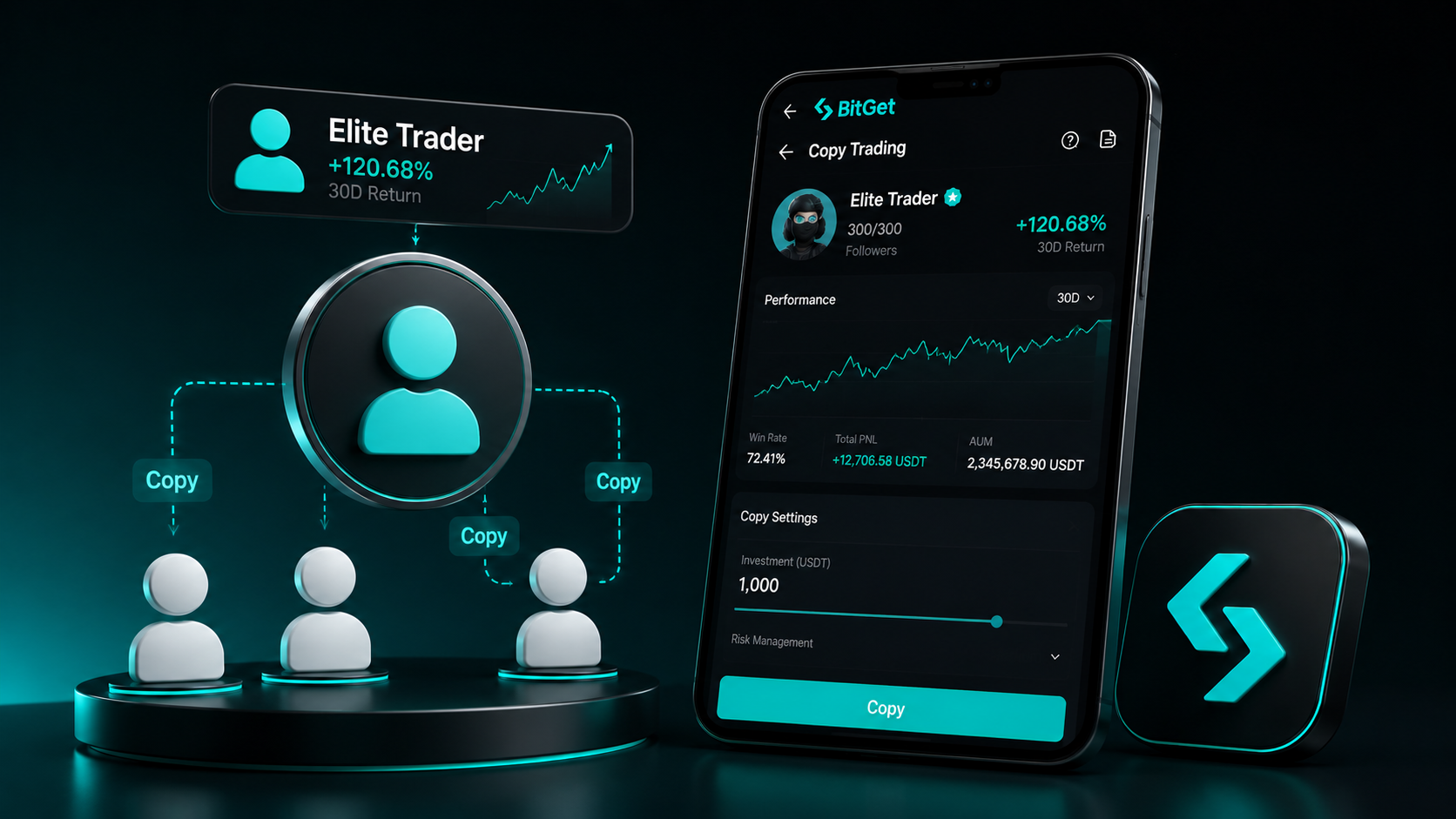
Copy trading is exactly what it sounds like. You browse a list of traders, pick one, and your account mirrors their trades automatically. They enter a position, your account enters. They exit, you exit. The trade sizes are scaled to whatever you set as your allocation.
BitGet built copy trading earlier and harder than every other major exchange. The result is the deepest leaderboard in crypto. Last time I looked, there were over 190,000 verified traders on the platform with public track records and more than 800,000 followers active.
Why does that matter? Because the more traders on the platform, the more chance you find one that really works. Smaller exchanges have copy trading sections with 200 traders, half of which are clearly bots and the other half blew up six months ago. BitGet has a deep enough pool that disciplined filtering can actually surface real talent.
The trade-off: more traders also means more noise. The default sort is ROI, which is the worst metric to pick on. We’ll get to that.
If you’re new to BitGet entirely, read the BitGet review first for context on the platform itself. The best crypto exchanges post compares copy trading depth across platforms.
How copy trading works (mechanics)
The plumbing under the hood is worth understanding before you allocate real money.
What happens when you follow a trader
- You pick a trader from the leaderboard and click Follow.
- You set your copy parameters — total allocation, position size per trade (either a fixed amount or a ratio), and any caps (max number of open positions, max margin per trade).
- Your sub-account is created automatically. The funds you allocate sit in this sub-account, separate from your main wallet.
- When the lead trader opens a position, your sub-account opens the same position at the next available price, scaled to your settings.
- When the lead trader closes the position, your sub-account closes at the next available price.
- Profits flow to your sub-account. Losses come out of your sub-account. Lead trader earns a profit share on any net positive close.
Latency and slippage
You’re not entering at exactly the same price as the lead trader. There’s a small delay between their order hitting the matching engine and your copy order following. In liquid pairs like BTCUSDT this is typically a few cents. In thin alt pairs it can be more.
This matters most for scalpers. A lead trader doing scalp trades with 0.3% targets is fighting against the 0.05% to 0.15% you might give up to slippage. Their results won’t translate to yours one-for-one.
For swing traders with 2%+ targets, slippage is rounding error.
Spot vs futures copy
Two separate products on BitGet. Spot copy means you mirror spot trades (no leverage, no liquidation risk). Futures copy means you mirror futures trades, including leverage settings.
The leaderboard splits the two — you pick a spot trader for spot copy and a futures trader for futures copy. We’ll cover the risk difference in detail below.
Bot copy vs human copy
The newer offering. Instead of copying a human trader’s discretionary moves, you copy a fixed bot strategy with published rules. Profit share applies but the variance is different — you’re not exposed to the trader having a bad week emotionally, only to the strategy underperforming in certain market conditions.
For the bot side, the crypto trading bots guide covers the strategy basics. I run the BitGet BTC/USDT spot grid bot (affiliate) as my main passive position. Set the range, set the grid count, let it run.
Copy trading fees and profit-share splits
Copy trading on BitGet has no upfront subscription. You pay when the trade pays.
The profit share
Each lead trader sets their own profit share, between 0% and 30%. Most sit between 8% and 12%.
The split works on a per-position basis. If the lead trader closes a winning position and your share of the profit is $100, and their profit share is 10%, you pay $10 to the lead trader and keep $90.
If a position closes at a loss, no profit share is paid. You absorb the full loss.
Trading fees still apply
You pay BitGet’s normal trading fees on every copied trade. Spot is 0.10% per side, futures is 0.02% maker / 0.06% taker. Fees come out of your sub-account.
For active copy trading, fees can add up. A futures trader doing 30 round trips a week with you scaled to a $5,000 position means roughly $90 in fees per week, or $360 per month. Worth factoring into expected returns.
What the actual cost looks like
A realistic example. You allocate $5,000 to a futures copy trader. Over 3 months:
- Lead trader does 200 round-trip trades.
- Net profit on your sub-account: $1,200 (24% in 3 months).
- Trading fees: roughly $480.
- Profit share (10% on positive trades, paid on winning trades only): roughly $200.
- Net to you: $520 (10.4% on $5,000 over 3 months).
Annualised that’s about 40% if it continues. Better than spot holdings, worse than the headline ROI of 24% that drew you in.
If you want to compare against other passive income options, the passive income crypto post covers staking, lending, and structured products side by side.
How to find a good copy trader (filters — drawdown, longevity, AUM)
This is the section that matters most. Pick badly and the platform is a money sink. Pick well and it’s a leverageable allocation.
Ignore ROI as the primary filter
The default sort is ROI. ROI is the worst single metric for picking a copy trader. Here’s why.
A trader who turned $1,000 into $8,000 over 60 days has 700% ROI. They sit at the top of the leaderboard. They probably did this by running 50x leverage and getting lucky with one or two directional moves. Their next big trade is one bad weekend away from a zero.
A trader who’s compounded steadily at 80% over 18 months has 80% annualised ROI. They sit far below the 700% guy on the leaderboard. They’re also the one who’s still going to be there in six months.
The filters I actually use
In rough order of importance:
1. Maximum drawdown — under 30%. This is the single most important metric. A trader who’s had a 60%+ drawdown at any point has shown you they can lose 60%+ again. Cap your shortlist at traders whose maximum drawdown is under 30%.
2. Track record length — over 6 months, ideally 12+. Anything under 6 months is noise. A trader can run hot for 4 months in a bull market and look like a genius. The traders who matter have survived multiple market regimes.
3. AUM (assets under management) — at least $100,000 followed. AUM tells you whether other people are betting real money on this trader. If they’ve got under $10,000 followed despite a clean track record, something’s off — either the strategy doesn’t scale or there’s something about the trader people are seeing that you’re not.
4. Followers — at least 50, ideally 200+. Similar logic. Low followers means low scrutiny. High followers means more eyes have audited the track record.
5. Win rate — between 50% and 75%. Below 50% means losing more trades than winning, which only works if the winners are massive (high-variance, hard to copy). Above 75% means tiny take-profits that get destroyed by one bad loss. The sweet spot is 55% to 70%.
6. Profit-to-drawdown ratio. Total profit divided by max drawdown. A trader who’s made 100% but had 50% drawdown has a ratio of 2. A trader who’s made 80% but had 15% drawdown has a ratio of 5.3 — much better risk-adjusted return.
7. Trade frequency. Day traders making 50+ trades a week are higher-fee and harder to copy due to slippage. Swing traders making 5–10 trades a week are easier to follow.
How to apply the filters
In the BitGet copy trading interface, set the sort to “Days Active” descending. This puts the longest-running traders at the top. Then scroll, eyeballing the drawdown column. Skip anyone with over 30% drawdown.
From the remaining list, click into each profile. Check AUM, followers, win rate, profit-to-drawdown ratio. Shortlist five.
Watch the shortlist for two weeks before allocating. Note their open positions, how they react to volatility, how often they trade. If a trader on your shortlist takes a big loss during the watch period, drop them.
Allocate to the top one or two from your shortlist with a small starting size — 1% to 2% of your total trading capital per trader. Scale up only if the trader continues to perform after another 4 to 6 weeks of live tracking.
This process feels slow. It is. It also means you don’t get rugged by leaderboard chasers. The best BitGet copy traders post has the full filter walkthrough with screenshots.
Red flags in trader profiles
The leaderboard hides these signals on the headline page. Look for them before you allocate.
Sudden ROI spikes
Open the equity curve and scan for vertical lines. A trader who’s compounded steadily for 8 months and then 3x’d their account in one week did something unusual. Sometimes it’s a great catch. Often it’s a single 50x trade that worked. The next one of those trades is statistically more likely to liquidate.
Recent drawdown nearing the maximum
If the current drawdown is close to the historical maximum, the trader is currently in pain. They may be about to break their previous worst loss. Wait until they’ve recovered before allocating.
Profit-share at or near 30%
The cap is 30% but the typical sits at 8% to 12%. A trader charging 25%+ is signalling confidence — or signalling that they expect to milk a small set of followers before the strategy stops working. Combined with a short track record, this is a red flag.
Zero followers and zero AUM
New traders have to start somewhere, but if there’s been zero traction at all and the account is more than 30 days old, ask why. Maybe the strategy doesn’t scale. Maybe people who looked closer saw something you didn’t.
Win rate at 95%+
Sounds like a strength. Actually a warning. A 95% win rate usually means tiny take-profits that get blown up by the rare big loss. The maths often nets negative over a full cycle.
Heavy bias to one token
A trader whose entire P&L came from ETH or SOL during a specific run benefits from one tailwind. When that token rotates out of favour, their strategy stops working. Look for diversification across at least three majors.
No futures losses logged
Spot copy traders can’t really fake this, but futures copy traders sometimes look suspiciously clean. If they’ve taken 400 trades and only had 6 losing weeks, something’s off with the metric or the strategy.
Spot copy vs futures copy (risk difference)
This is the choice that determines whether copy trading is a sensible product or a slow leak.
Spot copy
You mirror spot trades. No leverage, no liquidation risk. The worst-case scenario is the trader picks a coin that goes to zero and your allocation goes with it. The realistic worst case is a 30–50% drawdown during a bear cycle.
Returns are typically 30–80% annualised on the better spot copy traders. Lower than futures. But much, much smoother.
I run spot copy on a portion of my passive bag. The mental load is minimal. The downside is bounded.
Futures copy
You mirror futures trades, including the lead trader’s leverage settings. If they’re running 20x, you’re running 20x. Liquidation risk is real.
Top futures copy traders have logged 200%+ annualised returns over the last 18 months. Sounds great. The same leaderboard shows hundreds of futures copy traders who blew up after 4 to 12 months of similar headline numbers.
The selection bias on futures is brutal. You only see the traders who survived. Plenty more vanished from the leaderboard after a blow-up.
My rule
If you’re new to BitGet copy trading, start with spot copy only. Set up the account, allocate to one or two spot copy traders, watch them for 3 months. Learn how the mechanics feel.
Only after you’ve seen a full quarter of spot copy returns and understood the dynamics should you consider futures copy. Even then, allocate no more than 20% of your trading capital to futures copy. Sized small enough that a blow-up is a survivable loss.
If you don’t fully understand how futures work yet, the BitGet futures USDT-M post covers the mechanics. Don’t copy trade futures without understanding the underlying product.
Bot copy vs human copy
The newer option on BitGet, and one I think most beginners should prefer over copying a human.
Why bot copy is often safer
A human trader has bad days, emotional trades, revenge entries after a loss, and ego positions they refuse to close. Even disciplined traders have a 5% to 10% degradation from emotional drift over time.
A bot follows fixed rules. If the rules are good, they keep working. If the rules are bad, they break the same way every time and you can see it coming.
What bot copy looks like on BitGet
Bot operators publish their strategy settings — grid range, grid count, leverage, stop loss — and you can copy the bot with a single click. The bot runs in your sub-account using the operator’s published parameters. The operator earns a profit share on positive closes.
Variance is lower than human copy. Win rates are usually higher. Maximum ROI is often lower because there’s no judgment call catching a big move.
Where bot copy works well
Range-bound markets. Grid bots eat chop for breakfast. If BTC is ranging between $58K and $68K for 3 months, a grid bot inside that range banks consistent micro-profits.
Where bot copy works badly: strong directional trends. A grid bot in a downtrend keeps buying the dip until the dip goes to zero. Always check that the bot operator has set a stop-loss exit on range break.
The BTC/USDT spot grid bot (affiliate) is the one I run as my main passive position. Spot, no leverage, range-bound on the cleanest pair in crypto. The mental load is zero.
How to set it up (step-by-step)
The mechanics, end to end.
-
Open and verify your BitGet account. BitGet sign-up (affiliate) takes 90 seconds. KYC usually clears same-day. If you’re stuck on this step, the BitGet review walks through the full onboarding.
-
Fund your account. Deposit USDT into your spot wallet. For futures copy you’ll need to transfer it to the futures wallet later. Minimum sensible allocation is $500 — below that, position sizing gets awkward.
-
Navigate to Copy Trading. From the main menu, click Copy Trading. Choose Spot or Futures depending on which product you’re starting with. If you’re new, choose Spot.
-
Apply your filters. Sort by Days Active descending. Filter by maximum drawdown under 30%. Filter by AUM over $100,000 if available. This will cut the list from thousands of traders down to a few dozen.
-
Shortlist five traders. Click into each profile. Check the equity curve, win rate, profit-to-drawdown ratio, and recent activity. Shortlist five who pass the filters and feel sensible.
-
Watch for two weeks before allocating. No money on the line yet. Add the five to a watch list (a notes file works fine). Note their open positions and how they react to volatility.
-
Allocate to one trader with a small position. Pick the best of the five. Click Copy. Set your copy ratio (start with a fixed amount per trade, not a percentage of capital) and your maximum copy amount. Start with no more than 2% of your total crypto allocation.
-
Set boundaries. Use BitGet’s copy parameters to cap maximum loss per trade, maximum margin per trade, and maximum number of open positions. These limits override the lead trader’s actions if they push beyond your risk tolerance.
-
Review every 30 days. End of month, check your sub-account performance against the lead trader’s performance. Slippage and fees mean your returns will be slightly lower. If the gap is more than a few percent, the trader’s strategy isn’t translating well to copy.
-
Scale or cut after 90 days. After three months of data, scale up to the traders who are working and cut the ones who aren’t. Don’t let underperformers run “just in case it turns around”.
Position sizing rules
Same logic as direct trading. Just because the trader is doing the work doesn’t mean you can size irresponsibly.
Total copy allocation
No more than 20% to 30% of your trading capital across all copy traders combined. The rest should be in direct trades, bots, and Earn products. Diversification across approaches, not just across traders.
Per-trader allocation
No more than 5% to 10% of trading capital to any single copy trader. If a trader blows up, you lose 5%, not 30%. Pain, not catastrophe.
Per-trade limits
Use the cap settings. Set maximum margin per trade so that no individual copy entry exceeds 1% of your sub-account. This protects against a lead trader doing one wild position that you don’t want to copy at full size.
Stop using leverage on lead trader settings
If a lead futures trader uses 20x leverage, your sub-account uses 20x. BitGet lets you set a maximum leverage override for your sub-account — cap it at a lower level than the lead trader if you want. The returns will be smaller but so will the liquidation risk.
When to stop copying
Most people don’t stop copying when they should. The trader’s results turned south two months ago but you didn’t notice because you weren’t checking. By the time you act, you’re 30% in the red.
Red lines that trigger an exit
Maximum drawdown breached. If a trader’s current drawdown exceeds their previous maximum, exit immediately. They’re now in territory they’ve never recovered from before.
Strategy change. If a trader who was running 5x leverage suddenly opens a 50x position, the strategy has changed. Stop copying until you understand why.
Sudden trade frequency spike. A trader who was making 5 trades a day now making 30 is overtrading. That’s emotional, not strategic.
Two consecutive losing months. If month one and month two are both red, stop. Don’t wait for month three.
The lead trader stops trading. If they go silent for more than two weeks, exit. Either they’ve stepped away (and you don’t know when they’ll be back) or they’ve blown up and are pretending it didn’t happen.
How to exit cleanly
Click Stop Copying in the trader’s profile. Your sub-account will close all open copied positions at market. Withdraw the sub-account balance back to your main wallet.
If the trader has open positions that are deeply red when you exit, you’ll crystallise the loss. That’s the cost of exiting at the wrong time. Don’t let it stop you from exiting — running a bad trader hoping the loss recovers is how 20% drawdowns become 50% drawdowns.
Tax implications
Copy trading creates tax events the same as direct trading. Each copied trade is a taxable disposal in most jurisdictions.
What that looks like
If your sub-account does 300 round-trip trades in a year, that’s 300 disposals to report. Profit share paid to the lead trader is generally a fee, not a separate tax event, but rules vary.
CSV exports
BitGet exports copy trade history as a separate CSV from the Reports section. Each line shows entry price, exit price, profit/loss, profit share paid, and trading fees. The CSV imports into Koinly and CoinTracker, the two crypto tax platforms I’ve tried.
Quarterly export, quarterly import. Don’t leave it to year-end with a thousand trades unreconciled.
Watch the profit-share line
Some tax platforms don’t auto-handle the profit-share deduction. Check that your platform is subtracting the profit share from the gain on each trade. If it isn’t, you’re paying tax on income you didn’t keep.
The HMRC, IRS, and most other tax authorities treat copy trading as if you placed the trades yourself. That’s worth knowing if you live somewhere with strict reporting — the volume can be high.
For broader tax and storage logistics, how to store crypto safely and the BitGet review both cover the record-keeping side.
Ready to start copy trading the right way?
BitGet has the deepest copy trading leaderboard in crypto. Open the account, set the filters I’ve covered, and shortlist before you allocate.
Affiliate link. I may earn a commission at no extra cost to you.
Prefer a bot to a human?
If discretionary copy traders feel too uncertain, bot copy gives you a fixed strategy with published rules. The BTC/USDT spot grid bot is the one I run.
Affiliate link.
Frequently asked questions
How does BitGet copy trading work?
You browse a leaderboard of verified traders, pick one, and your account mirrors their trades automatically. You set your allocation and position sizing. The lead trader earns a profit share (typically 8% to 12%) on profitable trades. You pay normal BitGet trading fees on every copied trade.
How much does BitGet copy trading cost?
There’s no subscription fee. You pay a profit share to the lead trader on profitable trades (0% to 30%, typically around 10%). You also pay BitGet’s standard trading fees on every copied trade — 0.10% on spot, 0.02% maker / 0.06% taker on futures.
What’s the minimum amount to start copy trading on BitGet?
There’s no hard minimum but realistically $500 is the smallest sensible allocation. Below that, position sizing gets awkward and minimum order sizes can clip your copy ratios.
How do I pick a good copy trader on BitGet?
Filter by maximum drawdown (under 30%), track record length (over 6 months), AUM (over $100,000 followed), and profit-to-drawdown ratio. Do not sort by ROI alone — short-term high-ROI traders are usually one bad trade away from blowing up.
Is BitGet copy trading safe?
Copy trading carries the same risk as the underlying trader’s strategy. Spot copy is lower risk than futures copy. The biggest danger is picking a bad trader. Use the filters above, start with small allocations, and review monthly.
Can I copy trade without KYC on BitGet?
Basic copy trading is available without full KYC but features are limited. To use the full product, including higher allocations and futures copy, complete the standard KYC process.
What’s the difference between spot copy and futures copy?
Spot copy mirrors spot trades — no leverage, no liquidation risk. Futures copy mirrors futures trades, including leverage. Futures copy has higher potential returns and a much higher risk of total loss.
Final word
Copy trading on BitGet is a real product that real people make real money on. It’s also a money sink for everyone who clicks the top of the leaderboard and allocates without filtering.
The difference is the boring work: filtering by drawdown not ROI, watching for two weeks before allocating, capping per-trader size, reviewing monthly, exiting when the trader’s behaviour changes.
If you do that work, copy trading earns its place as a slice of the overall allocation. If you don’t, the leaderboard will eat your account in a way that looks like bad luck but is actually bad process.
Right — over to you.
Related posts
- BitGet Review: The Crypto Exchange I Actually Use
- Crypto Trading Bots: What Actually Works
- BitGet Futures Trading: USDT-M Perpetuals Explained