Most beginners buy Ethereum thinking it’s just a cheaper Bitcoin. Then they go to send it to a wallet, get hit with a $40 gas fee for what should have been a $5 transaction, and start asking the internet whether they’ve been scammed. They haven’t. They just bought an asset they didn’t understand.
ETH is not Bitcoin with a different ticker. It’s a different machine entirely — and the way you buy it, store it, and use it depends on whether you’re planning to hold, stake, or actually use it in DeFi. This is the full walkthrough on BitGet, with the gas fee bit nobody explains properly. Couple of affiliate links in here. I’ll flag them when they appear.
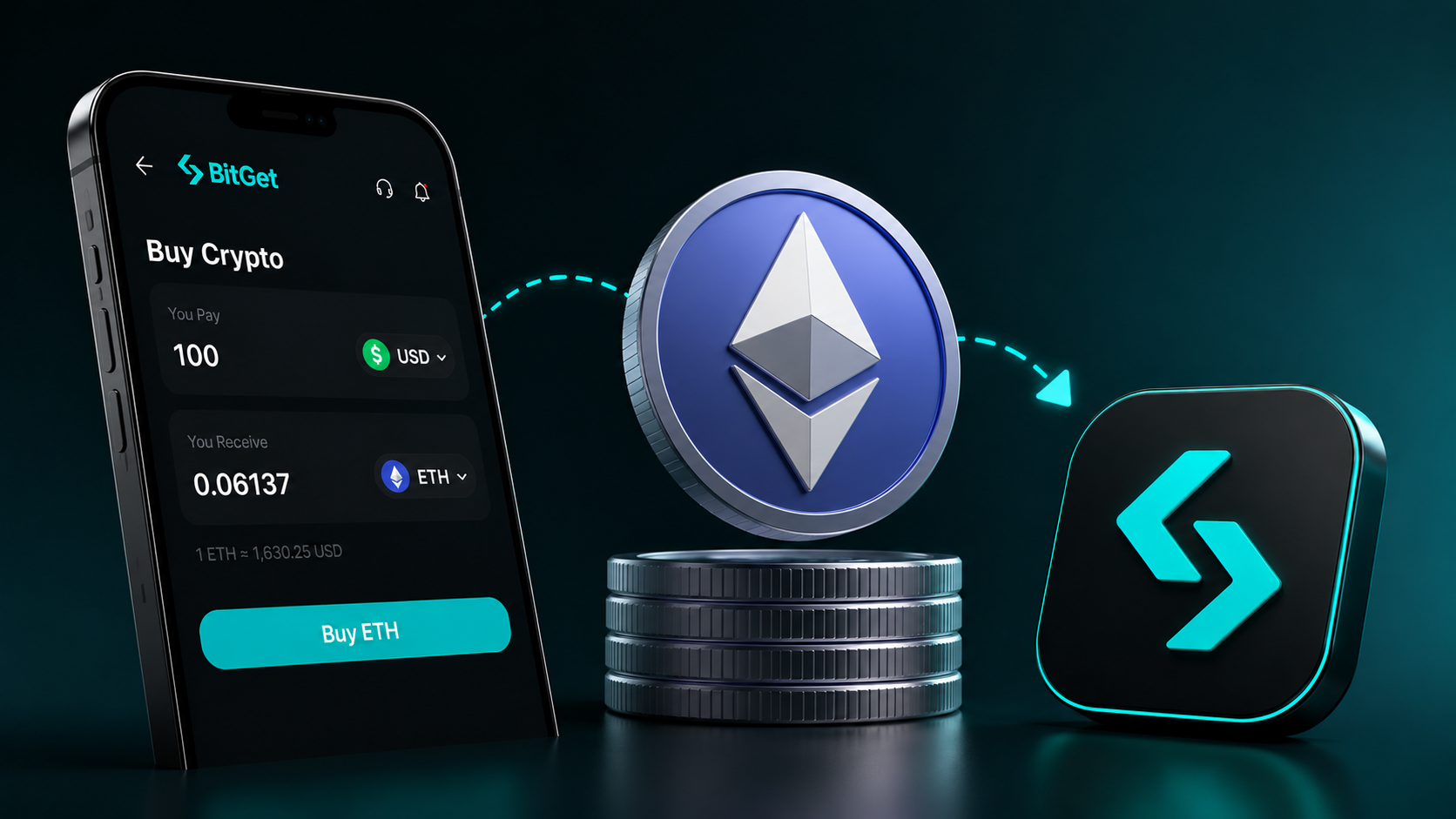
Short answer: To buy Ethereum on BitGet, sign up with email, enable 2FA, complete KYC, deposit USDT or fiat, then place a spot order on the ETH/USDT pair. Card buys cost 1–3%. Spot trading fees are 0.10%. Gas fees only apply when you move ETH on the Ethereum network — not when you trade on the exchange. Long-term ETH belongs on a Ledger; ETH you’ll use in DeFi belongs in a hot wallet. Total time from signup to ETH in your account: about 30 minutes.
Open a BitGet account → (affiliate)
Key takeaways
- Ethereum is a programmable blockchain. ETH is the fuel — you’ll pay it as gas every time you do anything on-chain.
- BitGet spot fees are 0.10%, the same as for Bitcoin. Gas fees only apply when you withdraw.
- Pick the right network when withdrawing: ERC-20 for the main Ethereum chain, Arbitrum or Base for cheaper L2 use.
- ETH staking earns 3–4% APY. You can stake on BitGet without running your own validator.
- Long-term holdings to Ledger. DeFi-active ETH in a hot wallet. Trading float on the exchange.
Why ETH is different from BTC (use case)
Bitcoin is digital gold. Ethereum is a global computer. That’s the short version, and the difference matters more than most beginners realise.
Bitcoin was built for one thing: moving value from A to B without a bank. The protocol is deliberately simple. The supply is capped at 21 million. The network does one job and does it well.
Ethereum was built to run code. Smart contracts, decentralised applications, stablecoins, NFTs, DeFi protocols — all of it lives on Ethereum or on chains built on top of Ethereum. ETH is the fuel that pays for every operation. If Bitcoin is a vault, Ethereum is a city — with shops, banks, marketplaces, and a tax (called gas) every time you move around.
Practical implications for a buyer:
- Bitcoin has a fixed supply and is mostly held as a store of value. Most BTC sits in wallets, not on-chain activity.
- Ethereum has a near-fixed supply (with some new issuance from staking, offset by EIP-1559 burning), but most ETH is actively used — staked, locked in DeFi, used as gas, traded.
- Bitcoin transactions are slow and cheap by design.
- Ethereum transactions are fast (12 second blocks) but cost varies wildly depending on network demand.
If you’re buying ETH purely to hold and hope the price goes up, you can treat it almost like BTC — buy, withdraw to a hardware wallet, leave it. If you’re buying to stake or to use in DeFi, the storage decision is different. We’ll get to that.
For the full Bitcoin vs Ethereum framing, the crypto for beginners post has the longer breakdown.
Why I recommend BitGet for buying ETH
Same reasons as for Bitcoin, with one extra: ETH is one of the largest and most liquid pairs on every tier-1 exchange, including BitGet. You get tight spreads, deep order books, and no surprises on entry price.
Honest fees. Spot maker/taker fees start at 0.10% on ETH/USDT, identical to BTC/USDT. Hold BGB and you get a 20% discount on top.
Flexible funding. Card, bank, P2P, or crypto deposit. Same four options as buying any other token on the platform.
ETH staking built in. You don’t need to run a validator or lock 32 ETH. BitGet’s Earn products let you stake any amount of ETH and earn yield. Withdraw it (with some unstaking delays — covered later).
Proof of Reserves. Monthly Merkle tree audits matched against on-chain wallets. ETH balances are verifiable.
Withdrawal options. When you take ETH off the exchange, you can pick the network — Ethereum mainnet (ERC-20), Arbitrum, Optimism, Base, or several others. That choice changes the fee by 10x or more. Most exchanges don’t give you the option. BitGet does.
For the full platform breakdown, the BitGet review covers safety, fee tables, and the product surface. For the broader picture on exchanges in general, best crypto exchanges has the comparison.
If you’re in the US, BitGet is geo-blocked. Coinbase Advanced and Kraken are the alternatives. Everywhere else, this is the workflow I’d use.
Signup + funding steps
Same as the BitGet sign-up flow for any token. If you’ve already got an account, skip to the funding section below.
Sign-up
- Open the sign-up page. Head to BitGet (affiliate — gives you a small fee discount). Enter email and a strong password.
- Verify the email. Six-digit code arrives within 30 seconds.
- Enable 2FA. Google Authenticator or Authy. Save the backup code on paper, not in the cloud.
- Complete KYC. Upload passport or driving licence, take a selfie. Mine cleared in 11 minutes.
- Add a payment method or prepare a crypto deposit.
Full step-by-step with the same flow used for BTC is covered in the how to buy Bitcoin walkthrough — the sign-up is identical.
Funding options for buying ETH
| Method | Fee | Speed | Best for |
|---|---|---|---|
| Crypto deposit | Network fee only | 10–60 min | Already hold USDT or USDC elsewhere |
| P2P (bank transfer) | 0% (rate spread) | 5–30 min | Best rate, requires a few extra steps |
| Bank transfer (third-party) | 0.5–1.5% | 1–3 hours | Mid-size buys |
| Card on-ramp | 1–3% | Instant | Small first buy |
Same logic as the BTC walkthrough. P2P or crypto deposit if you can wait an hour. Card if you can’t.
For the wider walkthrough on how exchanges and funding works, the how to buy crypto parent guide goes step by step.
Buying ETH: spot trade walkthrough
You’ve got USDT in your spot account. Time to buy ETH.
Limit order (the one I’d use)
- Open the BitGet app or web platform. Go to Spot Trading.
- Search ETH/USDT and select it.
- On the buy side, select Limit.
- Check the current price. Set your limit price slightly below the current ask. If ETH is trading at $3,420, set your limit at $3,415.
- Enter the USDT amount you want to spend.
- Tap Buy ETH. The order sits in the book until the price drops to your limit.
For any buy over $100, this is the right way. You control the entry price, you pay the maker fee tier, and you don’t get whipsawed.
Market order (only for tiny buys)
- Open Spot Trading, select ETH/USDT, switch to Market.
- Enter the USDT amount.
- Tap Buy ETH. Executes immediately at whatever price the order book gives you.
Fee: 0.10% plus a small slippage cost. Fine for $50, wasteful for $5,000.
A note on the pair
ETH/USDT is the deepest pair on every major exchange. ETH/USDC also works if you’ve deposited USDC instead. ETH/BTC is for traders who want to bet on the ratio between the two — ignore it for a first buy.
What you actually own
The moment the trade fills, ETH appears in your spot wallet. It’s not on the Ethereum blockchain yet — it’s an exchange-IOU against verified reserves. To get real on-chain ETH, you need to withdraw it. We’ll cover that in the storage section. Here’s where the gas fees come in.
Gas fees on Ethereum (what confuses beginners)
This is the part of buying ETH that catches every new user off guard. So here’s the actual explanation.
Gas is the fee you pay to do anything on the Ethereum network. Send ETH, swap a token, mint an NFT, interact with a DeFi protocol — every action costs gas, paid in ETH.
The gas fee depends on three things:
- Network demand. When Ethereum is busy (during big NFT mints, major DeFi events, market crashes), gas fees spike. When the network is quiet, they crash. The same transaction can cost $2 or $80 depending on the moment.
- Transaction complexity. A simple ETH transfer costs less gas than a DeFi swap, which costs less than a complex contract interaction.
- The network you use. Ethereum mainnet (Layer 1) is the most expensive. Layer 2 networks like Arbitrum, Optimism, and Base sit on top of Ethereum and cost a fraction of mainnet gas.
What this means for buying ETH
If you’re buying ETH and keeping it on the exchange: zero gas fees. Trading on BitGet happens off-chain in their internal books. You pay the 0.10% spot fee and that’s it.
If you’re withdrawing ETH to a wallet: you pay a withdrawal fee that includes the network gas. On BitGet, you choose which network to withdraw on:
| Network | Typical fee | Best for |
|---|---|---|
| Ethereum (ERC-20) | $1–$15 depending on congestion | Hardware wallets, big amounts |
| Arbitrum One | $0.50–$2 | DeFi use, frequent transactions |
| Optimism | $0.50–$2 | DeFi use, frequent transactions |
| Base | $0.50–$2 | DeFi use, Coinbase ecosystem |
| zkSync Era | $0.30–$1.50 | Newer L2, growing app set |
Send to whichever network your receiving wallet supports. If you’re sending to a Ledger, both ERC-20 and most L2s work — pick the cheapest.
Critical rule: the network on the send side must match the network on the receive side. Sending ERC-20 ETH to an address expecting Arbitrum, or vice versa, can lose your funds permanently. Always test with a small amount first.
How to check current gas
Etherscan gas tracker shows live gas prices for the Ethereum mainnet. If gas is sitting above 50 gwei, hold off on the withdrawal for a few hours unless you’re in a rush.
Storing ETH (Ledger works, hot wallet for DeFi)
Storage decisions for ETH are slightly different from BTC because of what you might want to do with it.
Three buckets
Bucket 1: long-term holding. You’re buying ETH and plan to hold it for 12+ months without doing anything with it. Treat it like BTC. Withdraw to a Ledger Nano X (affiliate). The Ledger device handles ETH natively via the Ethereum app. Plug in, send, confirm on-device. Keys never touch the internet.
Bucket 2: active DeFi use. You want to use ETH in DeFi — provide liquidity, swap, stake, mint, whatever. A hardware wallet is awkward for this because you’d have to plug in every time. Most DeFi users keep an active DeFi position in a hot wallet (MetaMask, Rabby, or BitGet Wallet) — software wallets that connect to dApps in the browser. The trade-off: faster access, higher risk. Anything in a hot wallet is one bad signed transaction away from being drained.
Bucket 3: trading float. ETH you’re actively trading on the exchange. Leave it on BitGet. Sized to what you’d accept losing in a tail event.
The split I run on ETH: 60% on Ledger, 30% in BitGet Earn (staking), 10% trading float. Adjust based on your activity.
Setting up a Ledger for ETH
- Buy a Ledger Nano X (affiliate). It costs about £150.
- Set up the device by following the on-device instructions. Write the 24-word seed phrase on the paper card. Never type it into a computer. Never photograph it.
- Install the Ethereum app on the device via Ledger Live.
- Add an Ethereum account in Ledger Live. Copy the receive address.
- On BitGet, go to Withdraw → ETH → Ethereum (ERC-20) network. Paste the address. Send a small test amount first ($5 of ETH). Confirm it lands.
- Send the rest in bigger batches.
Full self-custody playbook in how to store crypto safely. The hot vs cold wallet post explains the trade-offs between the two storage models. The Ledger Nano X review covers the device itself.
ETH staking overview
This is one of the bigger differences from buying BTC. Bitcoin doesn’t have staking. Ethereum does, and the yield is real.
What staking actually is
Ethereum moved to a Proof of Stake consensus model in 2022. Validators lock ETH as collateral, validate blocks, and earn rewards. The current network-wide yield sits around 3–4% APY, paid in ETH.
Three ways to stake
Solo staking. Run your own validator with 32 ETH locked. Maximum yield, maximum hassle, requires a dedicated machine running 24/7. Not for beginners.
Liquid staking. Use a protocol like Lido or Rocket Pool. You deposit any amount of ETH, receive a derivative token (stETH or rETH) that represents your staked ETH plus accrued rewards. You can use the derivative in DeFi while you earn. Higher complexity, smart contract risk.
Exchange staking. Stake ETH directly on the exchange. BitGet handles the validator infrastructure, you get a share of the rewards. Easiest by far. Lower yield than solo (the exchange takes a cut) but no technical setup.
Staking on BitGet
The on-chain ETH staking product on BitGet pays around 2.5–3.5% APY (rates change with network demand). Flexible staking lets you withdraw within a short unstaking window. Fixed-term staking pays a slightly higher rate in exchange for a lock-up.
Worth doing? If you’re holding ETH long-term and not planning to use it in DeFi, yes. Earning 3% on a long-term hold is free money. Just understand: when ETH is staked on an exchange, you don’t control the validator keys. It’s another exchange-IOU. Size accordingly.
For the full breakdown of BitGet’s Earn products — staking, savings, structured products, Launchpool — see the BitGet Earn products guide. For the wider passive income view, how to earn passive income in crypto without getting rugged covers off-platform options too.
Ready to buy your first ETH?
Sign-up takes 90 seconds. KYC usually clears same-day. Spot fees are 0.10% and ETH/USDT has the deepest book on the platform.
Affiliate link. I may earn a commission at no extra cost to you.
Common beginner mistakes
The ten ETH-specific mistakes I see most often. Skip these and you’re ahead of 80% of new ETH buyers.
Sending ETH on the wrong network. This is the most expensive mistake possible. ETH sent on the BSC network to an ERC-20 address (or any other mismatch) can be permanently lost. Always test with a small amount first.
Buying ETH and immediately withdrawing during high gas. New buyers panic that ETH “belongs in a wallet” and pay $50 in gas to move $200 of ETH. Wait for gas to drop, or use an L2 network if your wallet supports it.
Confusing ETH with ERC-20 tokens. ETH is the native asset of the Ethereum blockchain. USDT, USDC, LINK, UNI and others are ERC-20 tokens running on top of Ethereum. They all need ETH to pay gas — even if you’re sending USDT, you need a small amount of ETH in the wallet to cover the fee.
Running out of ETH for gas. If you withdraw exactly your USDT balance to a wallet and forget to keep some ETH for gas, you’re stuck. The USDT can’t move until you send ETH in. Always leave $5–$10 of ETH in any active wallet.
Staking everything immediately. Once ETH is staked on an exchange, you can’t trade it until you unstake — and unstaking takes anywhere from a few hours to a few days depending on the network queue. Don’t stake your trading float. Stake your long-term position.
Treating ETH like BTC for security. BTC sits in cold storage and rarely moves. ETH gets used. If you’re going to use ETH in DeFi, a hardware wallet is the wrong storage choice for that portion. Split the bag.
Using a single hot wallet for everything. If you keep all your DeFi ETH in one MetaMask wallet, one bad signed transaction drains the lot. Most DeFi-active traders run a “burner” wallet for new protocols and a “main” wallet for established positions, with limited fund movement between them.
Buying NFTs with ETH on day one. ETH is the gateway to a thousand wormholes. NFTs, memecoins, leverage on DeFi protocols. New buyers often discover this and start signing transactions before they understand what they’re approving. Buy ETH. Hold it. Learn the protocols for six months before you start signing.
Ignoring gas timing. Gas prices follow predictable patterns — usually cheaper on weekends and during US night-time hours. If you’re not in a rush, time your on-chain actions for low-gas windows.
Not having an exit plan. Same as with BTC. Decide before you buy what would make you sell. A specific price target. A specific drawdown. A specific time horizon.
One last thing.
If this guide saved you a few hours of research, signing up through my affiliate link costs you nothing and helps keep the lights on.
Affiliate link.
Frequently asked questions
What is the minimum amount of Ethereum I can buy on BitGet?
You can buy fractional ETH from around $1 worth. ETH is divisible to 18 decimal places (each unit is called a wei). Most people start with $50–$200 to learn the interface before scaling up.
Do I have to pay gas fees when I buy ETH on BitGet?
No. Trading on BitGet happens off-chain in the exchange’s internal order book. You pay the 0.10% spot trading fee and nothing else. Gas only applies when you withdraw ETH from the exchange to an on-chain wallet.
Which network should I use to withdraw ETH from BitGet?
Pick the network that matches your destination wallet. Ethereum mainnet (ERC-20) for hardware wallets and large transfers — fees $1–$15. Arbitrum, Optimism, or Base for active DeFi use — fees $0.50–$2. Always test with a small amount first to confirm the destination supports the network.
Is Ethereum a good first crypto to buy?
It’s the most common second buy after Bitcoin. ETH has more utility than BTC (staking, DeFi, NFTs) but also more complexity. If you only want to buy and hold, BTC is simpler. If you want to do anything beyond holding, ETH is unavoidable.
How does ETH staking work on BitGet?
BitGet handles the validator infrastructure and pays you a share of the staking rewards — typically 2.5–3.5% APY. You can stake any amount (no 32 ETH minimum like solo staking). Flexible staking allows withdrawal within a short unstaking window. The trade-off: you don’t control the validator keys yourself.
Can I store my ETH on a Ledger Nano X?
Yes. The Ledger Nano X has a native Ethereum app and handles ETH plus all ERC-20 tokens, Arbitrum, Optimism, Base, and most other Ethereum-compatible chains. Install the Ethereum app via Ledger Live, add an account, and use that address for withdrawals.
What’s the difference between ETH and ERC-20 tokens?
ETH is the native asset of the Ethereum blockchain. ERC-20 tokens (USDT, USDC, LINK, UNI, and thousands of others) are smart contract tokens running on top of Ethereum. They all need ETH to pay for gas. Even sending USDT requires a small amount of ETH in the same wallet.
Final word
Ethereum is more interesting than Bitcoin and more dangerous. It’s interesting because there’s actually something to do with it — stake, use in DeFi, build on top of. It’s dangerous because every one of those uses involves more attack surface than holding BTC in cold storage.
If I were buying my first ETH today, this is the order I’d do it in:
- Sign up on BitGet. Complete KYC.
- Fund with USDT via the cheapest route that fits the timeline.
- Buy ETH with a limit order on ETH/USDT.
- Keep the trading float on the exchange.
- Move the long-term hold to a Ledger.
- If staking on the exchange makes sense for your size, stake it.
- Don’t touch DeFi for at least six months. Watch from the sidelines first.
That’s the short version. Do those seven things in that order and you’ve avoided the mistakes that cost most ETH beginners more than the price drop ever would.
Right — over to you.
Related posts
- BitGet Review: The Crypto Exchange I Actually Use
- How to Store Crypto Safely: The Self-Custody Guide
- How to Buy Bitcoin (BTC) on BitGet: Step-by-Step