Cardano is the chain people either love or roll their eyes at. The peer-reviewed academic approach. The methodical rollout. The “slow but right” ethos that’s earned ADA a passionate retail base and a steady drip of mockery from faster-shipping camps. The fact remains — ADA has sat inside the top 15 for most of the last five years, network upgrades have shipped, and staking ADA from your own wallet is one of the cleanest passive yield setups in crypto.
I’ve held ADA across two cycles. The 2021 run, the 2022 crash, the slow grind sideways through 2023. This walkthrough is how to buy ADA on BitGet without the usual mistakes — plus how ADA staking actually works, because the model is different from most chains. Two of the links are affiliate. I’ll flag them.
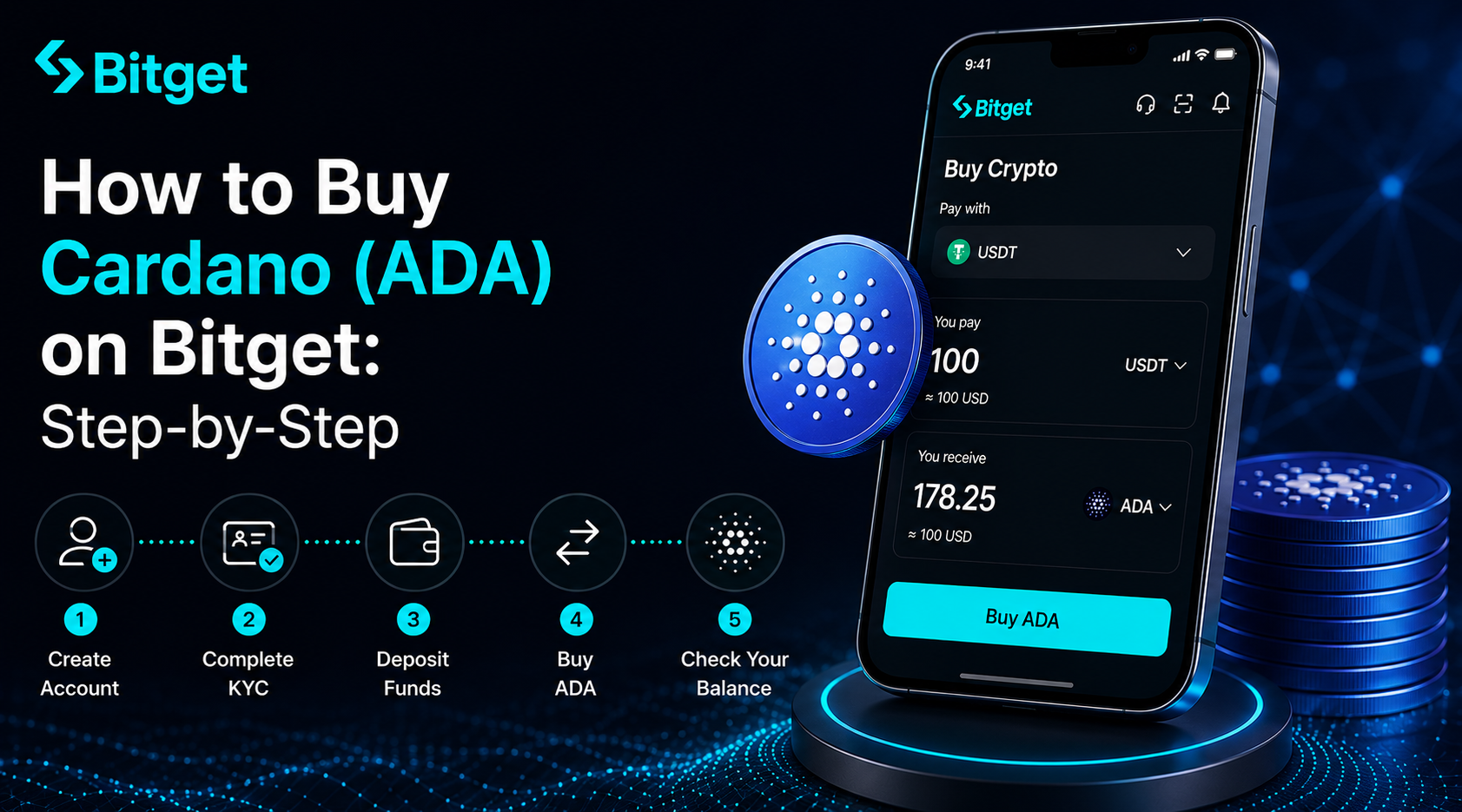
Short answer: To buy Cardano on BitGet, sign up with email, enable 2FA, complete KYC (usually same-day), deposit via card, P2P, bank, or crypto, then place a spot order on the ADA/USDT pair. Spot fees are 0.10%. Card on-ramp adds 1–3%. ADA staking is liquid — your tokens never leave your wallet, no lockup. Returns sit around 3–4% APY. For long-term holding, use a Ledger Nano X plus Eternl or Daedalus. Time from signup to ADA in your account: about 30 minutes.
Open a BitGet account → (affiliate)
Key takeaways
- ADA staking is liquid. Your tokens stay in your wallet, there’s no lockup, and you can unstake or move them any time.
- Cardano epochs are 5 days. Staking rewards arrive at the end of each epoch.
- BitGet spot fees are 0.10% maker/taker. Card adds 1–3% on top.
- KYC usually clears within 1–24 hours.
- Anything you’re not actively trading belongs on a Ledger plus a Cardano wallet like Eternl or Daedalus, not on an exchange.
What Cardano is (the academic blockchain)
Cardano launched in 2017, founded by Charles Hoskinson — one of the original Ethereum co-founders who left over disagreements about how Ethereum was being built. The Cardano pitch from day one was different: peer-reviewed research first, code second. Every major protocol change is published as an academic paper, peer-reviewed by external researchers, then implemented.
That’s the strength and the criticism in one sentence. Strength: when a Cardano upgrade ships, it has been picked apart by cryptographers for years before going live. Criticism: it takes years to ship. Smart contracts arrived on Cardano in September 2021, several years after Ethereum and after most “ETH killers” had come and gone.
The chain runs on Ouroboros — a proof-of-stake protocol that’s been published in over a dozen academic papers. ADA is the native token. The total supply is capped at 45 billion tokens, with around 35 billion currently in circulation. Market cap typically sits in the top 10–15. You can check current numbers on CoinGecko and CoinMarketCap.
The Cardano roadmap is broken into named eras — Byron, Shelley, Goguen, Basho, Voltaire — each focused on a different layer of functionality. As of writing, the chain has shipped staking, smart contracts, scaling improvements via Hydra, and is working through the governance era (Voltaire). For up-to-date project info the official Cardano site and IOG are the primary sources.
For the wider crypto context — what blockchains are, how exchanges work, what to start with — the how to buy crypto parent guide is the right starting point.
Why people buy ADA
A few honest reasons people pick up ADA, beyond the price-prediction noise.
Liquid staking. Stake ADA without sending it anywhere. The token stays in your wallet, you delegate to a stake pool, you earn rewards. You can unstake or move ADA at any time. No lockup. No slashing. That’s a meaningfully better UX than most PoS chains.
Long-term protocol commitment. Cardano isn’t going anywhere quickly. The treasury is well-funded, the academic foundation keeps publishing, and the community is one of the most engaged in crypto. If you want a chain that will still be here in five years, ADA is a reasonable bet.
Lower fees than Ethereum, more decentralised than many alts. Cardano transactions cost typically under $0.20. The network has thousands of stake pools — far more decentralised by validator count than chains like Solana.
The flipside: shipping is slow. DApp ecosystem is smaller than Ethereum or Solana. TVL on Cardano DeFi is a fraction of competing chains. If you want speed of innovation, ADA is not it. If you want stability and yield, it’s a defensible pick.
Why BitGet for buying ADA
Most major exchanges list ADA. Here’s why BitGet specifically.
Deep ADA/USDT order book. Tight spreads, fast fills.
0.10% spot fees. Same maker/taker rate. Drops with BGB holdings or volume.
Multiple funding routes. Card, P2P, bank transfer, crypto deposit.
Proof of Reserves. Monthly attestations. Verifiable on-chain.
Withdrawal works. ADA confirms in under a minute on the Cardano network.
Not for US residents. BitGet is geo-blocked in the US. Coinbase or Kraken are the alternatives there.
Full platform breakdown in the BitGet review.
Pre-signup + signup
Same five-minute prep as any exchange account.
A photo ID. Passport or driving licence, in date.
An email you control. Codes and alerts here for years.
A strong password. 16+ characters, never reused.
Authenticator app. Google Authenticator or Authy. SMS 2FA is a security hole.
Funding source. Debit card, bank, or crypto in another wallet.
Storage plan. Trading float on BitGet, long-term on a hardware wallet. Ledger Nano X supports ADA — order one if you don’t have one yet.
Signup steps
- Sign-up page. BitGet (affiliate — small fee discount). Email + strong password.
- Verify email. Six-digit code, paste it in.
- Enable 2FA. Security Settings → Authenticator. Scan QR, save backup code offline.
- Complete KYC. Passport or driving licence + selfie. Usually 1–24 hours.
- Add payment method. Card now, or P2P at funding.
Account ready in about ten minutes.
Funding the account
| Method | Fee | Speed | Best for |
|---|---|---|---|
| Crypto deposit | Network fee only | 1–60 min | Already hold USDT/USDC/ADA elsewhere |
| P2P (bank transfer) | 0% (small rate spread) | 5–30 min | Best rate |
| Bank transfer (third-party) | 0.5–1.5% | 1–3 hours | Mid-size buys |
| Card on-ramp | 1–3% | Instant | First small buy |
Crypto deposit is cheapest. Send USDT or USDC from another exchange or wallet. Pick the right network — TRC-20 USDT is the cheapest at around 1 USDT in fees.
P2P is highest-effort, lowest-fee. Matched with a USDT seller in your currency. Bank transfer to them, BitGet escrows the USDT, they release on confirmation. Rates within 0.5% of mid-market.
Card is fastest and most expensive. Fine for the first $50.
Placing your first ADA trade
USDT on the spot account. Convert to ADA.
Option A: Market order
- Spot Trading → search ADA/USDT → select.
- Buy side → Market.
- Enter USDT amount.
- Buy ADA. Fills in a second.
You pay 0.10% in fees plus a tiny slippage cost.
Option B: Limit order
- Spot Trading → ADA/USDT → Limit.
- Check the current price. Set your limit slightly below the ask — e.g. ADA at $0.46, limit at $0.458.
- Enter USDT amount.
- Buy ADA. Order parks in the book.
For buys over $100, the limit order is the right call. Saves the spread. Full order-type detail in the BitGet spot trading guide.
How much ADA to buy (position sizing)
Three rules for sizing an ADA position.
Rule one: ADA tracks the broader alt market. When BTC has a clean leg up, ADA usually follows. When alts get crushed, ADA gets crushed harder. Position for both directions.
Rule two: split the entry. Pick a target — say £1,000 over three months — and split into 12 weekly buys. You won’t hit the bottom. You won’t hit the top. You’ll get an average and learn the workflow along the way.
Rule three: hold a stablecoin reserve. ADA has had 70%+ drawdowns multiple times. Keep 30–40% of the budget as USDT for real dips.
For a first-ever ADA buy, start with the equivalent of a night out. Place the trade. Watch the price for two weeks. See how a 20% wobble feels in your gut. Scale up if you sleep through it.
This is the section where I’d point out that learning to read charts and size positions is a skill you can’t shortcut by reading articles. If you want to actually learn it, Trade Travel Chill (affiliate) is the community I’m part of and the structured education source I’d recommend. Optional. Useful when you’re ready.
Storing ADA (Ledger + Cardano wallet)
ADA storage is a two-piece setup — hardware wallet for keys, Cardano wallet software for staking and transactions.
Exchange (BitGet)
Fine for an active trading float. BitGet publishes Proof of Reserves. You don’t hold the keys, but you can withdraw anytime.
Cardano wallet software
For self-custody on Cardano you need a wallet app. Three common options:
Eternl (formerly ccvault.io). The wallet most active Cardano users run. Browser extension and mobile. Connects to a Ledger or Trezor. Supports staking, DApp connections, and native Cardano tokens.
Daedalus. The official full-node wallet from IOG. Downloads the entire Cardano blockchain to your computer. Slower setup, much heavier on disk space. Strong for hardcore self-custody. Less convenient for daily use.
Yoroi. Lightweight wallet from EMURGO. Browser extension and mobile. Easier than Daedalus, fewer features than Eternl.
For 90% of buyers, Eternl in hardware-wallet mode is the right pick.
Hardware wallet (Ledger Nano X)
A Ledger Nano X holds your private keys offline. Plug it in, confirm transactions on-device, the keys never touch the internet. Ledger costs about £150. Order from the Ledger store (affiliate).
The workflow: Ledger holds the keys, Eternl is the interface. You sign transactions on the Ledger, broadcast them through Eternl. Staking works the same way — you delegate to a stake pool through Eternl while your keys stay on the Ledger.
The split I run
- Trading float on BitGet: 20%
- Ledger + Eternl for long-term + staking: 80%
Full self-custody playbook in the how to store crypto safely guide.
Ready to buy your first ADA?
Sign-up takes 90 seconds, KYC clears same-day, and ADA/USDT runs deep liquidity on BitGet.
Affiliate link. I may earn a commission at no extra cost to you.
ADA staking: how it actually works
ADA staking is one of the better-designed yield mechanisms in crypto. Here’s the model.
Liquid by default. You don’t send your ADA anywhere to stake it. You delegate it to a stake pool from within your wallet. The ADA stays where it is. You can spend, send, or move it at any time without unstaking.
No slashing. Most proof-of-stake chains penalise you (slash your stake) if the validator you delegate to misbehaves. Cardano has no slashing. The worst case if your pool goes offline is missing out on rewards for that epoch.
5-day epochs. Cardano measures time in epochs of approximately 5 days. Staking rewards are paid out at the end of each epoch. After you first delegate, expect to wait 2–3 epochs (~10–15 days) before your first reward shows up — that’s the warmup period.
Returns around 3–4% APY. Network-wide ADA staking yields sit in this range. Some pools advertise higher because of fee structures or saturation gaming — most of the time the difference is marginal once you account for pool fees. Anything claiming 8%+ for plain ADA staking is misleading.
Pool selection matters mildly. Avoid pools that are saturated (over the saturation cap, currently 64M ADA). Avoid pools that haven’t produced blocks consistently. Beyond that, the maths is similar across well-run pools.
You can also stake ADA through BitGet Earn if you’d rather take the convenience tradeoff — covered in the BitGet Earn guide. Returns are usually similar minus a platform fee, and you give up custody for the duration. For most holders, self-custody staking through Eternl + Ledger is the better setup.
For ongoing Cardano news, CoinDesk’s Cardano coverage and the official Cardano blog are the sources I check.
Common ADA beginner mistakes
The mistakes I see when people start buying ADA.
Believing the $5, $10, $100 ADA predictions. ADA attracts ambitious price targets. The maths on most of them doesn’t work — they’d put Cardano’s market cap above every Western tech stock combined. Ignore the noise.
Sending ADA to the wrong network. When you withdraw ADA from BitGet, pick the Cardano network. Not BEP-20 wrapped ADA. Native ADA. Wrong network can mean funds gone.
Sending to a Byron-era address. Cardano has two address formats — older Byron and current Shelley. Most modern wallets use Shelley. If a wallet shows an “Addr1…” address, that’s Shelley. “Ae2tdPwUPEZ…” is Byron. Withdraw to Shelley unless you specifically know what you’re doing.
Expecting rewards on day one. The first staking reward takes 2–3 epochs (~10–15 days) to arrive after delegation. New stakers panic, change pools, restart the warmup, never earn anything.
Chasing high-APY ADA pools. Most “high-yield” ADA pools are gaming fee structures or are saturated. Plain network yield is around 3–4%. Anything wildly higher is a red flag.
Storing on the exchange forever. Trading float, yes. Long-term, move to Ledger + Eternl.
Sharing the seed phrase. No legitimate company will ever ask. Anyone who does is trying to rob you.
Ignoring 2FA. Set it up on day one. Authenticator app, not SMS.
Jumping to leverage. ADA spot is volatile enough. The BitGet futures USDT-M guide is research material, not week-one instructions.
Buying every Cardano-ecosystem token. Some are interesting projects. Many are zeros. Stick to ADA itself for the first six months.
One last thing.
If this guide saved you research time, signing up through my affiliate link costs you nothing and keeps the lights on here.
Affiliate link.
Frequently asked questions
What is the minimum amount of ADA I can buy on BitGet?
You can buy fractional ADA from around $1 worth. ADA is divisible to six decimal places (the smallest unit is called a Lovelace). Most people start with $50–$200 to learn the platform.
Do I need to verify my identity to buy ADA on BitGet?
Yes for full functionality. KYC usually clears within 1–24 hours and unlocks full deposit and withdrawal limits.
Can I stake ADA after buying it?
Yes — and ADA staking is one of the cleaner models in crypto. Delegate from Eternl, Daedalus, or Yoroi to any stake pool. Your ADA stays in your wallet. Returns are around 3–4% APY. No lockup, no slashing.
How long do I have to wait for staking rewards?
About 2–3 epochs (10–15 days) after you first delegate. Epochs are 5 days each on Cardano. After the initial warmup, rewards arrive every epoch.
What’s the difference between Eternl and Daedalus?
Daedalus is the official full-node wallet — downloads the whole Cardano blockchain to your computer. Heavyweight, slow setup. Eternl is a lightweight browser/mobile wallet that connects to your Ledger and runs much faster. For 90% of buyers, Eternl is the better choice.
Should I keep my ADA on BitGet or move it to a wallet?
Move long-term holdings to a Ledger + Eternl setup. You can stake from the wallet without giving up custody. Keep a trading float on the exchange.
Is Cardano a good long-term hold compared to Ethereum?
Different bets. Ethereum has more developer activity, larger DeFi TVL, and a longer track record with smart contracts. Cardano has academic rigour, liquid staking, and a long roadmap. Both belong on most diversified portfolios — compare directly via how to buy Ethereum.
Final word
ADA is a steady-state hold for most people. Buy it. Stake it. Forget about it for six months. The yield isn’t life-changing, but the staking model is one of the cleanest in crypto and you keep custody throughout.
Sign up. KYC. Fund cheaply. Place a limit order. Move long-term holdings to a Ledger + Eternl. Delegate to a healthy stake pool. Don’t chase $10 ADA predictions.
That’s the short version.
Right — over to you.
One more thing: Buying a token doesn’t mean it will go up. Most altcoins underperform Bitcoin over long enough timeframes. Only buy what you can afford to lose, and never put your rent money in crypto. If a YouTuber tells you a coin will 100x — they’re guessing too.
Related posts
- How to Buy Bitcoin (BTC) on BitGet: Step-by-Step
- How to Buy Solana (SOL) on BitGet: Step-by-Step
- How to Store Crypto Safely: The Self-Custody Guide