Avalanche launched in 2020 with a pitch that sounded too good — sub-second finality, EVM compatibility, and a subnet architecture that let projects spin up their own custom chains while still benefiting from the security of the main network. Four years later, the subnet model is the part that’s actually pulled in serious institutional attention. JP Morgan, Citi, and Franklin Templeton have all run pilots or shipped products on Avalanche subnets.
I’ve held AVAX since the 2021 launch incentives. Made money in the 2021 bull run, watched it collapse in 2022, accumulated in 2023, ridden the 2024–25 recovery. This walkthrough is how to buy AVAX on BitGet without the usual mistakes — including how to think about subnets, staking, and where to store it. Two of the links are affiliate. I’ll flag them.
Short answer: To buy Avalanche on BitGet, create an account with email, enable 2FA, complete KYC (usually same-day), deposit via card, P2P, bank, or crypto, then place a spot order on the AVAX/USDT pair. Spot fees are 0.10%. Card on-ramp adds 1–3%. AVAX staking returns sit around 7–9% APY with a minimum 25 AVAX delegation. For long-term holding, use a Ledger Nano X plus the Core wallet from Ava Labs. Time from signup to AVAX in your account: about 30 minutes.
Open a BitGet account → (affiliate)
Key takeaways
- Avalanche has three internal chains — the X-Chain (assets), C-Chain (EVM smart contracts), and P-Chain (staking and subnets). Most users only interact with the C-Chain.
- BitGet spot fees are 0.10% maker/taker. Card adds 1–3%.
- AVAX staking pays around 7–9% APY. Minimum delegation is 25 AVAX. Minimum stake period is two weeks.
- KYC usually clears within 1–24 hours.
- Move long-term holdings to a Ledger plus the Core wallet, not the exchange.
What Avalanche is (subnets + speed)
Avalanche was built by Ava Labs, founded by Emin Gün Sirer — a Cornell computer science professor with a long academic background in distributed systems. The chain went live in September 2020. The pitch was simple: solve the Ethereum scaling problem by building a different consensus mechanism (Avalanche consensus) that achieves finality in under a second.
The architecture is more layered than most chains. Avalanche has three built-in chains that work together:
- X-Chain (Exchange Chain). Handles asset creation and transfers. Native AVAX moves here.
- C-Chain (Contract Chain). EVM-compatible. Where smart contracts and DeFi live. This is where most users actually spend their time — MetaMask connects to the C-Chain by default.
- P-Chain (Platform Chain). Manages staking, validators, and subnet coordination.
Most beginners only ever interact with the C-Chain. The X-Chain and P-Chain exist mostly for advanced functionality.
The headline feature beyond speed is subnets. A subnet is a custom blockchain that runs on Avalanche infrastructure. You can deploy your own subnet with custom rules — your own gas token, your own validator set, your own throughput. Institutional players have run subnets for tokenised assets, KYC-gated DeFi, and gaming. Several gaming and finance subnets are now live with real users.
AVAX market cap typically sits in the top 15. Total supply is capped at 720 million. As of writing, around 410–420 million are in circulation. You can check current numbers on CoinGecko and CoinMarketCap. Project info on the official Avalanche site and Ava Labs.
For the wider crypto context, the how to buy crypto parent guide covers it.
Why people buy AVAX
The honest reasons people pick up AVAX, beyond the speculation.
Subnet narrative. This is the bullish thesis. If institutions keep launching custom subnets — tokenised treasuries, KYC-gated DeFi, gaming chains — AVAX captures value through validator staking and ecosystem activity. The 2024 incentive programme (“Avalanche9000”) cut the cost of launching a subnet by over 99%, which has accelerated the pace of new subnet launches.
EVM compatibility. Anything that works on Ethereum works on Avalanche’s C-Chain with minimal changes. MetaMask, Uniswap-style DEXes, Solidity contracts — they all port over. That’s a real adoption shortcut.
Fast and cheap. Sub-second finality, transaction fees usually under $0.05. Cheaper than Ethereum mainnet by a wide margin, comparable to other L1s.
Decent staking yield. Around 7–9% APY for delegators. Higher than Cardano, lower than some smaller L1s.
The bear case: subnet narrative has been “about to inflect” for two years. Many subnets that launched haven’t seen meaningful user volume. Competition from Solana, Sui, and the dozens of EVM L2s is brutal. If the institutional thesis doesn’t pay off, AVAX is just another EVM-compatible L1 in a crowded market.
Why BitGet for buying AVAX
Most major exchanges list AVAX. Why BitGet specifically.
Deep AVAX/USDT order book. Tight spreads, fast fills.
0.10% spot fees. Drops with BGB or volume.
Multiple funding routes. Card, P2P, bank transfer, crypto deposit.
Withdrawal works. AVAX confirms in under a minute on the C-Chain. Important: pick the C-Chain when withdrawing unless you specifically need X-Chain for staking.
Not for US residents. BitGet is geo-blocked in the US — try Coinbase or Kraken there.
Full platform breakdown in the BitGet review.
Pre-signup + signup
Standard five-minute prep.
A photo ID. Passport or driving licence, in date.
An email you control.
A strong password. 16+ characters, never reused.
Authenticator app. Google Authenticator or Authy. SMS 2FA is a security hole.
Funding source. Debit card, bank, or crypto in another wallet.
Storage plan. Trading float on BitGet, long-term on a hardware wallet. Ledger Nano X supports AVAX through Core or directly via Ledger Live.
Signup steps
- Sign-up page. BitGet (affiliate). Email + strong password.
- Verify email. Six-digit code.
- Enable 2FA. Security Settings → Authenticator. Save backup code offline.
- KYC. Passport/driving licence + selfie. Usually 1–24 hours.
- Payment method. Card now, or P2P at funding.
About ten minutes if your ID is ready.
Funding the account
| Method | Fee | Speed | Best for |
|---|---|---|---|
| Crypto deposit | Network fee only | 1–60 min | Already hold USDT/USDC/AVAX elsewhere |
| P2P (bank transfer) | 0% (small rate spread) | 5–30 min | Best rate |
| Bank transfer (third-party) | 0.5–1.5% | 1–3 hours | Mid-size buys |
| Card on-ramp | 1–3% | Instant | First small buy |
Crypto deposit is cheapest. Pick the right network for USDT — TRC-20 is about 1 USDT in fees, ERC-20 is closer to 8.
P2P matches you with a USDT seller in your local currency. Rates within 0.5% of mid-market.
Card on-ramp is fastest, 1.5–3% built into the rate.
Rule: card for the first $50, P2P or crypto deposit for the rest.
Placing your first AVAX trade
USDT on the spot account.
Option A: Market order
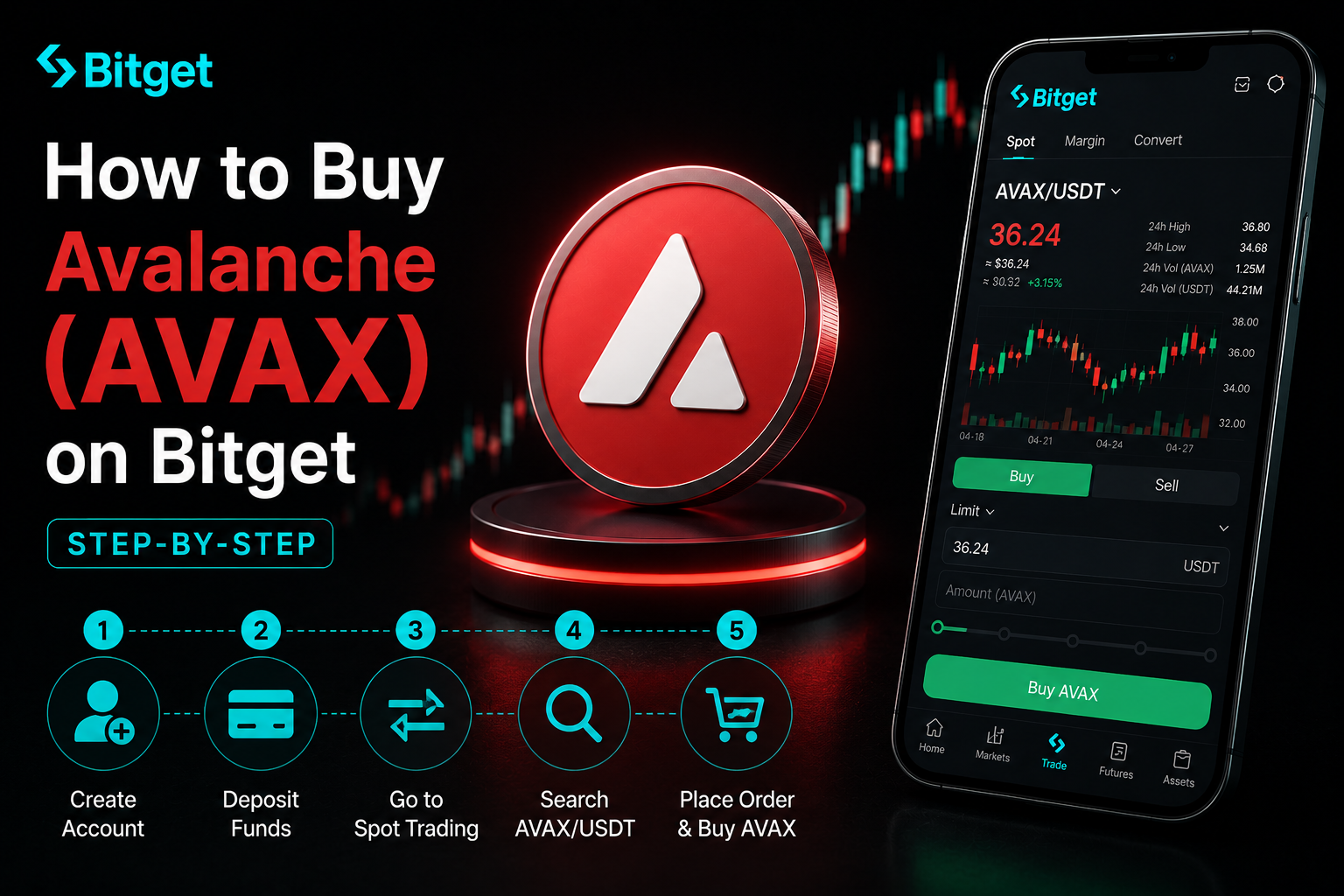
- Spot Trading → search AVAX/USDT → select.
- Buy side → Market.
- Enter USDT amount.
- Buy AVAX. Fills in a second.
You pay 0.10% in fees plus slippage.
Option B: Limit order
- Spot Trading → AVAX/USDT → Limit.
- Current price check. Set the limit slightly below the ask — AVAX at $35.50, limit at $35.30.
- Enter USDT amount.
- Buy AVAX. Order parks in the book.
For buys over $100, the limit order is the right call. Saves the spread, especially during volatile sessions when AVAX can move sharply with broader L1 narratives. Full order-type detail in the BitGet spot trading guide.
How much AVAX to buy (position sizing)
Three rules for sizing an AVAX position.
Rule one: AVAX is mid-cap volatile. It runs harder than BTC on the way up and falls harder on the way down. A 10% BTC move is often a 15–20% AVAX move in the same direction. Size for both sides.
Rule two: split the entry. Pick a target — say £1,000 over three months — and split into 12 weekly buys. You won’t hit the bottom or the top. You’ll get an average and learn the workflow along the way.
Rule three: hold a stablecoin reserve. AVAX has had 80%+ drawdowns in past cycles. Keep 30–40% of the budget as USDT for real dips.
For a first-ever AVAX buy, start with the cost of a takeaway meal. Watch it move 10–15% in a week. If you sleep through it, scale up.
This is the section where I’d point out that learning to actually trade — reading charts, sizing positions, taking profits at the right time — is a skill you can’t shortcut by reading articles. If you want to learn it properly, Trade Travel Chill (affiliate) is the community I’m part of and the structured education source I trust. Optional. Useful when you’re ready.
Storing AVAX (Ledger + Core wallet)
AVAX storage has options at every tier.
Exchange (BitGet)
Active trading float. BitGet publishes Proof of Reserves. You don’t hold the keys but you can withdraw anytime.
Hardware wallet (Ledger Nano X)
A Ledger Nano X supports AVAX natively. Two ways to use it:
- Direct via Ledger Live. Manage AVAX through the standard Ledger interface. Simple, works for holding and basic transfers.
- With Core wallet. Connect your Ledger to Core (the official Avalanche wallet from Ava Labs) for the full experience — staking, subnet interaction, cross-chain swaps between X/C/P chains.
Ledger costs about £150. Order from the Ledger store (affiliate). Set it up, write the 24-word seed on the card it ships with, store somewhere fireproof.
Core wallet
Core is the official Avalanche wallet from Ava Labs. Browser extension and mobile app. Handles the C-Chain, X-Chain, and P-Chain. Supports staking, subnet swaps, NFTs, and DeFi connections. Pairs natively with Ledger.
Use Core when you want to stake, interact with subnets, or swap between Avalanche’s internal chains. Use it without a Ledger if you’re holding small amounts; pair it with a Ledger for anything serious.
MetaMask
MetaMask connects to the C-Chain like any other EVM network. Fine for DeFi interaction on the C-Chain. Won’t handle X-Chain or P-Chain. Doesn’t natively support AVAX staking. Use it for DeFi, not for long-term storage.
The split I run for AVAX
- Trading float on BitGet: 20%
- Core + Ledger for long-term + staking: 80%
Full self-custody playbook in the how to store crypto safely guide.
Ready to buy your first AVAX?
Sign-up takes 90 seconds, KYC clears same-day, AVAX/USDT runs deep liquidity on BitGet.
Affiliate link. I may earn a commission at no extra cost to you.
AVAX staking: 7–9% APY with real constraints
AVAX staking is one of the higher-yielding L1 options for retail. The model has more rules than most chains, so worth understanding before you delegate.
Returns around 7–9% APY. Network-wide AVAX staking yields sit in this range. Some validators take a fee, some don’t — typical validator fees are 2–4%. Your effective yield after fees usually lands around 7%.
Minimum 25 AVAX for delegation. You can’t stake less. If you’re buying smaller amounts, accumulate until you’ve got at least 25 AVAX, then delegate. Below that threshold, BitGet Earn staking is the alternative (custodial — different tradeoff).
Minimum 2-week stake period. Once you delegate, your AVAX is locked for at least two weeks. You can pick longer lockups — anything up to one year — for slightly higher yield. Outside that window, your AVAX is liquid again at the end of the period.
No slashing. Like Cardano, Avalanche doesn’t slash for validator misbehaviour. Worst case is missing rewards if your validator goes offline.
Validator uptime matters. Pick validators with high uptime (above 99%) and reasonable fees. Both Core wallet and the AVAX explorer show validator stats clearly.
The staking happens on the P-Chain. To stake from a Ledger, you’ll move AVAX from C-Chain to P-Chain through Core, then delegate. Sounds more complex than it is — Core walks you through it.
If you’d rather hand off custody for convenience, BitGet Earn offers AVAX staking with similar yield (minus a small platform fee) and no minimum delegation. You give up custody for the duration. Covered in the BitGet Earn guide.
For ongoing Avalanche updates and subnet launches, CoinDesk’s Avalanche coverage and The Block are the sources I check.
Common AVAX beginner mistakes
The mistakes I see most when people start buying AVAX.
Sending to the wrong chain. When you withdraw AVAX from BitGet, you’ll see options for C-Chain and sometimes X-Chain. For sending to MetaMask, a Ledger via Ledger Live, or most DeFi use cases — pick C-Chain. X-Chain is for moving AVAX into the staking pipeline. Wrong chain doesn’t mean funds are gone (you can move between them in Core), but it can mean an extra hour of figuring out cross-chain swaps.
Sending to the wrong network entirely. Native AVAX, not BEP-20 wrapped AVAX. Wrong network can mean funds gone forever.
Trying to stake under 25 AVAX direct. The 25 AVAX minimum is hard. Below that, either accumulate more or use a custodial staking product.
Expecting daily payouts on staking. AVAX staking rewards pay out at the end of your stake period, not continuously. If you stake for two weeks, you see the reward after two weeks. Plan accordingly.
Buying on subnet hype without checking activity. A subnet launch gets coverage. Six months later you check on-chain — almost no users. Not every subnet launch is the same. Look at active addresses and TVL before sizing up on the back of subnet news.
Storing on the exchange forever. Trading float, yes. Long-term, move to Ledger + Core.
Sharing the seed phrase. No legitimate company will ever ask. Anyone who does is trying to rob you.
Ignoring 2FA. Set it up on day one. Authenticator app, not SMS.
Day-trading immediately. AVAX has the same volatility profile as most mid-cap L1s. New buyers see one good week and think they’ve got it figured out. The BitGet futures USDT-M guide is research material, not week-one instructions.
Chasing every L1 narrative. Solana, AVAX, Sui, Aptos, Sei — they all take turns leading the L1 rotation. Picking the rotation is hard. Holding a basket of L1s is more sustainable than chasing each one as it pumps.
One last thing.
If this walkthrough saved you research time, signing up through my affiliate link costs you nothing and keeps the lights on here.
Affiliate link.
Frequently asked questions
What is the minimum amount of AVAX I can buy on BitGet?
You can buy fractional AVAX from around $1 worth. AVAX is divisible to nine decimal places. Most people start with $50–$200 to learn the platform.
Do I need to verify my identity to buy AVAX on BitGet?
Yes for full functionality. KYC usually clears within 1–24 hours and unlocks full deposit and withdrawal limits.
What’s the difference between AVAX C-Chain and X-Chain?
The C-Chain is EVM-compatible and where most users interact — DeFi, MetaMask, DApps. The X-Chain handles basic asset transfers and is used in the staking pipeline. The P-Chain manages staking and subnets. When withdrawing AVAX from BitGet, pick C-Chain unless you specifically need X-Chain.
Can I stake AVAX after buying it?
Yes — through Core wallet with a minimum 25 AVAX delegation and a minimum 2-week stake period. Returns are typically 7–9% APY. No slashing. If you’ve got less than 25 AVAX, BitGet Earn offers custodial staking with no minimum.
What’s the difference between Core wallet and MetaMask for AVAX?
Core is the official Avalanche wallet — handles all three internal chains, supports staking and subnets natively. MetaMask connects to the C-Chain only and works fine for DeFi but doesn’t support staking. For long-term AVAX holding, use Core + Ledger.
Should I keep my AVAX on BitGet or move it to a wallet?
Move long-term holdings to a Ledger + Core setup. You can stake from there without giving up custody. Keep a trading float on the exchange.
What are Avalanche subnets and do they matter for an AVAX holder?
A subnet is a custom blockchain that runs on Avalanche infrastructure with its own rules. The thesis is that institutional and gaming subnets drive AVAX demand through validator staking. As of writing, the institutional thesis is partly playing out but still maturing.
Final word
AVAX is a tech-forward L1 with a real institutional angle and a real subnet narrative — both of which have been “about to inflect” for a while. If you believe the subnet story, the asset deserves a slot. If you don’t, it’s still a defensible mid-cap L1 with solid staking yield.
Sign up. KYC. Fund cheaply. Place a limit order. Move long-term holdings to Core + Ledger. Stake if you’ve got 25 AVAX or more. Don’t chase L1 rotation.
That’s the short version.
Right — over to you.
One more thing: Buying a token doesn’t mean it will go up. Most altcoins underperform Bitcoin over long enough timeframes. Only buy what you can afford to lose, and never put your rent money in crypto. If a YouTuber tells you a coin will 100x — they’re guessing too.
Related posts
- How to Buy Bitcoin (BTC) on BitGet: Step-by-Step
- How to Buy Solana (SOL) on BitGet: Step-by-Step
- How to Store Crypto Safely: The Self-Custody Guide