Dogecoin was a joke. Two engineers, Billy Markus and Jackson Palmer, took the Shiba Inu meme and forked Litecoin in 2013 just to mock the seriousness of altcoins. Eight years later it had a $90 billion market cap. Elon Musk had tweeted about it on a national US comedy show and the price did what memecoin prices do — it ran 1,000% and then gave most of it back.
I’ve held DOGE in two cycles. Made money on it, lost money on it, and gradually worked out the size you can hold without it ruining your mood for a year. This walkthrough is how to buy DOGE on BitGet — and the honest framing for whether it deserves a slot in a portfolio that’s meant to do something other than entertain you. Two of the links are affiliate. I’ll flag them.
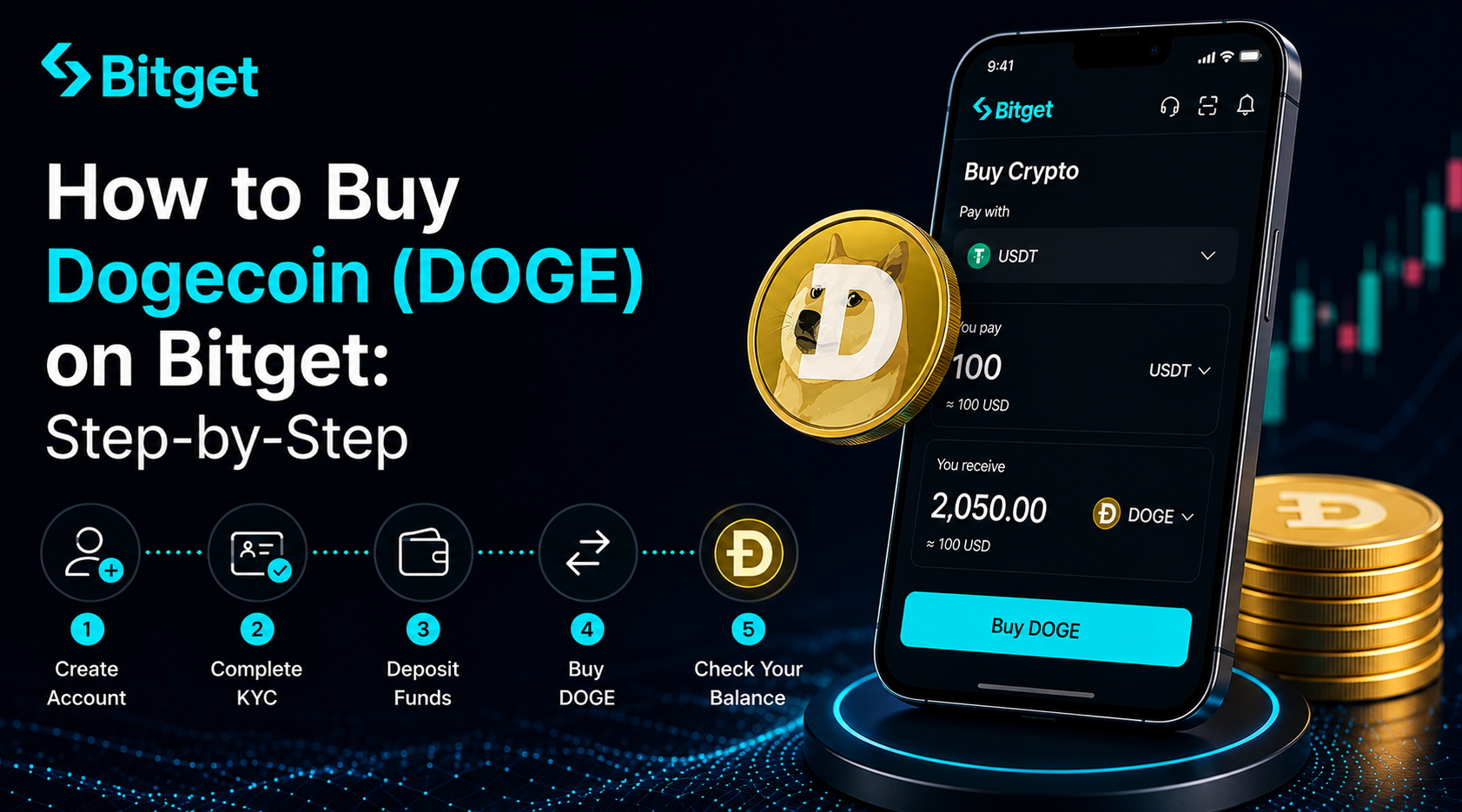
Short answer: To buy Dogecoin on BitGet, sign up with email, enable 2FA, complete KYC (usually same-day), deposit via card, P2P, bank, or crypto, then place a spot order on the DOGE/USDT pair. Spot fees are 0.10%. Card on-ramp adds 1–3%. DOGE has unlimited supply — about 5 billion new tokens issued every year — so treat it as a speculative position, not a savings account. For long-term holding, move DOGE to a Ledger Nano X. Time from signup to DOGE in your account: about 30 minutes.
Open a BitGet account → (affiliate)
Key takeaways
- DOGE has no supply cap. Roughly 10,000 new DOGE are minted per minute — about 5 billion per year. That’s permanently inflationary.
- BitGet spot fees are 0.10% maker/taker. Card adds 1–3%.
- KYC usually clears within 1–24 hours.
- DOGE is a speculative position. Size it like one — small enough to lose without it changing your life.
- Move long-term holdings to a Ledger, not the exchange.
What Dogecoin is (the joke that became a top 10 coin)
DOGE was created in December 2013 by Billy Markus and Jackson Palmer as a parody of how seriously crypto people were taking themselves. The branding was the Shiba Inu doge meme. The code was a fork of Luckycoin, which was itself a fork of Litecoin. It was meant to be tipping money. A way to send a few cents on Reddit to thank someone for a good post.
It became more than that. Mostly because of personalities. The Reddit community built around it had a lighter culture than most crypto. Tipping caught on. Then in 2020 and 2021, Elon Musk started tweeting about DOGE — and “the people’s crypto” turned into the most discussed token outside of Bitcoin and Ethereum for the better part of two years.
The technical specs are unremarkable. Block time is about a minute. Transaction fees are a fraction of a cent. Proof of work, merged-mined with Litecoin. The chain works, it confirms quickly, it’s been operating without major incident for over a decade.
The economics are the more interesting story. DOGE has no maximum supply. Around 10,000 new tokens are issued per minute — roughly 5 billion per year. As the total supply grows, the percentage inflation rate decreases (from about 5% currently down toward 3% over time), but the absolute issuance keeps adding to the float forever. That’s the opposite of Bitcoin, which is capped at 21 million.
For an asset with unlimited supply, the only way for the price to go up over the long term is for demand to grow faster than 5 billion new tokens a year. That’s possible. It’s also why DOGE behaves more like a speculative meme position than a store of value. Current market cap and supply figures live on CoinGecko and CoinMarketCap. Project info on the official Dogecoin site.
Is DOGE a serious investment? (honest answer)
The straight answer: DOGE is a speculation, not an investment. Here’s the case for both takes.
The bull case. DOGE has brand recognition larger than any altcoin outside Ethereum. It has a passionate retail base that buys every dip below certain levels. There’s been ongoing talk about X (Twitter) integrating crypto payments with DOGE involved — Musk has hinted at it multiple times without ever shipping it. If any payments integration does land, it could be meaningful for the use case.
The bear case. Unlimited supply. No technical roadmap that distinguishes it from a thousand other PoW chains. Smart contracts don’t exist on Dogecoin. DeFi ecosystem is zero. The entire price action correlates with Musk tweets and broader memecoin sentiment. Take Musk and Reddit out of the equation and you’re left with a slow PoW chain with permanent inflation.
My actual take. DOGE has a place in a portfolio if you treat it as a small speculative bet. I size mine at 2–3% of total crypto. Enough to participate if a memecoin season rips. Small enough that a 90% drawdown doesn’t change my life. If you can’t define a size that lets you sleep through both an 80% drop and a 500% rally without acting irrationally, your size is wrong.
What I won’t do — and won’t recommend anyone else do — is put DOGE in the “long-term hold” bucket the way I’d put BTC or ETH. The economics aren’t built for it.
The Elon factor and X integration
You can’t write about DOGE without writing about Elon Musk. The price has correlated more closely with his tweets than with any technical or fundamental factor for years.
The pattern has been consistent. He tweets a positive DOGE reference, price spikes 20–50%. He goes quiet, price drifts back. He tweets a Doge meme on launch day for X Money, price moves. The X integration speculation has been running since 2022 — Musk has hinted at crypto payments on the platform repeatedly. As of writing, nothing concrete has shipped with DOGE specifically as a payment rail, though the rumours keep cycling.
For up-to-date Musk/DOGE coverage, Reuters and CoinDesk are the sources I check.
What this means for a buyer:
– DOGE price action is news-driven. Position accordingly.
– Don’t chase Musk tweets. The pump usually peaks within a few hours, then retraces.
– Any X Money integration is rumour until it ships. Treat it as such.
The Elon factor cuts both ways. He could announce something tomorrow that prints 100% on DOGE. He could also stop posting about it entirely and the price would drift back down to where supply economics put it.
Why BitGet for buying DOGE
DOGE is on every major exchange. Why BitGet specifically.
Deep DOGE/USDT order book. Tight spreads even during memecoin chaos.
0.10% spot fees. Drops with BGB or volume.
Multiple funding routes. Card, P2P, bank transfer, crypto deposit.
Withdrawal works. DOGE confirms in a few minutes on the Dogecoin network.
Not for US residents. BitGet is geo-blocked in the US — try Coinbase or Kraken there.
Full platform breakdown in the BitGet review.
Pre-signup + signup
Same five-minute prep as any account.
A photo ID. Passport or driving licence, in date.
An email you control.
A strong password. 16+ characters, never reused.
Authenticator app. Google Authenticator or Authy.
Funding source. Debit card, bank, or crypto in another wallet.
Storage plan. Trading float on BitGet, long-term on a hardware wallet. Ledger Nano X supports DOGE.
Signup steps
- Sign-up page. BitGet (affiliate). Email + password.
- Verify email. Six-digit code, paste it in.
- Enable 2FA. Security Settings → Authenticator. Save backup code offline.
- KYC. Passport/driving licence + selfie. Usually 1–24 hours.
- Add payment method.
About ten minutes if your ID is ready.
Funding the account
| Method | Fee | Speed | Best for |
|---|---|---|---|
| Crypto deposit | Network fee only | 1–60 min | Already hold crypto elsewhere |
| P2P (bank transfer) | 0% (small rate spread) | 5–30 min | Best rate |
| Bank transfer (third-party) | 0.5–1.5% | 1–3 hours | Mid-size buys |
| Card on-ramp | 1–3% | Instant | First small buy |
Crypto deposit is cheapest. Send USDT or USDC from another exchange — TRC-20 USDT is about 1 USDT in fees.
P2P matches you with a USDT seller in your currency. Bank transfer, escrowed release. Rates within 0.5% of mid-market.
Card on-ramp is fastest, 1.5–3% fee bundled in.
Rule for DOGE: card for the first $50 to test the workflow, P2P or crypto deposit for everything else. If you’re sizing DOGE small (which you should), card may be fine for the whole position.
Placing your first DOGE trade
USDT in the spot account. Convert to DOGE.
Option A: Market order
- Spot Trading → search DOGE/USDT → select.
- Buy side → Market.
- Enter USDT amount.
- Buy DOGE. Fills in a second.
You pay 0.10% in fees plus slippage.
Option B: Limit order
- Spot Trading → DOGE/USDT → Limit.
- Current price check. Set limit slightly below the ask — DOGE at $0.085, limit at $0.0848.
- Enter USDT amount.
- Buy DOGE. Order parks.
For DOGE specifically — limit orders matter more during news-driven spikes. The spread widens when Musk tweets, market orders get filled at terrible prices, limit orders sit and wait for better entries. Full order detail in the BitGet spot trading guide.
Position sizing: treat DOGE as speculation
This is the most important section in this post.
Rule one: DOGE is news-driven, not value-driven. The price moves on Musk tweets, memecoin seasons, and broader risk-on appetite. It doesn’t move on fundamentals because there aren’t many to move on. Size like you’re holding a high-vol option.
Rule two: cap DOGE at 5% of your total crypto. That’s my personal limit. Some people go higher because they believe in the payment narrative. I’d rather not have a meme coin be the position that ruins my year. 2–3% is where I sit.
Rule three: don’t average down on DOGE. Averaging down works for assets with intrinsic value where the price is temporarily wrong. DOGE has no intrinsic value to revert to. Averaging down on a memecoin that’s losing momentum can mean a much larger loss when the trend completes.
Rule four: have an exit plan before you buy. Pick a target — say 3x — and decide at the start that you’ll sell at least half at that level. Pick a stop — say 50% drawdown — and decide at the start you’ll cut the position if it’s hit. Without rules set in advance, emotion takes over and emotion is a terrible trader.
For a first DOGE buy, start with the cost of a takeaway. Place the trade. Watch it move 10% up and 10% down in the same day. If that gives you anxiety, your size is wrong.
This is the section where I’d point out that learning to actually trade — risk management, position sizing, taking profits — is a skill you can’t shortcut by reading articles. If you want to learn it properly, Trade Travel Chill (affiliate) is the community I’m part of and the structured education source I’d point you at. Optional. Useful when you’re ready.
Storing DOGE
Same principle as every other token. Trading float on the exchange, real positions on a hardware wallet.
Exchange (BitGet)
Fine for active float. BitGet publishes Proof of Reserves. You don’t hold the keys but you can withdraw anytime.
Cold storage (Ledger Nano X)
A Ledger Nano X supports DOGE natively in Ledger Live. Plug in, confirm transactions on the device, keys never touch the internet.
Ledger costs about £150. Cheaper than the lesson of an exchange failure. Order from the Ledger store (affiliate). Set it up, write the 24-word seed on the card it ships with, store somewhere fireproof.
Other DOGE wallet options
- Dogecoin Core. The official full-node wallet. Downloads the whole blockchain. Heavyweight, fine for hardcore self-custody but overkill for most.
- Trust Wallet, Exodus. Mobile/desktop hot wallets that support DOGE. Convenient for small amounts and active spending. Not for long-term holding.
The split I run for DOGE
- Trading float on BitGet: 30%
- Ledger long-term: 70%
Because DOGE is a smaller portion of total holdings, the float share is a bit higher than I’d run for BTC or ETH. Full self-custody playbook in the how to store crypto safely guide.
Ready to buy your first DOGE?
Sign-up takes 90 seconds, KYC clears same-day, DOGE/USDT runs deep liquidity on BitGet.
Affiliate link. I may earn a commission at no extra cost to you.
Common DOGE beginner mistakes
The mistakes I see most when people start buying DOGE.
Buying off a tweet. Musk tweets, DOGE pumps 30% in an hour, retail piles in at the top, the pump retraces within a day. If you’re chasing a tweet pump, you’re providing the exit liquidity for people who bought earlier. Don’t.
Putting too much in. DOGE attracts beginners who go in heavy because the price feels low (“only 8 cents — easy 10x”). The price being a small number doesn’t mean it’s cheap. The market cap is what matters. Size based on percentage of portfolio, not the dollar price per token.
Storing on the exchange forever. Trading float, yes. Real position, no. Move it to a Ledger.
Sending to the wrong network. When you withdraw DOGE from BitGet, the network is Dogecoin. Not BEP-20 wrapped DOGE. Wrong network can mean funds gone forever.
Sharing the seed phrase. No legitimate company will ever ask for your 24-word seed phrase. Anyone who does is robbing you.
Ignoring 2FA. Authenticator app, not SMS. Set it up on day one.
Believing “DOGE to $1” promises. $1 DOGE would put the market cap above Visa. It’s possible. It’s also a price target, not a plan. Don’t size based on someone else’s price prediction.
Treating DOGE as a long-term store of value. It can’t be one — supply is unlimited. Hold it for what it is: a high-vol speculation with brand recognition.
Day-trading after one good week. New buyers see DOGE rip 50% in five days and think they’ve got it figured out. The next week DOGE retraces 30% and they get blown out. Six months of spot before you touch leverage.
Jumping straight to futures. BitGet futures is research material on DOGE. Not week-one instruction.
One last thing.
If this walkthrough saved you research time, signing up through my affiliate link costs you nothing and keeps the lights on here.
Affiliate link.
Frequently asked questions
What is the minimum amount of DOGE I can buy on BitGet?
You can buy fractional DOGE from around $1 worth. With DOGE trading at typical prices that’s hundreds of tokens for $20–$50. Most people start with $50–$200 for a first speculative position.
Do I need to verify my identity to buy DOGE on BitGet?
Yes for full functionality. KYC usually clears within 1–24 hours and unlocks full deposit and withdrawal limits.
Can I buy Dogecoin with a credit card on BitGet?
Yes, but it’s the most expensive route. Card on-ramps charge 1–3% and credit card providers often add a cash-advance fee. For DOGE — where you’re already in speculative territory — small position sizes via card may be acceptable. Larger buys should use bank transfer or P2P.
Is DOGE a good investment?
DOGE is a speculation, not a long-term investment in the traditional sense. Unlimited supply means it can’t function as a store of value the way Bitcoin can. It can perform very well during memecoin seasons and Musk-driven news cycles. Size accordingly.
Should I keep my DOGE on BitGet or move it to a wallet?
Move long-term holdings to a Ledger. Active trading float can stay on the exchange. The split I run is roughly 30% on exchange, 70% on cold storage.
What’s the deal with the Elon Musk and X Money rumours?
Musk has hinted multiple times that X (Twitter) could integrate crypto payments and DOGE has been mentioned in that context. As of writing, nothing concrete has shipped. Treat all of it as rumour until something is actually live on the platform.
Will Dogecoin reach $1?
Nobody knows. $1 DOGE would put the market cap above Visa, which would require a massive shift in demand or actual utility growth. Don’t make position-sizing decisions based on someone else’s price prediction.
Final word
DOGE is what it is. A meme with billions in market cap, a passionate retail base, and a tweet-driven price chart. There’s a place for it in a portfolio if you size it small and don’t pretend it’s anything other than a speculation.
Sign up. KYC. Fund cheaply. Place a limit order. Move long-term holdings to a Ledger. Cap the position at a few percent of your total crypto. Don’t chase tweets.
That’s the short version.
Right — over to you.
One more thing: Buying a token doesn’t mean it will go up. Most altcoins underperform Bitcoin over long enough timeframes. Only buy what you can afford to lose, and never put your rent money in crypto. If a YouTuber tells you a coin will 100x — they’re guessing too.
Related posts
- How to Buy Bitcoin (BTC) on BitGet: Step-by-Step
- How to Buy Solana (SOL) on BitGet: Step-by-Step
- How to Store Crypto Safely: The Self-Custody Guide