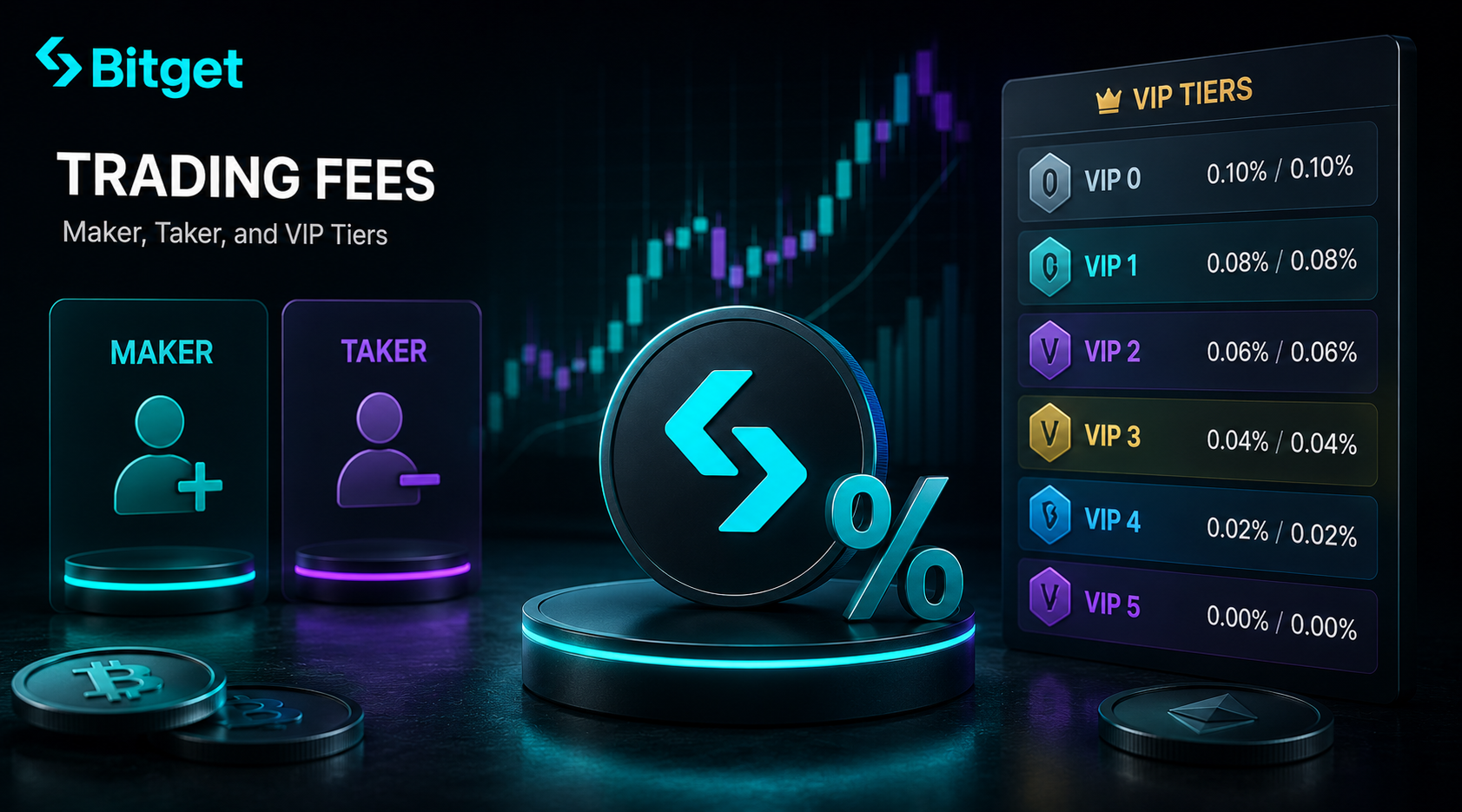
Fees are the one thing that compounds against you whether your trades win or lose. I worked out earlier this year that I’d paid roughly £2,400 in trading fees over 12 months on BitGet. That’s not a small number. It’s also less than I’d have paid on Coinbase for the same volume by a factor of about six. Fees aren’t a vanity number — they’re the silent tax on every trader, and most retail traders never look at theirs until they’re already deep into a losing month.
This post is the full breakdown of what BitGet actually charges, where the discounts come from, and the small tactical moves that can shave 30–40% off your annual fee bill. Some links are affiliate. I’ll mark them.
Short answer: BitGet spot fees start at 0.10% maker / 0.10% taker. Futures fees start at 0.02% maker / 0.06% taker. Holding BGB (BitGet’s native token) and using it to pay fees gets you a 20% discount on top. VIP tiers reduce fees further based on 30-day trading volume or BGB holdings. Withdrawal fees vary by network — USDT on TRC-20 is 1 USDT, on ERC-20 is around 8 USDT depending on Ethereum gas.
Open BitGet → (referral link)
Key takeaways
- BitGet spot fees are competitive with Binance (0.10% / 0.10%) and significantly cheaper than Coinbase (0.60% taker on the standard tier).
- BGB token holders get a 20% fee discount stacked on top of VIP tier discounts.
- Futures fees drop steeply at higher VIP tiers, reaching 0.012% maker / 0.035% taker at VIP 3.
- Network choice matters — USDT on TRC-20 costs 1 USDT to withdraw, USDT on ERC-20 can be 8+ USDT depending on Ethereum gas prices, per BitGet’s official fees page.
- Funding rates and Convert spread are the two hidden costs most traders miss.
BitGet spot fees by VIP tier
The base spot fee schedule. Regular tier applies to everyone with under 50 BTC of 30-day volume.
| Tier | 30-day volume (BTC) | Maker | Taker |
|---|---|---|---|
| Regular | < 50 | 0.10% | 0.10% |
| VIP 1 | 50 | 0.08% | 0.10% |
| VIP 2 | 200 | 0.07% | 0.09% |
| VIP 3 | 1,000 | 0.06% | 0.08% |
| VIP 4 | 2,000 | 0.05% | 0.07% |
| VIP 5 | 4,000 | 0.04% | 0.06% |
| VIP 6+ | 8,000+ | 0.02% | 0.04% |
Hold BGB and pay fees with it — 20% discount stacks on every tier. So a regular user paying with BGB pays 0.08% effective taker. At VIP 3 with BGB, it’s 0.064% taker. That’s competitive with Binance and significantly cheaper than Coinbase Advanced.
Source: BitGet official fees page. Rates can change — always check before assuming.
BitGet futures fees by VIP tier
Futures fees are lower than spot because the volumes are higher and the maker rebate model encourages liquidity provision.
| Tier | Maker | Taker |
|---|---|---|
| Regular | 0.02% | 0.06% |
| VIP 1 | 0.018% | 0.052% |
| VIP 2 | 0.016% | 0.045% |
| VIP 3 | 0.012% | 0.035% |
| VIP 4 | 0.010% | 0.030% |
| VIP 5 | 0.008% | 0.026% |
| VIP 6+ | 0.005% | 0.020% |
For comparison: Binance futures regular tier is 0.02% maker / 0.05% taker. Bybit is 0.02% / 0.055%. BitGet sits in the same ballpark as both and slightly cheaper at some tiers.
The maker rebate at VIP 5 and above can flip negative — BitGet pays you to provide liquidity at the highest VIP tiers. This is institutional pricing. Almost no retail traders hit those tiers but worth knowing it exists.
Same 20% BGB discount applies on futures. At regular tier with BGB you pay 0.016% maker / 0.048% taker. The difference compounds heavily over a year of active trading.
What’s the difference between maker and taker fees?
Two terms that confuse people for longer than they should.
Maker = you place an order that doesn’t immediately match. Your limit order sits on the order book waiting for someone to take it. You’re “making” liquidity for the book. Lower fee.
Taker = you place an order that immediately matches an existing order on the book. Market orders are always takers. Limit orders that cross the spread (limit-buy above ask, limit-sell below bid) are also takers. You’re “taking” liquidity. Higher fee.
The economic logic: exchanges want order books with depth. Makers add depth. Takers consume it. The fee difference is the incentive to add liquidity.
For most retail trades the difference is small in absolute terms — on a $1,000 trade the difference between maker (0.02% = $0.20) and taker (0.06% = $0.60) is 40 cents. Multiply across thousands of trades a year and it becomes real money. A serious active trader can save 50%+ on annual fees just by routing through limit orders that wait for fills instead of market orders.
The trade-off: limit orders can miss fills. If price moves away from your level, you don’t get the trade. So you save fees at the cost of execution certainty. For most strategies it’s worth it. For high-confidence directional trades where missing the fill is more expensive than the fee, market orders win.
How does BGB give you a 20% fee discount?
BGB is BitGet’s native exchange token. It does several things — fee discounts, VIP qualification, Launchpool, governance. The fee discount is the most useful for everyday traders.
To activate the discount, you need to:
- Hold BGB in your spot account.
- Toggle on “Pay fees with BGB” in account settings.
Once active, BitGet calculates your trading fee in the trading currency (USDT, BTC, etc.) and deducts the BGB equivalent at the current BGB price. You get a 20% discount on the fee.
Practical example. A $1,000 BTC trade at 0.1% fee costs $1. With BGB enabled, BitGet deducts $0.80 worth of BGB instead. You’ve saved $0.20 on a single trade.
Across a year of trading, the 20% discount matters. On £2,400 of fees that’s a £480 saving. Not life-changing, but more than enough to justify holding a small BGB balance.
The catches:
BGB price volatility. BGB pumps and dumps with BitGet news cycles. The value of your fee-discount balance moves with it. Hold enough to cover discounts but don’t view BGB as an investment position. The token is a tool, not a bet.
You need to top up regularly. Active traders burn through their BGB balance for fees. If it runs out, the discount stops and you pay full fees in the trading currency. Auto-replenish doesn’t exist — you set a reminder or check monthly.
For more on BGB beyond fee discount, see the BitGet Launchpool guide where holding BGB also qualifies you for free token airdrops.
What are BitGet’s withdrawal fees by network?
The bit where network choice can save you 80% of the cost.
Withdrawal fees on the major assets, as published on the official BitGet fees page:
| Asset | Network | Approx fee |
|---|---|---|
| BTC | Bitcoin | 0.0001 BTC (~$6 at $60,000) |
| BTC | Lightning Network | ~$0 (often free) |
| USDT | TRC-20 (Tron) | 1 USDT |
| USDT | BEP-20 (BNB Chain) | 0.5 USDT |
| USDT | ERC-20 (Ethereum) | ~8 USDT (varies with gas) |
| ETH | Ethereum | 0.0008 ETH (varies with gas) |
| ETH | Arbitrum | 0.0002 ETH |
| SOL | Solana | 0.001 SOL (~$0.20) |
| BNB | BNB Chain | 0.0005 BNB |
| XRP | XRP Ledger | 0.25 XRP |
The TRC-20 vs ERC-20 difference on USDT is the one to remember. If you’re withdrawing $1,000 of USDT and you pick ERC-20 over TRC-20, you’ve burned 8 USDT instead of 1 USDT. That’s a 0.7% withdrawal tax for picking the wrong network.
Always check what networks the destination wallet supports before withdrawing. Sending USDT on the wrong network is unrecoverable.
For larger transfers between exchanges, TRC-20 USDT is the de-facto standard for cost reasons. For smaller everyday transfers, Solana USDC has become a strong alternative — sub-cent fees and seconds to settle.
How do you qualify for VIP tiers?
Two paths. Most retail traders use neither, but it’s good to know how it works.
Path 1: trading volume
Hit 30-day trading volume in BTC equivalents:
- VIP 1: 50 BTC volume
- VIP 2: 200 BTC volume
- VIP 3: 1,000 BTC volume
- VIP 4: 2,000 BTC volume
- VIP 5: 4,000 BTC volume
At ~$60,000 per BTC, VIP 1 needs $3 million of 30-day volume. That’s $100,000 a day. Not retail territory.
Path 2: BGB holdings
Maintain a minimum BGB balance:
- VIP 1: 200 BGB
- VIP 2: 500 BGB
- VIP 3: 2,000 BGB
- VIP 4: 5,000 BGB
- VIP 5: 10,000 BGB
The BGB path is theoretically cheaper for low-volume traders who want VIP perks. But the BGB price varies and the tier requirements update — always check current values before buying BGB just for VIP qualification.
For most active retail traders, sitting at Regular tier with BGB fee discount enabled is the right move. The marginal benefit of VIP 1 (0.08% maker vs 0.10%) doesn’t justify holding $5,000+ of BGB for most retail accounts.
What hidden fees should you watch for?
Three costs that don’t show up in the standard fee schedule.
1. Funding rate (on futures)
Funding isn’t a fee in the traditional sense — it’s a payment between longs and shorts to keep the perpetual price tied to spot. But it functions as a cost on holding positions.
Funding rates on BitGet typically range from -0.01% to +0.03% per 8 hours during normal markets. During strong trends or squeezes they can hit 0.5% per 8 hours.
Hold a 10x leveraged position for a week with average funding of 0.01% against you = roughly 2.1% of your notional, or 21% of your margin. That’s a hefty hidden cost.
Always check the funding history on a contract before opening a leveraged position you plan to hold for more than a day. Read BitGet leverage explained for the full breakdown of how funding and leverage interact.
2. Spread on Convert (Swap)
BitGet Convert is the simple swap interface — “I have 100 USDT, give me ETH.” It looks free because there’s no fee line item.
The cost is hidden in the spread. The price you swap at is slightly worse than the live spot market mid-price. The gap is BitGet’s profit margin on the swap. It typically runs 0.1% to 0.5% depending on the pair.
For small swaps Convert is convenient. For larger amounts, place a limit order on the spot pair instead — you’ll pay 0.1% fee but get the live market price.
Read BitGet Convert and Swap for the deeper breakdown of when Convert wins versus spot orders.
3. Card on-ramp markup
Buying crypto with a card via the BitGet on-ramp costs 1–3% depending on the third-party provider. The headline says “instant buy” but the fee structure is opaque because the on-ramp partners (Mercuryo, Banxa, etc.) take a cut on top of BitGet’s processing.
For amounts over $500, P2P or bank transfer is usually meaningfully cheaper. For small one-off purchases under $200, the card route is fine — the convenience is worth the markup.
BitGet fees vs Binance, Bybit, and Coinbase
Side-by-side at standard (non-VIP, no token discount) tier.
| Exchange | Spot maker | Spot taker | Futures maker | Futures taker | Withdrawal (USDT TRC-20) |
|---|---|---|---|---|---|
| BitGet | 0.10% | 0.10% | 0.02% | 0.06% | 1 USDT |
| Binance | 0.10% | 0.10% | 0.02% | 0.05% | 1 USDT |
| Bybit | 0.10% | 0.10% | 0.02% | 0.055% | 1 USDT |
| Coinbase Advanced | 0.40% | 0.60% | N/A (limited futures) | N/A | Varies |
BitGet, Binance, and Bybit are all within a hair of each other on standard tier fees. The differences emerge at the VIP tiers and with native token discounts (BNB on Binance, BGB on BitGet). Coinbase Advanced is significantly more expensive for retail traders — about 6x the cost on spot trades.
If you’re choosing between the tier-1 exchanges purely on fees, BitGet vs Binance vs Bybit is close to a wash. Other factors (copy trading depth, bot ecosystem, security history) usually matter more.
For full head-to-head reviews, see BitGet vs Binance and BitGet vs Bybit.
Trade on BitGet with BGB fee discount
Sign-up takes 90 seconds. Enable BGB fee payment in settings and you’re 20% cheaper from your first trade.
Affiliate link. I may earn a commission at no extra cost to you.
Fee minimisation tactics
Five practical moves that compound across a year of trading.
1. Use limit orders, not market orders
Maker fees are 30–60% lower than taker fees. If you’re trading on a time horizon that allows it, post limit orders that sit on the book and wait for fills. The fee savings on active accounts are substantial — easily £500+ per year for moderate volume.
2. Hold BGB and pay fees with it
The 20% discount stacks on every other discount you qualify for. Hold enough BGB to cover roughly 3 months of expected fees. Top up when it gets low. Don’t over-hold BGB as a speculative position.
3. Pick the cheapest network for withdrawals
TRC-20 for USDT (1 USDT vs 8 USDT on ERC-20). Lightning for BTC where supported. Arbitrum or Optimism for ETH where the destination supports L2.
4. Avoid Convert for amounts over $500
Use spot limit orders instead. The Convert spread can be 0.2–0.5% versus 0.1% on a limit order. On $1,000 that’s $2–4 saved per swap.
5. Check funding before leveraged holds
A 0.05% funding rate per 8 hours against your direction is 4.5% per month. That’s bigger than most traders’ edge. Don’t pay funding for trades you weren’t planning to hold that long anyway.
For active traders running serious volume, the combined effect of these five tactics is 30–40% reduction in total fee outflow per year. That’s the difference between profitable and break-even for a lot of retail accounts.
Open BitGet and stack the fee discounts
Signing up via referral plus enabling BGB fee discount gets you the lowest base rate available to retail traders.
Affiliate link.
Frequently asked questions
What are BitGet’s spot trading fees?
BitGet spot fees start at 0.10% maker / 0.10% taker on the standard tier. Fees drop with VIP tier qualification (via 30-day volume or BGB holdings) and reduce a further 20% if you pay fees with BGB.
What are BitGet’s futures fees?
USDT-M, USDC-M, and Coin-M futures all start at 0.02% maker / 0.06% taker. Fees drop at VIP tiers — reaching 0.012% maker / 0.035% taker at VIP 3 and lower at higher tiers.
How do I get the 20% BGB fee discount?
Hold BGB in your spot account, then toggle “Pay fees with BGB” in account settings. BitGet automatically deducts BGB equivalent for each trade’s fee at a 20% discount.
What are BitGet’s withdrawal fees?
Withdrawal fees vary by network. USDT on TRC-20 costs 1 USDT. USDT on ERC-20 costs around 8 USDT depending on Ethereum gas. BTC on the Bitcoin network costs around 0.0001 BTC. Always check the official fees page for current rates.
Are BitGet fees competitive?
Yes. BitGet spot and futures fees are in the same range as Binance and Bybit, and significantly cheaper than Coinbase Advanced. The BGB fee discount makes BitGet one of the cheapest tier-1 exchanges for retail traders.
What’s the difference between maker and taker fees?
Maker fees apply when your order adds liquidity to the book (a limit order that doesn’t immediately match). Taker fees apply when your order removes liquidity (a market order or limit order that crosses the spread). Maker fees are lower.
Are there any hidden fees on BitGet?
Three to watch: funding rate on futures (paid every 8 hours, can compound to several percent on leveraged positions), the spread on Convert (0.1–0.5% built into the rate), and card on-ramp markups (1–3% from third-party providers).
Related posts
- BitGet vs Binance: Side-by-Side Comparison
- BitGet vs Bybit: Which Is Better for Futures?
- BitGet Spot Trading Guide
- BitGet Review: The Crypto Exchange I Actually Use