Heads up: Scalping crypto is the hardest, most fee-sensitive, and most psychologically punishing style of trading. It is not where beginners should start. Most retail scalpers blow up. This post covers leveraged trading and the numbers are examples, not promises. If you’re new to crypto, start with spot trading and learn the basics before going near 1-minute charts.
I scalped for about four months in 2021. I made money on roughly 58% of my trades. I lost money overall. Read that sentence again — winning more than half my trades and still finishing red. That’s scalping in a nutshell. The maths is brutal, the fees compound viciously, the psychology grinds you, and most retail traders who try it eventually quit or blow up. This is the honest version. Read it before you decide.
Short answer: Crypto scalping means taking very short trades — seconds to minutes — aiming for small profits per trade and stacking them through high volume. You need a win rate above 60% just to overcome fees, and the psychological load makes most retail scalpers quit within 6 months. Scalping works for a small minority of disciplined, well-capitalised traders. For most retail readers, swing trading or longer holds will produce better risk-adjusted returns.
Open BitGet for low-fee scalping → (referral link) — if you’re going to try it anyway.
Key takeaways
- Scalping = trades held for seconds to minutes, dozens to hundreds per day.
- Fees alone require a win rate of 55-60%+ just to break even at retail tiers.
- The mental load is enormous — most people who try scalping burn out in months.
- BTC and ETH are realistically the only pairs with the liquidity and consistency for retail scalping.
- The strategies that work (orderflow reading, range scalping at clear S/R, momentum follow-through) require months of dedicated practice. There are no shortcuts.
What scalping crypto actually means
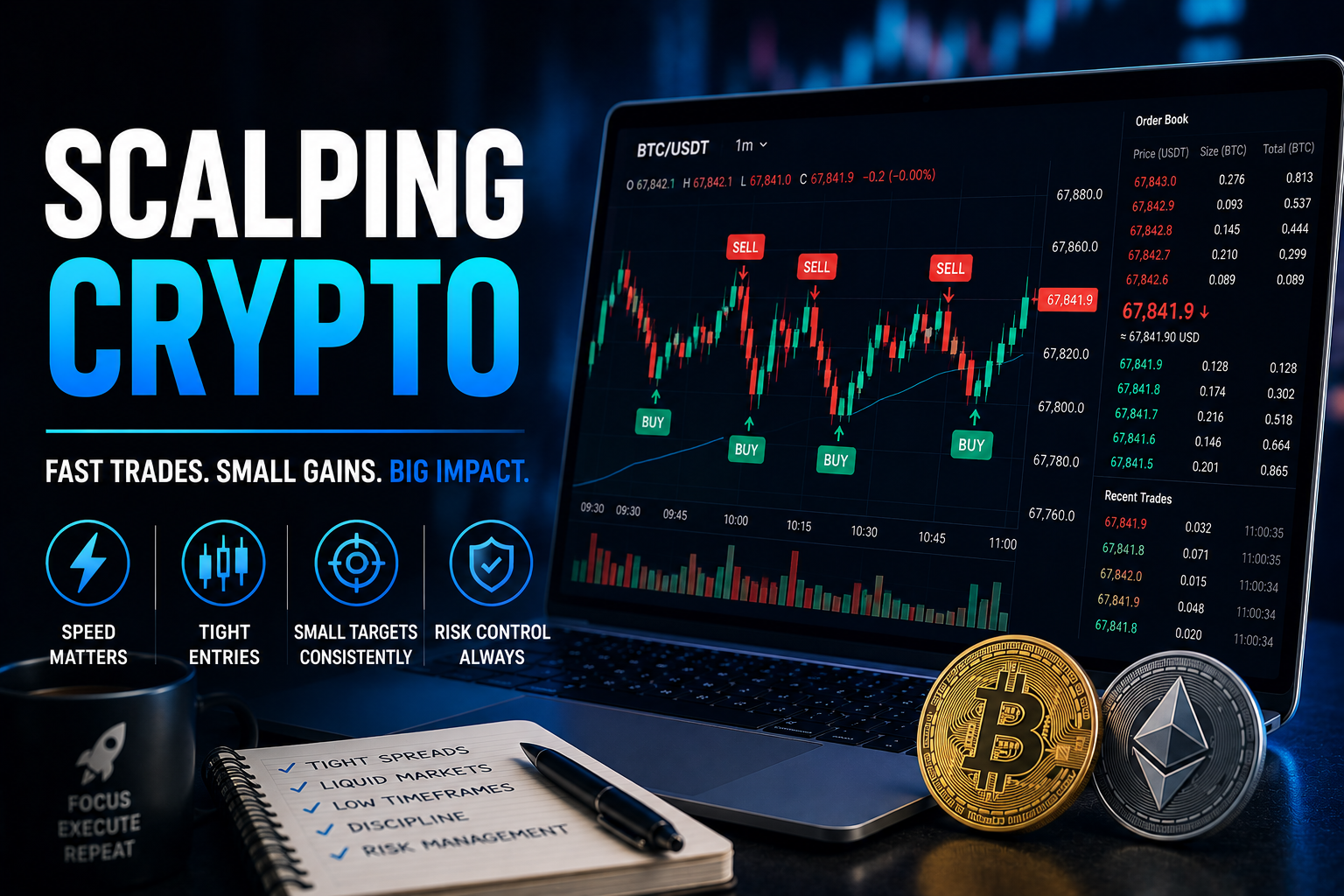
Scalping is the most active style of trading. A scalp trade lasts from a few seconds to a few minutes — almost never longer than 15 minutes. The goal is to capture a small price move (often 0.1% to 0.5%) and exit. Then take another trade. Then another.
A scalper might take 30 trades on a slow day and 200 on a busy one. The cumulative profit comes from stacking small wins. Each trade alone is barely worth the click. Hundreds of them, properly executed, add up.
Scalping vs day trading vs swing trading
| Style | Hold time | Trades per day | Profit per trade target |
|---|---|---|---|
| Scalping | Seconds to minutes | 30-200 | 0.1% – 0.5% |
| Day trading | Minutes to hours | 5-20 | 1% – 5% |
| Swing trading | Days to weeks | 0-2 | 5% – 30% |
The shorter the hold, the more trades you take, the smaller the move you’re chasing, and the more sensitive you are to fees and execution.
Why scalp at all?
The case for scalping:
- Lots of opportunities. Even in slow markets, the 1-minute chart has dozens of setups per day.
- Limited overnight risk. You’re never in a position long enough to be exposed to weekend gaps or news shocks while you sleep.
- Fast feedback. You find out within minutes whether a trade idea worked.
- Can be done in concentrated sessions. A disciplined scalper might trade 2-3 hours a day and be done.
The case against:
- Fees are existential. At retail fee tiers, fees can be 25-40% of gross revenue.
- Mental load is huge. Hundreds of decisions per session, each made fast.
- Edge is small. The price moves you’re targeting are within the noise of the market.
- Most retail scalpers lose. This isn’t theory. It’s the consistent observation across years.
The case against is stronger than the case for, for most people. Read on before you skip that sentence.
Why scalping is brutal (fees + mental load)
I’m going to make this concrete. The brutality of scalping comes from two compounding factors: trading costs eat your edge from below, and psychological costs eat your edge from above.
The fee maths
Take a realistic example. BitGet’s regular tier spot fees are 0.10% maker and 0.10% taker. Round-trip cost: 0.20%.
If your average winning scalp targets 0.4% gross profit and your average losing scalp loses 0.4% gross (a 1:1 risk-reward), your fee cost is 50% of your gross profit per winning trade. That’s brutal but tolerable.
If your average win is 0.3% and your average loss is 0.3% (a tighter scalp), fees are 67% of gross profit per winning trade. You need a much higher win rate to compensate.
The maths of how many wins per loss you need to break even at various fee scenarios:
| Round-trip fee | Avg win = Avg loss | Win rate needed to break even |
|---|---|---|
| 0.10% | 0.5% | 55% |
| 0.20% | 0.5% | 60% |
| 0.30% | 0.5% | 65% |
| 0.20% | 0.3% | 67% |
| 0.30% | 0.3% | 75% |
A scalper paying 0.20% round-trip with 0.3% gross win/loss needs a 67% win rate just to break even. After that, they need more to actually make money.
Why retail traders rarely hit those win rates
The kind of edges that produce 60%+ win rates at scalp timeframes require:
- Reading orderflow in real time
- Execution speed measured in milliseconds
- Knowing the personality of specific pairs across multiple sessions
- Having sized down enough that emotions don’t interfere
- Months to years of focused practice
None of that comes from reading a post or watching a YouTube video. It comes from screen time. Specifically, from screen time during which you’re losing money learning the craft.
The mental load
Scalping demands constant attention. Every minute can produce a new setup. You can’t take your eyes off the chart, can’t check your phone, can’t get up for a tea. The decision frequency is brutal.
This causes decision fatigue within 2-3 hours for most people. After decision fatigue kicks in, your win rate drops. The trades you took in hour 4 are statistically worse than the ones you took in hour 1.
The professional scalpers I’ve spoken to all do limited daily sessions — 2 to 4 hours — and step away when they hit their limit. Retail scalpers try to do 8-hour days and wonder why their results decline as the day goes on.
The lifestyle cost
This one rarely gets discussed. Scalping wrecks your life if you’re not careful.
Eyes ache from staring at screens. Back hurts from hours of sitting hunched. Sleep gets interrupted because crypto markets don’t close. Relationships suffer because you can’t be present at family events without one eye on a chart. Hobbies dry up because the time goes to charts. Within months, the average retail scalper is in worse physical and mental shape than when they started.
You can’t trade your way out of a body and a life. Choose carefully.
The maths: needing a 60%+ win rate to survive fees
This deserves its own section because it’s the single most important number in scalping. I see beginners posting screenshots of 70% win-rate days and not realising why that doesn’t translate to profit.
The break-even formula
A simple way to think about it:
Expected return per trade = (win rate × avg win) − (loss rate × avg loss) − fees
For break-even: (win rate × avg win) = (loss rate × avg loss) + fees
If avg win = avg loss (call it X), and fees per trade = F, then:
– win rate × X − (1 − win rate) × X = F
– (2 × win rate − 1) × X = F
– win rate = 0.5 + F/(2X)
Plug in F = 0.20% (round-trip fee) and X = 0.4% (gross win size):
– win rate = 0.5 + 0.002/(2 × 0.004) = 0.5 + 0.25 = 0.75
That’s 75% to break even on those assumptions. That’s brutal.
Why bigger wins help disproportionately
The lower the fee relative to the win size, the lower the win rate needed. This is why successful scalpers tend to use wider targets and stops, not tighter ones.
A scalper targeting 0.5% per trade with a 0.2% round-trip fee needs a 60% win rate to break even.
A scalper targeting 0.2% per trade with the same 0.2% round-trip fee needs an 75% win rate.
Counter-intuitively, scaling up the size of your target moves makes scalping easier, not harder. The trick is finding setups where 0.5% targets are realistic without making the hold time grow into day trading territory.
Why fee tier matters more here than anywhere else
If you’re going to scalp, you need to climb the fee tier ladder. At BitGet’s VIP 3 (the realistic upper bound for serious retail scalpers), spot fees are 0.06% maker / 0.08% taker. That cuts round-trip fees roughly in half.
For futures scalping (more common), USDT-M perpetual fees are 0.02% maker / 0.06% taker at regular tier. Round-trip is 0.08%. At VIP 3, it’s 0.012% maker / 0.035% taker. Round-trip is 0.047%.
Futures fees are much lower than spot fees. This is one of the reasons most scalpers use futures even when they don’t need leverage. The lower fees really matter.
Full breakdown is in bitget trading fees. If you’re considering scalping seriously, read it before you start.
Best pairs for scalping (BTC + ETH only realistically)
Liquidity is everything in scalping. You need tight spreads, deep order books, and consistent volume. That narrows the list drastically.
Why BTC and ETH are the only realistic options
These two have:
- Order books deep enough that a retail-sized order doesn’t move the price
- Tight bid-ask spreads (often 0.01% or less on major exchanges)
- 24/7 volume that doesn’t vanish at off-hours
- Predictable behaviour at key technical levels
- Lots of academic and trader analysis to learn from
Any other pair has at least one of these properties compromised. Mid-caps have wider spreads. Low-caps have manipulated order books. Memecoins have no honest price discovery at all.
What about SOL, BNB, or other large mid-caps?
You can scalp them, but be aware:
- Spreads are wider — typically 0.02-0.05% vs 0.005-0.01% on BTC/ETH
- Volume drops off in off-hours more than majors
- Whale wallets can move price more easily than on BTC
- Stop hunting is more common because clusters are easier to spot
For your first six months of scalping (if you go that route), I’d stay on BTC/USDT and ETH/USDT only. Add SOL/USDT when you have a track record and know your edge.
Spot vs futures pairs
Most scalpers use the perpetual futures version of these pairs — BTCUSDT and ETHUSDT futures — for three reasons:
- Lower fees
- Tighter spreads
- Higher leverage available (and used carefully, can mean smaller account sizes are viable)
The downside is liquidation risk. Use 2-5x leverage maximum for scalping. The high-leverage scalper isn’t a real strategy — it’s a coin flip with extra fees.
If you do scalp futures, bitget futures usdt-m covers the mechanics. The bitget leverage explained post is essential reading before you start.
The 1-minute and 5-minute setups that work
I’m going to lay out three setups that actually produce edge in scalping. These aren’t proprietary — they’re widely known — but most beginners ignore them in favour of fancier patterns.
Setup 1: Range scalp at clear S/R
The market is ranging. You’ve identified clear horizontal support and resistance on the 15-minute chart. Price is approaching the support level.
Trigger: a reversal candle on the 1-minute chart with volume — hammer, engulfing, or sustained rejection.
Entry: limit order just above support.
Stop: just below support (0.1-0.2% below).
Target: middle of the range or top of the range, depending on momentum.
This works because mean reversion is real in ranges. Win rate can hit 65-70% if you only take A+ setups at clear levels. The trick is having the patience to skip setups at marginal levels.
Setup 2: Pullback in a clean intraday trend
The 15-minute chart shows a clear intraday trend — higher highs and higher lows for at least the last 2 hours. Price pulls back on the 1-minute chart.
Trigger: bullish reversal candle at a prior pullback low or at the 20-period EMA on the 1-minute.
Entry: market order on confirmation, or limit order at the level.
Stop: just below the pullback low.
Target: the prior swing high.
This works because trends persist on short timeframes more reliably than they reverse. The setup looks for entries in the direction of the existing trend.
Setup 3: Momentum breakout with retest
Price breaks above a clear resistance level on the 5-minute chart with above-average volume. Then it pulls back to retest the broken level.
Trigger: a bullish reaction at the retest — usually a rejection candle on the 1-minute.
Entry: limit at the retest level.
Stop: 0.2% below the broken level.
Target: the height of the prior consolidation projected upward.
This works because breakouts with retests filter out fake breakouts — the retest confirms that the level has flipped from resistance to support.
What doesn’t work for scalping
Beginners try to scalp:
- News spikes — too fast, slippage destroys the trade
- Random pumps without a setup — no edge, just chasing
- Indicator crossover signals on 1-minute — overfit to past data, fails in real markets
- Fibonacci levels with no context — useless without confluence
- News-driven sentiment plays — momentum reverses unpredictably
If a “setup” isn’t built on price action and structure at a meaningful level, it isn’t a setup. It’s a guess with a chart attached.
Order flow basics
Order flow is reading the actual buying and selling happening in real time. It’s the next level up from chart pattern scalping and it’s where most professional scalpers actually live.
What order flow shows you
Order flow tools display:
- The order book — buy and sell orders sitting at every price level
- The tape — every actual trade as it executes, with size
- Volume profile — where volume has historically transacted
Reading this in real time tells you whether buyers or sellers are in control right now. You see large limit orders absorbing price moves. You see aggressive market orders breaking through levels. You see the spread tightening or widening.
Why this matters for scalping
At scalp timeframes, the chart is often too slow. By the time a 1-minute candle has formed, the move is already over. Order flow lets you see the buying or selling happening as it happens.
This is also where the gap between retail and professional scalpers becomes obvious. Professionals use dedicated order flow platforms (like Sierra Chart or NinjaTrader with crypto data feeds). Retail traders are usually working from the standard exchange interface.
How to start learning order flow
Free starting points:
- Watch the order book on your exchange while a normal day plays out. Notice what happens to price when a large order appears or disappears.
- Read about volume profile and where it concentrates on major pairs.
- Investopedia’s article on order flow is a decent jumping-off point.
This is months of study, not days. If you’re not willing to do that work, you don’t have a scalping edge.
Tools needed (TradingView Pro, BitGet TradingView integration)
Scalping needs better tools than swing trading. Here’s the minimum kit.
TradingView Pro or above
The free tier of TradingView caps you at 1 indicator per chart and limited timeframe types. For scalping you want:
- Multiple indicators per chart
- 1-second and tick-based timeframes
- Saved layouts and templates
- Custom alerts that fire fast
TradingView Pro+ at roughly $25/month is the realistic floor for serious scalpers. Pro at $15/month if you want to be cheap about it.
BitGet’s TradingView integration
The bitget tradingview integration lets you place trades directly from a TradingView chart inside your BitGet account. This is faster than switching between charting and order placement screens. For scalping where seconds matter, this is meaningful.
The integration is included free with a BitGet account. You don’t need a separate TradingView subscription to use BitGet’s embedded charts — but for serious customisation, a paid TradingView tier is worth it.
Hardware
I scalp from a setup with two monitors — one for chart and one for the order ladder. Some scalpers use three or four. Laptop-only scalping is brutally hard because you’re constantly switching tabs.
Mouse and keyboard matter too. You’re clicking hundreds of times per session. A precise mouse and a responsive keyboard reduce mis-clicks. Mechanical keyboards are popular among professional traders for tactile feedback.
Internet and latency
If your internet drops mid-trade you can lose meaningful money. Wired connection is non-negotiable. Mobile data is not acceptable as a primary scalping connection.
Latency between you and the exchange matters at scalp timeframes. If you’re in the UK trading on an exchange routed through Asia, you have a disadvantage versus traders located closer. Most retail exchanges don’t expose true latency stats, but proximity matters.
Position sizing under speed
Sizing for scalping is different from sizing for swing trading. Because you’re taking dozens of trades per day, the size per trade has to be small enough that any single trade barely moves the needle.
Risk per trade for scalping
Where a swing trader might risk 1-2% per trade, a scalper should risk no more than 0.25-0.5% per trade. The reason: scalping involves more trades, more decisions, and more chances to be wrong in a row.
A 0.5% risk per trade scalper who hits a 10-trade losing streak (which is normal in scalping) is down 5% on the day. That’s painful but survivable.
A 2% risk per trade scalper hitting the same 10-trade streak is down 20% on the day. That’s the kind of drawdown that triggers revenge trading and bigger losses.
Why this is psychological
Scalping is the trading style most likely to trigger emotional spiral. You take 30 trades a day. You’re going to hit losing streaks. You’re going to take bad trades through fatigue. The only protection is sizing so small that no individual session can ruin you.
I cover the broader sizing-psychology link in crypto trading psychology — it applies extra hard to scalping.
Maximum daily loss limit
The other rule I’d enforce on any scalper: a maximum daily loss. If you’re down 3% on the day, you stop. Close the platform. Walk away. Come back tomorrow.
This isn’t optional. It’s the rule that separates surviving scalpers from blown-up ones. Your worst trades happen after a streak of losses. Removing yourself from the chair after a threshold loss is the only defence.
Stop loss discipline
Stops on a 1-minute timeframe move fast. You don’t have time to deliberate. The discipline has to be installed before the session starts.
How stops on scalping differ from swing
Swing trade stops are placed at structural invalidation levels — clear support, recent swing lows. They give the trade room to breathe over days.
Scalp stops are tight. Often 0.1-0.3% from the entry. They have to be tight because the targets are also tight (0.3-0.5%) and the risk-reward needs to make sense.
This means scalp stops get hit more often than swing stops. Frequent stop-outs are part of the game. You can’t avoid them. You can only make sure each one is small.
Mechanical stop placement
For scalp entries:
- Range scalps: stop just beyond the level (0.1-0.2% past)
- Trend pullback scalps: stop just below the pullback low
- Breakout retest scalps: stop just below the broken level
Never place a stop based on a fixed % from entry. The stop should be at a price where the setup is invalidated.
The “stop moving” rule
Same rule as swing trading: do not move a stop against the trade. Ever. On a 1-minute timeframe this discipline matters even more because the temptation to move a stop and “let it work” comes constantly.
If you find yourself wanting to move a stop, the answer is to close the position at the market and reassess. Take the loss as planned. The trade is over.
Bots that scalp (and why most fail)
The promise of an automated scalping bot is tempting. Place a bot on your exchange, walk away, come back to profits. Every scalp bot marketed to retail makes some version of this promise.
Almost none of them deliver.
Why most scalping bots fail
The market conditions that produce edge for a scalp bot are narrow and shift constantly. A bot calibrated for ranging markets will get destroyed in trending markets. A bot calibrated for low-volatility markets will get destroyed in high-volatility ones.
Most retail-facing scalping bots use one of:
- Mean reversion strategies (fail in trends)
- Momentum/trend strategies (fail in chop)
- Grid strategies (fail when price exits the grid range)
- Martingale-style sizing (catastrophic eventually — see bitget martingale bot)
The bot doesn’t know which regime the market is in. It just runs. So you get profits during the regime it suits, and losses during the regime it doesn’t. Over a long enough timeframe, the losses eat the profits.
The BitGet bot ecosystem
BitGet has a deep native bot suite — covered in detail in the crypto trading bots guide and the are crypto bots profitable breakdown. Most of them are not scalping bots — they’re DCA, grid, or trend-following bots running on slower timeframes.
If you want a bot to automate something on a scalp-like timeframe, the closest fits are:
- BitGet spot grid bot — runs grid trades within a price range
- BitGet futures grid — same concept on perpetuals
- The BitGet AI bot — adaptive but black-box (bitget ai bot review)
None of these are pure scalping in the sense of taking 1-minute discretionary trades. They’re automated systematic strategies that happen to trade more often than swing strategies.
The bot copy trading angle
The BitGet bot ecosystem has expanded into bitget bot copy trading — you can subscribe to professional bot operators with a profit-share model. This is closer to honest because the bot operator only gets paid if their strategy works.
I cover the specifics in the linked post. The short take: better than buying a fixed bot strategy on Telegram, worse than learning to trade yourself.
If you do want to look at one BitGet bot for accumulation purposes, the bitget btc usdt spot bot is the one I personally run on a small portion of my account — but I run it for accumulation, not scalping. The strategy is a grid on the BTC/USDT pair set up for chop markets.
Direct link if you want to look at it: BitGet BTC/USDT spot bot → (affiliate link).
The TTC angle for learning properly
If you’re determined to scalp, you’ll learn faster in a community than alone. The reason is not that someone will tell you the magic setup. The reason is that scalping is mostly a behavioural skill — patience, discipline, emotion control — and behaviours change faster in structured environments than in isolated practice.
Why solo scalping training is slow
Scalp trading mistakes happen fast. By the time you’ve identified that you took an over-leveraged revenge trade on a marginal setup at 3pm, the trade is already over. Without a journal and an outside observer, you’ll repeat the same mistake tomorrow because you’ll forget the specifics.
A community where other traders watch your trades and point out the patterns shortens the learning curve dramatically.
What Trade Travel Chill teaches that helps scalpers
Trade Travel Chill (affiliate link) isn’t a scalp-only community — most members focus on swing and day trading. But the disciplines that translate are exactly the ones scalpers need:
- Position sizing rules
- Stop discipline
- Emotion management
- Daily loss limits
- Trade journaling
- Honest review of bad trades
These translate directly to scalping. The hard part of scalping is not finding setups. It’s executing them consistently while staying disciplined. That’s what TTC drills.
My full take on the community is in the trade travel chill review. The short version: I joined it in 2023 and it’s the single biggest contributor to me staying alive as a trader.
If you’re thinking about scalping and you’re not part of a community already, fix that first. Then think about scalping. Not the other way around.
Want to actually learn this without blowing up?
Scalping unsupervised is how retail traders lose accounts fast. Trade Travel Chill is the community I joined when I was rebuilding mine. Structured learning, real traders, no signal-pumping nonsense.
Affiliate link. I may earn a commission at no extra cost to you.
Verdict: most retail shouldn’t scalp
I’ll say it directly. Most retail traders should not scalp.
The honest case against retail scalping
- Fees eat 25-40% of gross profit at retail tiers
- Win rate requirements (60%+) are achievable but require months of dedicated practice
- The mental load is brutal and burnout is common
- The lifestyle costs are real and rarely discussed
- Many “scalpers” on social media are not actually profitable when fees are included
- Swing trading produces better risk-adjusted returns for less work
Who should consider it
- People who can dedicate 2-4 focused hours daily for at least 6 months of learning
- People who already have a profitable swing or day trading track record
- People with account sizes that justify VIP-tier fees (or at least BGB-discount fees)
- People with the temperament for high decision frequency under pressure
- People with realistic expectations about timeline and edge
Who shouldn’t
- Anyone hoping to make a living from scalping in the first 12 months
- Anyone who finds swing trading “too slow” and thinks scalping will be more exciting
- Anyone with a full-time job and limited dedicated screen time
- Anyone uncomfortable taking 10-20 losing trades in a row without tilting
- Anyone who hasn’t kept a trading journal for at least 3 months
If you’re in the second list, scalping isn’t the upgrade. Discipline on slower timeframes is.
What I’d do instead
If you have the time and discipline to scalp, you have the time and discipline to be a serious day trader on 15-minute and hourly timeframes. The same skills apply, the fee drag is lower, the mental load is more sustainable, and the returns over a year tend to be similar or better.
The retail traders I know who tried scalping and quit, and then moved to day trading or swing trading, almost universally said the change made them more profitable and happier.
If you’re going to scalp anyway, get the basics right.
BitGet’s fee tier and TradingView integration are the closest thing to a fair shot at retail scalping. Sign up takes 90 seconds.
Referral link.
Frequently asked questions
What is crypto scalping?
Crypto scalping is a short-term trading style where traders hold positions for seconds to minutes, targeting small price movements (0.1-0.5%) and stacking many trades per day. Scalpers might take 30-200 trades in a session, aiming for cumulative gains rather than single large wins.
Is crypto scalping profitable?
It can be, but the bar is high. You typically need a 60%+ win rate just to overcome fees at retail tiers, plus the discipline to take dozens of decisions without tilting. Most retail scalpers are not profitable when fees and time costs are honestly accounted for.
What is the best crypto for scalping?
BTC and ETH for the deepest liquidity, tightest spreads, and most reliable behaviour at technical levels. Mid-caps like SOL or BNB can be scalped but have wider spreads. Memecoins and low-caps are not realistic scalping pairs because order books are too thin and manipulated.
Can beginners scalp crypto?
Technically yes, but it’s not recommended. Scalping requires excellent execution discipline, emotional control under pressure, and dozens of high-quality decisions per session. Beginners should master swing trading or day trading first before considering scalping.
How much money do you need to scalp crypto?
Realistically $1,000-$5,000 minimum to make scalp position sizes meaningful while still risking only 0.25-0.5% per trade. Smaller accounts run into minimum order size issues and fees become a higher percentage of each trade. See how much money to start trading crypto for context on capital requirements.
What timeframes do scalpers use?
The 1-minute and 5-minute charts for entries, often with 15-minute or 1-hour charts for higher-timeframe bias. Some scalpers use even shorter (tick or 30-second) charts. Anything below 1-minute is closer to algorithmic trading than discretionary scalping.
Do scalping bots actually work?
A small number of professionally-developed scalping bots work in specific market regimes. Almost no retail-marketed scalping bots produce consistent profit after fees over long periods. The market regime that suited the bot’s design changes, and the bot doesn’t adapt.
Should I use leverage for scalping?
Light leverage (2-5x) can make scalp position sizes more efficient, especially on futures with lower fees. Heavy leverage (20x+) converts scalping into gambling because the liquidation distance is tighter than your typical stop. I’d never recommend more than 5x leverage for retail scalping.
Is scalping or swing trading better?
Swing trading is better for most retail traders. Lower fees, lower psychological load, more sustainable lifestyle, similar or better returns over the long term. Scalping is only the right choice for traders with the time, discipline, and edge to justify the extra complexity.
Final word
Scalping looks glamorous from outside. The reality is dozens of small decisions per hour, fees eating your profit from below, emotions eating your discipline from above, and a lifestyle that punishes your body and your relationships.
A small minority of people are temperamentally suited to it and can build a real edge. For most retail traders — the audience this site is written for — the better move is to develop a swing or day trading edge first, prove you can stay disciplined for a year, and then think about whether the extra complexity of scalping is worth it.
If you do scalp, do it on the best terms you can. Climb the fee tier. Use the lowest realistic leverage. Cap your daily loss. Keep a journal. Trade in focused 2-3 hour sessions rather than all day. Join a community. Do not assume that more trades equals more profit. The opposite is closer to the truth.
Right — over to you.
Related posts
- Swing Trading Crypto: The Sweet Spot Strategy
- Crypto Trading Psychology: The Mental Game That Decides Everything
- BitGet Futures Trading: USDT-M Perpetuals Explained