Pick any crypto chat room, throw the question “Bitcoin or Ethereum?” into the middle of it, and you’ll start a fight in about 90 seconds. Bitcoin maxis call Ethereum a centralised pre-mine. Ethereum holders call Bitcoin a digital rock that can’t do anything. Both sides are partly right, both sides are mostly wrong, and the actual answer for a beginner is more boring than either tribe wants to admit.
I hold both. I have for six years. This is the honest comparison from someone with no skin in the tribal war. Some links in this post are affiliate. I’ll flag them when they come up.
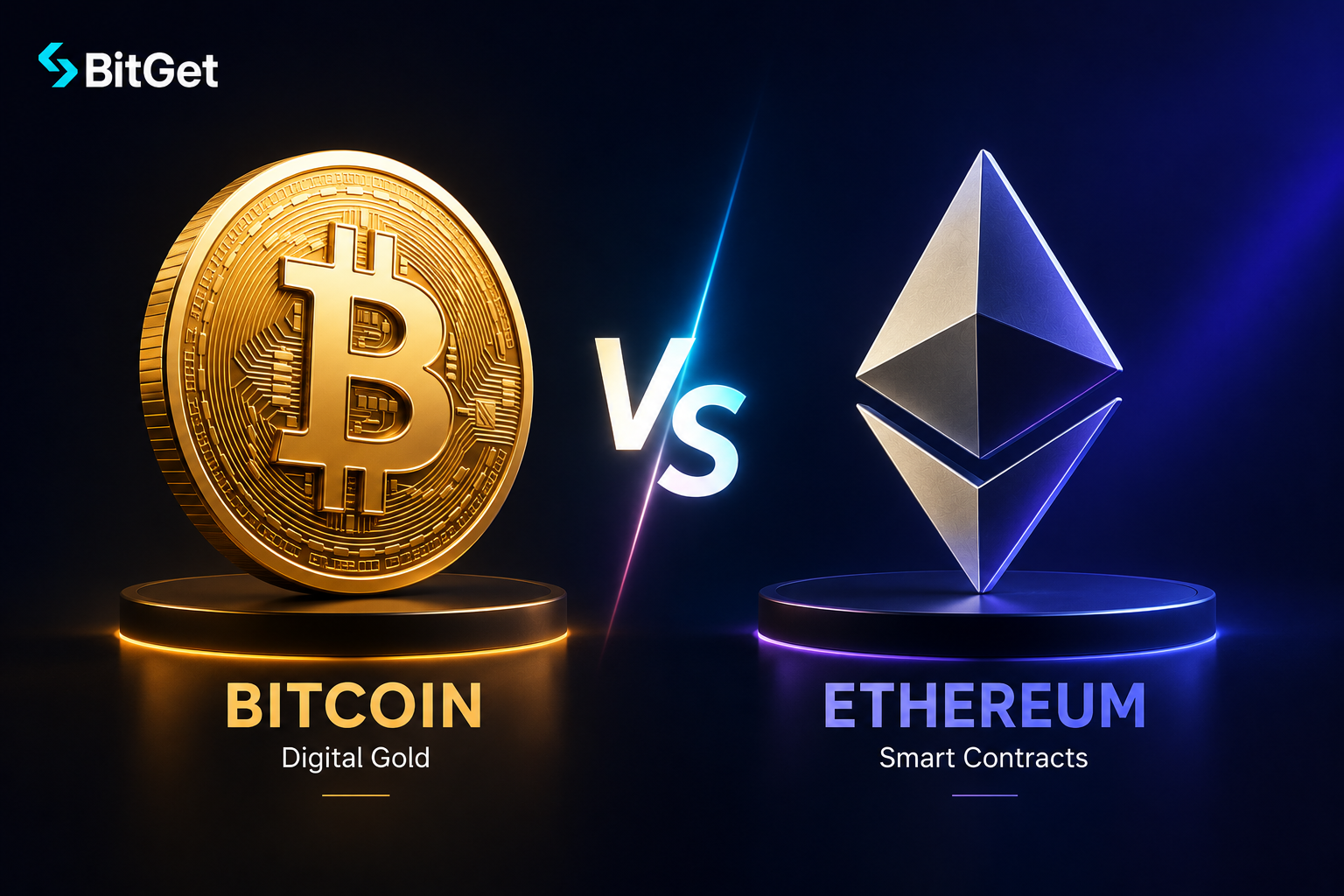
Short answer: Bitcoin and Ethereum solve different problems. Bitcoin is the original cryptocurrency — fixed supply (21M cap), Proof of Work security, designed as a store of value and decentralised money. Ethereum is a programmable blockchain — variable supply, Proof of Stake security, designed to run smart contracts and decentralised applications. For most beginners, buy Bitcoin first as your foundation, then add Ethereum as a second position. Most experienced holders own both, weighted more towards Bitcoin.
TL;DR + side-by-side table
| Factor | Bitcoin (BTC) | Ethereum (ETH) |
|---|---|---|
| Launched | January 2009 | July 2015 |
| Founder | Satoshi Nakamoto (pseudonymous) | Vitalik Buterin (public) |
| Primary purpose | Digital money, store of value | Programmable blockchain |
| Consensus | Proof of Work | Proof of Stake (since Sep 2022) |
| Supply cap | 21 million (hard cap) | No hard cap (deflationary mechanism) |
| Current supply | ~19.8M BTC | ~120M ETH |
| Block time | 10 minutes | ~12 seconds |
| Annual issuance | Halves every 4 years | Variable, ~0.5% net (post-burn) |
| Transaction fees | Variable, network-dependent | Variable, gas-based |
| Native staking | No | Yes (~3–4% APY) |
| Smart contracts | No (limited scripting) | Yes (full Turing-complete) |
| ETF approved | Yes (Jan 2024) | Yes (Jul 2024) |
| Energy use | High (PoW) | Low (PoS) |
| Lightning Network | Yes (L2 payments) | Multiple L2s (Arbitrum, Optimism, Base) |
Key takeaways
- Bitcoin is digital gold. Ethereum is digital infrastructure.
- Bitcoin has a fixed 21M supply cap. Ethereum has no hard cap but a burn mechanism.
- Ethereum’s switch to Proof of Stake in 2022 cut its energy use by 99%+.
- Both have approved spot ETFs in the US.
- ETH stakers earn 3–4% annually. BTC holders don’t earn anything natively.
- Most retail holders should buy Bitcoin first, then add Ethereum as a second position.
What Bitcoin is for
Bitcoin was created to solve one problem: digital money that doesn’t need a central authority. No bank. No government. No company. Just a network of computers agreeing on who owns what.
The pitch is store of value first, payment system second. As an investment thesis, Bitcoin’s argument is rooted in scarcity. There will only ever be 21 million coins. That cap is enforced by code. Every four years the rate of new coins entering circulation halves. Roughly 94% of all Bitcoin has already been mined. The remaining 6% will trickle out over the next century. Bitcoin halving explained walks through the supply schedule.
What Bitcoin doesn’t do well:
- Smart contracts. Bitcoin has limited scripting capabilities. You can’t build complex applications on it the way you can on Ethereum.
- High-throughput payments. The base layer handles around 7 transactions per second. Lightning Network adds a high-throughput layer on top, but it’s a separate system.
- Yield. Native Bitcoin doesn’t pay interest. You can wrap BTC and use it in DeFi, or lend it through centralised platforms, but those involve trust trade-offs.
What Bitcoin does brilliantly:
- Survives. Bitcoin’s protocol has had near-perfect uptime since 2009.
- Decentralises. No company runs Bitcoin. There are thousands of nodes worldwide. The protocol changes only through broad consensus.
- Resists. Multiple governments have tried to ban Bitcoin. None have succeeded.
If you want one sentence: Bitcoin is the asset most likely to still exist and function in 50 years. That’s its job. What is Bitcoin covers the full picture.
What Ethereum is for
Ethereum was launched in 2015 by Vitalik Buterin and a team of co-founders. The pitch was different from Bitcoin’s. Instead of just digital money, Ethereum aimed to be a global computer — a network where developers could write programs (smart contracts) that ran on the blockchain.
The result: Ethereum became the substrate for most of crypto’s experimentation. DeFi (decentralised finance), NFTs (non-fungible tokens), stablecoins, DAOs (decentralised autonomous organisations), most of Web3 — all of it sits on Ethereum or chains derived from it.
What Ethereum does well:
- Smart contracts. Anyone can deploy code that runs on the network. This is the whole foundation of DeFi, NFTs, stablecoins, on-chain games, prediction markets, identity systems.
- Programmable money. Stablecoins like USDC and USDT live primarily on Ethereum (and its L2s). What is USDT and what is USDC cover the stablecoin side.
- Yield. ETH staking pays around 3–4% APY for participating in network security. DeFi protocols offer higher yields with higher risk.
- Iteration. Ethereum’s developer community is massive — Coinmarketcap data suggests over 4,000 active dApps on Ethereum alone, plus a thriving Layer 2 ecosystem.
What Ethereum doesn’t do well:
- Simple value storage. Ethereum’s supply economics are more complex than Bitcoin’s. There’s no hard cap, just a burn mechanism that can make ETH deflationary under high demand.
- Stable fees. Gas fees on Ethereum’s base layer can spike during periods of high demand. Layer 2 solutions help, but they add complexity.
- Settlement finality on base layer. Ethereum has gradual finality (probabilistic for the first ~13 minutes). Bitcoin has the same property but the cultural expectation around BTC confirmations is more conservative.
What is Ethereum covers the full Ethereum story.
Supply economics compared
This is where the philosophical divide between Bitcoin and Ethereum is sharpest.
Bitcoin’s supply
- Hard cap: 21,000,000 BTC
- Currently mined: ~19.8M (about 94%)
- Issuance rate: Halves every 4 years
- Final coin mined: estimated year 2140
- Inflation rate today: ~0.85% annually
Bitcoin’s monetary policy is set in stone. The supply schedule cannot be changed without a hard fork that splits the network. Every halving makes Bitcoin more scarce. The economic argument is simple: fixed supply meets growing demand equals price appreciation over the long run.
Ethereum’s supply
- No hard cap
- Currently supply: ~120M ETH
- Issuance rate: Variable — depends on amount of ETH staked
- Burn mechanism: Transaction fees are burned (EIP-1559, August 2021)
- Net inflation rate today: roughly 0.5–1% but can go negative
Ethereum’s monetary policy is more nuanced. Stakers earn newly issued ETH for securing the network. Transaction fees get burned, removing ETH from supply. During periods of high network activity, more ETH is burned than is issued — making ETH temporarily deflationary.
This dynamic is sometimes called “ultrasound money” by Ethereum fans. The honest characterisation: Ethereum’s supply is responsive to network usage rather than fixed.
Which model is “better”
This depends on what you want.
If you want predictable monetary policy and the strongest possible “digital scarcity” story, Bitcoin wins. The 21M cap is the cleanest investment thesis in crypto.
If you want a system where the asset’s economics are tied to its usage as a platform, Ethereum’s model is more flexible — when the network is busy, supply shrinks; when usage drops, supply grows mildly.
For long-term holders, both work. The arguments matter more at the margin than they do for someone holding a small position over years.
Fees compared (Lightning vs L2s)
Both Bitcoin and Ethereum have scaling solutions sitting on top of their base layers. Both work. Both are different.
Bitcoin’s Lightning Network
Lightning is a Layer 2 payment network for Bitcoin. It opens “channels” between users that allow near-instant, near-free transactions, with settlement back to the base Bitcoin chain when channels close.
Lightning fees are typically a few satoshis per transaction (fractions of a penny). Transactions confirm in seconds. The downsides: liquidity management is complex for users running their own nodes, and most retail users access Lightning through custodial wallets (Wallet of Satoshi, Cash App, Strike) rather than running their own.
Lightning is what makes Bitcoin functional for actual payments. The base layer is too slow and too expensive for buying coffee. Lightning isn’t.
Ethereum’s Layer 2s
Ethereum’s scaling approach is different. Instead of one Layer 2, Ethereum has many — Arbitrum, Optimism, Base, zkSync, Polygon zkEVM, and others. Each one is a separate blockchain that processes transactions cheaply, then settles back to Ethereum’s base layer in batches.
L2 fees vary by chain but typically run 1–10 cents per transaction. Speed is seconds. DeFi protocols, NFT marketplaces, and most on-chain activity has migrated to L2s. The Ethereum mainnet is now mostly used for high-value settlement and as the “anchor” for L2 security.
Coinbase’s Base chain alone processes more transactions daily than Ethereum mainnet does.
Practical comparison
For a beginner sending value: Lightning is simpler conceptually but harder to access without a custodial wallet. L2s are more complex (you have to bridge between chains) but more accessible through standard wallets like MetaMask.
For DeFi or smart contract activity: Ethereum L2s are the only option. Bitcoin Lightning doesn’t do smart contracts.
For payments: Both work. Lightning is faster on Bitcoin. L2s are more flexible on Ethereum.
Security model (PoW vs PoS)
Bitcoin and Ethereum secure their networks differently. The mechanisms have different trade-offs.
Bitcoin’s Proof of Work
Bitcoin uses Proof of Work consensus. Miners compete to solve cryptographic puzzles. The first to find the answer adds the next block to the chain and earns the block reward.
The security argument: attacking Bitcoin would require controlling more than 50% of the network’s mining power (the “51% attack”). At current hash rates, that would cost billions of dollars in equipment, electricity, and operational infrastructure. The economic disincentive is the security.
The downside: massive energy consumption. Estimates put Bitcoin’s annual electricity use at around 150 TWh — comparable to a medium-sized country. Bitcoin defenders argue much of this comes from stranded renewable energy that would otherwise be wasted. Critics argue the energy use is excessive regardless.
Ethereum’s Proof of Stake
Ethereum switched from Proof of Work to Proof of Stake in September 2022 (the “Merge”). Instead of miners, validators stake 32 ETH each and are randomly selected to propose and attest to blocks. Validators who behave honestly earn rewards. Validators who attack the network lose their staked ETH.
The security argument: attacking Ethereum would require acquiring and then losing massive amounts of ETH. Currently around 27% of all ETH is staked (over 32 million ETH). A successful attack would cost tens of billions of dollars in destroyed value.
The benefits: energy use dropped by an estimated 99.95% after the Merge. Ethereum is now one of the lowest-energy major networks in crypto.
The downsides: Proof of Stake is newer and has less battle-tested history than Proof of Work. The dynamics around large staking pools (Lido, Coinbase) raise centralisation concerns that the community is actively working on.
Which is more secure
Honest answer: both are secure. Bitcoin’s security model is older and simpler. Ethereum’s is newer and more efficient. Both have held up under significant economic incentives to attack. Neither has been compromised at the protocol level.
For most users, the security difference is theoretical. What matters more is the security of your own keys and storage. How to store crypto safely covers the user side, which is where almost all real-world crypto losses come from.
Staking: ETH yields, BTC doesn’t natively
This is a real difference and one of the strongest arguments for Ethereum.
If you hold ETH, you can stake it and earn roughly 3–4% APY (varies based on total ETH staked and network activity). You can stake directly by running a validator (requires 32 ETH), or pool your ETH through services like Lido, Rocket Pool, or via centralised exchanges.
Bitcoin doesn’t have native staking. There’s no protocol-level mechanism to earn yield on BTC. Anything that promises BTC yield (BlockFi historically, Celsius, etc.) is doing it through lending — taking your BTC and lending it to traders or institutions. That carries counterparty risk and has resulted in multiple high-profile collapses.
There are some emerging protocols (Babylon, etc.) attempting to bring native-ish yield to Bitcoin, but they’re early and carry meaningful risk.
For a yield-focused holder, ETH has the cleaner story. For a holder who values capital preservation above yield, BTC’s “no yield” is actually a feature — it forces you to think of Bitcoin as a savings asset rather than an income asset.
ETFs: both approved now
Spot Bitcoin ETFs were approved in January 2024. Spot Ethereum ETFs followed in July 2024.
The Bitcoin ETF launch was historic — billions in inflows within weeks, IBIT became the fastest-growing ETF in history. Bitcoin ETF explained covers the full picture.
The Ethereum ETF launch was quieter. Same SEC approval process, similar list of issuers (BlackRock’s ETHA, Fidelity’s FETH, Bitwise’s ETHW, etc.), but lower inflows than the Bitcoin equivalent.
One important difference: Ethereum ETFs do not include staking yields. ETF holders forfeit the 3–4% APY that direct ETH holders can earn. Over a 10-year hold, that’s a meaningful drag on returns versus direct ownership.
The implication: for tax-advantaged account holders (IRAs, 401(k)s), ETH ETFs still make sense because the tax savings often exceed the foregone staking yield. For taxable account holders, direct ETH with staking is mathematically better in most scenarios.
Historical correlation + when they diverge
Bitcoin and Ethereum are highly correlated. When BTC moves up, ETH usually moves up. When BTC crashes, ETH usually crashes — often harder.
The 90-day correlation between BTC and ETH typically sits between 0.7 and 0.9. They behave as members of the same asset class more often than as independent assets.
That said, there are periods of divergence:
- Late 2020 to early 2021 (“DeFi summer” follow-on): ETH outperformed BTC dramatically as DeFi adoption surged.
- September 2022 (the Merge): ETH rallied independently of BTC on the successful transition to Proof of Stake.
- NFT booms: Each major NFT cycle has pulled ETH up more than BTC.
- Bitcoin halvings: BTC tends to lead, with ETH following with a lag.
The pattern: BTC dominates during macro-driven moves (rate cuts, ETF inflows, sovereign adoption). ETH outperforms during crypto-native activity surges (DeFi, NFTs, L2 growth, staking innovation).
For a portfolio, holding both partially smooths out these cycles. When BTC is leading, the BTC allocation captures gains. When ETH is leading, the ETH allocation captures gains. Pure-BTC or pure-ETH portfolios are more exposed to either dynamic.
Which to buy first
For nearly every beginner, the answer is Bitcoin first.
Why Bitcoin first
- Lowest crypto risk. Bitcoin has the longest track record, deepest liquidity, most institutional adoption, clearest regulatory status.
- Simplest thesis. Fixed supply, store of value. Easy to understand, easy to hold conviction during volatility.
- Largest available product surface. Every major exchange supports Bitcoin. Most brokers offer Bitcoin ETFs. Bitcoin can be self-custodied with the simplest wallets.
- Cleanest tax treatment. Bitcoin is treated as property in most jurisdictions, similar to gold. Tax handling is well-established.
Buy Bitcoin first. Make your first purchase. Get comfortable with how it works. Move some to cold storage. Hold it for a while.
How to buy Bitcoin walks through the purchase. Sign up to BitGet (affiliate) if you don’t already have an exchange — competitive fees and broad support.
When to add Ethereum
Once you’ve got a Bitcoin position and feel comfortable with the basics:
- You understand how crypto wallets work.
- You’ve moved at least some BTC to a hardware wallet.
- You’re past the initial volatility shock (i.e., your position has dropped 20% once and you didn’t panic-sell).
At that point, adding Ethereum as a second position makes sense. The mental model: BTC is your foundation, ETH is your platform exposure.
How to buy Ethereum covers the buying side.
Position split
For a beginner crypto allocation, a common split is 70/30 BTC/ETH or 80/20 BTC/ETH. Heavier on Bitcoin because that’s the lower-risk base. Add ETH for platform exposure.
Some experienced holders run 50/50 or even ETH-heavy. That’s a higher-risk position but reflects a different thesis about which asset will outperform over a given cycle.
Why most traders hold both
Six years of trading and I’d have a hard time naming a serious crypto holder who only owns one of BTC or ETH. The vast majority hold both. Here’s why.
Different cycles. As covered above, BTC and ETH lead in different market phases. Holding both means catching both legs.
Different risk profiles. BTC is more conservative. ETH is higher beta. A blended position has a smoother ride than either alone.
Different use cases. I use BTC as a store of value and as my long-term position. I use ETH for participating in DeFi yields, holding stablecoins (USDC and USDT mostly live on Ethereum and its L2s), and the occasional NFT purchase.
Different conviction time horizons. BTC is my “what happens in 10 years” position. ETH is my “what happens in 3–5 years” position. Different timeframes, different roles.
The honest version: you don’t have to pick. You can hold both and let the market decide which one wins.
How to buy each
Different process, same general flow.
Buying Bitcoin
- Open a crypto exchange account. Sign up to BitGet (affiliate) — KYC usually clears same day. Alternatives: Coinbase, Kraken, Gemini.
- Deposit funds via bank transfer, card, or P2P.
- Place a market or limit order on the BTC/USDT or BTC/USD pair.
- Move BTC to a Ledger Nano X (affiliate) for long-term storage.
- Full walkthrough in how to buy Bitcoin.
Buying Ethereum
- Same exchange account works for both. BitGet (affiliate) supports both.
- Deposit funds.
- Place an order on the ETH/USDT or ETH/USD pair.
- Move ETH to a Ledger (same hardware wallet works for both).
- If you want to stake, you can do so through the exchange or through pooled staking services like Lido or Rocket Pool.
- Full walkthrough in how to buy Ethereum.
Storage works the same way for both. A single Ledger device can hold BTC, ETH, and most other major crypto assets through different apps on the device. How to store crypto safely covers the storage playbook.
If you want to compare exchanges before committing, best crypto exchanges ranks the ones I’ve tested.
For active trading education, Trade Travel Chill (affiliate) is the community I’m part of. The members trade both BTC and ETH across cycles, and the education is structured rather than influencer-style. Worth a look if you want to graduate from buying-and-holding to active strategy.
Frequently asked questions
Which is better Bitcoin or Ethereum?
Different assets with different purposes. Bitcoin is the more established store of value with the simplest thesis. Ethereum is the platform underlying most of crypto’s innovation. For most retail holders, buying both is sensible — typically weighted more toward Bitcoin.
Should I invest in Bitcoin or Ethereum first?
Bitcoin first. It has the longest track record, the strongest brand recognition, the deepest liquidity, and the clearest regulatory treatment. Add Ethereum as a second position once you’re comfortable with the basics.
Is Ethereum a good long-term investment?
Ethereum has played the role of crypto infrastructure for the past decade. As long as smart contracts, DeFi, stablecoins, and on-chain applications keep growing, Ethereum has a structural argument for long-term demand. That doesn’t guarantee price appreciation — competition from other smart contract chains is real — but the thesis is coherent.
Can Ethereum overtake Bitcoin?
In market cap terms, ETH would need to roughly 4x relative to BTC to flip Bitcoin. This has been discussed for years and never happened. Could it happen? In principle yes, particularly if Ethereum’s monetary policy continues to tighten while BTC’s price action stalls. Practically, Bitcoin’s first-mover advantage and institutional adoption make a flip difficult.
What’s the difference between BTC and ETH?
Bitcoin is digital money with a fixed 21M supply and Proof of Work security. Ethereum is a programmable blockchain with variable supply, Proof of Stake security, and a focus on smart contracts. Different goals, different designs, different roles in a portfolio.
Does Ethereum pay interest?
Ethereum offers around 3–4% APY for users who stake their ETH. Staking can be done directly (32 ETH minimum), through pools like Lido or Rocket Pool, or through centralised exchanges. Bitcoin does not have native yield.
Is Ethereum more decentralised than Bitcoin?
By most measures, Bitcoin is more decentralised at the validator level (more independent miners worldwide). Ethereum has concerns around staking concentration (Lido, Coinbase, Binance run large pools). However, Ethereum has more developer activity and more diverse application use. Different decentralisation profiles.
Which uses less energy?
Ethereum, by a massive margin. Since switching to Proof of Stake in September 2022, Ethereum’s energy use dropped by an estimated 99.95%. Bitcoin still uses Proof of Work and consumes around 150 TWh of electricity annually.
Final word
There is no “winner” between Bitcoin and Ethereum. They’re different products that often work in the same portfolio.
Bitcoin is the asset most likely to still be functioning in 50 years. The supply is fixed. The protocol changes glacially. The security model is the oldest and most battle-tested in crypto. That’s the role it plays.
Ethereum is the asset where most of the innovation happens. Smart contracts, stablecoins, DeFi, NFTs, on-chain identity, prediction markets — all of it runs on Ethereum or chains derived from it. That’s the role it plays.
If I were starting again today:
- Open an exchange account. Sign up to BitGet (affiliate) or one of the alternatives.
- Buy Bitcoin first. Make it 70–80% of your initial crypto position.
- Add Ethereum as a second position. 20–30% of the crypto allocation.
- Get a Ledger Nano X (affiliate). Move both BTC and ETH to it for long-term holding.
- Consider staking your ETH for the 3–4% APY if you’re holding it longer than a year.
- Hold through cycles. Add small amounts when prices are down. Take some off the table when prices are up.
Not exciting. Boring works.
Right — over to you.
Related posts
- What is Bitcoin: The Beginner’s Explainer
- What is Ethereum: The Beginner’s Explainer
- Bitcoin ETF Explained: What It Is and Whether You Need One