If you’ve used Ethereum in the last three years and didn’t lose your shirt to gas fees, there’s a decent chance you were on Arbitrum without realising it. The chain is the largest Ethereum layer-2 by total value locked, and most of the DeFi activity that used to happen on Ethereum mainnet has quietly migrated to L2s like Arbitrum where transactions cost cents instead of dollars.
I’ve been using Arbitrum since the early Nitro rollout and held ARB since the airdrop in March 2023. This is the walkthrough I’d give a friend buying their first ARB on BitGet today. Two of the links below are affiliate. I’ll flag them as we go.
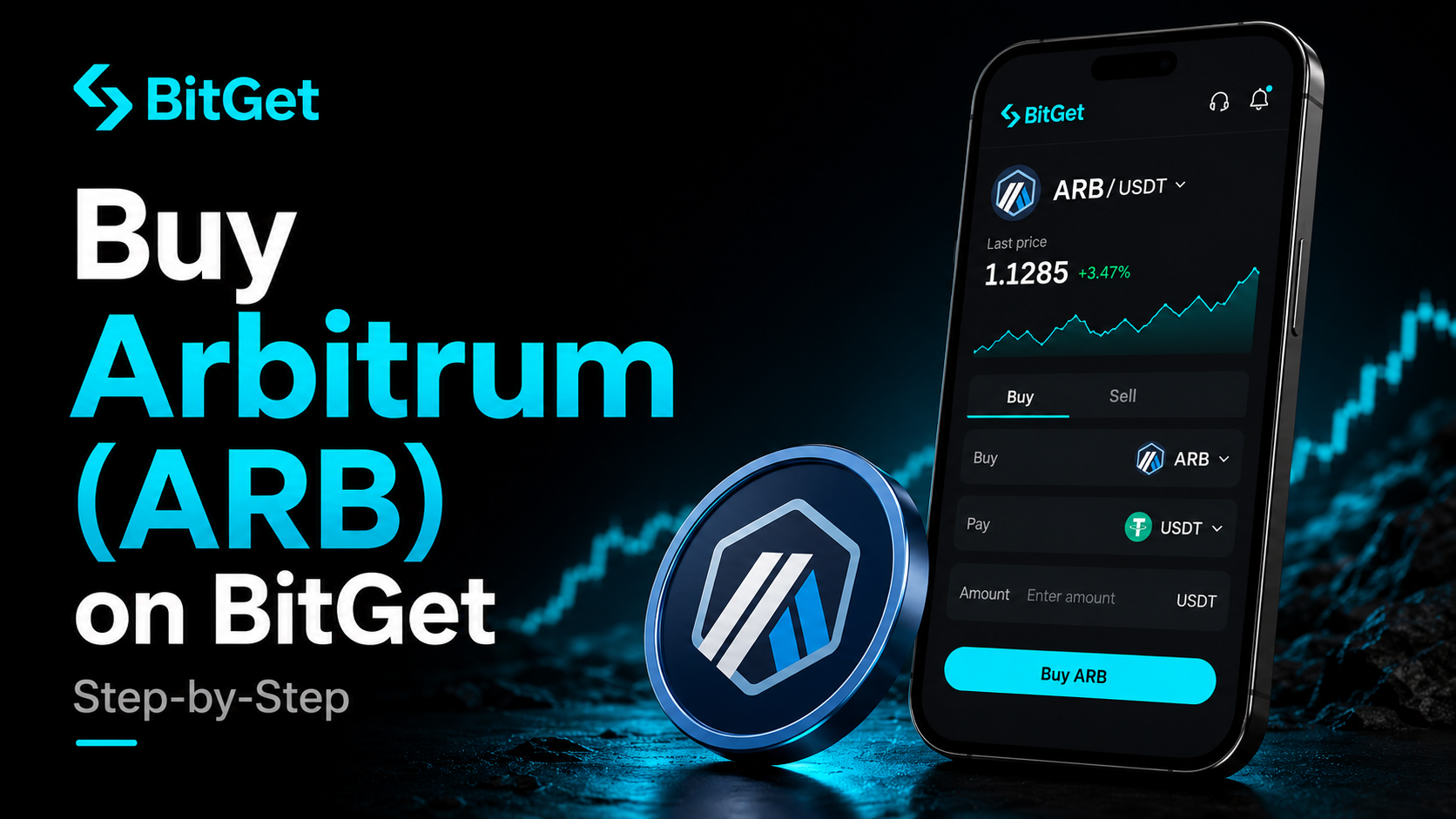
Short answer: To buy Arbitrum on BitGet, open an account with email, turn on 2FA, complete KYC (usually same-day), fund the account via card, P2P, bank transfer, or crypto deposit, then place a spot order on the ARB/USDT pair. Spot fees are 0.10%. Card on-ramp adds 1–3%. ARB is an ERC-20 token — it works in any Ethereum wallet (MetaMask, Rabby, Ledger Live). When sending ARB, pick the Arbitrum One network, not Ethereum mainnet. Time from signup to ARB in your wallet: about 30 minutes.
Open a BitGet account → (affiliate)
Key takeaways
- Arbitrum is an Ethereum layer-2 scaling network built by Offchain Labs, using an Optimistic Rollup architecture.
- It’s the largest Ethereum L2 by total value locked — check live numbers on L2Beat before buying.
- The ARB token launched in March 2023 with one of the largest airdrops in crypto history (around 1.16 billion ARB distributed to users).
- ARB is an ERC-20 token, meaning any Ethereum wallet supports it — but always pick the Arbitrum One network for transfers, not Ethereum mainnet.
- BitGet spot fees are 0.10% maker/taker. Card buys add 1–3%. Long-term ARB belongs on a Ledger Nano X, not on the exchange.
What an Ethereum L2 actually is
Quick refresher because the term gets used a lot and explained badly.
Ethereum’s base layer (layer-1) is secure but slow and expensive. It processes around 15 transactions per second and fees during congestion can hit double digits in dollars. That doesn’t work for everyday use — sending $10 of stablecoin shouldn’t cost $4 in gas.
Layer-2s are separate chains that do the heavy lifting off the main Ethereum chain, then settle a compressed batch of transactions back to Ethereum for finality. You get the security of Ethereum (the base chain is the source of truth) with much lower fees and faster confirmation on the L2 itself.
Arbitrum uses an Optimistic Rollup architecture. The “optimistic” part means transactions are assumed to be valid by default, with a window of about seven days during which anyone can submit fraud proofs to challenge invalid state changes. That seven-day window only matters if you’re withdrawing back to Ethereum L1 — for using Arbitrum directly, transactions are basically instant.
The architecture was designed by Offchain Labs, a team based out of Princeton with deep cryptography credentials. The Nitro upgrade in 2022 made the chain compatible with Ethereum tooling at the bytecode level, which is the technical reason MetaMask just works on Arbitrum without modification.
For the broader context on Ethereum itself, the what is Ethereum explainer covers the base layer. For the general buying workflow that applies to any asset, the how to buy crypto parent guide is the start point.
Why Arbitrum dominates the L2 leaderboard
Arbitrum hasn’t been the only Ethereum L2. Optimism, Base, zkSync, Starknet, Polygon zkEVM all compete in the same lane. So why is Arbitrum the one with the most TVL?
Early mover with real adoption. Arbitrum One launched mainnet in 2021, ahead of most competitors. By the time other L2s shipped, Arbitrum already had GMX, Camelot, Radiant, and a dozen other native DeFi protocols pulling in real volume.
Ethereum equivalence. Nitro made Arbitrum work the same as Ethereum at the bytecode level. Any Solidity contract that runs on Ethereum runs on Arbitrum unchanged. That’s a low-friction migration path for protocols.
Strong DeFi ecosystem. GMX alone has driven enormous perpetual trading volume from Arbitrum. The chain has the highest concentration of mid-cap DeFi outside Ethereum mainnet.
Arbitrum Orbit. Arbitrum lets other projects spin up their own chains using Arbitrum’s tech as the rollup layer. That’s how chains like Xai (gaming) and ApeChain (Yuga Labs) launched. The Orbit model means Arbitrum benefits from L3 activity even when users aren’t on the main Arbitrum One chain.
Live TVL numbers, withdrawal times, and ecosystem stats sit on L2Beat — that’s the canonical source for L2 metrics. Price and market cap on CoinGecko’s Arbitrum page and CoinMarketCap.
The March 2023 airdrop history (because it still matters)
ARB launched on 23 March 2023 in one of the largest crypto airdrops ever. Offchain Labs distributed around 1.16 billion ARB tokens to roughly 625,000 wallets — eligibility was based on Arbitrum usage during a six-month measurement period in 2022. Power users received anywhere from a few hundred to several thousand ARB each.
Coverage at the time from Reuters and CoinDesk noted the claim page crashed under load, ARB briefly traded for $10+ on exchanges before settling lower, and the token was the second-largest L2 launch by market cap behind Polygon’s MATIC.
Why this matters for buyers now. The airdrop set the initial supply distribution — a large portion went to early users, a chunk to the team and investors with vesting schedules, and the rest to the DAO treasury. Vesting unlocks have been a steady source of supply pressure on the chart. Check the Arbitrum tokenomics documentation or the Arbitrum Foundation site for current circulating supply versus total supply numbers.
The DAO model is the other piece. ARB is a governance token. Holders vote on Arbitrum DAO proposals — treasury spend, protocol changes, ecosystem grants. Whether that governance has meaningful impact depends on whether you think on-chain DAOs actually decide things or just rubber-stamp foundation proposals. Decide for yourself.
Why BitGet for buying ARB
A handful of exchanges list ARB. Here’s the case for BitGet on this token specifically.
Deep ARB/USDT order book. ARB has good liquidity on BitGet. Market orders up to a few thousand dollars won’t move the price. For a top-50 asset, that’s the expectation.
Fee table. Spot maker/taker fees start at 0.10% and drop with BGB holdings or volume. Full breakdown in BitGet trading fees.
Multiple funding paths. Card, bank transfer, P2P, or crypto deposit. Pick the trade-off between speed and cost.
Arbitrum network withdrawals. This is the one that matters most for ARB specifically. BitGet supports withdrawals over the Arbitrum One network — meaning you pay Arbitrum-level fees (cents) instead of Ethereum L1 fees (dollars). When you move ARB to your own wallet, pick Arbitrum One, not Ethereum.
Geo limits. BitGet is not available in the US. UK and EU residents are fine. If you’re in the US, Coinbase Advanced or Kraken both list ARB.
Full platform breakdown in the BitGet review.
Pre-signup checklist
Five things to have ready before opening the sign-up page.
A photo ID. Passport or driving licence, in date, photo clear. KYC asks for the document and a selfie.
A live email address. 2FA codes, withdrawal confirmations, and security alerts all come here.
A long password. 16 characters minimum, unique to this account.
An authenticator app. Google Authenticator, Authy, or 1Password’s TOTP. Install it before you sign up. SMS 2FA has been the entry point for a lot of account drains — covered in 2FA for crypto.
A funding source. Debit card for instant, bank account for P2P, or a wallet with USDT/USDC for crypto deposit.
Storage plan. Decide where the ARB is going to live before you buy. Trading float on the exchange, long-term holdings on a Ledger Nano X. The hot vs cold wallet post covers the trade-offs.
Step-by-step: BitGet signup
Five steps. About ten minutes if your documents are ready.
- Open the sign-up page. BitGet (affiliate — gives you a small fee rebate on top of the standard tier). Enter email and a strong password.
- Verify the email. Six-digit code arrives in under a minute.
- Turn on 2FA. Security Settings → Authenticator. Scan the QR with your app, save the backup code on paper.
- Run KYC. Identity Verification → upload ID and take a selfie. Most clear within an hour.
- Add a payment method. Card for instant. P2P and bank transfer can be set up at the funding step.
Account live. Funding next.
Funding: card vs P2P vs bank vs crypto deposit
Four ways to get money on BitGet.
| Method | Fee | Speed | Best for |
|---|---|---|---|
| Crypto deposit | Network fee only | 1–60 min | You already hold USDT/USDC/ARB elsewhere |
| P2P (bank transfer) | 0% (small rate spread) | 5–30 min | Best rate, slightly more steps |
| Bank transfer (third-party) | 0.5–1.5% | 1–3 hours | Mid-size buys |
| Card on-ramp | 1–3% | Instant | First small buy, can’t wait |
Crypto deposit is the cheapest path if you already hold USDT, USDC, or ARB on another exchange or in a wallet. Send to your BitGet deposit address. USDT on TRC-20 costs about 1 USDT in fees. USDT on Arbitrum One is even cheaper — fractions of a cent. ERC-20 is the most expensive at around 8 USDT in gas. Pick the network that matches your sending wallet.
P2P matches you against another user selling USDT for your local currency. You send a bank transfer, BitGet escrows the USDT. Rates land within 0.5% of mid-market.
Bank transfer through third-party on-ramps — visible fee, clears in a few hours.
Card on-ramp is the fastest and most expensive. Fee baked into the quote at 1.5–3% above spot.
For ARB specifically, I’d use card for the first $50, P2P or a crypto deposit (ideally USDT on Arbitrum if you have it) for everything after.
Placing your first ARB trade
Funds on the account. Two ways to convert them to ARB.
Option A: Market order (fast, slightly worse fill)
- Open BitGet. Go to Spot Trading.
- Search ARB/USDT and select the pair.
- Buy side, pick Market.
- Enter the USDT amount.
- Tap Buy ARB. Order fills in seconds.
You pay 0.10% in fees plus a small slippage cost.
Option B: Limit order (slower, better price)
- Open Spot Trading, select ARB/USDT.
- Buy side, pick Limit.
- Set your limit slightly below the current ask.
- Enter the USDT amount.
- Tap Buy ARB. The order sits until price hits your level.
For anything over $100, limit orders are worth the two minutes. The BitGet spot trading guide covers order types in full.
How much ARB to buy (position sizing)
ARB trades with mid-cap volatility. Three rules.
Rule one: ARB has higher beta than ETH. When Ethereum moves 5%, ARB often moves 8–14% in the same direction. The L2 narrative amplifies both directions. A position that feels comfortable in ETH can feel rough in ARB.
Rule two: split your entry over weeks. Pick a target — say £1,000 of ARB over three months — and split into 12 weekly buys. You won’t hit the bottom or the top. You’ll get a reasonable average and stop watching the chart.
Rule three: keep a stablecoin reserve. ARB has had 70%+ drawdowns since launch. If you go in 100% on day one and price drops 50%, you’ve used your ammo. Keep 30–40% in USDT.
For a first ARB buy, start with a pub-round amount. Place the trade, watch for two weeks, see how a 15% drop feels. Scale up if you sleep fine.
This is the section where I’d flag that position sizing and reading charts is a skill blog posts don’t teach. If you want to put the time in, Trade Travel Chill (affiliate) is the trading community I’m part of and the structured education I trust. Optional. Useful when you’re ready. The TTC review covers what’s inside.
Storing ARB: Ledger, MetaMask, or exchange?
You’ve bought the ARB. Where does it live?
Exchange (BitGet)
Fine for active trading float — what you’d be willing to lose without losing sleep. BitGet publishes Proof of Reserves and supports withdrawal at any time. But you don’t hold the private keys. The hot vs cold wallet breakdown covers the trade-off.
Hot wallet (MetaMask or Rabby)
ARB is an ERC-20 token. That means it works in any Ethereum-compatible wallet — MetaMask, Rabby, Trust Wallet, Coinbase Wallet, you name it. The catch: the wallet has to be on the Arbitrum One network when you receive ARB. MetaMask comes with Ethereum mainnet selected by default. You need to add Arbitrum One as a network (the wallet will prompt you to do this the first time you connect to an Arbitrum DApp, or you can add it manually via chainlist.org).
Rabby Wallet is the alternative I’d point most users at over MetaMask. Same Ethereum-compatible base, better UX for multi-chain users, displays the actual transaction simulation before you sign.
A hot wallet is connected to the internet. Good for amounts you’d actually use on Arbitrum DApps — DEX trades, lending, governance. Not where I’d put a five-figure long-term bag.
Cold wallet (Ledger Nano X)
A Ledger Nano X is a hardware wallet. ARB is supported through Ledger Live and through MetaMask or Rabby with the Ledger plugged in. Every send is signed on the device, so even a compromised laptop can’t drain you.
Ledger Nano X costs around £150. Cheaper than the lesson of an exchange failure, a phishing hit, or a malicious DApp signature. Order from the Ledger store (affiliate). Set it up, write the 24-word seed on the included card, store it somewhere fireproof. The seed phrase storage guide covers options that work.
When using the Ledger with Arbitrum, the same seed phrase secures ARB on Arbitrum One, ETH on Ethereum, USDC on Polygon, and everything else across EVM chains. One device, one seed, many networks. That’s the point.
The split I run for ARB
- Trading float on BitGet: 20% — for active trades.
- MetaMask/Rabby on Arbitrum: 15% — for DeFi and DEX use.
- Ledger long-term: 65% — doesn’t move except to top up.
Full self-custody playbook in how to store crypto safely.
Ready to buy your first ARB?
Sign-up takes 90 seconds, KYC usually clears the same day, and BitGet supports Arbitrum One network withdrawals so you pay cents in gas, not dollars.
Affiliate link. I may earn a commission at no extra cost to you.
ARB network choice: don’t get this wrong
ARB exists in two forms depending on the network. Native ARB on Arbitrum One (the L2) and bridged ARB on Ethereum mainnet (L1). They are the same asset technically — bridged ARB is a wrapped version that can be unwrapped to native ARB and back — but the practical difference matters.
On Arbitrum One: gas fees are cents. Confirmation is near-instant. This is where you want to hold and use ARB.
On Ethereum mainnet: gas fees can be dollars. Sending ARB on mainnet costs more than the ARB is often worth for small amounts. Don’t hold ARB on mainnet unless you’ve got a specific reason.
When you withdraw from BitGet, you’ll get a network picker. Pick Arbitrum One. Not Ethereum (ERC-20). The fee difference is roughly 100x.
If you accidentally receive ARB on Ethereum mainnet — say someone sent it to you on L1 — you can bridge it to Arbitrum One via the official Arbitrum bridge. Takes about ten minutes for deposits to L2. Withdrawals from L2 back to L1 take seven days because of the Optimistic Rollup challenge window.
For most users buying ARB to hold or use on Arbitrum, this never comes up — you withdraw from BitGet to Arbitrum One, the ARB lands in your MetaMask on Arbitrum One, done. The bridge only matters if you’re moving between chains.
Common ARB beginner mistakes
The errors I see most often.
Withdrawing ARB to Ethereum mainnet by accident. Slow and expensive. Always pick Arbitrum One on the network selector.
Storing ARB on the exchange long-term. Active float yes, life savings no.
Connecting a wallet to a fake Arbitrum DApp. Phishing sites that mimic GMX, Camelot, or the Arbitrum Foundation appear every other week. Bookmark official URLs. Double-check before signing transactions. The crypto scams guide covers the playbooks.
Approving unlimited token allowances. When you connect to a DEX, the contract often asks for unlimited ARB approval. That’s convenient but means the contract can move all your ARB at any future point. Use Rabby or Revoke.cash to manage and revoke allowances regularly.
Treating bridge transactions as instant. Deposits to Arbitrum (L1 → L2) are fast — about ten minutes. Withdrawals (L2 → L1) take seven days unless you use a third-party fast-bridge service that fronts liquidity. Plan around it.
Sharing the seed phrase. No exchange, no wallet, no support agent will ever ask for the 24-word seed. Anyone who does is trying to drain you. Phrase on paper, at home, nowhere else.
Skipping 2FA. Set it up the moment you create the BitGet account. Most account drains come from phished credentials hitting accounts without 2FA.
Jumping into futures. ARB perps exist. They’re for traders who already understand liquidations. The BitGet futures USDT-M post is research material, not a buy signal. Six months on spot before derivatives.
Buying every L2 token in sight. ARB, OP, MATIC, METIS, BOBA — they don’t all win. The L2 race will have winners and losers. Concentrate in the leaders, don’t spread thin across every contender. The how to buy Optimism post is the OP companion if you want both.
One last nudge.
If this walkthrough saved you research time, signing up through my affiliate link costs you nothing and helps keep the lights on.
Affiliate link.
Frequently asked questions
What is the minimum amount of Arbitrum I can buy on BitGet?
You can buy fractional ARB from around $1 worth. ARB is divisible to 18 decimal places (standard ERC-20). Most beginners start with $50–$200 to learn the interface.
Do I need to verify my identity to buy ARB on BitGet?
Yes for full functionality. You can hold and trade limited amounts without KYC, but withdrawal limits are tiny. KYC usually clears in 1–24 hours. The KYC explained post covers the process.
Can I buy Arbitrum on BitGet with a credit card?
Yes, but it’s a poor default. Card on-ramps charge 1–3% and many credit card issuers add a cash-advance fee or block crypto purchases. Use debit, bank transfer, or P2P instead.
What is the cheapest way to buy ARB on BitGet?
P2P trading or depositing USDT from another wallet. If you have USDT already on Arbitrum, deposit it directly — fees are fractions of a cent. P2P fees are essentially zero with a small rate spread.
What network should I use to withdraw ARB from BitGet?
Arbitrum One. Not Ethereum (ERC-20). The fee difference is roughly 100x. Arbitrum One transactions cost cents, Ethereum mainnet transactions cost dollars.
Should I keep my ARB on BitGet or in a wallet?
Move long-term holdings to a Ledger Nano X. MetaMask or Rabby on Arbitrum One works as a daily-use hot wallet. Keep an active trading float on the exchange.
What’s the difference between Arbitrum and Optimism?
Both are Ethereum L2s using Optimistic Rollups. Arbitrum has more TVL and a wider DeFi ecosystem. Optimism uses a different fault-proof system and runs the OP Stack — the codebase that powers Base and several other chains. Different bets on the same architecture.
Can I stake ARB to earn yield?
ARB doesn’t have native staking — it’s a governance token, not a proof-of-stake validator token. You can deposit ARB to lending protocols on Arbitrum (Aave, Compound, Radiant) to earn yield, but that’s lending, not staking, and carries smart contract risk.
Final word
The first ARB buy teaches you the workflow for every L2 trade after. Open the account. KYC. Fund cheap. Place a limit order. Pick the Arbitrum One network on withdrawal. Move long-term holdings to a Ledger.
That’s the short version. Do those five things in order and you’ve already avoided the mistakes that catch most beginners on their first L2 token.
Right — over to you.
One more thing: Buying a token doesn’t mean it will go up. Most altcoins underperform Bitcoin over long enough timeframes. Only buy what you can afford to lose, and never put your rent money in crypto. If a YouTuber tells you a coin will 100x — they’re guessing too.
Related posts
- How to Buy Ethereum (ETH) on BitGet: Step-by-Step
- How to Buy Optimism (OP) on BitGet: Step-by-Step
- How to Store Crypto Safely: The Self-Custody Guide