Litecoin is the boomer crypto. Launched in 2011 by an ex-Google engineer called Charlie Lee, it’s the oldest Bitcoin fork still running, the original “silver to Bitcoin’s gold” pitch, and the asset most beginners overlook because it doesn’t have a roadmap full of buzzwords. What it does have: a 14-year track record without a single chain halt, transaction fees measured in fractions of a cent, and a network that consistently processes more daily transactions than half the L2s combined.
I bought my first LTC in 2017 because everyone in the office got into Bitcoin and the “cheaper version” sounded reasonable. It still sits in my long-term bag. This is the walkthrough I’d give a friend buying their first LTC today on BitGet. A couple of links are affiliate. I’ll flag them.
Short answer: To buy Litecoin on BitGet, sign up with email, enable 2FA, complete KYC (usually clears same-day), deposit via card, P2P, bank transfer, or crypto, then place a spot order on the LTC/USDT pair. Spot fees are 0.10%. Card buys cost 1–3%. For long-term holding, move LTC to a Ledger Nano X. Time from signup to LTC in your account: about 30 minutes.
Open a BitGet account → (affiliate)
Key takeaways
- Litecoin is the longest-running Bitcoin fork — 14+ years live, zero chain halts.
- Blocks every 2.5 minutes (4x faster than Bitcoin’s 10), so transactions confirm faster.
- Litecoin halvings happen every 840,000 blocks, roughly every four years — the last one cut the block reward to 6.25 LTC.
- BitGet spot fees are 0.10% maker/taker. Card on-ramps add 1–3%, so fund via bank or P2P if you can wait.
- Long-term holdings belong on a Ledger, not on an exchange.
Litecoin in one paragraph (and the Charlie Lee story)
Charlie Lee forked Bitcoin in October 2011 and called the result Litecoin. The technical changes were modest by today’s standards: a different proof-of-work algorithm (Scrypt instead of SHA-256), four-times-faster block times, and a four-times-larger supply cap (84 million LTC vs Bitcoin’s 21 million). The pitch was simple — Bitcoin for everyday payments, with cheaper fees and faster confirmations.
It worked, for a while. Through the 2013 and 2017 cycles Litecoin was a top-five asset by market cap. The “silver to Bitcoin’s gold” framing stuck. Then Lee did something most founders don’t — he sold his entire LTC bag near the December 2017 top, claiming he wanted to remove the conflict of interest between his role at the Litecoin Foundation and his personal holdings. The sale was on the way down from $375 to $30 over the following year, and the community has had complicated feelings about it ever since.
The chain itself never stopped. Litecoin has now run for over 14 years without a single halt — better uptime than most centralised services. Daily transactions sit consistently in the hundreds of thousands range, which puts it ahead of most chains that get more headlines. You can verify on Litecoin’s block explorer or check market data on CoinGecko and CoinMarketCap.
In 2022 Litecoin activated MimbleWimble Extension Blocks (MWEB) — an opt-in privacy layer. Most exchanges treat the MWEB activation as a non-event, but it’s the kind of upgrade that keeps the chain relevant without overpromising.
For the wider context on what crypto is and how exchanges work, the how to buy crypto parent guide covers it. This post is LTC-specific.
Why I recommend BitGet for buying LTC
A handful of major exchanges list LTC. Here’s why BitGet is the one I’d point a beginner at.
Deep LTC/USDT order book. Litecoin has lower daily volume than Bitcoin but still ranks among the more actively traded altcoins on BitGet. Spreads are tight, fills are fast.
Honest fee table. Spot maker/taker fees start at 0.10% and drop with BGB holdings or volume. No hidden mark-up baked into the quote. See the BitGet trading fees breakdown for the full schedule.
Multiple on-ramps. Card, bank transfer, P2P, or crypto deposit. Pick the route that fits your timeline.
Withdrawals work. I move LTC out of BitGet to my Ledger a few times a year. Litecoin network confirmations clear in about 5–10 minutes (often quicker than Bitcoin). Network fees are negligible. Full breakdown of the platform in the BitGet review.
Not for US residents. BitGet is geo-blocked in the US. If that’s you, look at Coinbase Advanced or Kraken instead. Everywhere else, this is the workflow I’d use.
Pre-signup checklist (ID, bank, 2FA, storage)
Five minutes of prep before you open the sign-up page.
A photo ID. Passport or driving licence. KYC will ask for it and a selfie.
An email you control. You’ll get 2FA codes, withdrawal confirmations, and security alerts on this account for years. Use a real one.
A strong password. 16+ characters, never reused. A password manager makes this painless.
An authenticator app. Google Authenticator or Authy. Install it before sign-up. SMS 2FA is a security hole — SIM swap attacks have drained more crypto accounts than most beginners realise.
Your funding source. Debit card, bank account, or crypto in another wallet. UK Faster Payments and EU SEPA Instant make P2P near-instant.
A storage plan. Decide before you buy where the LTC is going. Trading float on BitGet, long-term holding on a hardware wallet. The Ledger Nano X supports LTC natively.
Step-by-step: BitGet signup
Five steps. About ten minutes.
- Open the sign-up page. Head to BitGet (affiliate — gives you a small fee discount). Enter your email and a strong password.
- Verify the email. A six-digit code arrives within 30 seconds. Paste it in.
- Enable 2FA. Security Settings → Authenticator. Scan the QR code with Google Authenticator or Authy. Write down the backup code somewhere offline — don’t screenshot.
- Complete KYC. Identity Verification → upload passport or driving licence, take a selfie. Most clear in 10 minutes to a few hours.
- Add a payment method. Card now if you’re going that route. P2P gets set up when you fund.
Account ready. Time to fund.
Funding: card vs P2P vs bank vs crypto deposit
Four ways to put money on the platform.
| Method | Fee | Speed | Best for |
|---|---|---|---|
| Crypto deposit | Network fee only | 1–60 min | Already hold USDT/USDC/LTC elsewhere |
| P2P (bank transfer) | 0% (small rate spread) | 5–30 min | Best rate |
| Bank transfer (third-party) | 0.5–1.5% | 1–3 hours | Mid-size buys |
| Card on-ramp | 1–3% | Instant | First small buy |
Crypto deposit is the cheapest if you hold USDT or LTC elsewhere. For USDT, TRC-20 costs about 1 USDT in fees, ERC-20 closer to 8 USDT. LTC deposits cost a fraction of a cent.
P2P is the highest-effort, lowest-fee route. Matched with a seller in your local currency, BitGet escrows the trade. Rates usually within 0.5% of mid-market.
Bank transfer is the middle ground — fees visible upfront, clears in a few hours.
Card on-ramp is fastest, most expensive. Fee bundled into the quoted rate. Fine for a first $50 to test the workflow.
My rule for LTC: card for the first $50, then P2P or crypto deposit.
Placing your first LTC trade
USDT is in your spot account. Two ways to convert it to LTC.
Option A: Market order (fast, slightly worse fill)
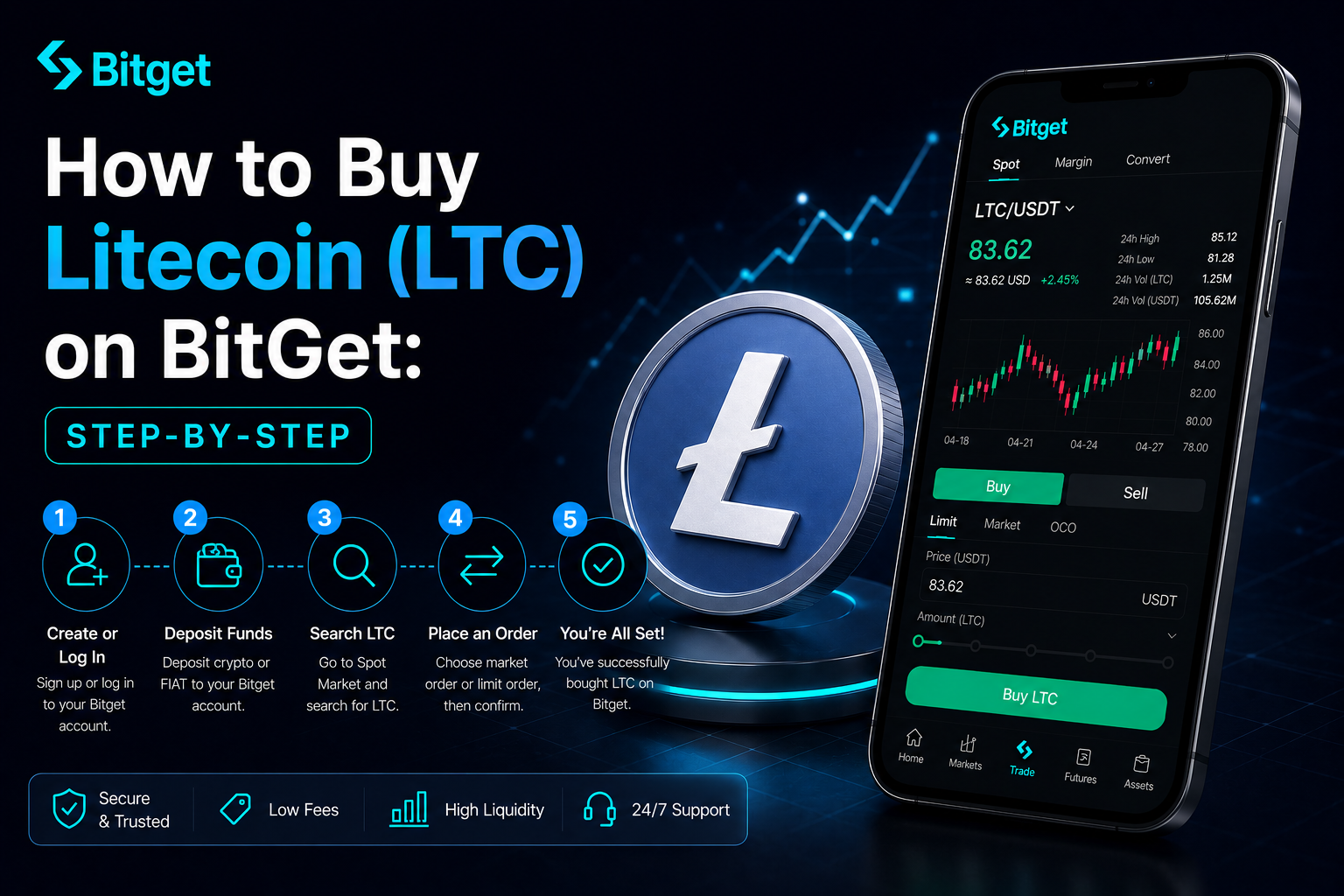
- Open the BitGet app or web platform. Go to Spot Trading.
- Search LTC/USDT and select it.
- On the buy side, select Market.
- Enter the USDT amount you want to spend (or use the percentage slider).
- Tap Buy LTC. The trade fills in seconds. LTC appears in your spot wallet.
You pay 0.10% in fees plus a small slippage cost.
Option B: Limit order (slower, better price)
- Open Spot Trading, select LTC/USDT.
- On the buy side, select Limit.
- Check the current price. Set your limit slightly below the current ask — e.g. if LTC is trading at $88.40, set your limit at $88.10.
- Enter the USDT amount.
- Tap Buy LTC. The order sits in the book until LTC drops to your price.
For anything over $100, limit orders are the right move. LTC spreads can widen during quiet sessions and you save the difference. Full breakdown in the BitGet spot trading guide and BitGet order types post.
How much LTC to buy (position sizing)
The question every beginner asks after the first sharp move. Three rules.
Rule one: LTC has lower beta than most altcoins. When Bitcoin moves 5%, LTC often moves 5–8% — closer to BTC’s behaviour than newer altcoins. That’s a feature for some buyers (steadier ride) and a bug for others (slower upside in a bull run).
Rule two: split your entry over weeks. Pick a target — say £1,000 of LTC over three months — and split into 12 weekly buys. You won’t hit the bottom. You won’t hit the top. You’ll get a reasonable average and learn the platform along the way.
Rule three: time around the halving. LTC halvings happen every four years. They’ve historically been less dramatic in price action than Bitcoin halvings, but they do reduce new supply hitting the market. Don’t FOMO in right before a halving expecting a guaranteed pump.
For a first-ever LTC buy, start with a coffee budget. Place the trade. Watch the price for two weeks. If you sleep fine, scale up.
Learning to size positions and read charts is a skill you can’t shortcut by reading blog posts. If you want to actually learn to trade — not just read about it — Trade Travel Chill (affiliate) is the community I’m part of and the one structured education source I trust. Optional. Useful when you’re ready.
For Litecoin news and updates, the Litecoin Foundation site and CoinDesk’s Litecoin coverage are the sources I check.
Litecoin halving cycles (and why people care)
Litecoin uses the same halving mechanic as Bitcoin. Every 840,000 blocks — roughly every four years — the block reward miners receive is cut in half. This reduces the new supply entering circulation and, in theory, creates upward pressure on price over time.
The history:
– 2015 halving: Block reward cut from 50 LTC to 25 LTC. Price action: modest in the months around it, larger move in the year following.
– 2019 halving: 25 LTC to 12.5 LTC. Price ran into the halving, sold off after, then recovered.
– 2023 halving: 12.5 LTC to 6.25 LTC. Less drama than expected, both in price and network metrics.
– Next halving (estimated ~2027): 6.25 LTC to 3.125 LTC.
The honest take: halvings matter for long-term supply dynamics but don’t reliably produce short-term price pumps. Anyone selling you “the halving guarantees a 10x” is guessing. The historical pattern has been a bigger move in the cycle after the halving than immediately around it — which makes sense, because the reduced supply takes time to bite.
If you’re sizing a long-term LTC position, halvings are a useful framing for “why hold for years not weeks”. They’re not a trade signal. Treat them accordingly.
Storing LTC: Ledger, Litecoin Core, or exchange?
You bought the LTC. Where does it live?
Exchange (BitGet)
Fine for your active trading float — the amount you’d be willing to lose without losing sleep. BitGet publishes Proof of Reserves monthly. But you don’t hold the private keys. The crypto wallets explained post covers the custody trade-off in more depth.
Hot wallet (Electrum-LTC, Litewallet)
Litewallet is the official Litecoin Foundation mobile wallet — clean, well-maintained, supports MWEB. Electrum-LTC is the lightweight desktop option, popular with users coming from Bitcoin’s Electrum. Both store keys on your device, both let you spend or receive on the LTC network directly.
Hot wallets are connected to the internet. Good for small balances you’ll spend. Bad for long-term holding.
Cold wallet (Ledger Nano X)
A Ledger Nano X is a hardware wallet — a USB device storing your private keys offline. LTC is fully supported via Ledger Live. You confirm every transaction physically on the device, so even a malware-ridden laptop can’t drain you. The hot vs cold wallet post covers the trade-off in depth.
Ledger costs about £150. Cheaper than the lesson of an exchange failure. Order one from the Ledger store (affiliate). Set it up, write the 24-word seed on the card it ships with, store the card somewhere fireproof and away from your home computer.
Litecoin Core (full node)
The hardcore option. Litecoin Core runs a full validating node of the Litecoin blockchain on your own machine. You don’t trust anyone for transaction data — you verify it yourself. Takes a chunk of disk space (around 100GB and growing) and a couple of days to sync from scratch. Overkill for most buyers, sensible for serious long-term holders.
The split I run for LTC
- Trading float on BitGet: 10% — for active trades.
- Hot wallet (Litewallet): 5% — for everyday spending.
- Ledger long-term: 85% — doesn’t move except to top up.
Full self-custody playbook in the how to store crypto safely guide.
Ready to buy your first LTC?
Sign-up takes 90 seconds, KYC usually clears same-day, and the LTC withdrawal flow is one of the cleanest on BitGet.
Affiliate link. I may earn a commission at no extra cost to you.
Litecoin vs Bitcoin: the real differences
A lot of beginners ask why hold LTC if you already hold BTC. The honest answer is — for most people, you don’t need both. They’re built for similar purposes and their price action correlates closely most of the time.
But here’s where they differ in practice:
Block time. LTC blocks every 2.5 minutes, BTC every 10. For payments, that means a typical LTC confirmation is faster than BTC’s. Practical difference for someone sending to a merchant: cleared in minutes vs cleared in an hour.
Supply cap. LTC caps at 84 million, BTC at 21 million. Four times more LTC supply. The argument “LTC will always be cheaper because more supply” is a misreading — price comes from demand against supply, not just absolute supply.
Mining algorithm. LTC uses Scrypt, BTC uses SHA-256. Different mining hardware, different mining economics. The practical upshot is that LTC mining is more accessible to small operators than BTC mining is today.
Privacy. LTC has MWEB — an optional privacy layer. BTC has nothing similar at the base layer (Lightning Network adds privacy on payment channels). For everyday holders this doesn’t matter; for users who care about transaction privacy it’s a real differentiator.
Cultural weight. BTC is the asset. LTC is the side project. The institutional treasuries, the ETF flows, the regulatory clarity — they go to BTC. LTC is a smaller, scrappier asset that’s lasted because it kept shipping and never broke.
If you’re buying both, the how to buy Bitcoin guide is the companion post.
Common LTC beginner mistakes
The mistakes I see most often.
Sending LTC to a Bitcoin address. They look similar but they’re different networks. Sending LTC to a BTC address (or vice versa) usually means the funds are lost. Always match the network.
Using a SegWit-only wallet for legacy addresses. Most LTC wallets handle both legacy and SegWit addresses fine, but a few older ones can trip up. Test with a small amount first.
Treating MWEB as default-on. MimbleWimble Extension Blocks are opt-in. You move LTC into the MWEB layer for privacy, not the other way round. Don’t assume your transactions are private unless you’ve explicitly opted in.
Storing on the exchange forever. Trading float yes. Life savings no. Move long-term holdings to a Ledger.
Sharing the seed phrase. No legitimate company, no support agent, no platform will ever ask for your 24-word seed phrase. The crypto scams guide covers the most common attack patterns.
Ignoring 2FA. Set it up the second you create the account.
Jumping straight to leverage. LTC is less volatile than most alts but it still moves. Six months of spot before you touch perps.
Buying because of Charlie Lee tweets. He’s still active, still tweets opinions, but he sold his bag in 2017. His views are commentary, not a roadmap. Trade on fundamentals, not founder tweets.
Forgetting tax records. Selling LTC for a profit is a taxable event in most jurisdictions. Keep records of every trade from day one.
One last thing.
If this walkthrough saved you a few hours of research, signing up through my affiliate link costs you nothing and helps keep the lights on.
Affiliate link.
One more thing: Buying a token doesn’t mean it will go up. Most altcoins underperform Bitcoin over long enough timeframes. Only buy what you can afford to lose, and never put your rent money in crypto. If a YouTuber tells you a coin will 100x — they’re guessing too.
Frequently asked questions
What is the minimum amount of Litecoin I can buy on BitGet?
You can buy fractional LTC from around $1 worth. LTC is divisible to eight decimal places (each unit is called a litoshi). Most people start with $50–$200 to learn the interface.
Do I need to verify my identity to buy LTC on BitGet?
Yes for full functionality. You can hold and trade limited amounts without KYC, but withdrawal limits are tiny. KYC usually clears within 1–24 hours and unlocks full deposit and withdrawal limits.
Can I buy Litecoin on BitGet with a credit card?
Yes, but I wouldn’t. Card on-ramps charge 1–3%, credit card providers often add a cash-advance fee on top, and many cards block crypto purchases anyway. Use debit, bank transfer, or P2P instead.
What’s the cheapest way to buy LTC on BitGet?
P2P trading or depositing crypto from another wallet. P2P fees are usually zero with a small rate spread. Crypto deposit only costs the network fee — LTC network fees are a fraction of a cent.
Should I keep my LTC on BitGet or move it to a wallet?
Move long-term holdings to a hardware wallet like the Ledger Nano X. Litewallet or Electrum-LTC for everyday spending. Keep an active trading float on the exchange.
When is the next Litecoin halving?
The next Litecoin halving is estimated for around 2027, when the block reward will drop from 6.25 LTC to 3.125 LTC. Halvings happen every 840,000 blocks — about every four years.
What’s the difference between Litecoin and Bitcoin?
Litecoin has 4x faster blocks (2.5 min vs 10 min), 4x the supply cap (84M vs 21M), uses Scrypt mining instead of SHA-256, and has the optional MWEB privacy layer. Bitcoin has more cultural and institutional weight; Litecoin has been more focused on payments speed.
Final word
The first LTC buy teaches you the workflow for every LTC trade after. Sign up. KYC. Fund cheaply. Place a limit order. Move the long-term bag to a Ledger. Don’t expect halving pumps to be guaranteed.
That’s the short version. If you do those five things in that order, you’ve already avoided most of the mistakes new buyers make on a 14-year-old chain.
Right — over to you.
Related posts
- How to Buy Bitcoin (BTC) on BitGet: Step-by-Step
- How to Buy Dogecoin (DOGE) on BitGet: Step-by-Step
- How to Store Crypto Safely: The Self-Custody Guide