Bitcoin Cash is the chain that left the family argument and started its own. In August 2017, a chunk of the Bitcoin community decided Satoshi’s idea was meant to be spent in shops, not held in vaults. They forked the chain, raised the block size from 1MB to 8MB (later 32MB), and walked off with their own coin. Almost a decade on, BCH is still here — smaller, cheaper to transact on, and far less hyped than its parent.
I’ve held BCH on and off since the fork itself, when every BTC holder woke up with an equal amount of the new coin in their wallet. This is the walkthrough I’d give a friend buying their first BCH on BitGet today. Two of the links below are affiliate. I’ll flag them as they come up.
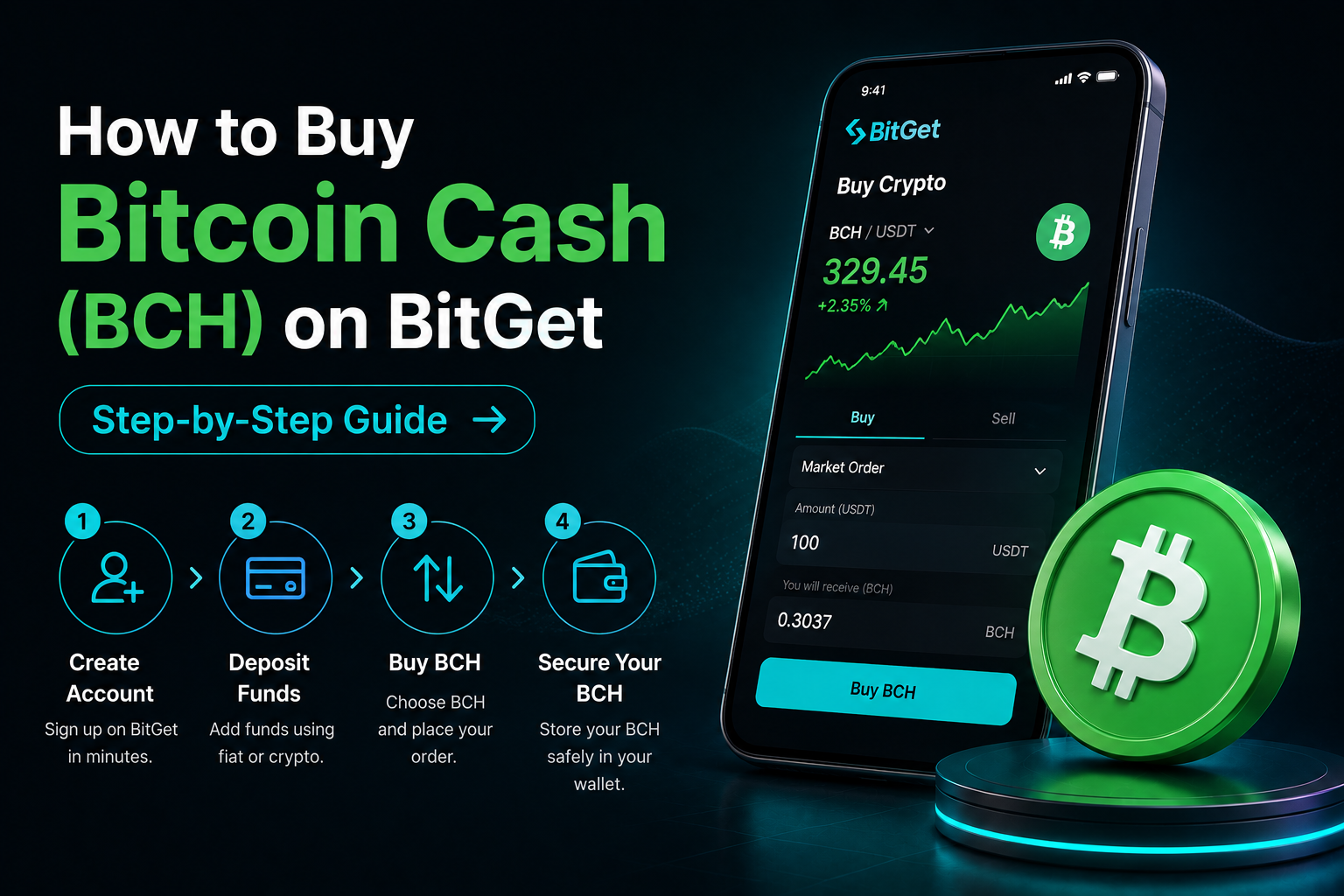
Short answer: To buy Bitcoin Cash on BitGet, open an account with email, turn on 2FA, finish KYC (usually same-day), fund the account via card, P2P, bank transfer, or crypto deposit, then place a spot order on the BCH/USDT pair. Spot fees are 0.10%. Card on-ramp adds 1–3%. For long-term storage, send BCH to a Ledger Nano X — Electron Cash works well as a desktop wallet. Time from signup to BCH in your wallet: about 30 minutes.
Open a BitGet account → (affiliate)
Key takeaways
- BCH forked from Bitcoin in August 2017 over a disagreement about block size and on-chain scaling.
- Block size on BCH is now 32MB, against 1MB on Bitcoin — that’s the whole technical pitch.
- BitGet spot fees sit at 0.10% maker/taker. Card buys add 1–3%, so use P2P or a crypto deposit if you can wait.
- KYC usually clears within 1–24 hours. Have a passport or driving licence ready before you start.
- For anything you’re not actively trading, the right home is a hardware wallet — not an exchange.
Why Bitcoin Cash exists at all
To understand BCH you have to understand the argument that created it. Around 2015–2017, Bitcoin started running into a scaling wall. Blocks were filling up, fees were climbing, and confirmations were slowing. One camp wanted to keep Bitcoin’s 1MB block size and push transactions off-chain via Lightning. The other camp wanted to raise the block size on the main chain so the network could handle more transactions directly.
The two sides couldn’t agree. On 1 August 2017, the second camp hard-forked the chain. Anyone holding BTC at that moment received an equal amount of BCH in the same address. Block size jumped to 8MB at launch, then 32MB later. Roger Ver — once known as Bitcoin Jesus for his early evangelism — became one of the more vocal BCH supporters and ran bitcoin.com behind the project.
BCH has split again since. Bitcoin SV (BSV) forked off in 2018. Bitcoin Cash Node and Bitcoin ABC parted ways in 2020. Each split chipped away at network effects, and BCH today sits well outside the top ten by market cap. That said, it still has a working chain, real merchants accepting it, and a community focused on payments rather than store-of-value narratives.
Live numbers on price, market cap, and daily volume sit on CoinGecko’s BCH page and CoinMarketCap. Worth a check before you place the trade. For the wider context on what Bitcoin actually is, the what is Bitcoin explainer covers it. For the general buying workflow that applies to any coin, the how to buy crypto parent guide is the place.
BCH vs BTC: the differences that matter to a buyer
If you’re choosing between BTC and BCH, here are the practical splits.
Block size and fees. BCH blocks hold 32MB of transactions. Bitcoin holds 1MB plus a separate witness data section. That means BCH transactions are cheap — fractions of a cent — even during busier periods. Bitcoin base-layer fees can spike to several dollars during congestion.
Confirmation time. Both chains target a 10-minute block. The difference is more about congestion. BCH almost never has a backlog. Bitcoin can.
Supply. Both have a 21 million coin cap. Both follow the same halving schedule. The next halving for BCH happens roughly in sync with Bitcoin’s, give or take a few days.
Adoption. Bitcoin sits at over $1 trillion in market cap most days. BCH sits in the hundreds of millions to low billions depending on the cycle. That’s the unavoidable gap. Bitcoin has the brand, the institutions, the ETFs, the Coinbase ads. BCH does not.
Use case. BCH leans into “electronic cash” — small payments, point-of-sale, merchant acceptance. Bitcoin has moved firmly into “digital gold” territory with institutional treasuries and macro narratives. Different jobs.
For a side-by-side on Bitcoin specifically, the how to buy Bitcoin walkthrough is the companion to this one.
Why I’d point a beginner at BitGet for BCH
A handful of exchanges list BCH. Here’s why BitGet works for this particular coin.
Active BCH/USDT order book. BCH has thinner liquidity than BTC almost everywhere — that’s just the size difference. On BitGet the book is deep enough that a $500 market order won’t move the price noticeably. For a coin with smaller volume, that matters.
Honest fee structure. Spot maker/taker fees start at 0.10% and drop with BGB holdings or volume. The chart price is what you trade against. Full breakdown in BitGet trading fees.
Multiple funding routes. Card, bank transfer, P2P, or crypto deposit from another wallet. You pick the trade-off between speed and cost.
Reliable withdrawals. I’ve withdrawn BCH from BitGet to my Ledger several times. Confirms in 10–60 minutes depending on network conditions. No surprise fees. Full platform breakdown in the BitGet review.
Geo limits. BitGet is not available in the US. UK and EU residents are fine. If you’re a US reader, look at Coinbase or Kraken — both list BCH. Everywhere else, this is the workflow I’d run.
Pre-signup checklist
Five things to have ready before you open the sign-up page. Five minutes of prep saves you twenty minutes of stop-start.
A photo ID. Passport or driving licence, in date, photo clear. KYC asks for the document plus a selfie.
A live email address. You’ll get 2FA codes, withdrawal confirmations, and security notices to this address. Don’t use a throwaway.
A long password. 16 characters minimum, never reused on any other platform. A password manager does the heavy lifting.
An authenticator app. Google Authenticator, Authy, or 1Password’s TOTP feature all work. Install before you create the account. SMS 2FA has been the entry point for a lot of account drains — covered in 2FA for crypto.
A funding source. Debit card for the fastest first-buy, bank account for P2P, or an existing crypto wallet for a deposit.
Storage plan. Decide where the BCH is going to live before you buy it. Active trading float on the exchange. Long-term holdings on a Ledger Nano X. Don’t buy first and figure out storage afterwards — that’s how exchange-held bags become “lost” bags during an outage.
Step-by-step: BitGet signup
Five steps. Around ten minutes if your documents are to hand.
- Open the sign-up page. BitGet (affiliate — gives you a small fee rebate on top of the standard tier). Enter email and a strong password.
- Verify the email. A six-digit code arrives in under a minute. Paste it in.
- Turn on 2FA. Security Settings → Authenticator. Scan the QR code with your app and save the backup code somewhere offline. On paper. Don’t screenshot it onto a cloud-synced phone.
- Run KYC. Identity Verification → upload your ID and take a selfie. My most recent verification cleared in around fifteen minutes. Some take a few hours.
- Connect a payment method. Card if you’re going for instant. P2P or bank transfer can be set up when you fund.
Account live. Funding next.
Funding: card vs P2P vs bank vs crypto deposit
Four ways to put money on BitGet. Each has a different cost and time profile.
| Method | Fee | Speed | Best for |
|---|---|---|---|
| Crypto deposit | Network fee only | 1–60 min | You already hold USDT/USDC/BCH elsewhere |
| P2P (bank transfer) | 0% (small rate spread) | 5–30 min | Best rate, slightly more steps |
| Bank transfer (third-party) | 0.5–1.5% | 1–3 hours | Mid-size buys |
| Card on-ramp | 1–3% | Instant | First small buy, can’t wait |
Crypto deposit is the cheapest path if you already have USDT, USDC, or BCH on another exchange or in a wallet. Send to your BitGet deposit address. For USDT, TRC-20 costs about 1 USDT in network fees. ERC-20 runs closer to 8 USDT. Pick the network that matches the wallet you’re sending from.
P2P trades you against another BitGet user who’s selling USDT for your local currency. You send them a bank transfer, BitGet escrows the USDT until the bank confirms. Rates land within 0.5% of mid-market most of the time.
Bank transfer through a third-party provider is the middle ground — visible fee, clears in a few hours.
Card on-ramp is the fastest and the most expensive. Fee is baked into the quote, so USDT will arrive at 1.5–3% above spot. Fine for a first $50 to learn the workflow. Bad value as your default.
My rule on BCH: card for the first small buy, P2P or crypto deposit for everything after.
Placing your first BCH trade
Funds on the account. Two ways to convert them to BCH.
Option A: Market order (fast, slightly worse fill)
A market order buys at the best available price in the book. Instant. Fine for small amounts.
- Open BitGet (app or web). Go to Spot Trading.
- Search for BCH/USDT and select the pair.
- On the buy side, pick Market.
- Enter the USDT amount or use the percentage slider.
- Tap Buy BCH. Order fills in a second or two. BCH lands in your spot wallet.
You pay 0.10% in fees plus a small slippage cost on the spread.
Option B: Limit order (slower, better price)
A limit order parks a buy at a price you choose. The market has to come to you.
- Open Spot Trading and select BCH/USDT.
- On the buy side, pick Limit.
- Check the current price. Set your limit slightly under the current ask — if BCH is trading at $410, set your limit at $408.
- Enter the USDT amount.
- Tap Buy BCH. The order sits in the book until price hits your level.
For anything over $100, limit orders are worth the extra two minutes. BCH spreads can widen during low-volume sessions. The BitGet spot trading guide covers order types in full and the BitGet order types post breaks down stops and trailing orders.
How much BCH to buy (position sizing)
Three rules I’d hand a beginner.
Rule one: BCH trades more like a mid-cap than a blue-chip. When Bitcoin moves 5%, BCH usually moves 7–12% in the same direction. The beta is real. A position that feels comfortable in BTC can feel rough in BCH.
Rule two: split entries over weeks, not minutes. Pick a target — say £500 of BCH over two months — and split it into eight or ten weekly buys. You won’t hit the bottom. You won’t hit the top. You will get a reasonable average and you’ll learn the platform without staring at the chart all day.
Rule three: keep a stablecoin reserve. BCH has had 70%+ drawdowns multiple times. If you put 100% in on day one and price drops 50%, you’ve used your ammo. Keep 30–40% of your BCH budget in USDT for the genuine dips.
For a first-ever BCH buy, start with a number you’d happily pay for a pub round. Place the trade, watch it for two weeks, see how a 15% drop feels in your gut. If you sleep fine, scale up.
This is the section where I’d flag that position sizing and reading charts is a skill you don’t get from blog posts. If you want to put the time in, Trade Travel Chill (affiliate) is the community I’m part of and the structured trading education I trust. Optional. Useful when you’re ready. The TTC review covers what’s inside.
Storing BCH: Ledger, Electron Cash, or exchange?
You’ve bought the BCH. Where does it live?
Exchange (BitGet)
Fine for active trading float — what you’d be willing to lose without losing sleep. BitGet publishes Proof of Reserves and supports withdrawal at any time. But you don’t hold the private keys. That gap matters more in a crisis than in a normal week. The hot vs cold wallet breakdown covers the trade-off.
Hot wallet (Electron Cash)
Electron Cash is the BCH equivalent of Electrum on Bitcoin. Desktop wallet, lightweight, open-source, fully under your control. You generate a seed phrase, write it down, and use the wallet to send and receive BCH directly on-chain. No third party between you and the network.
A hot wallet is connected to the internet. That’s the convenience and the weakness. Good for amounts you’d use to test self-custody or pay a small invoice in BCH. Not where I’d put a five-figure bag.
Cold wallet (Ledger Nano X)
A Ledger Nano X is a hardware wallet — a USB-sized device that holds your private keys offline. BCH is fully supported through Ledger Live. Every send is signed on the device itself, so even a compromised laptop can’t drain you without physical access to the hardware.
Ledger Nano X costs around £150. That’s a fraction of what you’d lose in a single exchange failure or phishing hit. Order from the Ledger store (affiliate). Set it up, write the 24-word seed on the included card, store the card somewhere fireproof — and not in the same room as the laptop you use to access exchanges. The seed phrase storage guide covers the options that actually work.
The split I run for BCH
- Trading float on BitGet: 20% — what’s available for active trades.
- Electron Cash: 10% — for spending and testing on-chain transactions.
- Ledger long-term: 70% — doesn’t move except to top up.
Full self-custody playbook in how to store crypto safely.
Ready to buy your first BCH?
Sign-up takes 90 seconds, KYC usually clears the same day, and BitGet has one of the deeper BCH/USDT books outside the big four exchanges.
Affiliate link. I may earn a commission at no extra cost to you.
BCH as a payment coin: what actually works
This is the bit that gets lost in the BTC-vs-BCH culture war. BCH was designed for payments and it does that job well.
Send a BCH transaction today and you’ll pay roughly a tenth of a cent in fees. The same payment over Bitcoin’s base layer is more expensive, and over Bitcoin Lightning requires channel setup and routing knowledge most beginners don’t have. BCH gives you on-chain payments at a usable price out of the box.
Merchant tooling exists too. Bitcoin.com’s wallet supports BCH-native QR payments. BitPay accepts BCH. A handful of POS systems integrate it. Adoption is modest compared to Lightning over the last two years, but BCH still has more merchant pickup than most coins outside the top ten.
For an everyday spending use case — sending a few hundred dollars across borders without a bank fee — BCH is one of the simplest options. The trade-off is volatility. You’re spending an asset that can move 5–10% in a day. Most users solve this by converting to a stablecoin or fiat the moment they need to spend.
For news on BCH adoption, network upgrades, and broader Bitcoin-family coverage, CoinDesk’s Bitcoin Cash tag and Reuters’ crypto desk are the sources I check.
Common BCH beginner mistakes
The errors I see most often.
Confusing BCH with BTC at the wallet level. Bitcoin Cash and Bitcoin use different addresses now, but in the early days some wallets accepted both formats. Modern BCH addresses use the CashAddr format starting with bitcoincash:. Bitcoin addresses don’t. Sending BCH to a Bitcoin address (or vice versa) used to lose funds — modern wallets warn you, but always check the address format before sending.
Sending BCH over the wrong network. When you withdraw from BitGet, pick the Bitcoin Cash (BCH) network. Not BSV. Not BEP-20 wrapped BCH. Native BCH only. Wrong-network sends are the most common way beginners lose funds.
Storing on the exchange long-term. Active float yes, life savings no. Move long-term holdings to a hardware wallet.
Treating BCH as a Bitcoin proxy. It isn’t. BCH is a separate asset with separate price action, separate adoption metrics, and separate fundamentals. Don’t buy BCH thinking you’re getting a “cheaper Bitcoin” — you’re getting Bitcoin Cash, which moves differently.
Falling for BCH-themed scams. Every fork has its army of “official” Telegram groups, fake support accounts, and copy-paste airdrop pages. Bookmark official sites. Ignore DMs. The crypto scams guide covers the playbooks.
Sharing the seed phrase. No exchange, no wallet, no support agent will ever ask for your 24-word seed. Anyone who does is trying to steal from you. The phrase lives on paper, at home, and nowhere else.
Skipping 2FA. Enable it on the BitGet account the second you create it. Most account drains come from phished credentials hitting accounts without 2FA — not from broken encryption.
Jumping into futures on a smaller-cap. BCH derivatives exist, but they’re for traders who already know how leverage liquidations work. The BitGet futures USDT-M guide is research material, not a buy signal. Six months on spot before you touch perpetuals.
One last nudge.
If this walkthrough saved you a few hours of research, signing up through my affiliate link costs you nothing and helps keep the lights on.
Affiliate link.
Frequently asked questions
What is the minimum amount of Bitcoin Cash I can buy on BitGet?
You can buy fractional BCH from around $1 worth. BCH is divisible to eight decimal places (the same as Bitcoin), so whole-token buys are never required. Most beginners start with $50–$200 to learn the interface before scaling up.
Do I need to verify my identity to buy BCH on BitGet?
Yes for full functionality. You can hold and trade small amounts without completing KYC, but withdrawal limits are tiny. KYC usually clears in 1–24 hours and unlocks full deposit and withdrawal limits. The KYC explained post covers what’s involved.
Can I buy Bitcoin Cash on BitGet with a credit card?
Yes, but it’s a poor default. Card on-ramps charge 1–3% and credit card issuers often slap a cash-advance fee on top. Many issuers also block crypto purchases entirely. Use debit, bank transfer, or P2P unless you’re testing the workflow with a small amount.
What is the cheapest way to buy BCH on BitGet?
P2P trading or depositing USDT from another wallet. P2P fees are essentially zero — you pay a small spread on the rate. Crypto deposit only costs the network fee on whatever chain you’re sending from.
Is BCH a good long-term hold?
Honest answer: nobody knows. BCH has working tech, real merchant adoption, and a community focused on payments. It also has a smaller market cap than Bitcoin and lower trading volume than the top altcoins. Treat it as one position in a diversified portfolio, not your single bet on the future of payments.
Should I keep my BCH on BitGet or in a wallet?
Move long-term holdings to a Ledger Nano X or another hardware wallet. Electron Cash works as a desktop hot wallet for amounts you want to spend. Keep an active trading float on the exchange.
What’s the difference between Bitcoin Cash and Bitcoin SV?
BSV forked from BCH in 2018 over another scaling and protocol disagreement. They are separate chains with separate communities, separate prices, and separate development teams. Buying BCH does not give you BSV and vice versa.
Can I stake Bitcoin Cash?
Not in the proof-of-stake sense — BCH uses proof-of-work, the same consensus as Bitcoin. Some platforms offer “BCH earn” products that pay yield on deposited BCH, but the yield comes from lending, not staking. Read the fine print before depositing.
Final word
The first BCH buy teaches you the workflow for every BCH trade after. Open the account. KYC. Fund the cheapest way you have time for. Place a limit order. Move the long-term portion to a Ledger. Don’t chase the next BCH news pump.
That’s the short version. If you do those five things in that order, you’ve already avoided most of the mistakes that catch beginners on their first altcoin.
Right — over to you.
One more thing: Buying a token doesn’t mean it will go up. Most altcoins underperform Bitcoin over long enough timeframes. Only buy what you can afford to lose, and never put your rent money in crypto. If a YouTuber tells you a coin will 100x — they’re guessing too.
Related posts
- How to Buy Bitcoin (BTC) on BitGet: Step-by-Step
- How to Buy Litecoin (LTC) on BitGet: Step-by-Step
- How to Store Crypto Safely: The Self-Custody Guide