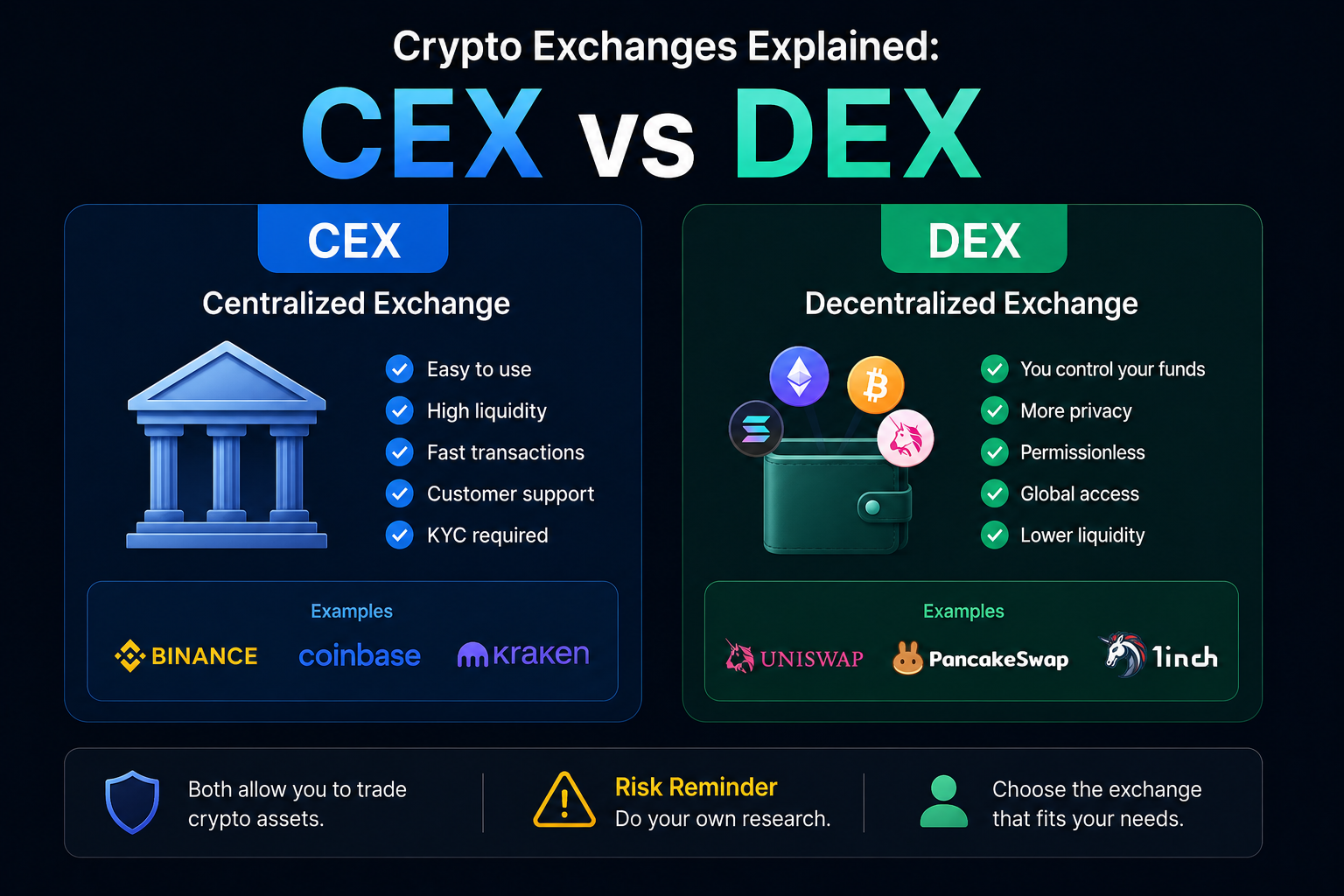
The first time I bought crypto I used a centralised exchange because that’s what every YouTube video told me to do. The first time I bought a small-cap altcoin nobody had heard of, I had to use a decentralised one because the big platforms didn’t list it. Six years and a few hundred trades later, I use both — for different jobs. If you don’t know which is which, you’ll either pay too much in fees, hand your ID over when you didn’t need to, or get phished out of your bag connecting to a fake site. Here’s the honest version.
Short answer: A centralised exchange (CEX) is a company — like BitGet, Binance, or Coinbase — that holds your crypto for you and matches buyers with sellers on its own order book. A decentralised exchange (DEX) is a piece of software running on a blockchain — like Uniswap, Curve, or dYdX — that lets you swap tokens directly from your own wallet, with no company in the middle. CEXs are easier and faster for beginners. DEXs give you self-custody and access to more tokens. Most active traders use both.
Open a BitGet account → (affiliate link)
Key takeaways
- A CEX is a company that custodies your crypto and runs an order book. A DEX is on-chain software that lets you swap from your own wallet.
- CEXs are faster, cheaper for fiat on-ramp, and easier to use. DEXs give you self-custody and access to thousands of tokens CEXs don’t list.
- Most CEXs require KYC. Most DEXs don’t — they only need a wallet connection.
- Hacks happen on both. CEXs get breached at the company level (Mt. Gox, FTX). DEXs get drained through smart contract exploits.
- The setup I actually use: CEX for fiat on/off-ramp and active trading, DEX for small-cap access, hardware wallet for storage.
What a crypto exchange actually does
Strip away the marketing and a crypto exchange does one of two things: it either matches buyers with sellers, or it lets you swap one token directly for another.
The matching version is an order book. You post an order to buy 0.1 BTC at $60,000. Someone else posts an order to sell 0.1 BTC at $60,000. The exchange matches you, the trade clears, and you both pay a small fee.
The swap version uses something called an automated market maker (AMM). Instead of a buyer and a seller, you’re trading against a pool of tokens that other people have deposited. The price is set by a maths formula based on how much of each token is in the pool. You put ETH in, you take USDC out, and you pay a small fee that goes to the pool depositors.
Centralised exchanges almost always use order books. Decentralised exchanges almost always use AMMs (Uniswap, Curve, PancakeSwap) — though a few, like dYdX, run on-chain order books instead.
That’s the actual difference under the hood. Everything else — fees, KYC, custody, security — flows from that one design choice.
What both have in common
Both let you trade one crypto for another. Both charge fees. Both publish prices. Both can list new tokens and delist old ones. Both can have downtime. Both have winners and losers depending on which token you’re trying to buy, in which size, on which day.
The difference is who holds your money while you’re doing it.
Centralised exchange (CEX) — BitGet, Binance, Coinbase
A centralised exchange is a company. It’s based somewhere — usually Seychelles, Singapore, the Cayman Islands, or the US. It has employees, lawyers, compliance officers, and a help desk. When you sign up, you create an account with an email and password, prove your identity, deposit money, and they hold your crypto in their wallets while you trade.
The big names you’ll see most often:
- BitGet — the one I use day-to-day. Strong futures, deep copy trading, competitive fees.
- Binance — the largest by volume globally. Wide token selection. Restricted in some countries.
- Coinbase — the most beginner-friendly in the US. Higher fees. Publicly listed on NASDAQ.
- Kraken — long-running, US-based, conservative but reliable.
- Bybit — popular in Asia, growing in Europe. Strong derivatives.
- OKX — broad product set, decent fees, less brand recognition in the West.
Per the Investopedia explainer on centralised exchanges, CEXs are the dominant venues for crypto trading by volume — the top ten CEXs handle hundreds of billions of dollars in monthly volume between them, vastly more than all DEXs combined.
How a CEX works in practice
You sign up. You verify your ID (KYC). You deposit fiat from your bank or card. Your money becomes an exchange balance — a row in their database that says “Alan owns $5,000 worth of USDT”. You place a buy order. The exchange matches you with a seller and updates the balances. You now own the crypto inside the exchange. You can trade it, withdraw it, or leave it there.
The “leave it there” part is the trap. Your crypto on a CEX isn’t really yours in the same way crypto in your own wallet is. The exchange holds the private keys. If the exchange goes bust — Mt. Gox in 2014, FTX in 2022 — your balance can vanish overnight.
That’s the trade-off CEXs ask you to make: convenience and speed in exchange for custody risk.
What CEXs are good at
- Fiat on-ramp (buying crypto with a card or bank transfer)
- Fiat off-ramp (selling crypto back to your bank)
- Speed (orders fill in milliseconds)
- Deep liquidity on the major pairs (BTC, ETH, SOL, etc.)
- Advanced order types (limit, stop, trailing, OCO)
- Futures, options, margin
- Copy trading and trading bots
- Customer support (in theory)
If you’re buying your first crypto with a credit card, a CEX is the only realistic option. DEXs can’t take Visa.
Decentralised exchange (DEX) — Uniswap, dYdX, Curve
A decentralised exchange isn’t a company. It’s a set of smart contracts deployed on a blockchain. Nobody runs it day-to-day. There’s no help desk. There’s no login. You connect your wallet, sign a transaction, and the contract executes.
The big names:
- Uniswap — the largest DEX by volume. Ethereum and L2s. Open-source AMM.
- Curve — specialised in stablecoin swaps and low-slippage pairs.
- PancakeSwap — the dominant DEX on BNB Chain.
- dYdX — derivatives-focused. Uses an on-chain order book.
- Jupiter — the dominant DEX aggregator on Solana.
- GMX — perpetual futures on Arbitrum and Avalanche.
According to data from DefiLlama, total DEX volume regularly clears $100 billion per month across all chains. That’s not nothing — but it’s still well under what the major CEXs do.
How a DEX works in practice
You install a wallet — MetaMask on Ethereum, Phantom on Solana, etc. You fund the wallet with crypto. You visit the DEX website. You click “connect wallet”. The site asks your wallet to approve a connection — you click yes. You pick a token to swap, type an amount, and click swap. Your wallet pops up asking you to sign the transaction and pay the gas fee. You sign. The transaction goes on-chain. A few seconds later, the swap is done.
You never deposit crypto into the DEX. The crypto leaves your wallet only at the moment of the swap. There’s no balance to withdraw. There’s no account.
That’s the fundamental difference: on a CEX, you trust the company. On a DEX, you trust the code.
What DEXs are good at
- Self-custody (your crypto stays in your wallet until the moment of trade)
- No KYC (you trade with a wallet address, not an ID)
- Token availability (any token with liquidity can be traded — long before CEXs list it)
- Geographic access (works anywhere with an internet connection)
- Composability (DEXs plug directly into other DeFi apps)
If you want to buy a token within an hour of launch, a DEX is usually the only option. CEXs list slowly. DEXs list instantly because anyone can create a pool.
Custody difference (the only thing that really matters)
If you read nothing else in this post, read this section.
The single biggest difference between a CEX and a DEX is who holds your crypto. Every other difference is downstream of that one.
On a CEX, the exchange holds your keys
When you have 1 BTC sitting in your BitGet or Binance account, you don’t actually own 1 BTC on the blockchain. The exchange owns 1 BTC. Your account is an IOU. The exchange’s database has a row that says you’re owed 1 BTC, and as long as the exchange honours that IOU, you can trade it or withdraw it.
This works fine 99% of the time. CEXs employ teams of security people, hold most of their funds in cold storage, and publish proof-of-reserves audits. BitGet’s proof of reserves page is one example.
But the 1% of the time it doesn’t work fine, it doesn’t work fine in a catastrophic way. The crypto industry has watched roughly $9 billion in customer funds disappear into failed centralised platforms — Mt. Gox lost 850,000 BTC in 2014, FTX customers lost about $8 billion in 2022, Celsius and Voyager and BlockFi added to the pile. Per Reuters coverage of the FTX collapse, even sophisticated institutional investors lost everything.
The simple rule: don’t keep crypto on an exchange you wouldn’t be okay losing.
On a DEX, you hold your own keys
Your crypto sits in your own wallet. You hold the seed phrase. Nobody can freeze it. Nobody can lose it for you. Nobody can decide to shut you out.
This is what people mean by “self-custody”. The blockchain doesn’t care who you are. The wallet doesn’t have an account. The keys are the ownership.
The catch: you’re now responsible for the keys. If you lose your seed phrase, the crypto is gone. If you get phished and sign a malicious transaction, the crypto is gone. If your computer gets compromised, the crypto is gone.
Self-custody isn’t safer in every scenario. It’s safer against exchange failure. It’s more dangerous against your own mistakes.
This is why the setup most experienced traders use is: small amounts on a CEX for active trading, plus a hardware wallet like the Ledger Nano X for long-term storage. CEX for the day-to-day, cold wallet for the bag. The hot vs cold wallet post breaks down the threat model in detail.
Fees compared (CEX vs DEX)
People assume DEXs are cheaper because there’s no middleman. Sometimes they are. Often they aren’t.
CEX fee structure
CEXs typically charge a maker fee (for adding liquidity to the order book with a limit order) and a taker fee (for removing liquidity with a market order). Maker fees are lower. Both are charged per trade.
Typical CEX fees on the spot market:
| Exchange | Maker | Taker |
|---|---|---|
| BitGet (regular) | 0.10% | 0.10% |
| BitGet (VIP 1+) | 0.080% | 0.090% |
| Binance | 0.10% | 0.10% |
| Coinbase Advanced | 0.40% | 0.60% (regular) |
| Kraken | 0.16% | 0.26% |
| Bybit | 0.10% | 0.10% |
A 0.10% fee on a $1,000 trade is $1. On a $10,000 trade it’s $10. These add up if you trade frequently, but for a single buy-and-hold purchase they’re trivial. The BitGet trading fees post breaks down the VIP tiers and discounts.
DEX fee structure
DEXs charge a swap fee (paid to the liquidity providers, usually 0.05% to 1% depending on the pool) plus a blockchain gas fee (paid to the network to process the transaction).
The swap fee is often comparable to CEX fees. Uniswap’s standard pool charges 0.30%. Curve’s stablecoin pools charge 0.04%. PancakeSwap is 0.25%.
The gas fee is the killer. On Ethereum mainnet, a single DEX swap can cost anywhere from $5 to $80 depending on network congestion. During the 2021 bull run I’ve personally paid $120 to swap $400 worth of an altcoin. That math doesn’t work. The gas fees explained post covers why this happens and how to pay less.
On L2s — Arbitrum, Optimism, Base, Polygon — gas can drop to a few cents. On Solana, it’s a fraction of a cent. On BNB Chain, similar.
The honest comparison
For trades under $1,000 on Ethereum mainnet: CEX is almost always cheaper.
For trades on L2s or Solana: DEX is competitive, sometimes cheaper.
For large trades on illiquid pairs: CEX is usually cheaper because of better liquidity. DEX slippage on a $50,000 trade in a small pool can eat 2-5% of the trade.
For trades on tokens that aren’t listed on any CEX: DEX is the only option, regardless of fees.
Liquidity comparison
Liquidity is how much of an asset you can buy or sell without moving the price. More liquidity = smaller spread = less slippage.
CEXs dominate liquidity on the major pairs. If you want to buy $100,000 of BTC right now, you’ll get a better fill on Binance, BitGet, or Coinbase than on any DEX. The order books are deeper, the market makers are tighter, the price impact is smaller.
DEXs dominate liquidity on the long tail. If a token launched yesterday and the top liquidity is in a Uniswap pool, that’s where you trade it. CEXs won’t have it listed for months, if ever.
The rough split:
- Top 30 tokens by market cap: CEX liquidity is 5–10x deeper than DEX
- Top 100–500 tokens: roughly comparable
- Long-tail tokens (>500): DEXs dominate completely
This is why most professional traders run both. CEX for size on the majors. DEX for early access on the minors.
KYC reality (most CEXs require it, DEXs don’t)
KYC stands for Know Your Customer. It’s the process where you upload an ID, take a selfie, and prove you are who you say you are. It exists because regulators require exchanges to know who’s using them — to prevent money laundering, sanctions evasion, and tax evasion.
KYC on CEXs
In 2026, essentially every major CEX requires KYC for anything beyond a tiny deposit. BitGet has a basic verification tier that unlocks trading and a full tier required for higher withdrawal limits. Coinbase, Kraken, and Binance all require ID before you can trade.
The process is usually:
- Email and password
- Phone number
- ID upload (passport or driver’s licence)
- Selfie or video verification
- Proof of address (for higher tiers)
Most exchanges clear basic KYC within a few hours. Some clear it in minutes. The KYC explained post covers what they do with your data, the failure modes, and what’s possible without it.
KYC on DEXs
There is no KYC on a DEX. You connect a wallet and you trade. The DEX doesn’t know your name, your country, or your tax status. It knows a wallet address.
That doesn’t mean you’re invisible — every transaction is on the public blockchain, and blockchain analytics firms can often link a wallet to a real identity through deposits and withdrawals. But the DEX itself collects nothing.
This is one of the genuine reasons DEXs exist. If you live in a country where crypto access is restricted, or you don’t want to hand your passport to a Cayman Islands company, DEXs let you trade anyway.
Security risks: hacks vs smart contract exploits
Both types of exchange get hit. The attack surface is different.
CEX risks
The big risks on a CEX are:
- Exchange insolvency — the company goes bust and customer funds are lost or frozen. FTX, Mt. Gox, Celsius, Voyager, BlockFi.
- Exchange hack — attackers breach the company’s hot wallets. Bitfinex 2016 ($72m), Coincheck 2018 ($530m), KuCoin 2020 ($280m), Bybit 2025 ($1.5bn).
- Account takeover — attackers phish your credentials or SIM-swap your phone and drain your account.
- Regulatory action — your jurisdiction restricts access, freezes withdrawals, or seizes funds.
CEX risks are concentrated. When something goes wrong, it goes wrong for everyone on the platform at once.
DEX risks
The big risks on a DEX are:
- Smart contract exploits — bugs in the contract code let attackers drain liquidity pools. Common.
- Phishing sites — attackers spin up fake DEX URLs and trick you into signing malicious transactions.
- Approval scams — you sign a transaction giving a contract unlimited permission to move your tokens, and the contract drains your wallet later.
- Rug pulls — the team behind a token pulls all the liquidity from the pool and disappears.
- Front-running / MEV — bots see your transaction in the mempool and exploit it.
DEX risks are distributed. You can lose your own funds without anyone else being affected. But the trade-off is, you have to know what you’re signing every single time you connect your wallet.
My personal rule
Hardware wallet for storage. Period. The crypto scams guide covers the specific attack patterns. The seed phrase storage guide covers the backup side. Most retail crypto losses come from a small handful of repeatable mistakes — learn what they look like before you make them.
I also use NordVPN on every device I trade from — public WiFi is where account takeovers happen, and I’ve watched people get drained connecting to their exchange from an airport. The setup I use is here (affiliate link).
Geographic access
CEXs respect borders. DEXs don’t.
If you live in the US, BitGet’s main platform isn’t available to you — you need to use a US-friendly alternative or a different setup. Same goes for Binance (Binance.US is a separate, more limited platform). UK users have access to most exchanges but with promotional restrictions thanks to FCA rules. Some countries can’t access most major CEXs at all.
A DEX doesn’t care where you are. As long as you have a wallet and an internet connection, the contract executes. This is one of the reasons DEX volume tends to spike during periods of regulatory uncertainty — people who lose CEX access don’t stop trading, they move on-chain.
This is also where a VPN comes in for people travelling. I’ve been locked out of exchange accounts simply by logging in from the wrong country on holiday. A VPN that keeps your traffic origin consistent saves a lot of trouble.
The CEX + DEX hybrid most active traders use
Nobody who’s been doing this for a few years uses only one. The split most experienced traders run looks something like this:
CEX (BitGet, in my case) — used for:
- Fiat on-ramp (buying with a card or bank transfer)
- Active spot trading on the top 50 tokens
- Futures and copy trading
- Bots (grid, DCA) on liquid pairs
- Fiat off-ramp when I want to bank profit
DEX (Uniswap, Jupiter, depending on the chain) — used for:
- Buying tokens too small or new for CEX listings
- Trading directly from a hardware wallet
- Access in geographies where CEXs are restricted
- Specific DeFi strategies (LP, yield farming)
Hardware wallet (Ledger Nano X) — used for:
- Long-term storage of anything I’m not actively trading
- Signing DEX transactions for higher-value swaps
- Cold backup of the seed phrase
This isn’t a unique setup. Most traders I know run something similar. The CEX is the workhorse for size and speed. The DEX is the access point for everything the CEX doesn’t list. The cold wallet is the vault. Each tool does the job it’s best at.
If you want to actually learn to trade across both venues, Trade Travel Chill (affiliate) is the community I’m part of — structured education from traders who use both CEXs and DEXs day-to-day. The trade travel chill review covers what’s inside.
When DEX makes more sense
Use a DEX when:
- The token isn’t on a major CEX. Small caps, new launches, niche DeFi tokens.
- You want to stay self-custodial. Trading directly from your hardware wallet without ever depositing to a third party.
- You’re in a restricted jurisdiction. DEXs work where CEXs don’t.
- You’re doing DeFi-native strategies. LP, yield, lending — these only exist on-chain.
- The transaction size is small enough that gas isn’t crushing. On L2s, this includes basically any trade. On Ethereum mainnet, you want trades of $1,000+ to justify the gas.
The honest version: DEXs make most sense for traders who know what they’re doing and want either token access or self-custody. They’re not where I’d send a complete beginner.
When CEX makes more sense
Use a CEX when:
- You’re buying your first crypto. Card on-ramp, simple interface, fiat support.
- You want to trade futures or use leverage. DEX derivatives exist (dYdX, GMX) but liquidity and UX are weaker.
- You want to use a trading bot or copy trader. BitGet copy trading and the BitGet futures USDT-M products work in ways DEXs can’t match.
- Liquidity matters. Top-pair trades fill better on CEXs.
- Speed matters. CEX order matching is millisecond-level. DEX transactions take 12 seconds on Ethereum, 400ms on Solana — both slower than a CEX.
- You need fiat off-ramp. Withdrawing back to a bank account requires a CEX.
For most beginners, the answer is simple: start on a CEX, learn how trading works, move long-term storage to a hardware wallet, and only graduate to DEXs once you actually understand what you’re signing.
Ready to start with a proper CEX?
BitGet is the one I use. Sign-up takes about 90 seconds and KYC usually clears the same day.
Affiliate link. I may earn a commission at no extra cost to you.
Frequently asked questions
Is a DEX safer than a CEX?
Neither is inherently safer — they fail differently. A CEX can lose your money in a hack or bankruptcy. A DEX can lose your money through a smart contract exploit, a phishing site, or a mistaken transaction you sign yourself. CEXs concentrate risk on the company. DEXs put the risk on you.
Can I use a DEX without KYC?
Yes. Connecting a wallet doesn’t require any ID. The DEX has no idea who you are. Note that on-chain transactions are public — blockchain analytics can often link wallets to real identities through deposits — but the DEX itself collects nothing.
What’s the cheapest way to swap tokens?
For top pairs and small amounts under $1,000, a major CEX is usually cheapest. For trades on L2s like Arbitrum, Optimism, or Base, DEXs are competitive. For trades on tokens the CEXs don’t list, DEX is the only option. Fees aren’t just the headline number — slippage and gas matter too.
Do DEXs have customer support?
No. There’s no help desk. If you send tokens to the wrong address, sign a malicious transaction, or lose your seed phrase, nobody can help you. This is the cost of self-custody.
Which is better for buying my first crypto?
A CEX. Specifically one that supports your local currency, has card and bank deposit options, and operates legally in your country. BitGet, Coinbase, and Kraken are all reasonable starting points. The how to buy crypto guide walks through the full process.
Can I lose money on a DEX trade even if there’s no hack?
Yes. Slippage on illiquid pools can cost you several percent. Front-running bots can sandwich your trade and skim profit. Failed transactions still cost gas. And the price can simply drop after you buy.
Are CEXs going to be replaced by DEXs?
Unlikely in the near term. DEXs have grown massively but still represent a fraction of total crypto trading volume. CEXs offer better UX, fiat access, and derivatives liquidity. The two will keep coexisting and most active traders will keep using both.
Final word
Centralised and decentralised exchanges aren’t enemies — they’re tools for different jobs.
If you’re new to crypto, start with a CEX. Use BitGet or whichever one is most convenient where you live. Buy your first crypto with a card or bank transfer. Get a feel for how trading works. The crypto for beginners guide covers what comes first.
Once you’ve got the basics, learn how to use a DEX. Set up a wallet. Practise small swaps. Understand what you’re signing. The crypto wallets explained post covers the wallet side.
Once you’ve got both, move storage to a hardware wallet — Ledger Nano X (affiliate) is the one I use, and the ledger nano x review covers why. Keep day-to-day trading funds on the CEX, long-term bag on cold storage, and use DEXs for what they’re actually good at: token access and self-custody.
That’s the setup. Not exciting. Not new. Just what works.
Right — over to you.
Related posts
- How to Buy Crypto: The Beginner’s Walkthrough
- Best Crypto Exchanges Tested and Ranked
- How to Store Crypto Safely: The Self-Custody Guide