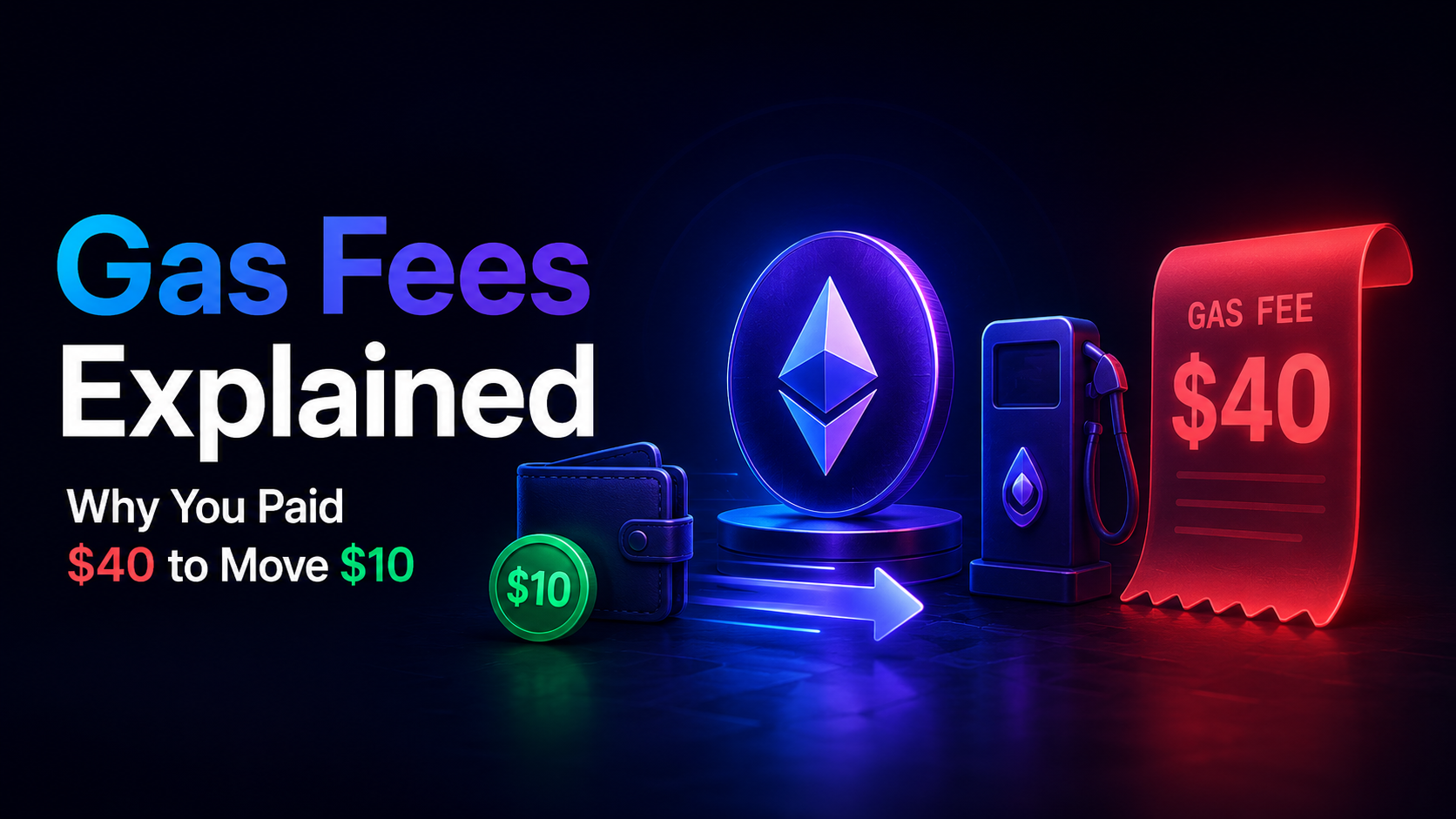
The first time I tried to move $80 worth of an altcoin between two wallets, it cost me $63 in gas. I sat there staring at MetaMask thinking I’d done something wrong. I hadn’t. That’s just what the Ethereum network was charging that day. If you’ve ever tried to send a small amount of crypto and watched the fee eat most of it, you’ve already met gas. The good news is it’s not random. There’s a reason it spikes, a way to predict it, and a handful of tricks to pay a fraction of what most beginners pay. Here’s the actual explanation.
Short answer: A gas fee is what you pay the blockchain to process your transaction. It’s not paid to the exchange or to the recipient — it’s paid to the validators (or miners) who confirm the transaction and add it to the next block. On Ethereum it’s denominated in “gwei” (one billionth of an ETH). The fee depends on how much computational work your transaction needs and how congested the network is at that moment. The same transaction can cost $2 at 3am and $80 at peak hours.
Open a BitGet account → (affiliate link) — most on-exchange trades have no gas fee at all.
Key takeaways
- A gas fee is what you pay the blockchain network to process your transaction. It’s not optional.
- Gas is measured in “gwei” — one gwei is one billionth of an ETH.
- After EIP-1559 (August 2021), Ethereum gas has two parts: a base fee (burned) and a priority fee (tipped to the validator).
- L2s like Arbitrum, Optimism, Base, and Polygon cut gas costs by 10-100x. Solana and BNB Chain are even cheaper.
- Failed transactions still cost gas. You can pay $40 for a transaction that never went through.
- Most CEX trading has no on-chain gas fee at all — only withdrawals do.
What a gas fee actually is (paying for compute)
Every transaction on a blockchain has to be processed by computers running the network. Those computers — validators on Ethereum, miners on Bitcoin — don’t run for free. They charge for the work.
That charge is the gas fee.
Think of it like petrol. You can’t drive a car without burning some fuel. The further you go, the more fuel you burn. A simple drive costs little; a long, complicated drive costs more. Same with blockchain transactions. A basic ETH transfer needs about 21,000 units of gas. A complex DeFi transaction interacting with five smart contracts might need 500,000+ units.
The total fee you pay is:
gas used × gas price = total fee
Both numbers matter. Gas used depends on what you’re doing. Gas price depends on how busy the network is.
That’s the whole model. Everything else is detail.
Per Ethereum.org’s gas explainer, gas exists for two reasons: to pay for the resources your transaction consumes, and to prevent infinite-loop spam attacks. Without gas, someone could submit a transaction that never finished and clog the whole network.
Where the fee actually goes
After EIP-1559 (the August 2021 upgrade) gas on Ethereum splits into two parts:
- The base fee is determined algorithmically by the network and is burned — destroyed, removed from circulation forever.
- The priority fee (or “tip”) goes to the validator who included your transaction.
This matters because every transaction now permanently removes ETH from the supply. As of late 2024, over 4.5 million ETH had been burned since EIP-1559 went live — that’s roughly $15 billion at current prices, gone from circulation.
Gwei explained (the unit)
Gwei is the unit gas prices are quoted in. It’s just a fraction of an ETH.
- 1 ETH = 1,000,000,000 gwei (1 billion gwei)
- 1 gwei = 0.000000001 ETH
Why use gwei instead of ETH? Because gas prices are tiny. Quoting them in ETH gives you numbers like “0.000000025 ETH per unit”. Quoting them in gwei gives you “25 gwei”. The latter is easier to read.
When you see “gas price: 25 gwei” on Etherscan or MetaMask, that’s the price per unit of gas. If your transaction uses 21,000 units of gas at 25 gwei, the total is:
21,000 × 25 = 525,000 gwei = 0.000525 ETH
At an ETH price of $3,500, that’s about $1.84.
Same transaction at 100 gwei (a busy day):
21,000 × 100 = 2,100,000 gwei = 0.0021 ETH ≈ $7.35
Same transaction at 400 gwei (a peak congestion day):
21,000 × 400 = 8,400,000 gwei = 0.0084 ETH ≈ $29.40
For a simple transfer. The price scales with the network, not your transaction size.
Base fee vs priority fee (EIP-1559)
Before August 2021, gas pricing was a blind auction. You guessed how much to pay. If you guessed too low, your transaction sat in the mempool unconfirmed for hours. If you guessed too high, you overpaid. It was a mess.
EIP-1559 fixed this. The new model:
Base fee
The base fee is set algorithmically based on how full recent blocks have been. If the last block was more than 50% full, the base fee goes up by up to 12.5%. If it was less than 50%, the base fee drops by up to 12.5%. The network self-regulates.
The base fee is burned — sent to a wallet nobody can spend from. This is the deflationary mechanism in Ethereum.
You don’t really set the base fee yourself. Your wallet detects the current base fee and includes it automatically.
Priority fee
The priority fee is the tip you pay the validator to include your transaction. Higher tip = your transaction gets included faster.
Most wallets auto-suggest a priority fee based on current network conditions. Typical numbers are 1-3 gwei in normal conditions, 5-15 gwei when busy, 50+ gwei during major events.
If you’re not in a hurry, you can drop the priority fee to 1 gwei and still get included within a few blocks. If you’re trying to snipe a token launch, you might pay 100+ gwei to get in front of everyone else.
Max fee
The max fee is the upper limit you’re willing to pay (base fee + max priority fee). If the base fee spikes during your wait, your transaction won’t pay more than this cap. If the spike is high enough, your transaction can sit unconfirmed until the base fee drops below your cap.
Why gas spikes (demand, mempool congestion)
Gas isn’t random. It tracks demand for block space.
Ethereum produces a new block roughly every 12 seconds. Each block has a target size — about 15 million gas units of capacity. When demand for transactions is higher than that, blocks fill up, base fee rises, and gas gets expensive. When demand drops, base fee falls.
The big spikes in Ethereum gas history:
- CryptoKitties (December 2017) — the first viral on-chain game. Gas prices jumped 6x as people tried to breed cats. The network was clogged for weeks.
- DeFi summer (mid-2020) — Compound launched COMP token rewards, yield farming exploded, gas regularly hit 400+ gwei. Per Etherscan’s historical data, the average gas price tripled within weeks.
- NFT mints (2021) — popular NFT collections like Bored Apes pushed gas to 1,500+ gwei during mint windows. Some people paid $5,000+ in gas just to mint a JPEG.
- Memecoin season (2023-2024) — token launches on Ethereum mainnet regularly spiked gas above 200 gwei for hours.
- Major DEX activity — any time an arbitrage opportunity opens up, MEV bots flood the mempool with bids and gas spikes.
The pattern is predictable: when something exciting is happening on Ethereum, gas goes up. When nothing is happening, gas comes down.
Time of day matters
Gas tends to be cheapest during off-peak hours in Western timezones — typically 2am-7am UTC. Most retail activity happens during US and European market hours. Off-peak gas is sometimes 5-10x cheaper than peak gas.
I’ve personally cut a $35 swap to $4 by waiting six hours.
Gas on Ethereum L1 vs L2s (Arbitrum, Optimism, Polygon, Base)
This is the biggest practical change in crypto gas in the last few years.
L2s — Layer 2 scaling networks — process transactions off the main Ethereum chain and post compressed proofs back to it. Because they batch many transactions together before settling on Ethereum, the per-transaction cost drops massively.
Typical gas costs for a simple swap:
| Network | Typical swap cost |
|---|---|
| Ethereum L1 | $5 – $40 (often higher) |
| Arbitrum | $0.10 – $1.00 |
| Optimism | $0.10 – $1.00 |
| Base | $0.05 – $0.50 |
| Polygon (PoS) | $0.01 – $0.10 |
| Polygon (zkEVM) | $0.20 – $1.00 |
The user experience is the same — you connect MetaMask, you swap on Uniswap or another DEX, you sign the transaction. The fees are dramatically lower.
The catch is you have to bridge ETH (or USDC) to the L2 first. Bridging itself has a one-time cost (usually $5-15 on Ethereum L1, or much cheaper via a CEX withdrawal that supports the L2 directly).
If you trade on-chain regularly and you’re not using L2s, you’re voluntarily paying 20-100x more in fees. There’s almost no reason to stay on L1 for normal trading. If you want to get into specific tokens on these chains, how to buy arbitrum, how to buy optimism, and how to buy polygon walk through the process.
Gas on other chains (SOL, BNB, TRX comparison)
Not every chain uses the gas model Ethereum does. Quick comparison:
| Chain | Typical transaction cost | Pricing model |
|---|---|---|
| Ethereum | $1 – $40+ | Gas units × gwei, EIP-1559 |
| Arbitrum / Optimism / Base | $0.05 – $1 | Same model, L2 amortisation |
| Solana | $0.0001 – $0.01 | Fixed compute cost + priority fee |
| BNB Chain | $0.10 – $0.40 | Gas units × gwei (BNB) |
| Tron (TRX) | Often near zero | Energy / bandwidth allowance |
| Polygon PoS | $0.01 – $0.10 | Gas units × gwei (MATIC) |
| Avalanche C-Chain | $0.10 – $1.00 | Gas units × gwei (AVAX) |
Solana is the cheapest by a wide margin for normal trades, which is why memecoin season migrated there. Tron is cheap because of its bandwidth allowance system — but the chain trades cheapness for centralisation.
BNB Chain sits in the middle: cheaper than Ethereum L1, more expensive than L2s, but with a much wider token selection than most L2s have.
The trade-off is decentralisation. Ethereum’s high gas is partly the cost of running the most decentralised smart contract network. Solana and BNB Chain are cheaper because their networks are more centralised. Different trade-offs for different jobs.
How to actually pay less
There are five things that actually move the needle on what you pay.
1. Use an L2 instead of L1
This is the single biggest lever. Same DEX, same tokens, 1/20th the gas. Bridge ETH or USDC to Arbitrum, Optimism, or Base and trade there. The bridges from Ethereum take 10 minutes to a few hours; most CEXs (BitGet included) can withdraw directly to L2 networks for the cheapest path.
2. Time your transactions
Gas is lowest during off-peak hours. Saturdays and Sundays are usually cheaper than weekdays. Late nights UTC are cheaper than business hours. If a transaction isn’t urgent, queue it for a quiet window.
Tools like Etherscan’s gas tracker show real-time and historical gas prices. ethgas.watch is another solid option.
3. Batch your transactions
If you need to do five swaps, doing them on the same chain in the same session usually costs less than spreading them out, because each swap doesn’t require a separate ETH withdrawal from your CEX. The withdrawal fee is paid once.
Some wallets and DEXs support multi-call transactions that bundle several actions into one signed message — these can save 20-40% versus doing them individually.
4. Trade on a CEX when you can
Spot trades on a CEX have no gas fee at all. Only withdrawals do. If you’re buying BTC, ETH, SOL, or any major token, doing it on BitGet costs you a flat 0.10% trading fee with zero gas. The same trade on a DEX costs you gas plus the swap fee. For top-tier tokens, the CEX is usually cheaper.
DEXs only beat CEXs on long-tail tokens the CEX doesn’t list. For everything else, CEX wins on price.
The full breakdown is in the crypto exchanges explained and bitget trading fees posts.
5. Set your own gas in MetaMask
MetaMask defaults to “market” gas, which is usually higher than necessary. For non-urgent transactions you can switch to advanced mode and manually set a lower priority fee — sometimes 1 gwei is enough to get included within a few blocks.
The risk: if you set it too low and the base fee climbs, your transaction can stall for hours or fail entirely. You can speed it up later by submitting a replacement transaction with higher fees, but you’ll pay for both.
Gas tracker tools (etherscan, ethgas.watch)
If you do any volume on Ethereum or L2s, install at least one of these in your browser bookmarks:
- Etherscan Gas Tracker — the reference. Shows current gas price, recommended priority fee, and estimated cost for common transactions (transfer, swap, NFT mint).
- ethgas.watch — a cleaner UI with historical charts and time-of-day patterns. Good for picking a window to transact.
- Blocknative Gas Estimator — accurate predictions, with a confidence range.
- L2Beat — for comparing gas costs across L2s in real time.
I usually check Etherscan before I send anything from Ethereum mainnet. If gas is above 60 gwei and the trade isn’t time-sensitive, I wait.
Setting gas in MetaMask
Quick walkthrough:
- Open MetaMask, initiate the transaction as normal.
- On the confirmation screen, click “Estimated gas fee” or the gear icon to expand options.
- Switch from “Low / Market / Aggressive” to “Advanced”.
- Set your max priority fee — for non-urgent transactions, try 1-2 gwei.
- Set your max fee — at least 20% above current base fee, otherwise risk of stalling.
- Confirm.
For non-urgent transactions you can often save 30-50% by manually setting gas. For urgent transactions (token launches, arbitrage), pay market or above.
I’ve also tried out third-party RPCs that route MEV-protected transactions — they can save you from being sandwiched by bots on bigger swaps. Worth looking into once you’re doing meaningful size.
Failed transactions and why they cost you
Here’s the painful one: failed transactions still cost gas.
Why? Because the validators still did the work. They tried to execute your transaction. The transaction reverted — usually because of insufficient slippage tolerance, an expired deadline, a token approval problem, or a smart contract error — but the compute work was done. So you pay.
Failed transactions usually cost less than the full successful fee, but on Ethereum L1 a failed swap can still cost $5-25.
Common causes of failed transactions:
- Slippage too low — the price moved between when you submitted and when it executed. The contract refused to proceed because the trade would give you less than your slippage tolerance allowed.
- Insufficient gas limit — your wallet underestimated how much gas the transaction needed. It ran out mid-execution.
- Token approval not set — you tried to swap a token the DEX didn’t have permission to spend yet.
- Front-running — someone got in before you and changed the pool price.
- Smart contract revert — a bug in the contract, or a condition (like “only owner can call this”) that wasn’t met.
If you’re getting failed transactions repeatedly, increase slippage tolerance, increase gas limit, or use a DEX aggregator (like 1inch or Matcha) that handles routing more cleverly than a single-pool swap.
Want to skip gas fees entirely?
Most spot trades on BitGet have zero on-chain gas. You only pay a flat 0.10% trading fee, no matter how busy Ethereum is.
Affiliate link. I may earn a commission at no extra cost to you.
Frequently asked questions
Why are Ethereum gas fees so high?
Because demand for Ethereum block space is high and supply is fixed. Ethereum produces a block roughly every 12 seconds with a target size of 15 million gas. When more people want to transact than that capacity allows, base fee rises until enough demand is priced out. L2s solve this by processing transactions off the main chain.
What is gwei?
Gwei is a unit of ETH — specifically one billionth of an ETH (0.000000001 ETH). Gas prices are quoted in gwei because the per-unit cost is too small to express comfortably in ETH.
How much gas does a typical transaction use?
A simple ETH transfer uses 21,000 gas. A standard ERC-20 token transfer uses around 50,000-65,000 gas. A simple Uniswap V2 swap uses around 100,000-150,000 gas. A complex DeFi transaction can use 500,000+ gas.
Can I get my gas fee back if a transaction fails?
No. Failed transactions still consume gas because the validators did the work attempting to execute them. The transaction reverts but the fee stands.
How do I pay less in gas?
Use an L2 (Arbitrum, Optimism, Base, Polygon) instead of Ethereum mainnet. Trade on a CEX for top-tier tokens. Time transactions for off-peak hours. Set custom gas in MetaMask for non-urgent transactions. Avoid Ethereum mainnet for small amounts.
Is gas the same on every blockchain?
No. Different chains use different models. Solana charges a tiny fixed fee per signature plus optional priority. Tron uses a bandwidth allowance system. Bitcoin has its own fee structure based on transaction size in bytes. Ethereum’s gas model has been copied by most EVM chains.
What happens if I set gas too low?
Your transaction can sit in the mempool unconfirmed for hours, or fail entirely if the base fee rises above your max fee setting. You can usually replace it with a higher-fee version. For urgent transactions, pay market or above.
Final word
Gas isn’t a scam. It isn’t a hidden fee. It’s the cost of running a decentralised network where thousands of computers process every transaction. Some of that cost is unavoidable. A lot of it is avoidable if you know what you’re doing.
If I were starting again today, this is the order I’d do it in:
- Do my buying and selling on a CEX. BitGet handles 99% of my normal trading volume with no gas fees at all.
- When I need to be on-chain, default to an L2. Arbitrum or Base for most things, Polygon for cheap experimentation.
- Only touch Ethereum L1 for transactions worth large enough to justify the fee — usually $5,000+.
- Keep long-term storage on a hardware wallet — the Ledger Nano X (affiliate) is what I use, and the ledger nano x review covers why.
- Use a gas tracker before any L1 transaction. If gas is high and the trade isn’t urgent, wait.
That’s the playbook. Not glamorous. Not new. Just what works.
If you want to actually learn how to trade properly without burning money on fees, Trade Travel Chill (affiliate) is the community I’m part of. The trade travel chill review covers what’s inside.
Right — over to you.
Related posts