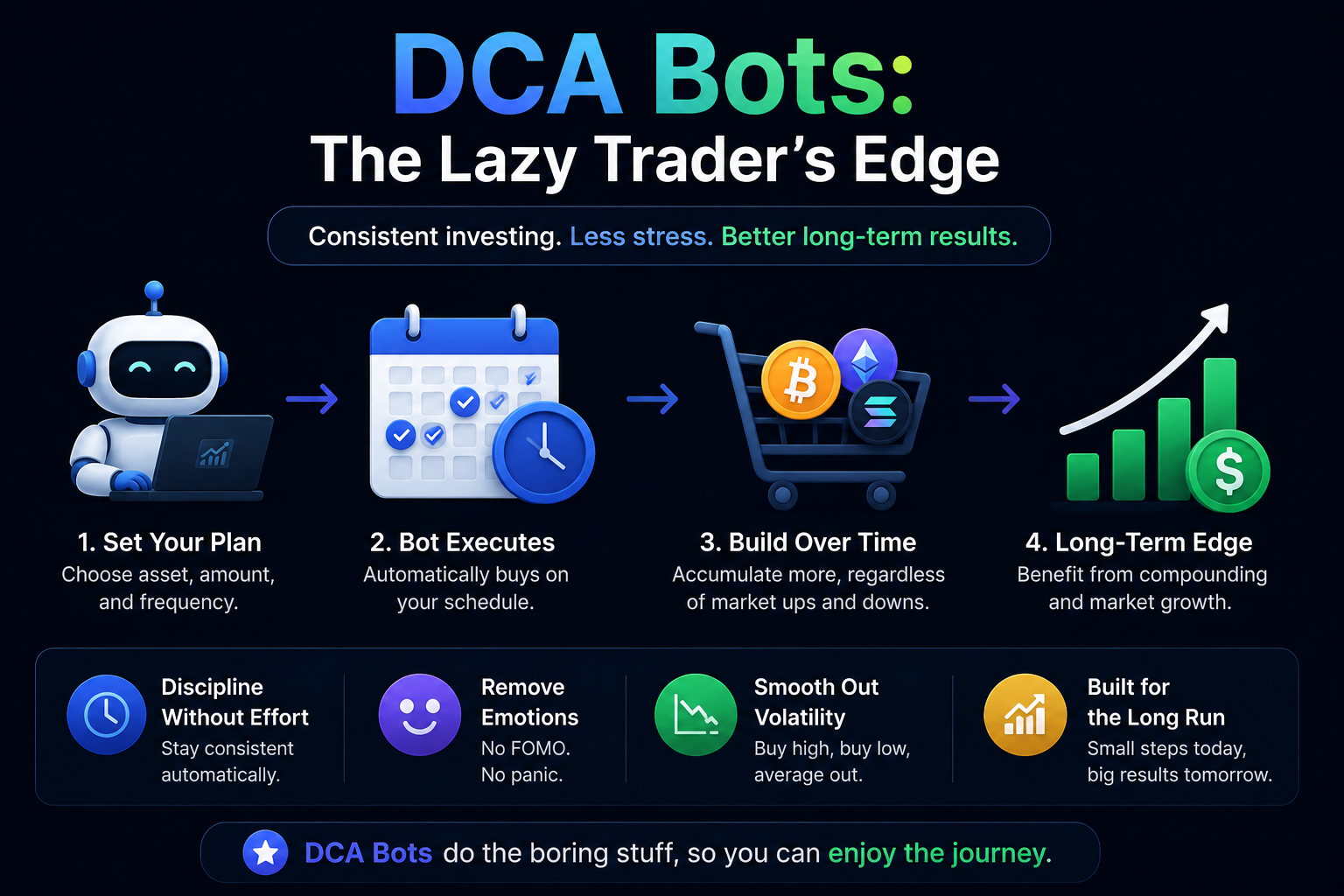
The best trade I ever made wasn’t a trade. It was a £50 weekly recurring buy on BTC I set up in 2020 and forgot about for nearly two years. When I finally checked, I had a position worth more than three months of my salary at the time. No charts, no leverage, no Twitter scrolling. Just £50 a week buying whatever Bitcoin was that morning. That’s DCA. And BitGet has a free bot that does this for you with two clicks.
This is the post that walks through how to set up the BitGet DCA bot, what frequency to pick, which pairs make sense (spoiler: not many), and the tax thing nobody tells you about.
Short answer: BitGet’s DCA bot automates recurring buys of a chosen pair on a chosen frequency, using a chosen amount per buy. The right setup for most people is weekly buys of BTC/USDT at an amount that’s 1-3% of your monthly income, with ETH/USDT as a secondary smaller allocation if at all. It’s the boring strategy that quietly outperforms most active trading over long enough timeframes.
See the active bot I run alongside DCA → (affiliate)
Key takeaways
- BitGet’s DCA bot is free, automates recurring spot buys, and works on any listed pair.
- The boring, correct setup is weekly BTC/USDT buys at 1-3% of monthly income, ETH/USDT optionally as a secondary.
- DCA is the only crypto strategy with multi-decade academic backing across asset classes.
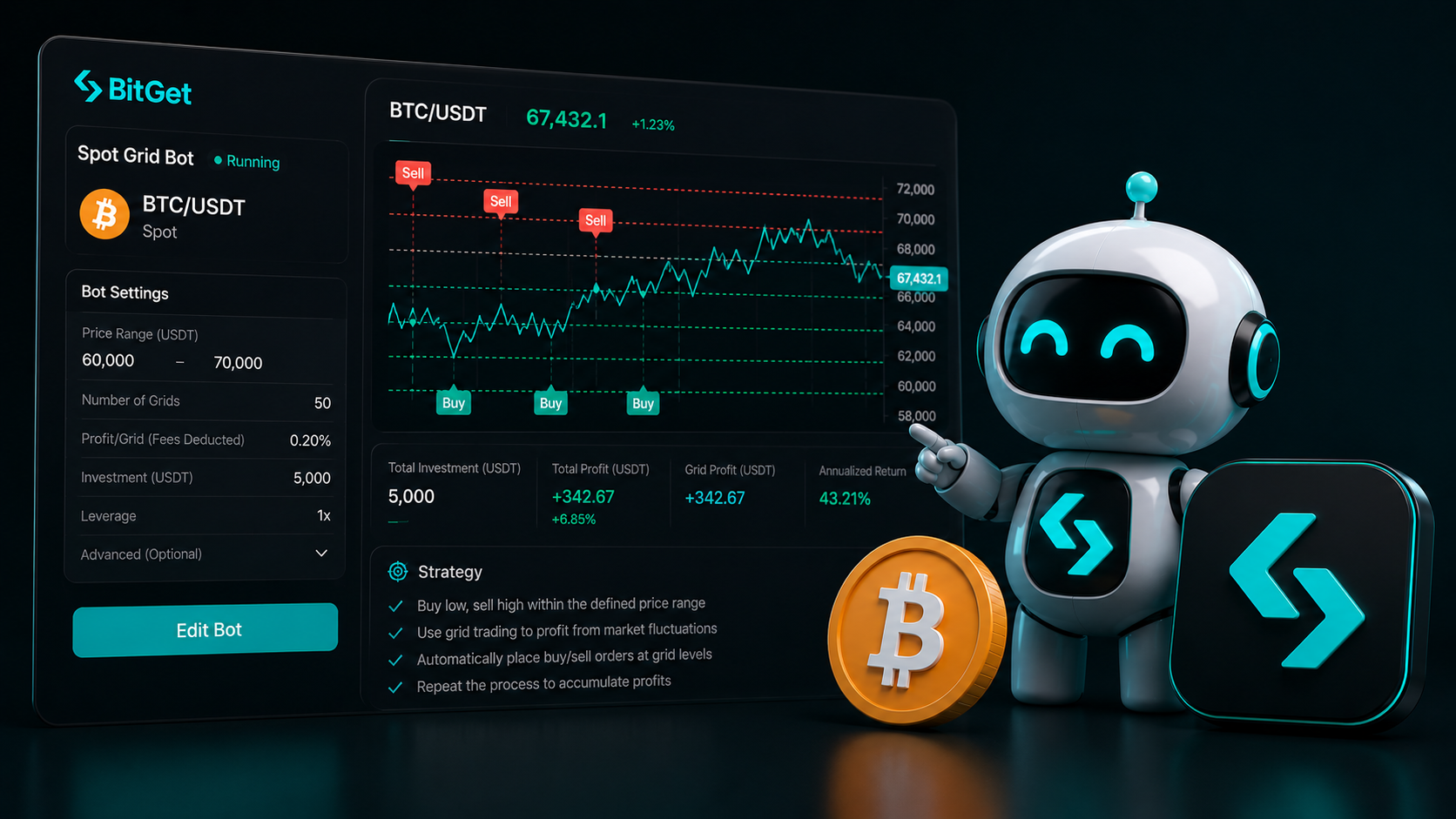
- The DCA bot pairs well with a grid bot — DCA accumulates the position, the grid trades the chop around it.
- Every buy is a separate tax lot. Tracking software is required if you DCA for any meaningful period.
What the BitGet DCA bot does (recurring buys)
The mechanics in plain English.
Recurring market buys
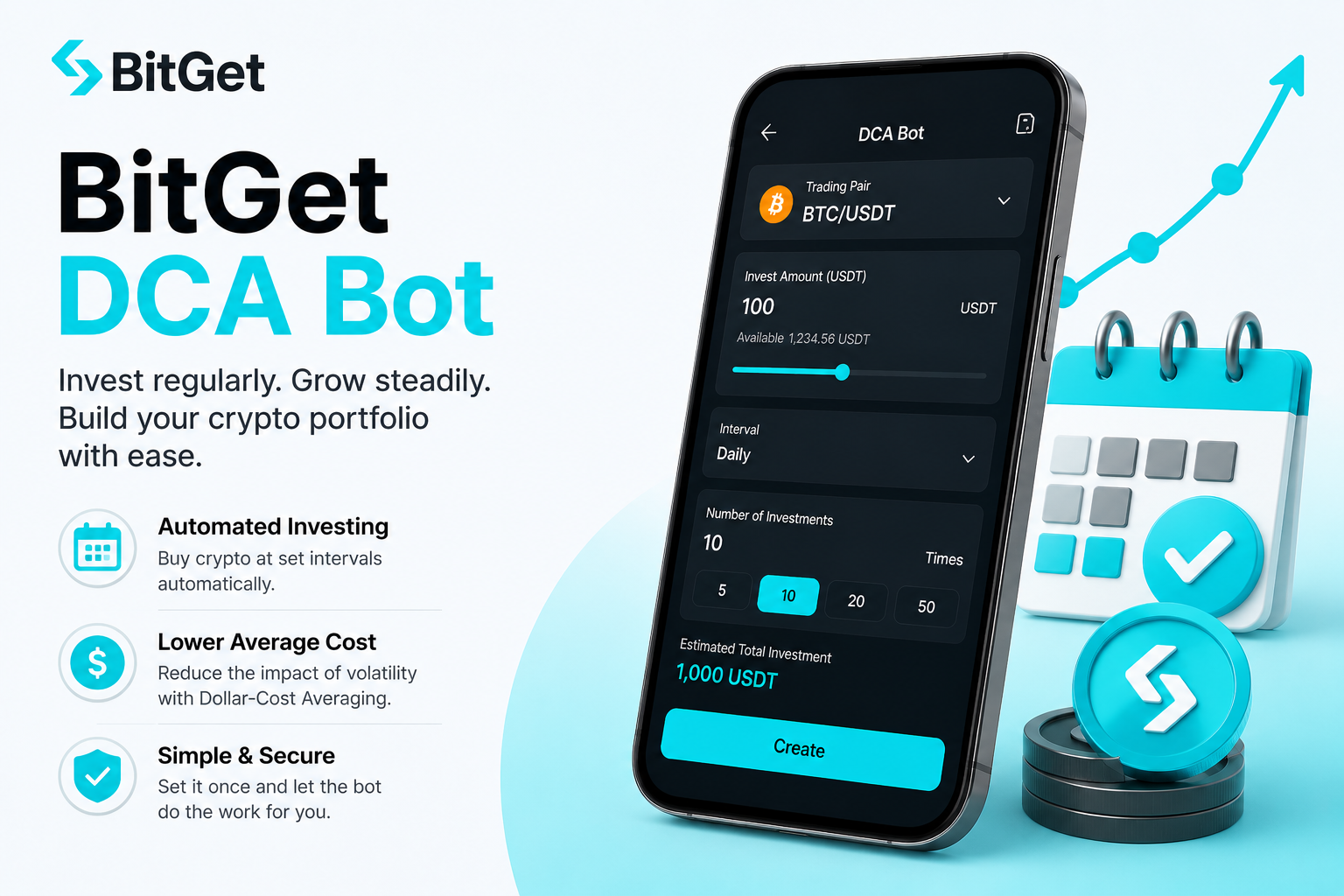
You pick a pair (e.g. BTC/USDT). You pick a frequency (daily, weekly, monthly). You pick an amount per buy (e.g. $50). The bot places a market buy of that amount at the scheduled time. Repeats indefinitely until you pause it.
That’s the whole strategy. No signal generation. No range setting. No leverage. Buy a fixed amount on a fixed schedule.
Why it’s called dollar-cost averaging
Dollar-cost averaging refers to buying a fixed dollar amount regardless of price. When the price is high, you get fewer units. When the price is low, you get more units. The average price you pay across many buys converges toward the time-weighted average price of the asset.
This means you’ll never time the bottom perfectly. You’ll also never time the top perfectly. You’ll get the boring average. Which, across most assets across most timeframes, beats active trading by retail traders.
What the bot doesn’t do
The DCA bot doesn’t sell. It only accumulates. If you want a take-profit rule, you implement it manually outside the bot. The bot’s job is buy on schedule and stop when you tell it to.
It also doesn’t try to identify good entry points. The schedule is the schedule. Whether BTC is at $50K or $80K that morning, the bot buys.
How this differs from the broader concept
If you want the general framework on DCA bots across exchanges, the DCA bots guide covers the cross-platform view. This post is specifically about the BitGet implementation — quirks, fees, fund handling.
BitGet DCA bot vs the general DCA concept
The platform-specific bits.
What BitGet’s bot has
- Multiple frequency options (daily, weekly, monthly, custom)
- Multiple pair selection (any BitGet spot pair)
- Amount adjustment without resetting the schedule
- Pause and resume without losing the schedule
- Trade history exportable as CSV
- No fee beyond the standard 0.10% spot fee
What BitGet’s bot doesn’t have
- No dynamic sizing based on volatility (some third-party DCA bots adjust the amount when price drops)
- No automatic take-profit
- No portfolio-level DCA (you set one pair at a time)
- No funding from a specific spot wallet — pulls from your USDT balance
Where this matters
For most people the BitGet implementation is enough. The dynamic-sizing feature in third-party bots sounds smart but academic evidence on its actual benefit over flat DCA is thin. Flat DCA wins on simplicity.
If you want to DCA into multiple pairs, you create multiple bot instances. Each runs independently.
Why I use BitGet’s bot specifically
Three reasons:
- It’s free
- It runs on the same exchange where I trade actively, so capital management is simpler
- It pairs cleanly with my BitGet spot grid bot on the same account
For wider exchange-side context, are crypto bots profitable covers when DCA bots outperform active trading.
Setting it up (step-by-step)
The actual click-by-click.
Step 1: open or fund your BitGet account
If you don’t have an account, sign up here (affiliate). KYC usually clears same-day. Fund USDT to your spot wallet — DCA buys pull from spot USDT.
You can fund via card, bank transfer, or P2P. The BitGet on-ramp post covers each method.
Step 2: navigate to the DCA bot
Trading Bots > Auto-Invest (or DCA, depending on app version). Click Create New Plan.
Step 3: pick the pair
The pair you’ll be accumulating. For most people: BTC/USDT. The pair appears in the dropdown — you’re buying BTC using USDT.
Step 4: pick the frequency
Daily, weekly, monthly, or custom. Most people should pick weekly. Reasons in the next section.
Step 5: pick the amount
The amount of USDT per buy. Make this a meaningful percentage of your savings rate but small enough to be sustainable. 1-3% of monthly income is my default.
If your income is £3K/month, that’s £30-£90 per month allocated. Spread weekly, that’s £7.50-£22.50 per week.
Step 6: pick the start time
The clock time the buy executes. I pick a time when I’m typically not watching markets — that removes the temptation to second-guess. 09:00 GMT works for me.
Step 7: enable and confirm
Review the parameters one more time. Confirm. The bot is live and the first buy will execute at the next scheduled time.
Step 8: set the funding rule
Make sure your USDT spot balance has enough to cover at least 4-8 weeks of buys. If the balance hits zero, the bot pauses (it doesn’t sell other assets to keep going). Top up monthly or quarterly.
Pair DCA with a grid bot
My BTC/USDT spot grid trades the chop around your DCA position. The two strategies stack cleanly on the same pair.
Affiliate link.
Frequency decision (daily vs weekly vs monthly)
The right answer is almost always weekly.
Daily
Pros: smooths volatility maximally, removes any timing risk
Cons: more transactions to track for tax, more visible in your activity log, more friction with monthly funding cadence
If you have a daily income (rare for most readers) or are deploying very large amounts, daily can make sense.
Weekly
Pros: balances tax simplicity against volatility smoothing, aligns with most income cadences, easy to mentally track
Cons: small theoretical underperformance vs daily during sharp short-term volatility
This is my default for almost everyone. 52 transactions per year is manageable. The smoothing is sufficient. Weekly works.
Monthly
Pros: minimal tax complexity (12 transactions/year), aligns with monthly paychecks
Cons: more timing risk — if your monthly buy hits at a local high, you’ve concentrated in a bad week
If you really hate tracking lots, monthly is acceptable. Mathematically slightly worse than weekly across most periods.
Custom
Custom lets you pick days. I see people use this for buying on dips (custom day = whenever I want). But that’s not DCA anymore — it’s active timing, which is the thing DCA exists to avoid.
If you want to actively buy dips, just trade manually. The DCA bot exists for people who want to remove active decisions.
The vast majority answer
Weekly buys of a fixed amount. Done.
Pairs that make sense for DCA (BTC + maybe ETH only)
The unpopular take.
BTC/USDT is the answer
Bitcoin has 15+ years of price history, the deepest liquidity, the highest market cap, the most institutional adoption. DCA into BTC has the strongest empirical case across crypto.
If you only DCA one pair forever, make it BTC.
ETH/USDT is the secondary
Ethereum has 9+ years of history, second-deepest liquidity, the most active smart contract ecosystem. DCA into ETH has a reasonable case, though more uncertain than BTC.
A typical split if you want both: 70-80% BTC, 20-30% ETH. Two separate DCA bots running in parallel.
Why I don’t DCA alts
The historical track record of DCA on altcoins is brutal. Most altcoins that existed five years ago are dead, dying, or down 80%+ from their previous peaks. DCA into a dying asset is the worst possible outcome — you keep buying as it falls, ending with a large position in something with no future.
According to CoinGecko’s market data, of the top 100 altcoins from 2018, fewer than half remained in the top 200 by 2023. The survivor rate among DCA candidates is too low to justify the strategy on alts.
If you want exposure to alts, buy them tactically with conviction and a thesis. Don’t DCA. The risk profile is wrong.
Stablecoin pairs don’t make sense
USDC/USDT and similar don’t move enough for DCA to do anything useful. The whole point of DCA is averaging across price movement. No movement, no averaging.
What about top-10 alts like SOL or XRP?
Higher-conviction case than long-tail alts. Still worse than BTC and ETH for long-term DCA. If you want some exposure, a small allocation (5-10% of your DCA budget) is defensible. I personally don’t bother.
For the broader exchange-pair context, the BitGet spot trading guide covers pair selection more generally.
Position sizing rule
How much per buy.
The 1-3% of monthly income rule
DCA amount per month = 1-3% of your gross monthly income.
At 1%, you’re building exposure slowly. At 3%, you’re materially compounding crypto exposure over time.
If your income is £4K/month, that’s £40-£120/month allocated. Spread weekly, £10-£30/week.
Why not more
Crypto is volatile. A position that’s grown to be a meaningful percentage of your net worth can produce drawdowns that affect your daily life — sleep, mood, decision-making. Sizing the DCA to be a small slice of income keeps the position growing without dominating your psychological state.
When I started, I DCA’d 5% of income. That worked because crypto was a small percentage of my net worth. Once my crypto position became significant, I dropped the DCA rate down to 2%. The position grows from price appreciation more than from new buys.
Why not less
If the DCA amount is too small relative to your wealth, the strategy doesn’t move the needle. £5/week DCA on a £100K crypto holding is psychologically pointless — even a five-year run doesn’t materially change the position.
The DCA rate should be sized so that, over 2-3 years, the cumulative new capital is at least 20-30% of your current crypto holdings. Otherwise it’s not really doing anything.
The pause rule
Pause the DCA when your crypto allocation exceeds your target percentage of net worth. Resume when it falls back below.
My target is 20% of net worth in crypto. When I’m meaningfully above that, I pause DCA. When I’m at or below, the bot runs.
For broader context on crypto position sizing, the passive income crypto post covers the wider allocation framework.
DCA + grid bot combo
The setup I actually run.
The thesis
DCA accumulates the position. The grid bot trades the chop around the position. The two strategies do different jobs and stack cleanly.
DCA wins in long-term uptrends. Grid wins in ranging markets. Between them you have a strategy that performs in both conditions.
The capital split
If I have $10K to deploy as a long-term BTC strategy:
- $5K-$7K in the DCA bot, running weekly buys of $50 per week
- $1K-$2K in the spot grid bot
- $1K-$2K in cold storage (the bag I’m not trading)
The DCA buys flow into spot wallet. From there I periodically move accumulated BTC into cold storage or use it as part of the grid bot capital.
The mechanical flow
- Monday morning: DCA bot buys $50 of BTC at market
- Tuesday-Sunday: grid bot trades around current price, accumulating realised gains
- Monthly: I move excess BTC from spot wallet to cold storage (Ledger)
- Quarterly: I review the grid range and rebalance if needed
This is the boring engine. It compounds. It doesn’t make headlines.
Why both not just one
DCA alone leaves volatility unharvested. Grid alone doesn’t add new capital. Together they cover both gaps — the DCA adds capital at a fixed rate, the grid extracts incremental profit from price movement.
The crypto trading bots guide breaks down which combos work in which conditions.
Fees and slippage on BitGet DCA
The cost of running the bot.
Trading fees
BitGet’s standard spot fee is 0.10% per side (maker and taker). The DCA bot places market orders, so you’re paying the taker fee on each buy.
On a $50 buy, that’s $0.05 in fees. On a $1K monthly DCA budget, that’s about $1/month in fees. Negligible.
If you hold BGB tokens and use them to pay fees, you get a discount (typically 20%). For most DCA users this doesn’t justify holding BGB just for the discount. If you’re already an active trader using BGB, you’ll benefit on DCA too.
The BitGet trading fees post covers the fee structure across tiers.
Slippage
Market buys execute at whatever price is available at the moment. On BTC/USDT with deep liquidity, slippage on small orders is minimal — usually under 0.01%.
On smaller pairs, slippage can be higher. Another reason DCA on majors only.
Hidden costs
No subscription fee. No bot rental fee. No deposit fee on internal funds (deposits via bank may have payment processor fees — separate from BitGet).
The economics are clean. 0.10% per buy and nothing else.
Cost vs benefit
If your DCA earns 8% annualised vs 0% from sitting in cash, and the fees are 0.10% per buy at weekly cadence, your annual fee drag is 5.2%/year × 0.10% = 0.052% of the position. Effectively zero on long enough timeframes.
Tax: each DCA buy is a separate lot
The thing nobody warns you about.
The basic problem
In most jurisdictions (UK, US, EU, Australia, Canada), every crypto purchase creates a separate tax lot. When you sell some BTC, you need to know which lot you’re selling from to calculate the gain.
Weekly DCA for a year = 52 separate lots. Multi-year DCA = hundreds of lots.
What this means in practice
When you eventually sell, you need to specify (or your software needs to specify) the lots being disposed of. FIFO, LIFO, average cost, or specific identification — each rule changes your tax bill.
In the UK specifically, HMRC’s same-day and 30-day matching rules add complexity. Crypto tax software handles this — manual tracking is impractical past about 20 lots.
The tooling
Export your trade history from BitGet (Reports > Trade History > Download CSV). Import into Koinly, CoinTracker, Cointracking, or your country’s equivalent. The software handles the lot matching automatically.
I do this annually for tax filing. The first import takes 30 minutes. Subsequent imports take 5 minutes.
What this costs
Most tax software is £40-£200/year depending on transaction volume. The cost is trivial compared to the time saved.
The “I’ll never sell” cop-out
People say “I’ll just never sell so tax doesn’t matter.” Three problems:
- You eventually will sell (everyone does)
- Spending crypto on goods is a taxable disposal in most jurisdictions
- Inheritance and other life events are taxable disposals
Plan for tax from day one. Don’t be surprised in year five.
For the wider regulatory context, HMRC’s crypto guidance (UK) or IRS crypto guidance (US) are starting points.
When DCA fails (no income, paycheck timing matters)
The honest limits.
When you have no spare income
DCA only works if the capital comes from new income or actual surplus. Selling other assets to fund DCA doesn’t work — you’re just moving allocation, not building exposure.
If your income only just covers expenses, DCA is the wrong strategy. Save until you have surplus. Then DCA.
When paycheck timing creates accidental concentration
If your salary lands on the 28th of every month and your DCA buys execute on the 1st, you’re consistently buying right after your account refills. Over time this can correlate with month-end market patterns.
This is a minor effect but real. The mitigation: pick a DCA day that doesn’t align with your salary day. Weekly DCA on Wednesdays, for example, breaks the pattern.
When you keep pausing and resuming
The whole point of DCA is the discipline of buying regardless of conditions. If you pause every time price drops because you think it’ll go lower, you’re not running DCA — you’re trying to time the bottom.
Pausing on rules (e.g. allocation cap) is fine. Pausing on emotions defeats the strategy.
When DCA replaces, rather than supplements, an emergency fund
Crypto is volatile. Your DCA should be on top of cash savings, not instead of them. If the bot has accumulated your entire savings and you suddenly need £2K for a car repair, you’re selling crypto at whatever the current price is — possibly at a loss.
Keep 3-6 months expenses in cash first. Then DCA crypto on the surplus.
When the asset has a structural decline
DCA works on assets that trend up over long periods. If you DCA into something that’s structurally declining (a failing altcoin, an obsolete asset), you keep buying as the price falls toward zero. DCA doesn’t save you from a bad asset selection.
This is the strongest argument for DCAing only BTC and maybe ETH. Their structural cases for long-term price appreciation are the strongest in crypto. Most alts don’t have the same case.
Frequently asked questions
Is the BitGet DCA bot free?
Yes. No subscription or rental fee. You pay only the standard 0.10% spot trading fee on each buy.
What’s the minimum amount per buy?
BitGet’s minimum order size on BTC/USDT is typically around 0.0001 BTC, which at current prices is around $6-$8. So your DCA buy needs to be at least that much. Most pairs have similar low minimums.
Can I DCA into multiple pairs simultaneously?
Yes. Create a separate DCA bot instance for each pair. They run independently.
Will the bot stop if my USDT balance runs out?
Yes. The bot pauses if there’s insufficient USDT. It doesn’t sell other assets to keep buying. Top up your spot USDT balance monthly or quarterly.
Can I change the amount or frequency after starting?
Yes. Edit the bot settings without resetting. The next scheduled buy uses the new parameters.
Is the DCA bot the same as auto-invest?
On BitGet, yes. The names are used interchangeably depending on app version. Same product.
Does the bot work during exchange maintenance?
If BitGet has scheduled maintenance during your DCA window, the buy is delayed until trading resumes. The bot doesn’t skip buys.
Can I DCA on the mobile app?
Yes. Same DCA bot interface as the web version. The BitGet app walkthrough covers the bot section.
My honest take
The DCA bot is the strategy I’d recommend to my mum. It’s boring, free, requires nothing from you once set up, and beats most active trading by retail traders across long enough timeframes.
If you only do one thing on BitGet, set up a weekly BTC/USDT DCA at 1-3% of your monthly income, fund the USDT balance once a quarter, and don’t touch it. Five years later, look at the position.
If you want to add a tactical layer, run my BTC/USDT spot grid bot on a slice of capital alongside. The grid trades the chop around the position the DCA is accumulating.
If you want to actually learn to trade beyond DCA — entries, exits, risk management — Trade Travel Chill is the community I’m part of. Trade Travel Chill is here (affiliate). It’s the structured education I’d point you at if you want to go past DCA.
Most people never need to go past DCA. That’s the honest truth.
Right — over to you.
Add the grid bot on top of DCA
My BTC/USDT spot grid runs alongside DCA on the same pair. The DCA accumulates, the grid harvests the chop.
Affiliate link. I may earn a commission at no extra cost to you.
Related posts
- DCA Bots Guide — Cross-Platform View
- BitGet BTC/USDT Spot Trading Bot
- How to Buy Bitcoin — Step by Step