If you’ve been on any crypto exchange for more than five minutes, you’ve seen “USDT” everywhere. It’s the quote currency in 90% of trading pairs. It’s the default settlement token between exchanges. It’s the thing nearly every trader holds when they want to sit out a market move. It’s also one of the most controversial assets in crypto history. Six years of trading, I’ve held a lot of USDT and never lost a cent of peg value. I’ve also read the lawsuits, the settlements, and the investigative reporting. Here’s the honest picture.
Short answer: USDT (Tether) is the largest stablecoin in crypto, designed to trade 1:1 with the US dollar. It’s issued by Tether Limited and backed by reserves that include US Treasury bills, cash, Bitcoin, gold, and secured loans. With a market cap of around $120 billion-plus and daily volume above $50 billion, USDT is the default trading and settlement token across centralised exchanges. It’s not without risk — but it has held its peg through every major crypto crisis since 2014.
Buy USDT on BitGet → (referral link)
Key takeaways
- USDT is the third-largest crypto by market cap behind Bitcoin and Ethereum — around $120 billion-plus in circulation.
- It is issued by Tether Limited, a private company headquartered in the British Virgin Islands, operationally connected to the Bitfinex exchange.
- Reserves include short-duration US Treasury bills (~65%), cash, BTC, gold, secured loans, and other assets — verified by quarterly BDO attestation.
- USDT exists on more than ten blockchains. TRC-20 (Tron) is the cheapest at roughly 1 USDT per transfer.
- Daily volume regularly exceeds $50 billion, more than any other crypto including Bitcoin — driven by exchange-to-exchange transfers and trading pair quotes.
What USDT actually is
USDT is short for “US Dollar Tether”. It is a cryptocurrency designed to maintain a 1:1 peg with the US dollar. One USDT is meant to be redeemable for one US dollar at any time through the issuer.
In practice, almost nobody redeems USDT directly. Most people buy and sell USDT on exchanges, where the market price hovers between $0.999 and $1.001 most of the time. The redemption mechanism exists in the background as a backstop — when the price drifts too far from $1, arbitrageurs step in, buy USDT below $1, redeem at $1 with Tether Limited, and pocket the difference. That arbitrage activity is what keeps the peg tight.
USDT is what’s called a fiat-backed stablecoin. The issuer (Tether Limited) holds reserves designed to back every USDT in circulation. Compare that to algorithmic stablecoins like the now-collapsed UST, which tried to maintain a peg through code and market incentives without holding reserves. USDT’s design is more conservative. It’s also more dependent on the issuer being honest about what’s in the vault.
USDT launched in 2014, originally on a protocol called Mastercoin built on top of Bitcoin. It has since expanded to more than a dozen blockchains. The brand has become so synonymous with “stablecoin” in retail crypto that many traders use the terms interchangeably.
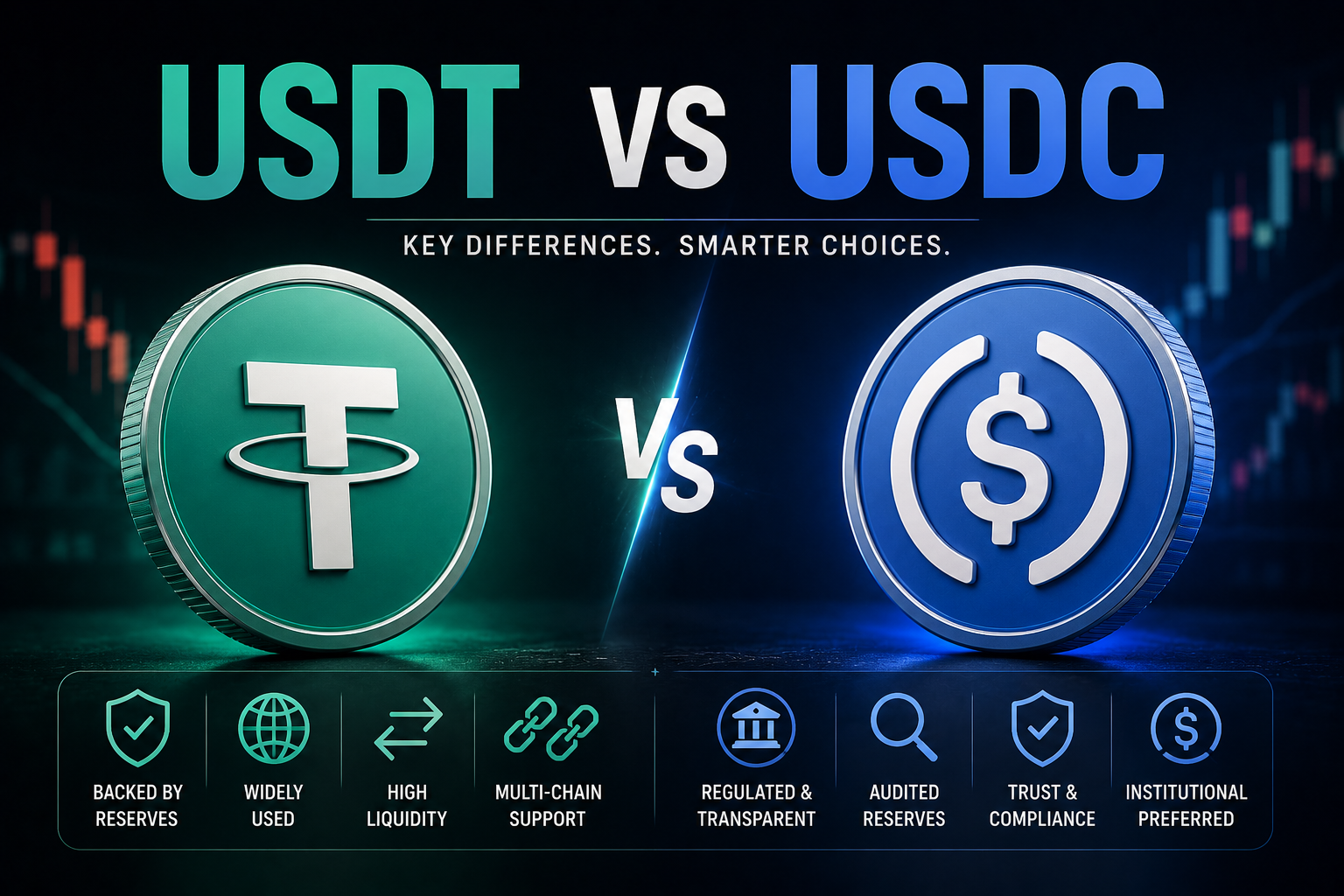
If you want the broader comparison with the second-biggest stablecoin, the USDT vs USDC post covers the head-to-head.
Who issues Tether
USDT is issued by Tether Limited, a company headquartered in the British Virgin Islands. Tether Limited is part of the iFinex group — the same parent company that owns and operates the Bitfinex cryptocurrency exchange.
That Bitfinex-Tether relationship has been the source of most of the controversy around USDT for the past decade. The two companies share executives, ownership, and (historically) banking arrangements. Investigations have repeatedly probed whether USDT issuance has been used to support Bitfinex operations or manipulate crypto markets.
The CEO of Tether is Paolo Ardoino, an Italian software engineer who took over from Jean-Louis van der Velde in 2024. The CTO role has been a key Tether position for years, with Ardoino holding it before stepping up to CEO.
Tether Limited is a private company. It does not file public financial statements the way a public company does. Its disclosures are limited to the quarterly attestation reports it commissions from BDO Italia, plus occasional press releases about issuance, redemptions, and reserve composition. You can see the Tether transparency dashboard for the current public data.
By contrast, Circle (which issues USDC) is publicly listed on the New York Stock Exchange. That structural difference is one of the main arguments USDC holders make for preferring USDC.
How USDT maintains its peg
The peg mechanism is straightforward in principle and surprisingly robust in practice.
Issuer redemption
Tether Limited will redeem USDT for US dollars at $1.00, subject to KYC and minimum thresholds. This isn’t open to retail — the minimum redemption is $100,000 and you need to be a verified Tether account holder. But it doesn’t need to be open to retail. As long as professional arbitrageurs can redeem, the peg holds.
When USDT trades below $1 on exchanges, professional traders buy it at the discount, transfer to Tether, redeem at $1, and pocket the spread. This arbitrage drags the market price back to $1. The reverse works when USDT trades above $1 — traders deposit $1, mint USDT, sell at the premium.
The mechanism works because Tether has the operational capacity and the reserve liquidity to process redemptions at scale. In May 2022 during the Terra collapse, Tether processed over $10 billion in redemptions in a week without breaking. That was the largest stress test the peg has ever faced. It held.
Market liquidity
Beyond formal redemption, the depth of USDT’s market makes the peg self-reinforcing. With $50 billion in daily volume, the order book is deep enough that retail-sized trades don’t move the price. Even institutional flows have to be patient to fill at peg.
The risk
The peg breaks if redemption stops working. If Tether’s banking partners cut them off, if a regulator freezes their accounts, or if the reserves turn out not to match the float — the redemption mechanism falters and the market price moves accordingly. This is the structural risk of holding USDT.
The mitigation Tether has put in place over the past few years is to hold reserves primarily in liquid US Treasury bills, which are easily convertible to cash even in stressed conditions. As of recent attestations, this gives them a reserve base that could be liquidated in days rather than weeks.
Tether’s reserve composition
This is the most-discussed and most-misunderstood part of the USDT story. Based on Tether’s most recent public attestation reports:
| Asset class | Approximate % of reserves |
|---|---|
| US Treasury bills (direct + repo) | ~65% |
| Cash and bank deposits | ~5–10% |
| Secured loans | ~5–8% |
| Bitcoin | ~3–5% |
| Gold | ~3–5% |
| Other investments | ~5–10% |
The total reserve value has consistently exceeded the total USDT in circulation by $5–10 billion since 2022. That surplus is held as a buffer.
A few things worth knowing about the structure:
US Treasury bills. This is the bulk of reserves and the safest part. T-bills mature in 1 year or less, are backed by the US government, and are the most liquid debt instrument in the world. Tether holds them either directly or through reverse repurchase agreements with major banks.
Cash. Held at regulated banks in various jurisdictions. Spread across multiple institutions to reduce concentration risk.
Secured loans. Loans Tether makes to third parties, secured by collateral. The composition of these has shifted over time — Tether announced in 2022 it would gradually reduce its secured loan book. The criticism here is that the disclosures don’t name the counterparties or describe the collateral in granular detail.
Bitcoin. Tether began allocating a portion of reserves to BTC starting in 2023. The rationale is to back USDT with a scarce asset that may appreciate over time. The criticism is that BTC is volatile — if its price falls 50%, that portion of reserves shrinks too, potentially creating undercollateralisation.
Gold. Held in vaults. Less liquid than T-bills but less volatile than BTC.
Other. Money market funds, corporate bonds, and minor positions.
The criticism that won’t go away is that this is an attestation, not a full audit. The auditor (BDO Italia) confirms the assets exist at a point in time. A full audit would examine processes, control environment, and related-party transactions in detail. No Big Four firm has done a full audit of Tether. BDO is a top-six firm and the work is credible, but it’s not the same as a PCAOB-grade audit of a public company.
If reserve quality is the most important factor for you, USDC’s reserve mix is simpler and more transparent. The USDT vs USDC comparison covers that in detail.
The 2017–2021 reserve controversy
Tether’s reputation took years of damage from a sequence of investigations and disclosures between 2017 and 2021. Here’s the short version, with sources.
2017 — banking issues and “Tether print” memes
In 2017, Tether’s banking relationships came under strain. Wells Fargo cut ties. Bitfinex moved to smaller Caribbean banks. Researchers including the University of Texas published a paper arguing that Tether issuance was being used to manipulate Bitcoin’s price during the 2017 bull run. The paper’s conclusions have been disputed by Tether but the question shaped public perception of USDT for years.
2019 — New York Attorney General investigation
The New York Attorney General opened an investigation into Bitfinex and Tether, alleging that Bitfinex had used Tether reserves to cover up an $850 million loss from a payment processor (Crypto Capital Corp.). The case revealed that Tether had not been fully backed during portions of 2017–2018. Reuters covered the case.
2021 — NYAG settlement
In February 2021, Tether and Bitfinex settled with the NYAG. They paid $18.5 million in penalties and agreed to provide quarterly reserve disclosures and stop serving New York residents. As part of the settlement, Tether did not admit wrongdoing but committed to ongoing transparency.
2021 — CFTC settlement
In October 2021, the US Commodity Futures Trading Commission fined Tether $41 million for making misleading statements between 2016 and 2018 about whether USDT was fully backed by US dollars. The CFTC found that during portions of the period, Tether held a mix of assets that included unsecured receivables — not the “always 100% cash” claim Tether had made publicly. Bitfinex was fined $1.5 million as part of the same settlement. The CFTC press release has the full details.
What this means today
The settlements are public record. They cover specific historical periods (2016–2018 mostly) and were resolved with fines and disclosure commitments. Tether has not faced enforcement action since for similar issues. The quarterly attestation regime that started after the NYAG settlement is the current disclosure framework.
The honest read: USDT had real reserve problems during 2016–2018, was investigated and fined for misleading disclosures, and has since restructured to address most of the concerns. The reserve mix in 2026 is meaningfully different from 2017. Whether you trust the current disclosures depends on how you weigh the past against the present.
I hold USDT and I sleep fine. I also don’t hold large balances I can’t afford to lose. The rotation rule applies here as much as anywhere else.
The 2021 CFTC settlement — what it really said
It’s worth a closer look at the CFTC settlement because it’s the most cited and most misunderstood event in Tether’s history.
The CFTC found, based on Tether’s own records, that during certain periods between 2016 and 2018:
- Tether did not have sufficient US dollar reserves in a 1:1 ratio with the USDT in circulation.
- Tether held cash for less than 28% of the days during a 26-month sample period at the level it claimed.
- The reserves included unsecured loans to affiliated entities and not just bank deposits.
The CFTC ordered Tether to pay $41 million and to keep records of its reserves and make them available. Tether neither admitted nor denied the findings — standard for CFTC settlements.
What the settlement didn’t say:
- It did not find that USDT was unbacked. The CFTC findings were about the quality and composition of backing, not the existence of backing.
- It did not find ongoing fraud at the time of settlement. The findings covered historical conduct.
- It did not result in criminal charges. The CFTC is a civil regulator.
The takeaway: Tether had a real and demonstrated reserve quality problem in 2016–2018. They paid a fine, restructured the reserve composition, and moved to quarterly attestations. That’s the current state.
If that history makes you uncomfortable, USDC is the alternative that addresses most of those concerns by design. If it doesn’t bother you and you value the deeper liquidity of USDT, you’re in the same camp as most active crypto traders.
USDT chains — TRC-20 vs ERC-20 vs others
USDT exists on more chains than any other stablecoin. The big three for retail use:
TRC-20 (Tron)
The cheapest network for USDT transfers. About 1 USDT per transaction, sub-5-second confirmations. This is the default for cross-exchange transfers in 2026.
Tron is a high-throughput, low-fee blockchain founded by Justin Sun. It has been criticised for centralisation, but for the narrow purpose of moving USDT cheaply between exchanges, it works exceptionally well. Most centralised exchanges support TRC-20 deposits and withdrawals.
If you want the full picture on Tron itself, the how to buy Tron guide covers the network.
ERC-20 (Ethereum)
The original home of USDT after Mastercoin. Most secure, most DeFi support, most expensive. Gas fees swing from $2 to $30 depending on network congestion.
ERC-20 USDT is the default for any DeFi interaction — Aave, Compound, Curve, Uniswap, etc. If you’re using USDT in DeFi, you’re using ERC-20 (or one of the L2 versions).
Solana
Fast and cheap. Sub-cent fees, 1–2 second confirmations. Solana USDT has grown rapidly as Solana’s overall ecosystem has scaled.
BNB Smart Chain (BEP-20)
Cheap and fast. ~$0.20 per transaction. Heavy use on BSC-native DeFi (PancakeSwap, Venus).
Others
USDT also exists on Polygon, Avalanche, Arbitrum, Optimism, Aptos, Sui, Algorand, Tezos, EOS, and others. For each new chain, the question is whether liquidity is deep enough to be useful. For most retail traders the answer is: stick to TRC-20 and ERC-20 unless you have a specific reason to use another.
Picking the right chain
The rule I follow: always send on the cheapest chain that both ends support. If both exchanges support TRC-20, use TRC-20. If one only supports ERC-20, you’re paying gas. Always double-check the destination address format matches the network before clicking send.
The BitGet withdrawals post covers the network selection step on BitGet specifically.
How to buy USDT on BitGet
The path is short. Here it is end to end.
- Open a BitGet account. Sign-up link (referral). Email, password, six-digit verification.
- Enable 2FA. Google Authenticator or Authy. Don’t use SMS.
- Complete KYC. Passport or driver’s licence plus selfie. Usually clears within hours.
- Fund the account. Three options:
– Crypto deposit (free) — send BTC, ETH, or any other supported asset from another wallet.
– Card on-ramp (1–3% fee) — buy USDT directly with a Visa/Mastercard. The BitGet on-ramp post walks this through.
– P2P (cheapest) — buy from another user with bank transfer in your local currency. The BitGet P2P post covers the process. - Hold USDT or earn yield. Once you have USDT in your spot wallet, you can either trade with it, withdraw it to your own wallet, or deposit it into BitGet Earn for yield.
If you already hold BTC or ETH and want to swap to USDT, BitGet Convert offers fee-free swaps (with a small spread baked into the rate). Spot trading offers tighter pricing if you’re moving size.
How to earn yield on USDT
This is where USDT becomes useful beyond just sitting in dollars.
BitGet flexible savings
The default option. Deposit USDT, earn ~2–4% APY, withdraw any time. Interest accrues daily and pays out daily. Detailed walkthrough in the BitGet savings post.
BitGet fixed savings
Lock USDT for 7, 14, 30, or 90 days at a higher rate. Currently 4–8% APY depending on term and promotion. Higher yield, less flexibility.
BitGet Launchpool
Stake USDT (or BGB) to earn newly listed tokens. The yield depends on the token but historically averages 5–15% APY in equivalent value during the lockup. Free tokens for parking USDT. Coverage in the BitGet Earn products post.
DeFi (Aave, Curve)
USDT exists in DeFi but the pools are usually shallower than USDC. Current rates on Aave’s Ethereum market are 3–6% APY. Curve’s tri-pool (DAI/USDC/USDT) offers a different yield profile based on swap volume.
The wider yield landscape is in the yield farming explained post.
Realistic expectations
In a normal market, 3–8% APY on USDT is the achievable range without taking outsized risk. Anything above 15% APY on a multi-week campaign should be scrutinised — the yield has to come from somewhere.
The collapse of Anchor Protocol on Terra in May 2022 was a textbook case of unsustainable yield. They paid 20% APY on UST for over a year. The whole protocol collapsed in 72 hours when the structural subsidy ran out. Read the passive income crypto post for the full breakdown of sustainable vs unsustainable yield.
Want to start earning on USDT?
BitGet Earn supports flexible USDT savings, fixed terms, and Launchpool. Sign-up is fast and KYC usually same-day.
Affiliate link.
USDT as the default trading pair
The reason USDT dominates centralised exchanges is structural. It was the first major stablecoin, it had the deepest liquidity from year one, and every exchange built its plumbing around it.
Pair coverage
On BitGet, more than 800 spot pairs exist. The vast majority are quoted in USDT. If you want to buy SOL/USDT, ATOM/USDT, AVAX/USDT, or basically anything else, the USDT pair is the deepest and tightest.
The same is true on Binance, Bybit, OKX, Kucoin, and every other major non-US exchange. USDT is the default.
Why this matters
When you’re trading actively, the depth of the order book on the USDT pair determines how much you can move without affecting the price. Deeper liquidity means tighter spreads and less slippage. USDT pairs almost always have the deepest liquidity.
If you tried to do the same trading in USDC, you’d often find the USDC pair has a tenth the volume — meaning wider spreads, more slippage, and worse execution. For institutional traders this is a deal-breaker. For retail it’s a small ongoing cost.
What this means for your stable balance
If you trade across multiple altcoins and use multiple exchanges, you almost have to hold USDT. The alternative is constantly converting between USDC and USDT and paying the spread on every conversion.
For my own rotation, USDT is the working capital for trading and USDC is the longer-term parking. Detailed in the USDT vs USDC post.
TTC mention — learning the trade flow
When you’re new, the flow of “fiat in → USDT → altcoin trade → USDT → cash out” feels mechanical and intimidating. After a few months it becomes muscle memory. After a few years it becomes second nature.
If you want to compress that learning curve — instead of fumbling through three bear markets like I did — Trade Travel Chill (affiliate) is the trader community I’m part of. They cover stablecoin rotation, exchange routing, and the practical mechanics of moving money through crypto efficiently. Not free, not a magic bullet, but real signal.
Risks of holding USDT
Honest list. Six years of using this asset, here are the actual things that could hurt you.
Issuer risk
The biggest one. If Tether Limited’s reserves turn out to be insufficient, or if its banking relationships are cut, the redemption mechanism falters. Market price of USDT drops. Holders who can’t redeem face the secondary market.
Mitigation: don’t hold huge balances long-term in any single stablecoin. Rotate. Diversify.
Regulatory risk
USDT has not registered as a federally-authorised stablecoin under the US GENIUS Act and has not sought MiCA issuer authorisation in the EU. Several EU-licensed exchanges have delisted USDT pairs for EU users. Regulatory squeeze in the US could affect Tether’s banking access.
Mitigation: hold a portion of stables in USDC if you’re in a jurisdiction with active stablecoin regulation.
Exchange risk
USDT held on a failing exchange is gone with the exchange. The peg doesn’t matter if the venue doesn’t exist.
Mitigation: don’t store more on any exchange than you can lose. The how to store crypto safely guide covers the self-custody alternatives.
Network risk
USDT on one chain is not the same asset as USDT on another chain — they’re separate token contracts. Sending to the wrong network destroys the funds. Always confirm network compatibility before clicking send.
Mitigation: triple-check the network field. The BitGet withdrawals post covers the safety steps.
Peg risk
USDT has wobbled below peg several times. In May 2022 it traded as low as $0.95 during the Terra collapse. In October 2022 it dipped briefly during FTX. Every time it has recovered, but holders who sold into the panic locked in losses.
Mitigation: have a pre-decided rule for what you do if USDT de-pegs by 5%. Usually the right answer is “do nothing” and wait for recovery.
Self-custody risk
If you hold USDT in your own wallet, you’re responsible for the keys. Lose the seed phrase and you lose the funds. There’s no Tether customer support that can recover it.
Mitigation: hardware wallet, written seed phrase, multiple secure storage locations. The Ledger Nano X review covers the hardware option.
NordVPN note
Most stablecoin losses happen at the account level, not the chain level. Phishing, session hijacking, public WiFi attacks — these are the vectors that actually drain accounts.
I run NordVPN (affiliate) on every device I trade from. A VPN encrypts your traffic, hides your IP, and blocks the easy network-level attacks. Not a magic shield, but one fewer attack surface.
The broader security checklist — 2FA, withdrawal whitelists, cold storage for size — is in the how to store crypto safely guide.
Pros and cons of USDT
| Pros | Cons |
|---|---|
| Largest market cap and deepest liquidity | History of CFTC enforcement (2021 settlement) |
| Cheapest cross-exchange transfers (TRC-20) | Reserves include volatile assets (BTC, gold) |
| Most trading pairs on every CEX | Quarterly attestations, not full audits |
| Multi-chain support unmatched | Delisted on some EU venues under MiCA |
| Held through every major crypto crisis | Issuer is private, not publicly listed |
| Quarterly BDO attestations | Some regulatory uncertainty in US under GENIUS Act |
| Battle-tested through Terra collapse | Reserve disclosures less granular than USDC |
My honest take
I use USDT every day. It’s my working capital for trading on BitGet. It’s the asset I move between exchanges when I want to deploy capital. It’s the quote currency for most of the pairs I touch.
I also don’t keep my long-term savings in USDT. The reserve composition is wider than I’d ideally want, and the regulatory clarity is weaker than USDC. For money I don’t need to move for months, USDC is the better tool.
That split — USDT for active capital, USDC for storage — is what I’d recommend to anyone trading at scale. For absolute beginners, either is fine. The difference between the two is small enough that picking either as your default won’t materially affect your outcomes.
The biggest risk with USDT is not the underlying asset. It’s holding too much of any single stablecoin on a single exchange. Diversify the venues. Don’t store more than you can afford to lose. Rehearse the withdrawal.
That’s how to use USDT without worrying about it.
Ready to start trading?
BitGet is my main exchange for USDT pairs. Sign-up takes 90 seconds.
Affiliate link.
Frequently asked questions
Is USDT safe?
USDT has held its peg through every major crypto crisis since 2014, including the Terra collapse and FTX. Its reserves are predominantly US Treasury bills, with quarterly attestations from BDO. The main risks are issuer-level (Tether Limited’s banking and regulatory standing) rather than reserve-level. It is safer than most altcoins. It is less transparent than USDC.
Is USDT really backed by dollars?
USDT is backed by a mix of assets, not exclusively dollars. Roughly 65% is in US Treasury bills, 5–10% in cash, 5–8% in secured loans, 3–5% in BTC, 3–5% in gold, and the rest in other investments. Total reserve value has exceeded total USDT in circulation since 2022 per quarterly attestation.
Can USDT crash to zero?
In theory yes, if Tether’s reserves were wiped out or seized. In practice the reserves are heavily concentrated in US Treasury bills, which are highly liquid. A USDT collapse would require coordinated failure of the issuer plus inability to access reserves. Historically every wobble has recovered.
What is the cheapest way to send USDT?
USDT on Tron (TRC-20) is the cheapest. About 1 USDT per transaction with sub-5-second confirmation. ERC-20 USDT costs $5–25 in gas depending on Ethereum network congestion.
Can I earn interest on USDT?
Yes. BitGet Earn offers 2–4% APY on flexible USDT savings, higher on fixed terms. DeFi protocols like Aave offer similar rates. The BitGet Earn products post covers the options.
What’s the difference between USDT and USDC?
USDT is larger (~$120B+ vs ~$40B+), has more trading pairs, and offers cheaper TRC-20 transfers. USDC has more transparent reserves, simpler reserve mix (T-bills + cash only), and clearer regulatory standing. Both target $1 peg. Full comparison in USDT vs USDC.
Is Tether under investigation?
Tether settled with the NYAG (2021) and CFTC (2021) for historical disclosure issues. No active US enforcement action is currently public. Various ongoing journalistic investigations continue but have not produced new enforcement.
Why do most exchanges use USDT?
Network effects. USDT was the first major stablecoin and built deepest liquidity first. Every exchange and market maker integrated USDT into their plumbing. Switching costs are real, so USDT remains dominant even as USDC has caught up on quality.
Can I hold USDT on a Ledger?
Yes. Ledger supports USDT on Ethereum, Tron, Solana, Polygon, BNB Smart Chain, and other supported networks. The Ledger Nano X review covers the setup.
What happens if Tether is shut down?
If Tether’s banking relationships were severed and redemptions paused, the secondary market price of USDT would drop sharply. Holders unable to redeem would face the market price. This is the structural risk of holding USDT in size — the mitigation is diversification across stablecoins and venues.
Related posts
- USDT vs USDC: Honest Stablecoin Comparison
- What is USDC? Circle’s Stablecoin Explained
- How to Cash Out Crypto: Withdraw to Bank Account