I copied a human trader once. He blew the account up over a long weekend while I was off-grid in Snowdonia. By the time I got signal back, my equity was down 38% and his profile had been quietly deleted. That’s the day I started paying attention to the other thing BitGet rolled out — Bot Copy Trading. Not a person making decisions on caffeine and conviction. A coded strategy with rules I could read before I subscribed. Different product, different risks, same affiliate flag — I’ll mark every link.
This is the post that breaks down what Bot Copy Trading actually is on BitGet, how the profit-share model works in practice, and whether copying a bot beats copying a human (spoiler: it’s usually a tighter trade, but the catch will eat your compounding).
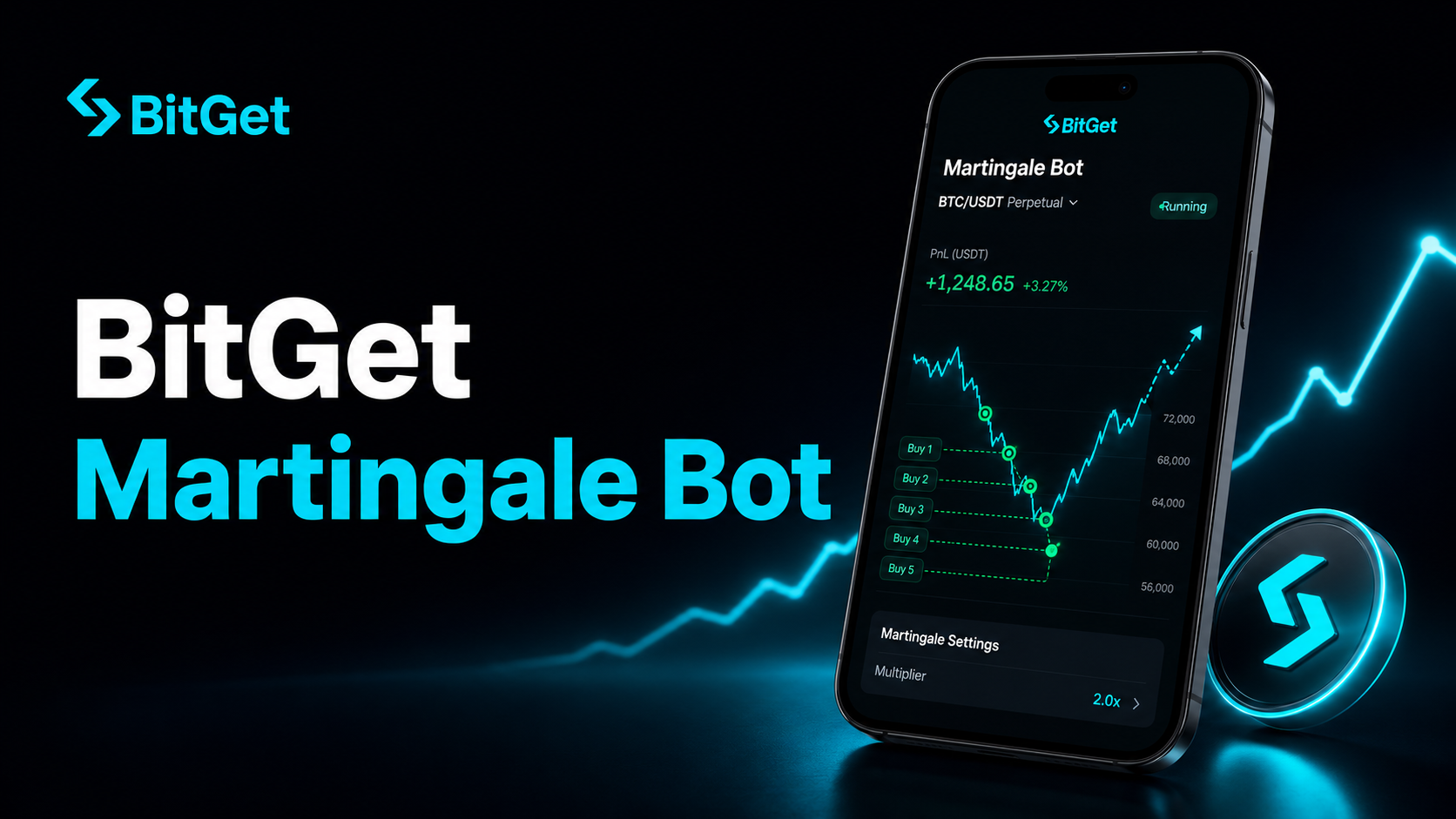
Short answer: BitGet Bot Copy Trading lets you subscribe to a published trading bot — grid, DCA, smart trend, or futures — and the same settings deploy to your account automatically. The bot operator earns a profit share (typically 0-30%, capped) of your realised gains. Realistic returns sit at 0.5-2% per month after fees and the profit share, with some bots posting better in chop and worse in trends. It’s mechanically tighter than human copy trading but the profit share quietly compounds against you over time.
See the bot I run on BTC/USDT → (affiliate)
Key takeaways
- Bot Copy Trading lets you replicate a coded strategy, not a human trader’s discretionary calls.
- Profit share runs 0-30% depending on the operator, deducted only from realised profit, not deposits.
- Elite Bot Trader status on BitGet requires consistent multi-month performance plus minimum AUM thresholds.
- Bot copy outperforms human copy in ranging markets — the bot doesn’t doubt itself or oversleep.
- The profit share quietly eats compounding. Over a year, 20% off the top of every gain is the difference between 18% and 14.4% net.
What bot copy trading actually is (vs traditional copy trading)
BitGet runs two distinct copy products and people confuse them constantly. Worth separating.
Traditional copy trading
You subscribe to a human trader on the BitGet copy trading platform. Every position they open, your account opens proportionally. Every position they close, yours closes. The trader is making discretionary calls — reading the chart, watching news, sometimes guessing. You’re along for the ride.
The upside: a skilled trader can capture moves a bot can’t read. The downside: you’re trusting their judgment, their sleep schedule, and their risk discipline. I’ve watched copy-trading leaderboards where the top trader of the month vanished from the leaderboard the next month, often along with subscribers’ capital.
Bot copy trading
You subscribe to a published bot — a coded strategy with fixed rules. Could be a grid bot, a DCA bot, a smart trend bot, or something more complex. The strategy doesn’t change because the operator had a bad week. The rules in the bot are the same rules executing on your account.
The upside: mechanical, transparent, no overnight blow-ups from emotional decisions. The downside: a bot can’t adapt to conditions it wasn’t designed for. A grid bot in a strong trend underperforms holding. A trend bot in pure chop underperforms a grid.
Why this distinction matters for risk
In traditional copy trading, your risk profile is “whatever the trader does today.” In bot copy trading, your risk profile is “whatever the bot does for the conditions it encounters.” The first is unbounded. The second is bounded by the bot’s design.
I sleep better with the second. That’s not advice — that’s preference. Some people do better trusting a human with a verified track record. Most don’t.
For a wider primer on the trade-off, the copy trading vs bots breakdown goes deeper.
How the profit-share model works (0-30%)
Here’s the part most subscribers don’t actually read before clicking.
What gets shared
The bot operator earns a percentage of your realised profit. Realised profit is gain on a completed round trip — bought at $60K, sold at $61K, realised $1K (minus fees). The profit share is calculated on that realised amount.
Unrealised gains — inventory you’re holding that has gone up but you haven’t sold — don’t trigger the profit share. The operator only earns when the bot closes a position at a gain.
What doesn’t get shared
Your initial deposit. Your principal. Any losses you take. The operator never charges you for losing trades. The model only pays out on wins.
That sounds fair, and it mostly is. The catch (more on this later) is that the profit share quietly compounds against you in good months and gives the operator nothing in bad months. Asymmetric in the operator’s favour.
The 0-30% band
BitGet caps the profit share at 30%. Most published bots set theirs somewhere between 10% and 25%. A small number set it at 0% — usually new operators trying to build a subscriber base before raising the share.
According to publicly available BitGet documentation, the profit share is debited automatically from your account when the bot closes a winning round trip. You don’t see a separate invoice. The realised profit shows up in your account already net of the share.
How often the share is calculated
Every closed round trip. Not weekly or monthly. The moment a buy-sell pair completes at a profit, the operator’s cut comes out and the rest credits to your account. This makes the share mechanically clean but psychologically invisible — you never see the cumulative deduction unless you specifically calculate it.
I check mine quarterly. Most months it’s a few percent of gross profit. Over a year it adds up to a real number.
Want a bot to copy?
My BTC/USDT spot grid is published on BitGet. Same settings I run myself, same range, profit-share capped at BitGet’s standard rate.
Affiliate link.
Elite Bot Trader status — what qualifies a strategist
Not every operator on BitGet can publish a bot. There’s a vetting layer.
The qualification thresholds
According to BitGet’s elite trader programme criteria, a strategist needs:
- Multi-month verified performance on the bot they want to publish
- Minimum AUM (assets under management) on the operator’s own account running the same strategy
- Minimum number of completed trades to demonstrate the strategy isn’t a fluke
- Drawdown history within acceptable bands — strategies with single-event blow-ups don’t get promoted
The exact thresholds shift over time. As of writing, you’ll see Elite Bot Trader badges on operators who’ve run their strategy for at least three months with verified results and meaningful capital deployed.
What the badge doesn’t tell you
The badge means BitGet’s automated checks have cleared the operator. It doesn’t mean the strategy will work next month. It doesn’t mean the operator hasn’t survived purely on favourable market conditions. It doesn’t predict future drawdown.
I treat Elite Bot Trader as a filter to remove obvious bad operators, not a guarantee of good performance. A bot with the badge is still a bot you need to evaluate.
How to verify a strategist independently
Click into the operator’s profile. Look at:
- Total trades executed (a low number means the strategy is undertested)
- Profit-loss curve shape (smooth growth beats spikes followed by drawdowns)
- Maximum drawdown to date (if it’s never had a drawdown, it hasn’t traded in a hostile market)
- Subscriber count and total AUM (lots of subs isn’t proof of quality, but very few is a signal)
- Time since the bot launched (anything under 90 days is too new to judge)
Cross-check the profile against CoinGecko data for the trading pair — if the operator’s claimed performance happened during a period when the pair was unusually favourable to their strategy type, discount accordingly.
Picking a bot to copy (filters that matter)
This is where most people make their decision badly. Here’s the filter stack I’d use.
Filter 1: strategy type matches current market
Match the bot to the market condition you expect.
- Strong sideways chop expected → grid bot
- Slow accumulation, no view on direction → DCA bot
- Defined trend with momentum → smart trend or trend-following bot
- Range-bound with funding pressure → futures grid
A grid bot in a strong directional trend will underperform. A trend bot in pure chop will underperform. Match the tool to the conditions or accept the lag.
For the strategy breakdown, the crypto trading bots guide walks through which bot suits which market.
Filter 2: profit-share level vs track record
A bot with a 25% profit share and 4 months of data is a worse subscription than a bot with a 15% profit share and 12 months of data, all else equal. The longer the verified track record, the more I’m willing to pay in profit share.
A 0% profit share operator is either new (caution) or struggling to attract subscribers (more caution). Free isn’t always cheap.
Filter 3: maximum drawdown tolerance
What’s the worst loss the bot has posted in a single month? If it’s 25%, that’s the loss you need to be psychologically prepared to take. If you’d panic at 10%, this isn’t your bot.
The historical max drawdown is a lower bound on the future max drawdown. The actual future max is probably worse, because the bot hasn’t seen every market condition yet.
Filter 4: pair selection
A bot on BTC/USDT or ETH/USDT is fundamentally lower risk than the same strategy on a small-cap alt. Bigger order books, more liquidity, less slippage. I default to majors for any meaningful capital allocation.
Filter 5: operator behaviour patterns
Look at the operator’s other published bots. If they have 12 published bots all on different pairs, that’s a strategist throwing strategies at the wall to see what sticks. If they have one or two bots that have run for a year, that’s a strategist with conviction.
Conviction is a better signal than variety.
The pick I’d actually make today
If I were starting fresh and picking one bot to subscribe to, I’d take a BTC/USDT spot grid from an operator with 6+ months of verified data, a profit share between 15% and 20%, max drawdown under 15%, and at least 200 active subscribers. That’s a profile I’d put real capital behind.
The BitGet copy traders post goes through the human-side picks. The same filters mostly apply to bots, with the strategy-type filter being the main addition.
Bot Copy Trading vs human copy trading (comparison table)
The cleanest side-by-side I can give you.
| Factor | Bot copy trading | Human copy trading |
|---|---|---|
| Strategy transparency | Coded rules, fully visible | Discretionary, you guess |
| Consistency | Mechanical, no emotion | Variable, depends on operator state |
| Best in | Identifiable market conditions | Markets requiring judgment |
| Worst in | Conditions outside the bot’s design | Operator’s bad weeks |
| Drawdown profile | Bounded by code | Unbounded — full account at risk |
| Operator profit share | 0-30% (capped on BitGet) | 0-15% typical |
| Pause / stop | One click, instant | One click, but their position is open until you close |
| Speed of execution | Sub-second | Limited by operator action speed |
| Adaptability | Zero | High (in skilled hands) |
| Catastrophic risk | Range break + held inventory | Operator blow-up + full liquidation |
Where bot copy wins
Ranging markets, predictable conditions, when you want exposure to a strategy without the operator-risk overlay. Grid and DCA bots in particular fit this profile.
Where human copy wins
Volatile, news-driven markets where reading the chart in real time has actual edge. A good discretionary trader who knows when to step aside outperforms any bot in those windows.
Where both lose
Strong directional trends. Grid bots underperform holding. Most discretionary traders eventually overtrade or oversize during a strong move. The boring answer in a defined trend is just hold spot.
Realistic returns and survivor bias
Time for the uncomfortable conversation.
What the leaderboards show
BitGet’s bot copy leaderboards show top performers posting impressive monthly returns — 5%, 8%, sometimes claiming 15% in a single month. These numbers are real for the operator at the time they were posted.
They’re also subject to massive selection bias.
The survivor bias problem
The bots showing on the leaderboard are the ones that worked recently. The bots that blew up are not on the leaderboard. They’ve been delisted, or they’re buried 80 pages deep where nobody sees them.
If 100 bots launched a year ago and 70 of them are now showing strong returns while 30 quietly failed, the leaderboard tells you the top 10 of the 70. The implied success rate looks like 100%. The actual launch-cohort success rate is more like 30-40% when you account for delisted strategies.
This is the same dynamic that makes hedge fund index returns look better than they actually are — the dead funds drop out of the index. Same problem here.
What I expect from a competent bot subscription
After accounting for survivor bias, fees, and the profit share, my realistic expectation for a well-chosen bot subscription on a major pair is:
- 0.5-2% per month in normal conditions
- Up to 3% in months that perfectly match the bot’s design
- Breakeven to -2% in conditions that work against the bot
- Annualised net return somewhere between 5% and 15% if everything goes well
That’s not nothing. It’s also not the 50% APY the marketing implies. Returns above 30% annualised on a bot are usually either short-term luck or the bot is taking risk you haven’t priced in.
What the Bitwise crypto industry data shows on retail performance
Retail traders as a group underperform buy-and-hold over multi-year periods. A bot subscription with measured risk and disciplined sizing will beat the average retail outcome in most periods. That’s a low bar but it’s the right benchmark.
Risk: the bot doesn’t think for you when conditions change
The biggest gap between bot expectations and reality.
The bot doesn’t know it’s wrong
A grid bot in a strong downtrend will keep buying every rung as price falls. The bot’s design says “this is a sale, accumulate.” The bot doesn’t have context. It doesn’t know the news headline. It doesn’t see the volume profile. It just runs.
If you’re not paying attention, the bot will happily accumulate a large position in a falling asset while showing you small realised gains from the round trips that completed before the trend developed.
The “set and forget” myth
You can’t really set and forget a bot. You need to:
- Check the bot’s status weekly (5 minutes)
- Review the range monthly (15 minutes)
- Pause around major catalysts (FOMC, halving, ETF decisions)
- Reassess if performance deviates meaningfully from the historical band
If you can’t commit even that small amount of attention, the bot isn’t a “passive income” tool — it’s a delayed loss generator.
When the bot’s design doesn’t fit anymore
Market structure changes over multi-year windows. A grid bot tuned to a 70/30 range/trend split will underperform if the market shifts to 50/50. Your bot’s edge isn’t permanent.
I review my bot’s design assumptions every 6 months. If the market has shifted, I redeploy with adjusted parameters or pause until conditions are favourable again.
The catastrophic scenario
The worst-case isn’t the bot losing 10% in a bad month. The worst-case is the bot accumulating inventory at high average price during a slow grind down, then the asset enters a multi-year bear market and the inventory never recovers.
This is the case people don’t price in. It’s also why I never deploy more than 5-8% of trading capital to a single bot, and why I never feed cold storage holdings into a bot.
For broader risk discipline, are crypto bots profitable breaks down the realistic expectations.
Step-by-step: deploying a copied bot
The actual process, start to finish.
Step 1: open or fund a BitGet account
If you don’t already have one, sign up at BitGet (affiliate). KYC is typically same-day. You’ll need to fund USDT to deploy any bot. The BitGet KYC walkthrough covers what documents you need.
Step 2: find a bot to copy
Navigate to Copy Trading > Bot Copy in the BitGet menu. Use the filters to narrow by strategy type, pair, profit share, and historical performance. Apply the filter stack from the section above.
Step 3: review the bot’s details
Click into a bot. Read:
- Strategy description (grid? DCA? trend?)
- Historical performance chart
- Maximum drawdown
- Total trades executed
- Profit share rate
- Operator profile (other bots, AUM, time on platform)
Step 4: decide on allocation
Bot copy trading on BitGet typically has a minimum subscription size around $100-$300 depending on the bot. I’d suggest deploying no more than 5-8% of your trading capital to any single bot, regardless of the minimum.
Step 5: subscribe
Click subscribe, confirm the allocation, agree to the profit share terms. The bot deploys on your account immediately.
Step 6: monitor for the first week
Check the bot daily for the first week. Make sure orders are filling, the range is sensible, and the realised profit is tracking expectations. After a week of confirmation, drop to weekly checks.
Step 7: unsubscribe protocol
If you decide to unsubscribe, the bot stops trading and any open inventory remains in your account. You then decide whether to manually close the inventory or hold it. This is the moment where most subscribers freeze — the bot leaves you holding a position you need to manage manually.
Plan your exit before you subscribe. If the bot leaves you holding 0.5 BTC at $58K average and current price is $54K, what’s your move? Decide now, not under pressure.
The catch (profit-share eats into compounding)
Here’s the part the marketing skips.
The compounding math
Compare two scenarios over 24 months, starting with $10K, assuming 1.5% gross monthly return.
Scenario A — no profit share (e.g. you run the bot yourself):
- Month 1: $10,150
- Month 12: $11,956
- Month 24: $14,295
Scenario B — 20% profit share (copying a published bot):
- Net monthly return: 1.2%
- Month 1: $10,120
- Month 12: $11,539
- Month 24: $13,316
The difference over 24 months is roughly $980 on a $10K start. That’s a real number. Scale it up to a $50K bot subscription and the gap is $4,900 over two years.
When the profit share is worth it
The profit share is justified if:
- You can’t or don’t want to set up the bot yourself
- The operator’s strategy is meaningfully better than what you’d build alone
- The time saved is worth more than the compounding lost
- You want the convenience of one-click setup and rebalancing
For a complex strategy that’s been refined over multiple market cycles, paying 15-20% of profit for access is rational.
When it isn’t
If the bot is something you could build yourself in 30 minutes — a basic BTC/USDT grid, for example — paying a profit share over multiple years is expensive convenience. You’d be better off learning the manual setup.
The BitGet BTC/USDT spot bot post walks through the exact manual setup for that pair if you’d rather skip the profit share.
My approach
I run my own BTC/USDT bot manually because I can. I subscribe to a smart trend bot on a different pair because the strategy is more complex than I want to build and the operator’s track record justifies the share. Mix and match.
TTC mention — for picking strategies in general
Knowing how to pick a bot is a subset of knowing how to evaluate strategies. If you want the broader framework — entries, exits, risk sizing, when to trust a strategy and when to walk — Trade Travel Chill is the structured education community I’m part of. They cover trade selection logic that applies whether you’re running a bot, copying a trader, or trading manually.
I’d point you at the Trade Travel Chill review for the full breakdown. Or if you want to go straight to the community, Trade Travel Chill is here (affiliate).
Frequently asked questions
Is BitGet Bot Copy Trading the same as regular copy trading?
No. Regular copy trading replicates a human trader’s discretionary calls. Bot copy trading subscribes you to a coded strategy. The risk profiles and adaptability are different.
How much does the profit share cost?
Profit share ranges from 0% to 30%, capped by BitGet. Most operators set theirs between 10% and 25%. The share comes out of realised profits, not your principal.
Can I lose more than my deposit?
On spot bots, no. The worst case is your deposit ends up as held inventory at a low price. On futures bots with leverage, yes — leverage can liquidate the position beyond your deposit if you’ve not set appropriate margin buffers. Check the bot type carefully before subscribing.
What happens when I unsubscribe?
The bot stops trading. Any open inventory remains in your account for you to manage manually. Plan your exit strategy before subscribing.
Can I run multiple bots at once?
Yes. BitGet allows multiple bot subscriptions per account. Watch your total exposure though — running five bots that all do well in chop and badly in trends gives you concentrated risk in a single market condition.
Is the operator’s historical performance reliable?
It’s verified by BitGet, but it’s not a future forecast. The bot has only run in the conditions it has run in. Future conditions will include scenarios the historical record doesn’t.
What’s the minimum to start?
Most bots have a minimum subscription size of around $100-$300. The bot you choose will display its specific minimum. I’d suggest at least $500 to make the strategy meaningful, regardless of the minimum.
How is the profit share calculated and deducted?
Per closed round trip. The moment a buy-sell pair completes at a gain, the share is deducted automatically and the rest credits to your account. You see net realised profit only.
My honest take
Bot copy trading is a useful tool for traders who want access to a strategy without the setup work. It’s mechanically cleaner than human copy trading. The risks are more bounded. The profit share is the price you pay for the convenience.
It’s not passive income. It’s a delegated strategy with a recurring profit-share cost. Treat it like that and you’ll size it correctly. Treat it like a savings account and you’ll be unpleasantly surprised the first time your chosen bot hits its max drawdown.
If you’re brand new, copy a BTC/USDT grid bot from an operator with 6+ months of data, allocate no more than 5% of your trading capital, monitor weekly, and reassess every 90 days. That’s the lowest-risk starting point.
If you’ve been around the block, you probably want to run the bot yourself and skip the share. That’s the bot I run myself — settings are public, no profit share if you deploy manually.
Right — over to you.
Subscribe to the bot in one click
My BTC/USDT spot grid is published on BitGet’s bot copy platform. Same range and grid count I run on my own capital.
Affiliate link. I may earn a commission at no extra cost to you.
Related posts
- BitGet BTC/USDT Spot Trading Bot — My Settings
- BitGet Copy Trading — How It Works
- Copy Trading vs Bots — Which Wins