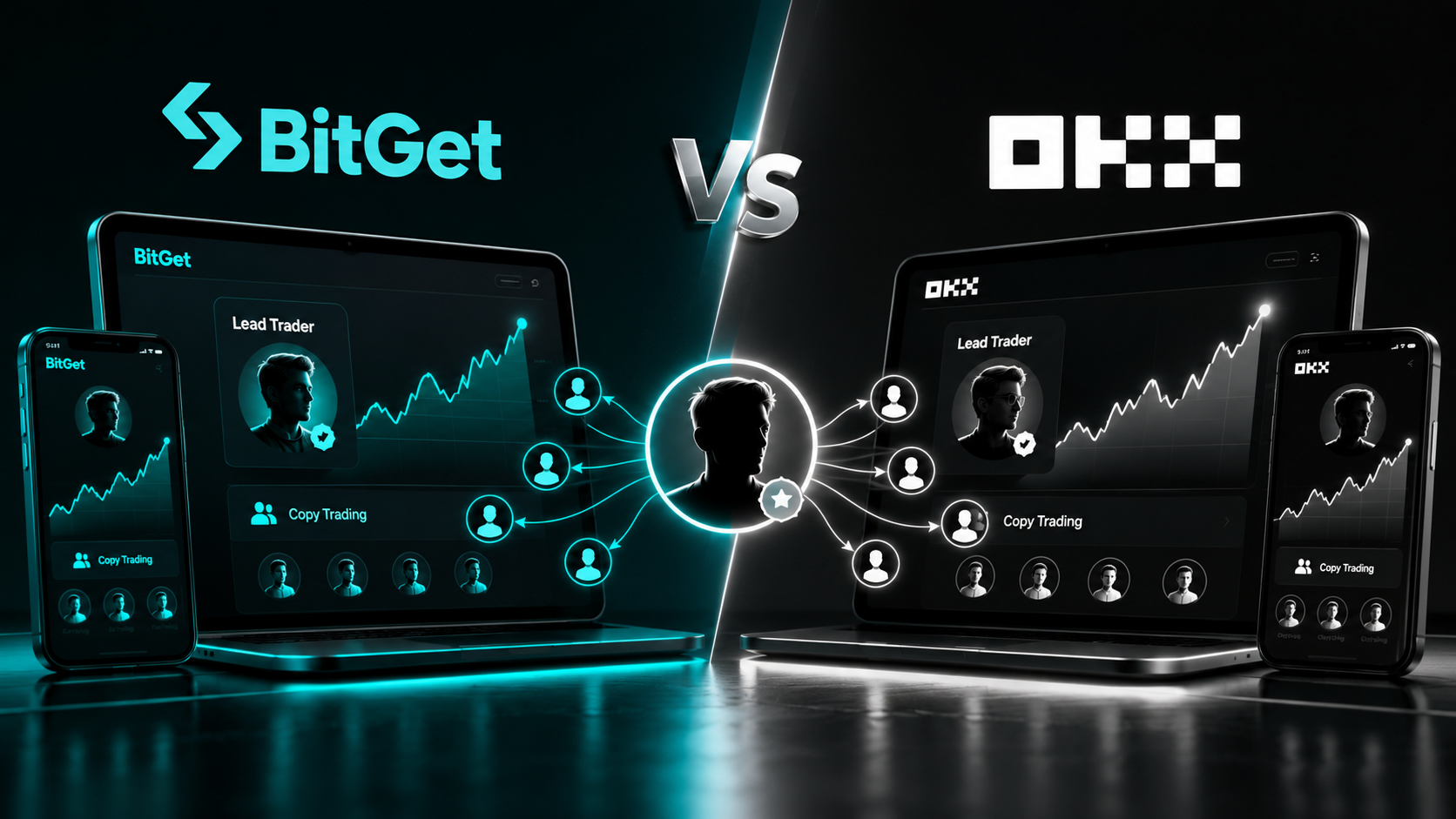
OKX has been around longer, lists more spot pairs, and runs one of the best Web3 wallets in the industry. BitGet has the deepest copy trading network in crypto and a stronger bot suite. If you’re choosing between them, the answer depends entirely on what you actually want to do — and most comparison posts skip that part.
I’ve used both. Here’s the head-to-head from someone who treats them as venues, not religions. Some links are affiliate. Flagged when they appear.
Short answer: BitGet wins on copy trading depth (~190k traders vs OKX’s much smaller pool) and the bot ecosystem. OKX wins on spot pair coverage, the Web3 wallet, and the cleaner DeFi integration. For copy trading and bots — BitGet. For DeFi, on-chain trading, and the widest spot list — OKX. My main: BitGet for trading, OKX Wallet as a backup Web3 wallet.
Open a BitGet account → (affiliate)
Key takeaways
- BitGet hosts approximately 190,000 elite copy traders. OKX’s pool is a fraction of that.
- OKX lists 700+ spot pairs and 270+ futures pairs vs BitGet’s 800+ spot and 660+ futures.
- Both publish monthly Proof of Reserves. Neither has had a major hack to date.
- OKX Wallet supports 100+ chains and is one of the most-used Web3 wallets in crypto. Bitget Wallet supports 130+ but is less polished.
- BGB and OKB serve similar functions (fee discounts, ecosystem perks) within their respective platforms.
TL;DR comparison table
| BitGet | OKX | |
|---|---|---|
| Founded | 2018 | 2017 |
| HQ | Seychelles | Seychelles |
| Spot pairs | 800+ | 700+ |
| Futures pairs | 660+ | 270+ |
| Max leverage | 125x | 125x |
| Spot fees (regular) | 0.10% / 0.10% | 0.08% / 0.10% |
| Futures fees | 0.02% / 0.06% | 0.02% / 0.05% |
| Copy trading | 190k+ traders | Smaller pool |
| Native bots | Broad suite | Broad suite |
| Web3 wallet | Bitget Wallet | OKX Wallet (best in class) |
| Proof of Reserves | Monthly | Monthly |
| Native token | BGB | OKB |
| US available | No | Limited (via OKX US) |
Full BitGet review for the platform I use most. The BitGet vs Bybit post is the other major head-to-head.
Spot trading head-to-head
Pair coverage
BitGet edges this — 800+ vs 700+. Both list every major and most mid-caps. OKX has historically been faster on certain narrative tokens (DeFi summer, Solana ecosystem, AI tokens) because of stronger Asian retail demand for those categories.
Liquidity
OKX has deeper books on BTC and ETH spot for retail size. BitGet has caught up significantly in the last 18 months as overall volume has grown. For most retail position sizes the difference is invisible.
Fees
OKX has a slight edge on spot maker fees (0.08% vs 0.10% on BitGet). With token discounts (OKB on OKX, BGB on BitGet), both end up in a similar place — around 0.06–0.08% effective for regular users.
UI
OKX’s spot UI is more sophisticated, with advanced charting tools and a denser layout. BitGet’s is cleaner but more functional. If you came from TradingView, OKX feels familiar. If you came from Binance, BitGet feels familiar.
The BitGet spot trading guide covers the BitGet side in detail.
Futures comparison
This is where the gap reverses.
Contracts
- BitGet: 660+ futures pairs across USDT-M, USDC-M, and Coin-M
- OKX: 270+ futures pairs, plus options on BTC, ETH, SOL
For pair diversity, BitGet is well ahead. For options trading, OKX is the only choice between the two — OKX has the most developed crypto options market outside of Deribit.
Fees
OKX is marginally lower (0.02% / 0.05% vs BitGet’s 0.02% / 0.06%). For position traders, this is rounding error. For high-frequency strategies, the 0.01% taker difference adds up.
Leverage
Both cap at 125x on majors. Both should be used with much less than that.
Funding rates
Both refresh every 8 hours. Numbers track each other closely because they’re determined by the perpetual-to-spot premium.
Verdict
If you trade a wide range of alt perpetuals — BitGet, by clear margin (660+ vs 270+).
If you trade options — OKX, by default.
If you trade BTC/ETH perpetuals only and care about fees — OKX edges it.
For the BitGet side, see BitGet futures USDT-M and BitGet leverage explained.
Copy trading depth
This is the headline category for this comparison.
BitGet
- Approximately 190,000 elite traders
- 800,000+ followers across the platform
- Verifiable ROI, win rate, max drawdown, AUM filters
- Multiple copy modes: fixed ratio, fixed amount, proportional
- Active marketplace — new strategy publishers join weekly
The BitGet copy trading guide covers the setup. The TL;DR: BitGet has been winning this category for three years running and the lead is widening.
OKX
- Smaller pool of copy traders
- Functional with the basic filters
- Less depth in the strategy marketplace
- Decent execution but fewer good traders to pick from
OKX’s copy trading is fine. It’s just not the focus of the platform. OKX leans more heavily into spot, DeFi, and the Web3 wallet — copy trading is a side product, not the headline.
Why it matters
If copy trading is the feature you came for, BitGet is the answer. The depth of the trader pool is the single biggest factor — a 5x larger pool means 5x more chance of finding traders with the specific risk profile you want.
If copy trading is a “nice to have” and you mainly want the platform for something else, OKX’s offering is good enough.
Bots head-to-head
Both exchanges have native bot suites. Strategy coverage:
| Bot type | BitGet | OKX |
|---|---|---|
| Spot grid | Yes | Yes |
| Futures grid | Yes | Yes |
| DCA | Yes | Yes |
| Martingale | Yes (don’t use) | Yes (don’t use) |
| AI / trend-following | Yes | Yes |
| Arbitrage bot | Limited | Yes (cross-platform) |
| Bot copy trading | Yes | Limited |
| Bot strategy marketplace | Yes | Limited |
OKX has a more developed cross-exchange arbitrage bot, which is useful for advanced users running cross-venue strategies. BitGet has the broader strategy marketplace where bot operators publish settings on a profit-share basis.
For the spot grid bot on BTC/USDT specifically, the BitGet BTC/USDT spot bot covers my actual settings. The crypto trading bots guide is the wider primer.
Web3 wallets compared
This is where OKX wins clearly.
OKX Wallet
- Supports 100+ chains natively (EVM, Solana, Cosmos, Bitcoin, Aptos, Sui, TON, etc.)
- Built-in DEX aggregator with best-rate routing
- Cross-chain swaps without bridging manually
- NFT marketplace integrated
- Multi-chain portfolio view in one place
- Mobile and browser extension
OKX Wallet is one of the best self-custody Web3 wallets in crypto. The DEX aggregator alone saves real money on swaps compared to going directly to a single DEX.
Bitget Wallet (formerly BitKeep)
- Supports 130+ chains
- Built-in swaps
- NFT support
- Mobile and browser extension
- Web3 features
Bitget Wallet covers more chains numerically but the UX is rougher and the DEX aggregator is weaker. It’s improving rapidly but OKX Wallet is the better daily driver right now.
My setup
I use OKX Wallet for on-chain stuff (DeFi swaps, cross-chain bridges, NFT activity) even though I trade on BitGet. Splitting the exchange and the Web3 wallet across two providers is a feature, not a bug — it limits how much exposure any single platform has to my activity.
For self-custody storage, neither of these is a substitute for a hardware wallet. The Ledger Nano X review and hot vs cold wallet posts cover the right setup.
Security: PoR + history
Proof of Reserves
Both publish monthly Merkle tree Proof of Reserves. Users can verify their own balances are included. Reserve ratios on both are above 100% in the most recent reports.
Hack history
Neither BitGet nor OKX has had a major exchange-level hack. Both have been operating since 2017–2018 without an insolvency event or customer fund loss.
OKX had a regulatory pause in China in 2021 when the country banned crypto exchanges — they were forced to exit the Chinese market. No customer funds were lost; users had time to withdraw. The OKX team has written about that period publicly.
Insurance funds
OKX maintains an insurance fund for derivatives that covers auto-deleveraging losses. BitGet runs a $400M+ Protection Fund as a broader emergency reserve.
What I do
Same as for any exchange: trading float on the venue, long-term holdings off-exchange on hardware. The BitGet review covers the rotation in more detail.
If copy trading is what you’re after, BitGet is the easy pick.
5–10x more traders to choose from, with the filters to strip out the lucky-window leaderboard merchants.
Affiliate link. I may earn a commission at no extra cost to you.
BGB vs OKB tokens
BGB
- Fee discount (up to 20%)
- Launchpool / Launchpad qualification
- VIP tier acceleration
- On-chain governance
- Used across BitGet Earn products
OKB
- Fee discount on OKX
- Jumpstart (OKX’s version of Launchpool) qualification
- VIP tier acceleration
- OKX Chain (X Layer) ecosystem usage
- Burn schedule that has historically pushed the price up
Both serve the same functions inside their respective platforms. OKB has had stronger price performance historically because of more aggressive token burns and tighter supply. BGB has appreciated significantly as BitGet’s product surface expanded.
For practical use, hold a small amount of whichever token corresponds to your primary exchange to get the fee discount. Don’t size up as a directional bet unless you have a real view on the exchange’s growth.
CoinGecko’s exchange token rankings shows the current standings.
Geography
- US: BitGet is fully blocked. OKX operates a separate, regulated US entity (OKX US) with a limited product set.
- UK: Restricted on both. Some products available; futures usually not.
- EU: Mostly available, both navigating MiCA compliance.
- Canada: Blocked on both.
If you’re in the US specifically, OKX US is an option — but it’s a different product with fewer pairs, no copy trading, and no derivatives. For non-US users, geography is a wash.
For privacy and account security on public WiFi, I use NordVPN (affiliate). It’s not for bypassing exchange geo-blocks (which carries account-freeze risk) — it’s for stopping DNS hijacking and lookalike WiFi attacks when trading from coffee shops or hotels. Personal habit, not pitch.
Which to pick by use case
The actual decision.
Pick BitGet if you:
- Want copy trading with the deepest trader pool
- Run multiple bot strategies and want a developed marketplace
- Trade a wide range of alt perpetuals (660+ pairs)
- Want one platform for spot, futures, copy, and bots
- Want BGB exposure for fee discounts and Launchpool access
Pick OKX if you:
- Trade BTC/ETH options
- Use a Web3 wallet daily for DeFi and cross-chain swaps
- Want the slightly cleaner DeFi-to-CeFi integration
- Live in the US (OKX US, with limitations)
- Already hold OKB or are in the OKX ecosystem
Run both if you:
- Trade on BitGet but use OKX Wallet for on-chain (what I do)
- Want to compare execution
- Have enough size that splitting flow makes sense
For copy trading specifically, BitGet is the clear pick.
My honest take
I run my primary trading on BitGet. The copy trading and bot ecosystem are the two things that keep me there. The futures pair coverage is wider, the bot marketplace is more developed, and the platform has shipped meaningful new features every quarter.
I keep OKX Wallet installed as my primary Web3 wallet. The DEX aggregator and cross-chain swap routing save real money compared to going to Uniswap or Jupiter directly. For on-chain activity, OKX Wallet is my daily driver — even though I trade on BitGet’s CEX.
This is the split that works: BitGet for CeFi trading, OKX Wallet for DeFi. Different tools for different jobs.
If you’re a beginner picking one, BitGet is the more complete CeFi product. OKX is the better Web3 ecosystem. Pick by the use case that matters most to you.
For the wider context, best crypto exchanges is the parent ranked list. BitGet vs Binance and BitGet vs Bybit cover the other major head-to-heads.
Learning to trade properly
Picking an exchange is the easy bit. Trading well is the hard bit. Most retail traders blow up because they didn’t learn position sizing, didn’t set stop losses, or chased pumps. If you want structured education from a community that doesn’t sell pump groups, the one I’m part of is Trade Travel Chill (affiliate). Real curriculum, real traders. Personal recommendation, not a pitch.
Made your pick? Mine is BitGet for CeFi.
If this post saved you a week of research, signing up through my link is the easiest way to say thanks. Costs you nothing.
Affiliate link.
Frequently asked questions
Is BitGet better than OKX?
For copy trading, bots, and alt futures pair coverage — yes. For Web3 wallet quality, options trading, and DeFi integration — OKX. For most retail copy traders and bot users, BitGet wins.
Which has more spot pairs?
BitGet lists 800+ spot pairs. OKX lists 700+. Both cover every major and most mid-caps.
Which is better for copy trading?
BitGet, by a large margin. The pool of traders is roughly 5-10x larger than OKX’s, with more granular filtering.
Which is better for DeFi and Web3?
OKX. The OKX Wallet supports 100+ chains, has a strong DEX aggregator, and cross-chain swap routing. Bitget Wallet covers more chains numerically but is less polished.
Is OKX safe?
OKX has been operating since 2017 with no major hack or insolvency event. They publish monthly Proof of Reserves. The 2021 China exit was regulatory, not security-related, and customers had time to withdraw.
Does OKX work in the US?
Yes, via OKX US — a separate regulated entity with a limited product set. No copy trading or derivatives. Full BitGet is not available in the US.
Which has lower fees?
OKX has slightly lower spot maker fees (0.08% vs 0.10%) and futures taker fees (0.05% vs 0.06%). Token discounts on both bring effective fees close together.
Should I hold BGB or OKB?
Hold a small amount of whichever token corresponds to the exchange you actually use, for the fee discount. Don’t size up as a directional bet unless you have a real view on the exchange’s growth.
Final word
The honest framing: BitGet is the better CeFi product for active traders. OKX is the better Web3 ecosystem for on-chain users. They overlap on spot and futures but lean in different directions.
If you want one CeFi platform for copy trading, bots, and alt futures, BitGet. If you want the best Web3 wallet in crypto and you’ll use it daily, OKX Wallet. If you want both, run both — there’s no rule that says you have to pick.
For me: BitGet for trading, OKX Wallet for on-chain. That’s the rotation I’ve run for years and it still fits.
Right — over to you.
Related posts