The first time I heard the phrase “Trade by Design” I rolled my eyes. Most acronyms in crypto are marketing wrappers around something that already exists. TBD sounded like another one. Then I sat through the actual course, traded with the framework for six months, and watched my hit rate stop being random. This is the honest write-up — what the TBD System is, why Annii Snelleksz built it, and whether it’s worth your money.
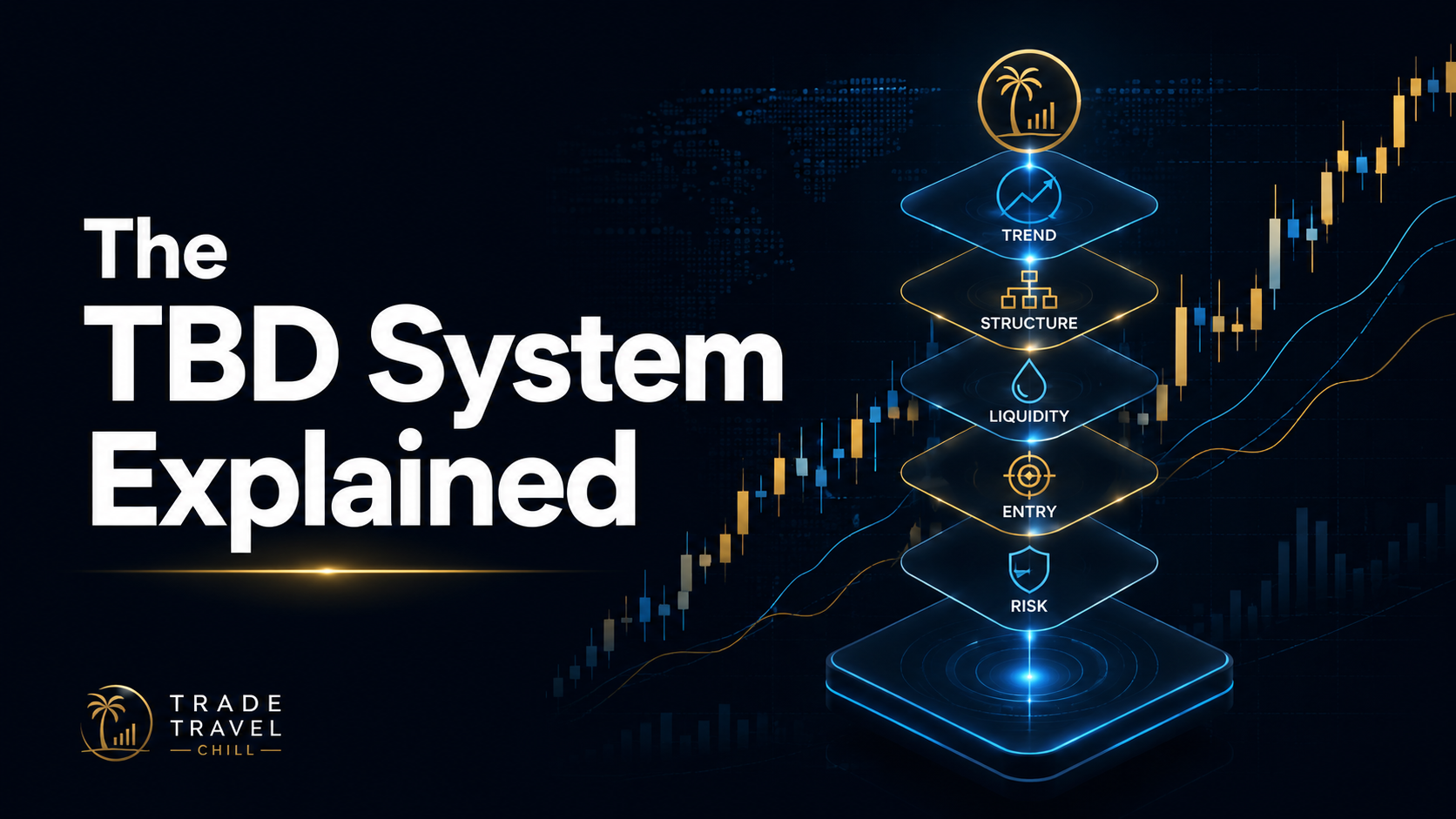
Short answer: The TBD System (“Trade by Design”) is the proprietary crypto trading methodology built by Annii Snelleksz, the Dubai-based founder of Trade Travel Chill (referral). It blends forex-style precision — defined entries, structured risk, multi-timeframe confirmation — with crypto market structure: liquidity sweeps, market-maker traps, smart money concepts. It is not a signals service. It is a framework that tells you what a valid setup looks like, where to enter, where to stop, and where to take profit — so you stop guessing. I’ve been a member for over a year. It changed how I trade.
See the TBD System inside TTC → (referral link)
Key takeaways
- The TBD System = “Trade by Design” — a structured crypto trading methodology, not a tip service.
- Built by Annii Snelleksz, founder of Trade Travel Chill (TTC), Dubai-based, started trading in 2017.
- Blends forex precision (defined risk, multi-timeframe analysis) with crypto market structure (liquidity sweeps, MM manipulation, smart money concepts).
- Sits inside a structured course path: Zero to Crypto → TBD → Trading Masterclasses → Liquidity → MM Masterclass → Scalp (locked).
- TBD Indicators (proprietary, members only) plug straight into TradingView.
- TTC pricing: Business Class $88/mo or $899/yr; First Class $158/mo or $1,610/yr. 48-hour money-back. 20% off paying in crypto.
What the TBD System actually is
The TBD System stands for Trade by Design. It’s the trading methodology Annii Snelleksz built and teaches inside Trade Travel Chill. The “by design” part is the whole point — every trade has a defined reason for existing, a defined risk, a defined invalidation, and a defined target.
If you’ve ever opened a position because “the chart looks bullish” or “RSI is oversold” without being able to articulate exactly why you took it, the TBD System is the opposite of that.
It’s a framework, not a signal feed. Nobody messages you “long ETH at 3,210.” The system teaches you to read the chart, identify a high-probability zone, wait for the trigger, and execute with sizing that respects your account.
The three jobs the framework does
- Tells you what a valid setup looks like. Most beginners trade everything. The TBD System filters — only setups with specific market-structure conditions get traded.
- Tells you where to enter, stop, and target. No more “I’ll just see what happens.” Entry, stop, target are defined before the position opens.
- Tells you when to do nothing. Half of trading is sitting on your hands. TBD makes “no trade” a valid output.
That third one is the part that took me longest to accept. Pre-TBD I felt like every day I didn’t trade was wasted. Post-TBD I take 2–4 trades a week and my P&L curve is straighter than it was when I was taking 15.
Who Annii Snelleksz is
Before you commit to learning a system, you should know who built it. Annii Snelleksz is the founder of Trade Travel Chill (referral). She’s Dubai-based, an ex-business owner who pivoted full-time into crypto trading.
She started trading in 2017 — meaning she traded through the 2017 retail bull, the brutal 2018 bear, the COVID dump in March 2020, the 2021 mania, the FTX implosion in late 2022, and the cycle into 2024–2026. That’s a real lived through-line. According to CoinGecko market history, the global crypto market cap travelled from about $20 billion in early 2017 to roughly $3 trillion at the 2021 peak and back through multiple 70%+ drawdowns. Surviving and trading through all of that as a retail trader is not nothing.
She founded TTC in 2022 — the bottom of the bear market — which I think tells you something. The platform wasn’t built to ride a bull market hype cycle. It was built to teach the kind of structured trading that survives bear markets too.
The TBD System is her own creation. It came out of years of testing forex techniques on crypto charts and figuring out what carried over, what broke, and what needed rebuilding for the unique liquidity profile of crypto.
Why this matters
There are a lot of crypto “educators” who started teaching in 2021, blew up their accounts in 2022, and quietly disappeared. Annii is still here. She still posts charts. She still takes live questions. TTC still ships new material. The continuity matters when you’re paying for education.
Why the name “Trade by Design” (not by chance, not by guessing)
The name is deliberate. There are three ways retail traders open positions:
- Trade by chance — random, no system, vibes-based. Most beginners. Win rate ~ random.
- Trade by guessing — based on a YouTuber’s call, a Telegram tip, or a hunch. Slightly better than chance, but the wins don’t compound because you can’t repeat what you don’t understand.
- Trade by Design — every position has a documented reason, a planned risk, a defined invalidation, and a target. The wins are repeatable because the process is repeatable.
The framing is simple. Trading is a sample-size game. According to Investopedia’s overview of trader survival rates, the overwhelming majority of retail day traders lose money — and one of the biggest reasons is they can’t repeat their winning trades because they don’t understand why they won.
You can’t repeat what you don’t design. Trade by Design fixes that.
The mindset shift
The biggest mindset shift in TBD is moving from outcome-based thinking to process-based thinking. Pre-TBD I judged every trade on whether it made money. Post-TBD I judge it on whether I followed the process. The process produces wins over a sample; individual outcomes don’t matter.
This is why a crypto trading journal becomes mandatory once you adopt TBD. You can’t measure process adherence without writing it down.
The forex-precision-meets-crypto thesis
This is the core idea behind the whole framework. Forex has been around for decades and the retail forex education industry has developed extremely structured methodologies — multi-timeframe analysis, defined session times, fixed-percentage risk per trade, smart-money concepts (SMC), order blocks, fair value gaps (FVGs). Names like ICT and SMC have become standard reference points. According to Investopedia’s primer on forex trading, forex is the most liquid market in the world by far, and that liquidity has shaped how forex traders learn to read structure.
Crypto, by contrast, grew up on YouTube TA — RSI crossovers, MACD signals, “the chart is bullish, ape in.” It’s a market structurally similar to forex (24/7, global, deep liquidity in majors) but the retail education layer was thin and chaotic.
Annii’s thesis: take the structured methodology forex traders have spent decades refining, and apply it to crypto’s unique conditions.
What carries over from forex:
– Multi-timeframe analysis
– Defined risk per trade (1–2% of account)
– Session-based trading (Asian / London / NY equivalents)
– Liquidity-aware entries
– Smart money concepts (read more on SMC in crypto)
– Order block trading (more on order blocks)
– Fair value gap setups (more on FVGs)
What’s unique to crypto and rebuilt for TBD:
– Liquidation cascade dynamics (perp funding, cascading liqs)
– Lower-liquidity altcoin behaviour
– 24/7 markets with no closing bell
– Weekend manipulation patterns
– Funding rate as a signal
The result is a framework that reads like ICT/SMC if you’ve encountered it on forex Twitter, but tuned for crypto’s specific liquidity quirks.
Why this matters for a beginner
You don’t need a forex background to learn TBD. The system is taught from scratch inside TTC. But knowing that the underlying logic has decades of forex testing behind it — rather than being something some YouTuber made up in 2021 — should give you more confidence in the framework itself.
The structured course path
This is where TTC’s curriculum design impressed me. The TBD System isn’t dropped on you in one massive course. It’s the centre of a structured path that walks a complete beginner up to scalp trading.
Here’s the order:
1. Zero to Crypto (the beginners course)
If you’ve never bought a coin, this is where you start. Wallets, exchanges, what spot trading is, what futures are, why leverage will wreck you if you don’t know what you’re doing. By the time you finish, you can fund an account and place a basic trade without panicking. If you’re not at this stage yet, my how to start trading crypto with 100 post covers the absolute basics first.
2. Trade by Design (the TBD System course)
The core methodology. Market structure, multi-timeframe analysis, identifying setups, entry triggers, stop placement, target setting, position sizing. This is where the framework lives. Expect to spend weeks here, not days.
3. Trading Masterclasses
Deeper sessions on specific applications. Topics rotate. These are where the rubber meets the road — applying TBD to specific market conditions, specific assets, specific timeframes.
4. Liquidity Course
The liquidity sweep / liquidity grab framework. How market makers hunt retail stops. Where liquidity actually sits on the chart. How to use it instead of being it. Covered in depth in my standalone post on liquidity sweeps in crypto.
5. MM (Market Maker) Masterclass
The five patterns of market-maker manipulation. How retail gets played. How to spot it before you become exit liquidity. The standalone version of this material is in market maker manipulation in crypto.
6. Scalp Trading Course
Locked. You only get access to the Scalp Course after you’ve completed TBD + Indicator/Heatmap training + MM Masterclass. The gate is deliberate — scalping on the 1-minute chart with leverage is the fastest way to blow up if you don’t have the foundational structure. TTC won’t let you near it until you do. See also scalping crypto for the standalone primer.
What this structure actually does
Most courses dump everything on you at once. TTC’s pathway means you build skill in the order it actually compounds. Beginners don’t jump to scalping. Intermediates don’t skip the liquidity course. The structure stops you doing the dumbest version of yourself.
The TBD Indicators (custom proprietary tools)
The TBD System is delivered as a framework you can apply visually on any chart. But TTC also ships proprietary TBD Indicators to members — custom tools that plug into TradingView and reduce the time it takes to read a setup.
Full breakdown is in my standalone post on TBD Indicators, but the short version:
- The Heatmap — visualises where liquidity sits and how it’s being absorbed.
- The level-mapping indicator — auto-maps key TBD levels so you stop drawing them by hand.
- The First Class exclusive indicator — additional advanced tool only available to First Class members.
The indicators are members-only. You can’t download them anywhere else. They are not signal generators — they don’t tell you to buy or sell. They reduce the cognitive load of identifying TBD setups so you can focus on execution instead of chart-drawing.
The Cabin Crew
You’re not just learning from one person. TTC has a team of pro traders — the Cabin Crew — who teach, host live sessions, and answer questions across different time zones.
Quick roster:
- Annii Snelleksz — founder, TBD creator, Dubai-based.
- Cajun Spice — Doha-based, global-firms background, runs private consultancy.
- Janet Hauiti — no-nonsense, judgement-free mindset and habit work.
- Cody Selby — TBD method specialist, runs Friday trading hangouts.
- NRJ — former retail trader who found TTC by luck and now coaches.
Multiple coaches across multiple time zones means you can get live coverage no matter where you are. Asia, Europe, US — there’s almost always someone live on a session or in the Discord. Full Cabin Crew profiles in the dedicated post.
What “2 hours a day” actually looks like in practice
TTC’s headline pitch is that the TBD System is designed for a 2-hour-a-day workflow. That sounds suspiciously like marketing. Let me describe what 2 hours actually looks like for me as a working trader using the system.
My typical day (UK timezone)
Morning (30 mins) — I open TradingView, run my top-down analysis: weekly, daily, 4H structure on BTC, ETH, and whatever 2–3 alts I’m watching. I mark key TBD levels using the indicators. I note where liquidity sits. I write a one-line bias for each: long bias, short bias, or no bias.
Late morning / lunch (45 mins) — I check the London session open. Are any of my setups triggering? Are levels being respected? If a setup forms, I size the position based on stop distance, enter, and walk away. If nothing’s forming, I close TradingView.
Evening (45 mins) — I review what happened during the US session. I journal any trades I took. I prep for tomorrow’s setups based on how the day closed.
Total: ~2 hours. Some days less. Some days more if a setup is taking longer to develop.
That’s not “watch the screen all day.” The whole design of TBD is that you set up your trades on higher timeframes and execute when the setup triggers — you don’t need to babysit the chart.
What this isn’t
This isn’t scalping. Scalping requires screen time. TBD as a swing/day approach is designed for people with jobs. If you want to scalp, that’s a separate path inside TTC (scalping crypto) and it requires more screen time.
What you actually need
A laptop, a TradingView account, an exchange that integrates with TradingView (I use BitGet — see BitGet TradingView integration), the TBD Indicators (members only), and discipline. That’s the whole stack.
Want to learn the TBD System properly?
The system is taught inside Trade Travel Chill — Annii’s community where I’m a member. Business Class $88/mo (or $899/yr), First Class $158/mo (or $1,610/yr). 48-hour money-back guarantee. Pay in crypto, get 20% off.
Referral link. I may earn a commission at no extra cost to you.
How TBD differs from generic crypto courses
Most crypto courses fall into one of three buckets. The TBD System sits outside all three.
Bucket 1: YouTube TA bootcamps
“Here’s the RSI. Here’s the MACD. Here’s a triangle.” These teach you to identify shapes on a chart. They don’t teach you process, sizing, or risk. You finish the course knowing what a head and shoulders looks like and still no idea how to trade one. The market is full of these. According to Investopedia’s research on technical analysis adoption, classic technical indicators have been studied for decades — but indicator knowledge alone doesn’t make a trader. See also my breakdown of crypto trading indicators.
Bucket 2: Signal-pumping Telegram groups
You pay, you get DMs telling you what to buy. You’re a passenger, not a driver. When the group goes dark, your skill set evaporates. Worse — many of these groups are pumping bags onto members.
Bucket 3: Generic “trading psychology” courses
Lots of mindset, no system. You finish feeling motivated and still have no framework. Useful for people who already have a system and need to execute it better. Useless on its own.
Where TBD sits
The TBD System teaches you a complete framework — structure analysis, setup identification, entry triggers, stop placement, position sizing, target setting, post-trade review. You walk out with a process you can repeat without anyone holding your hand. The community wraps around it for accountability and live discussion.
That’s a structurally different product to the three buckets above. It’s the closest thing in crypto to what a forex prop firm would teach a new trader.
The honest gripes — it’s not magic
I’d rather you go in with eyes open. Here’s what TBD doesn’t do.
One. It’s not a signal service. You won’t get DMs telling you to buy. If that’s what you want, this is the wrong product.
Two. It rewards effort. You can’t passively absorb the TBD System. You have to study the modules, draw the levels, paper trade the setups, journal the results, and ask questions in the Discord. Members who do that get the value. Members who don’t, don’t.
Three. The learning curve is real. The framework is structured but it’s also intermediate-level material. If you’ve never read a candle chart, expect 4–8 weeks of focused work to get comfortable. The Zero to Crypto course is there to bridge you, but you have to do it.
Four. Some setups don’t fire for weeks. Patience is part of the design. If you need action every day, TBD will frustrate you. You’ll trade worse setups because you’re bored and lose money because of impatience, not because the system is broken.
Five. It’s crypto-only. TBD is built for crypto market structure. The principles transfer to other markets but the platform doesn’t teach stocks, forex, or commodities.
Pricing — what you pay and what you get
Pricing is real and I’ll be specific. Pulled from the TTC site as of writing.
Business Class
- $88 / month or $899 / year (saves ~$157 vs monthly)
- Self-paced learning, course recordings, daily market update recordings, live session recordings
- TBD Indicators included
- Discord and Telegram access
- 48-hour money-back guarantee
- Email support
First Class
- $158 / month or $1,610 / year (saves ~$286 vs monthly)
- Everything in Business Class PLUS:
- Live market updates 3× daily (real-time, not recorded)
- Live trading sessions with the Cabin Crew
- Live weekly Q&A hangouts
- Exclusive advanced indicator (additional TBD tool)
- Direct access to pro traders via Discord
- Mindset coach access
- Monthly Top Trader Award
- Alt coin fundamental analysis
- Ambassador program (earn commissions)
20% off paying in crypto
Pay in crypto and you get 20% off any membership. That turns the Business Class annual from $899 into ~$719, and the First Class annual from $1,610 into ~$1,288. Easy path: open a BitGet account (referral), buy USDT on the spot market (not the card on-ramp, which has card fees), pay TTC directly with crypto. Two affiliate accounts, one funnel, real savings.
How I think about cost
If TBD stops you taking one bad trade — one position you would’ve over-sized, one stop you would’ve moved, one chase you would’ve avoided — the membership has paid for itself for the year. My average pre-TTC losing trade was ~£180. So one prevented mistake = membership covered.
TTC vs YouTube vs other paid communities
Here’s how TBD-via-TTC compares against the obvious alternatives.
| TBD System (TTC) | YouTube free TA | Generic paid Discord | Free SMC content | |
|---|---|---|---|---|
| Cost | Paid sub | Free | Paid sub | Free |
| Structured curriculum | Yes | No | Rare | No |
| Crypto-specific | Yes | Mixed | Mixed | Mixed |
| Proprietary indicators | Yes | No | Rare | No |
| Live sessions | Yes (First Class) | Rare | Sometimes | Rare |
| Community/Discord | Yes (1,000+ active) | No | Yes | Scattered |
| Pro trader walkthroughs | Yes | Some | Sometimes | No |
| Risk management focus | Heavy | Light | Varies | Varies |
| Signals vs education | Education-first | Mixed | Often signals | Education |
| Accountability | High | None | Low | None |
YouTube TA specifically
I still watch YouTube. Coin Bureau for fundamentals. Crypto Banter for entertainment plus occasional usefulness. But here’s the thing — YouTube teaches you what to think about. It doesn’t teach you a system. You can watch 300 hours of crypto TA YouTube and still not have a process for sizing positions or placing stops.
Why TBD is harder to copy
A lot of generic SMC/ICT content floats around on YouTube and X for free. What you can’t get free is the structured curriculum, the community of 1,000+ active traders, the live sessions across three time zones, the proprietary indicators, and the Cabin Crew answering questions. The framework’s underlying ideas aren’t proprietary — the delivery system around it is what you pay for.
Should you join? My take
Asked directly: should you pay for the TBD System?
Yes if:
– You’ve been in crypto a while and your trading is inconsistent or losing
– You can put 8–10 hours a week into learning for the first 2 months
– You want a structured framework instead of more YouTube hours
– You’re at the beginner-to-intermediate stage
– You want a community of traders to learn alongside
No if:
– You’ve never bought any crypto (start with how to buy crypto first)
– You want plug-and-play signals
– You’re an experienced systematic trader with a backtested edge already
– You won’t put in the time
– Your trading budget is zero — start with Investopedia’s basics and YouTube and circle back
For me, TBD is the single best framework I’ve used in crypto. I’d argue the TBD System is the best crypto trading strategy for retail traders who want a complete system rather than a collection of indicators.
That said — and this is important — I’d never pay for any education if I hadn’t first learned the basics for free. Don’t pay $88/mo to learn what a candle is. Start free, get to the limit of free, then upgrade.
Ready to trade by design instead of by guessing?
Join the community I’m in. Business Class $88/mo, First Class $158/mo. 48-hour money-back. 20% off paying in crypto.
Referral link.
Where to apply the TBD System (the exchange question)
A framework is only useful if you can actually trade it. You need an exchange with deep liquidity in majors, a clean TradingView integration, and reasonable fees. I use BitGet (referral) — full breakdown in my BitGet review. It has direct TradingView integration, low maker/taker fees, and supports both spot (BitGet spot trading guide) and USDT-M perps (BitGet futures USDT-M).
For TBD specifically, the TradingView integration matters most — you’ll be drawing levels in TradingView, watching for TBD triggers, and wanting to execute without flipping windows. BitGet’s TradingView integration lets you place orders directly from the chart.
If you trade futures, BitGet leverage explained is required reading first — never run the leverage caps just because they’re available.
Frequently asked questions
What is the TBD System?
The TBD System (“Trade by Design”) is a proprietary crypto trading methodology built by Annii Snelleksz, founder of Trade Travel Chill. It blends forex-style precision (defined risk, multi-timeframe analysis, smart money concepts) with crypto market structure (liquidity sweeps, market-maker dynamics). It’s a framework, not a signal service.
Who created the TBD System?
Annii Snelleksz — Dubai-based crypto trader, ex-business owner, founder of Trade Travel Chill (TTC) in 2022. She started trading crypto in 2017 and built the TBD System by adapting structured forex methodologies for crypto market conditions.
Where can I learn the TBD System?
Inside Trade Travel Chill (TTC). The TBD course is the centrepiece of the TTC curriculum and is available to both Business Class ($88/mo) and First Class ($158/mo) members. It’s not available anywhere else.
Is TBD a signals service?
No. The TBD System teaches you the framework so you can identify and execute your own trades. Nobody DMs you “buy this now.” If you want signals, this is the wrong product.
How long does it take to learn the TBD System?
Plan for 4–8 weeks of focused study to be comfortable with the framework, then ongoing practice (paper trading first). Most members start placing live TBD trades after 2–3 months. See how long to learn crypto trading for the wider context.
Does the TBD System work for beginners?
It can, but you need to do the Zero to Crypto course first inside TTC. If you’ve never bought a coin, learn the basics before trying to learn a trading system. See crypto trading for beginners.
What’s the difference between Business Class and First Class?
Business Class ($88/mo or $899/yr) gives self-paced access to all courses, recordings, and the Discord. First Class ($158/mo or $1,610/yr) adds live market updates 3× daily, live trading sessions, weekly Q&A hangouts, an exclusive advanced indicator, direct pro trader access, and alt coin fundamental analysis.
Is the TBD System worth the money?
In my experience yes — if you’re committed. If TBD stops you taking one over-sized trade you’ve covered the membership. If you don’t put the hours in, no system is worth paying for. See also are crypto trading courses worth it.
What if I don’t like it?
48-hour money-back guarantee. Try the first course modules. If it’s not for you, get your money back. No drama.
Final word
The TBD System is the most structured framework I’ve found in crypto. It won’t make you rich overnight — nothing does — but it’ll stop you being your own worst enemy on the chart.
Six years in, my biggest regret is not learning a structured framework five years earlier. The thousands I lost during 2021–2022 trading on vibes would have been preserved by half an hour spent placing a stop where the chart actually invalidated, not where I emotionally wanted it to be.
If you’re at the stage I was in 2022 — losing money you can’t quite explain — TBD is what I’d point you at. If you’re brand new, learn the basics first. If you’re already an experienced systematic trader, you already know what you need.
Right — over to you.
Related posts
- Trade Travel Chill Review: Where I Actually Learned to Trade
- TTC Cabin Crew: Meet the Pro Traders Behind Trade Travel Chill
- TBD Indicators Explained: What They Show and How to Use Them