There’s a video for every search you can think of called “How I turned $100 into $100,000 trading crypto”. The thumbnails are all the same. Yellow arrows, shocked face, dollar signs. The maths inside the videos almost never works.
I’ve been trading retail crypto for six years. I’ve started accounts at $100, at $500, at $5,000. The $100 starts taught me more than the bigger ones — because at $100, the maths is brutal and honest. There is nowhere to hide.
This post is the version I wish someone had handed me when I tried it the first time. The real constraints, the path that actually compounds, and the path that wipes the account out by week three.
Short answer: $100 is enough to learn the mechanics of crypto trading, but not enough to make a living from. Stick to spot trading on BitGet, skip futures and leverage entirely, set a 90-day learning window, and treat the $100 as tuition rather than capital. Use the time to learn position sizing, journaling, and one strategy before you scale up. The traders who survive year one are the ones who treated their first account as a classroom.
Open a BitGet account → (referral link)
Key takeaways
- $100 is a learning budget, not a wealth-building budget. The win is staying in the game, not 10x-ing the account.
- Skip futures and leverage at $100 — a single liquidation wipes the whole stack.
- Fees and spread punish small accounts disproportionately. Pick a low-fee venue or watch the account bleed.
- Spot trading on a small set of large-cap assets (BTC, ETH, SOL) is the only path with realistic odds.
- Pair your $100 with structured education. Capital without skill compounds losses. Skill without capital is a problem you can solve later.
The honest reality of trading with $100
Before any strategy, let’s deal with the maths.
A $100 account in crypto runs into three hard walls that bigger accounts don’t see.
Fees eat into every trade. Take a 0.10% maker/taker fee on BitGet spot. Buy $100 of BTC. You pay $0.10 in fees. Sell that BTC. Another $0.10. That’s $0.20 round-trip — 0.20% of your account gone before the price even moves. Do that 50 times in a month and you’ve paid $10 in fees, or 10% of your capital. Active traders at $100 can lose 30–40% of the account purely on fees in a busy month, even with break-even price action.
Spread eats the rest. On smaller altcoin pairs, the bid-ask spread can be 0.3–1%. On a $100 trade that’s $0.30 to $1.00 lost the moment you click buy, before fees, before market moves. The spread on BTC/USDT is usually a fraction of that — another reason to stick to large caps.
Position sizing is impossible. Standard risk management says you don’t risk more than 1–2% of your account per trade. On a $100 account, 1% is $1. You can’t realistically execute a trade with a $1 risk budget — the smallest order size, plus fees, plus stop-loss slippage, blows through that immediately. So either you break risk-management rules and trade with outsized risk, or you take such small positions that the wins don’t matter.
This is why every honest trader will tell you $100 is a learning amount, not a trading amount. The aim isn’t to compound it into $10,000 in three months. The aim is to learn enough that when you have $1,000 or $5,000, you don’t blow that up either.
For the bigger picture on capital sizing, how much money to start trading crypto is the deeper read.
What $100 can actually teach you
The constraints I just listed look like obstacles. They’re actually the curriculum.
Trading is 80% behaviour and 20% strategy. A $100 account forces you to face the behaviour part first, because the strategy part doesn’t generate real money at this size. That’s the value.
What you’ll learn from $100 in 90 days of disciplined trading:
- How market orders, limit orders, stop-losses, and take-profits actually work — not in theory, in your hand
- What it feels like to watch a position go red and stay disciplined
- What it feels like to watch a position go green and not exit early
- How fees and spread compound into real losses on a real account
- How emotional you actually get when real money is on the line, even small money
- How a trading journal changes your decisions
- Whether you actually enjoy this enough to keep doing it for years
You can’t learn any of that from paper trading. The moment money is on the line, your brain switches modes. A $100 account is the cheapest possible price for that switch to happen.
What you won’t learn from $100:
- How to size a real position with real risk management
- How institutional flow affects price across a session
- How to manage multiple positions at once
- How to scale into a winning trade
Those lessons come later, with more capital. Skipping the $100 lesson and starting at $5,000 is the most expensive mistake I see beginners make.
The path I recommend: $100, spot only, 90 days
If you give me a beginner with $100 and 90 days, this is the path I’d lay out.
Days 1–7. Setup and first trade.
Open a BitGet account. Complete KYC. Deposit $100 (via card or bank, whatever clears fastest in your country). Buy $80 worth of BTC at spot. Hold the remaining $20 as USDT for execution practice. Don’t sell. Just watch the position for a week to see how the price moves on a 4-hour and daily chart.
Days 8–30. Mechanics.
Place 5–10 small trades using the $20 USDT float. Buy small amounts of BTC, ETH, or SOL. Set a limit order. Set a stop-loss. Watch what fills and what doesn’t. Test what a 2% move feels like. The trades don’t need to be profitable — they need to be deliberate. Every trade gets logged in a journal: entry, exit, reason, what you felt, what you’d do differently.
The journal is non-negotiable. Read crypto trading journal for a template. The traders who scale from $100 to a real account all kept one. The ones who didn’t are still trading $100.
Days 31–60. One strategy.
Pick a single strategy. One. Either DCA into BTC weekly, or trade a single setup (a clean breakout, a clean liquidity sweep entry, a moving-average crossover — doesn’t matter what). The point is to repeat the same setup enough times to know if it works for you.
Most beginners try seven strategies in their first month and learn nothing about any of them. You’ll be tempted to do this. Don’t.
Days 61–90. Review and decide.
By day 90, you have 50+ entries in a journal. You can answer real questions: which setups had a positive expectancy? Which time of day were you most disciplined? Which losses came from missed stops vs bad setups? Which wins came from skill vs luck?
This is also where you decide if you want to keep going. Some people get to day 90 and realise active trading isn’t for them. That’s a $100 lesson too — and it’s much cheaper than learning it at $10,000.
Why futures at $100 is account suicide
Every search for “trading with $100” gets recommended a YouTube video about taking a $100 account to $10,000 using 20x leverage. The video gets 800,000 views. The traders who try it get liquidated.
Here’s the maths.
You open a $100 futures position with 20x leverage. Your notional position size is $2,000. Your liquidation price is roughly 5% from entry (a touch less after fees and margin requirements). The market moves against you 5% — which BTC does in a normal day, multiple times per week — and your $100 is gone. Not 5% of it. All of it.
Now you try again with the next $100. Same setup. Same outcome. Or you survive a few moves, get cocky, increase the leverage to 50x or 75x. The liquidation distance shrinks to 1–2%. The next 1% move wipes it.
Futures isn’t a get-rich-quick tool. It’s a risk-transfer tool. Done well, it lets a skilled trader sharpen returns on capital they already understand how to deploy. Done poorly — which is how every beginner does it — it accelerates the path to zero.
The rule is simple. No futures, no leverage, no margin until you have:
- At least 12 months of consistent, profitable spot trading
- A documented strategy with a journal showing real expectancy
- Enough capital that 1% risk per trade is a meaningful position
- The emotional discipline to not chase losses
If you can’t tick all four, leverage will kill the account. Not might — will. The only question is how fast.
For the related risk reading: crypto trading mistakes beginners make covers this and a dozen others.
The $100 setup on BitGet
Practical walkthrough.
Step 1. Open the account.
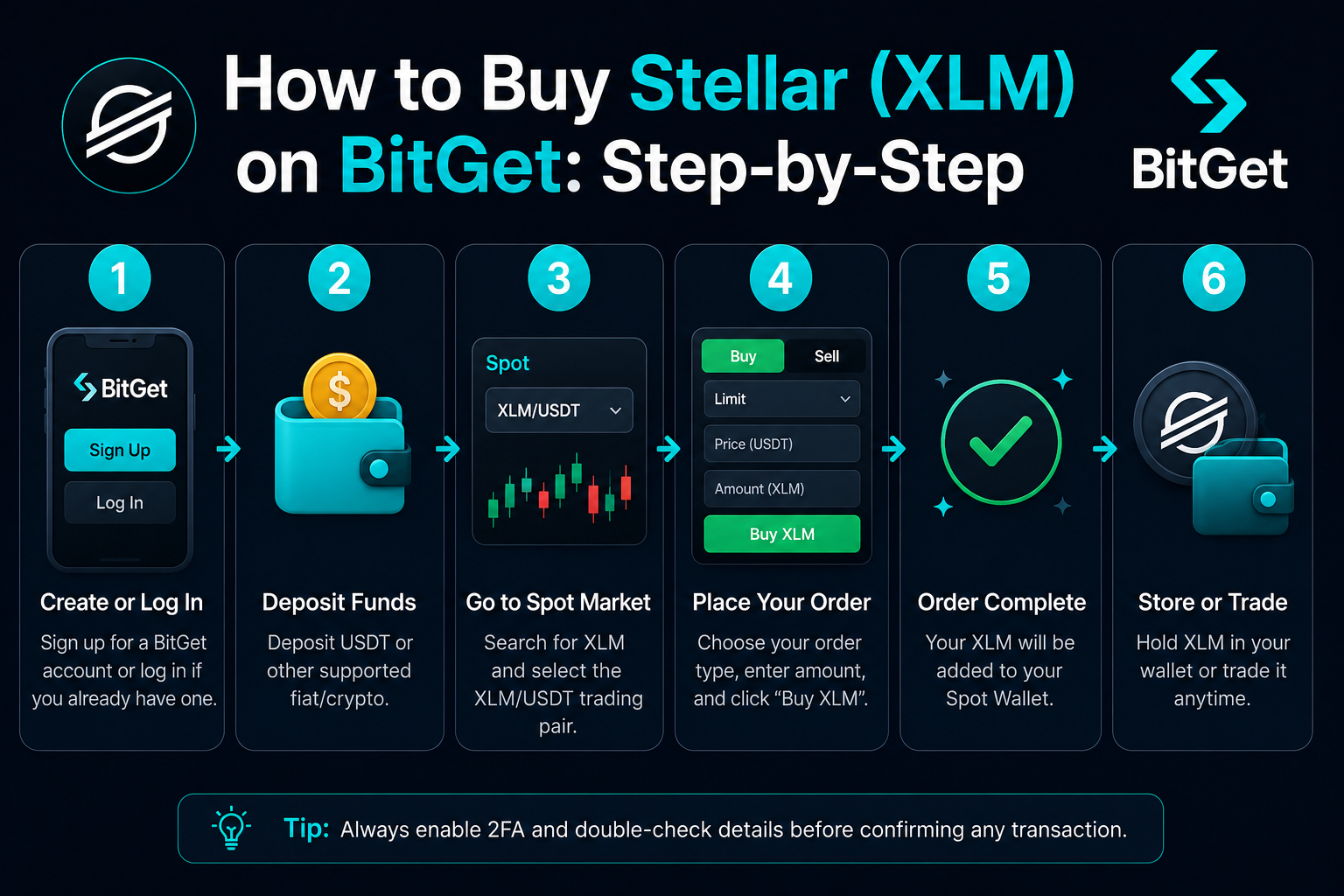
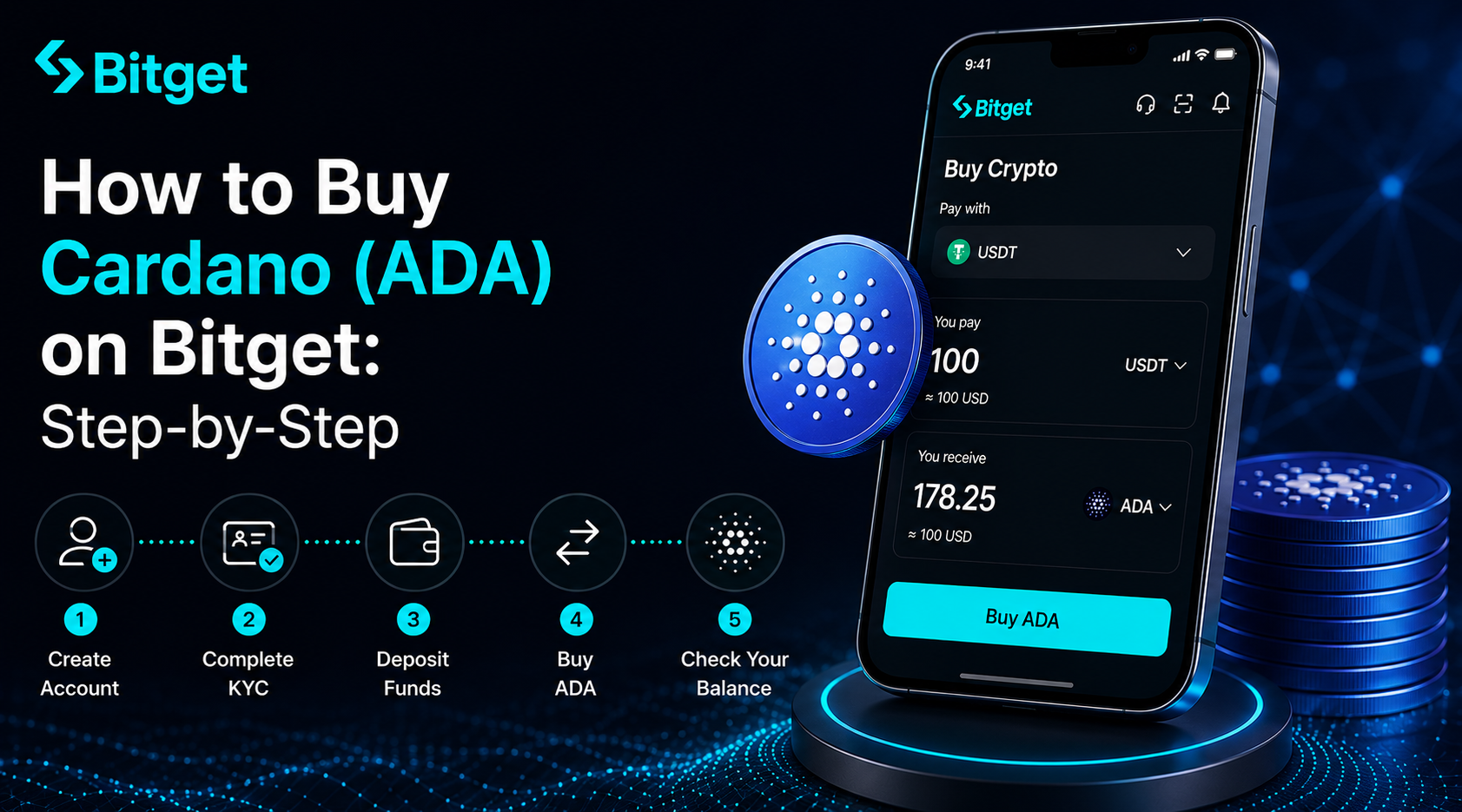
Go to BitGet (referral). Sign up with email. Complete KYC — for most regions this clears within a few hours. The full sign-up walkthrough is in BitGet review and the deposit options are covered in how to buy crypto.
Step 2. Deposit the $100.
You have three options. Card deposit (instant, but 1–3% fee). Bank transfer (24–48 hours, lower fee, sometimes free). Crypto deposit from an existing wallet (network fee only). For a first-timer with $100, card is the fastest path to actually trading. Just know the fee hits your starting balance.
Step 3. Buy spot, not futures.
On BitGet, the default trading page is spot. Don’t switch to futures. Don’t enable margin. Don’t touch copy trading until you’ve understood your own decisions for a few weeks.
Step 4. Pick the right pairs.
Stick to BTC/USDT, ETH/USDT, and maybe SOL/USDT. Tight spreads, deep liquidity, low slippage. Avoid newly listed altcoins and meme tokens — the spread alone can eat 1–3% per trade.
Step 5. Use the BGB fee discount.
Hold a small amount of BGB (BitGet’s native token) in your account. Enable “Use BGB to pay fees” in settings. You get a 20% discount on spot fees — taking the 0.10% rate down to 0.08%. On a small account, that 20% saved compounds meaningfully over 90 days.
For a deeper feature walk-through, see BitGet spot trading guide and BitGet trading fees.
Position sizing at $100
Risk management on a small account requires a workaround.
The standard textbook rule says risk 1% of your account per trade. On a $100 account that’s $1 of risk per trade. With a 5% stop-loss, that means a $20 position size — fine on BTC, where $20 buys a real fraction. But the moment you factor in fees ($0.04 round-trip) and a tight stop, you’re risking a meaningful percentage of the $1 risk budget on transaction costs alone.
What I’d actually do at $100:
- Maximum position size: $40. Two positions max at any time.
- Maximum risk per trade: $4 (4% of account). Yes, this breaks the 1% rule. The textbook rule doesn’t work at $100.
- Stop-loss distance: 5–10%. Tight enough to cap the loss, wide enough to avoid being stopped by noise.
- Take-profit target: 2x the risk. $4 risked, $8 targeted.
This setup keeps you in the game for around 20–25 losing trades before the account is wiped. That’s enough room to learn without going to zero in week one.
The deep dive on this maths lives at crypto position sizing. The companion read on stops: how to set stop-losses in crypto.
The day you scale to $1,000, you switch back to the 1% rule. At $5,000, you use it religiously. At $100, you accept the maths is bent and you trade tiny.
Fee impact at $100
Let me show you the fee bleed in numbers, because it’s the silent account killer.
Scenario: A $100 account, trading 4 times per week, average position size of $40.
| Item | Calculation | Result |
|---|---|---|
| Trades per week | 4 round-trips | 8 total fills |
| Cost per fill (0.10% on $40) | $0.04 | — |
| Weekly fee cost | 8 × $0.04 | $0.32 |
| Monthly fee cost | $0.32 × 4 | $1.28 |
| Annual fee cost | $1.28 × 12 | $15.36 |
| % of starting account per year | $15.36 / $100 | 15.4% |
Trading 4 times a week, you’d need to make 15% returns just to break even on fees. That’s before slippage, before spread, before bad trades.
Now apply the 20% BGB discount. The fee drops to 0.08%. Annual fee cost drops to $12.30, or 12.3% of the starting account.
Now scale up activity to 10 trades per week — a normal level for active beginners trying to learn. Annual fees become $30+. You need to make 30% on the account just to cover the desk costs.
This is why low-fee venues matter at small accounts. And why “trade less, journal more” is the only path that works at this size. See BitGet trading fees for the full schedule.
Open the account and get the first trade out of the way.
BitGet is the exchange I use. Sign-up takes a couple of minutes, KYC usually clears same day, and the 20% BGB fee discount is worth more than it sounds at $100.
Affiliate link. I may earn a commission at no extra cost to you.
The “learn while you DCA” approach
If active trading at $100 sounds like it’s set up to lose, that’s because it largely is. Here’s the path most professional traders actually recommend for the $100 starter: learn while you DCA.
Dollar-cost averaging means buying a fixed amount of an asset at fixed intervals, regardless of price. For BTC, $25 a week or $100 a month. You don’t time the entry. You don’t try to catch dips. You just buy.
Why it works at $100:
- You’re not paying for active trading edge you don’t have yet
- You build a real position over time without needing trading skill
- You stay engaged with the market without losing money to fees
- You spend the time learning, not trading
You can do this on BitGet with their auto-invest feature — set up recurring buys of BTC or ETH. Set it once. Walk away. Spend the saved energy on education.
For the strategy comparison, best crypto trading strategy covers DCA, swing, and active strategies side by side. According to research from Fidelity, DCA has historically outperformed most retail attempts at timing the market over rolling multi-year periods — by a wide margin.
DCA isn’t sexy. It also isn’t the path that wipes out 80% of beginner accounts in the first six months.
Paper trading vs $100 real money
A common question: should I paper trade with virtual money first, or risk the $100?
Honest answer: both, in sequence.
Paper trading first (2–4 weeks). Use TradingView’s paper trading mode or BitGet’s demo account. Place 20–50 simulated trades. Learn the interface. Learn what an order looks like. Learn the difference between limit and market. Get the mechanical mistakes out of the way without real money on the line.
Then real money ($100, 90 days). Once the mechanics are smooth, switch to real money. Because the moment money is on the line, your brain changes. You’ll exit winning trades early. You’ll hold losers too long. You’ll skip stops because you don’t want to “be wrong”. None of that shows up in paper trading. All of it shows up at $100.
A study by the Bank of International Settlements found that 73–81% of retail crypto traders lose money in their first year. The gap between paper-trade results and real-money results is one of the big reasons. Treat paper trading as a tutorial, not a strategy validation.
The trader I respect most in TTC puts it this way: paper trading teaches you what the buttons do. Real money teaches you what your brain does. You need both lessons.
When to scale up: the 3 conditions
After 90 days at $100, the question is whether to put in more capital. Three conditions need to be true before you scale.
One. The account is still alive. If you’ve blown the $100 by week six, the lesson is you need more education before more capital. Take three months off live trading. Read. Paper-trade. Join a community. Try again with a fresh $100. Don’t add a $1,000 deposit to a busted strategy.
Two. The journal shows a positive trend. Not necessarily profit. A positive trend means: fewer rule-breaks per month, better adherence to stops, fewer revenge trades, longer time between mistakes. If your journal shows the same mistakes in month three as month one, you haven’t learned yet. Adding capital adds losses.
Three. You can articulate one strategy in one sentence. “I buy BTC when it reclaims the daily 200-EMA after a sweep of the previous low, stop below the sweep, target the next major liquidity pool above.” If you can’t say something that specific, you don’t have a strategy yet. You have a vibe. Don’t fund a vibe with more money.
If all three are true, scale up by 5x — to $500. Trade that for another 90 days under the same rules. If it survives, scale to $2,500. Then $10,000. The reason for the slow ramp is simple — every level of capital surfaces a new emotion. Scaling fast skips the emotional adjustment and the account dies on the way up.
For the next step in the sequence, how to day trade crypto and swing trading crypto are the two main paths once you have real capital.
Why education matters more than capital at this stage
Here’s the bit nobody wants to hear. At $100, your single highest-return decision isn’t picking the right trade. It’s investing in real education.
A $100 account, traded poorly for 90 days, ends at roughly $0–$50.
A $100 account, sitting in spot BTC while you spend $88 on a month of TTC’s Business Class, ends with $88 of education and roughly $100 still in the account. The Business Class tier gets you the full TBD System course, the indicators, daily market update recordings, Q&A archives, and Discord access. That’s 1,000+ hours of structured learning.
Six months later, when you have $1,000 or $5,000 saved up to trade, the version of you with the education has dramatically better odds than the version with $200 more in the account.
I’m not saying this because I’m affiliated. I’m saying it because I’ve watched it play out across hundreds of traders in the community. The ones who treated education as the highest-ROI line item compounded faster than the ones who hoarded capital.
TTC has two tiers — Business Class at $88/month (or $899/year) for self-paced, and First Class at $158/month (or $1,610/year) for live sessions and pro trader access. Pay in crypto and you get 20% off. There’s a 48-hour money-back guarantee on Business Class. For the full breakdown read trade travel chill review and compare against best crypto trading courses.
For the wider question of whether paid courses earn back: are crypto trading courses worth it covers it honestly.
How long until you can quit your job?
Honest answer: probably never from $100. And probably not from $1,000 either.
Let me show you the maths.
Suppose, by some miracle, you double a $100 account every six months. That’s a 100% return per six months, or roughly 200% annualised. Top hedge funds dream of 30% annualised. You’re claiming a return 7x that, sustainably. Already implausible. Let’s pretend it’s real.
| Time | Account |
|---|---|
| Start | $100 |
| 6 months | $200 |
| 12 months | $400 |
| 24 months | $1,600 |
| 36 months | $6,400 |
| 48 months | $25,600 |
| 60 months | $102,400 |
Five years of 200% annualised returns gets you to $100k. At a 5% monthly withdrawal that’s $5,000/month — close to a UK median salary, before tax. Quittable, maybe, after five years of impossible returns.
In the real world, top retail traders compound at 30–60% per year in good market conditions, with drawdowns of 20–50% in bad ones. From $100, that compounds to four-figure money in three to five years. Not quittable. Not life-changing.
The path to “quit your job from trading” looks like:
- Have a real job or income stream
- Save aggressively (10–30% of income)
- Build a $20–50k trading account from those savings
- Trade that account profitably for 2–3 years
- Use the returns to test scaling, not to live on
- Quit only when trading income matches your salary for 12+ consecutive months
People who try to quit on smaller accounts almost always blow up trying to over-leverage to hit the income they need. The pressure of “I need to make rent from this account” is the worst pressure to trade under.
For more on this pathway: how long does it take to learn crypto trading and crypto trading vs investing.
Common mistakes I see at $100
The pattern is so consistent I could write the obituary of a $100 account in advance.
Over-trading. 20 trades in week one. Fees eat 5% of the account. Account dies in month two from fee bleed alone.
Chasing meme coins. Account allocated entirely to a small-cap that “looked like it was about to run”. Down 60% by Friday.
Adding leverage to “speed it up”. 10x on a $100 account. One bad candle. Account zero.
Switching strategies every week. Each one tried for three days, abandoned for the next thing seen on YouTube. Nothing is ever tested long enough to know if it works.
No journal. Same mistakes in month three as month one. No record of which setups were profitable. No way to improve.
Holding through obvious losses. “It’ll come back”. Sometimes it does. Often it doesn’t. The trade goes from -10% to -50% and the trader still hasn’t closed it.
Adding more money after losses. Account drops to $40. Trader deposits another $100 to “trade out of the hole”. Now risking $140 with worse psychology. Account dies at $0.
The fix for all of them is the same. Slow down. Trade tiny. Journal everything. Get an education that compresses 18 months of trial-and-error into 3 months of structured learning. See crypto trading mistakes beginners make for the full list.
The $100 starts with two accounts: exchange + education.
If you actually want to learn this — not just read posts about it — Trade Travel Chill is the community I’m part of. The Business Class tier covers the curriculum that compresses years of trial-and-error.
Referral link.
Frequently asked questions
Can I make money trading crypto with $100?
In dollar terms, yes — you can make $10, $20, sometimes $50 over a few months if you trade well. In life-changing terms, no. $100 is too small to generate meaningful income from active trading after fees, spread, and position sizing constraints. Treat the $100 as a learning budget that prepares you for a $1,000 or $5,000 account where the returns start mattering.
Should I use leverage on a $100 account?
No. A single 5% adverse move on 20x leverage liquidates a $100 account. Even at 5x leverage, a 20% adverse move (one bad day in crypto) takes the account to zero. Stick to spot trading until you have a documented profitable strategy with a real account and a year of journal data.
How long should I trade $100 before scaling up?
Minimum 90 days. The 90-day window forces you to see at least one minor correction, one rally, one boring week, and one volatile week. Less than 90 days and you scale up before you’ve seen enough variance. More than 12 months at $100 usually means you’re stalling on the next step because you’re afraid to risk more capital.
What’s the best crypto to trade with $100?
Stick to BTC, ETH, and SOL. They have the tightest spreads, deepest liquidity, lowest slippage, and the best risk-reward characteristics for a small account. Avoid newly listed tokens, meme coins, and anything with a daily volume below $50M — the spread alone will eat your returns.
Is BitGet good for small accounts?
Yes. BitGet’s spot fees are 0.10% with a further 20% discount when you pay with BGB, bringing it to 0.08%. That’s competitive with the top tier of crypto exchanges. The platform also supports recurring buys (DCA), copy trading, and bots — all of which help small accounts learn without over-trading. For more, see BitGet review.
Should I paper-trade first?
Yes, for 2–4 weeks. Use BitGet’s demo or TradingView paper mode. Learn the mechanics — orders, stops, limits, margin types — without real money on the line. Then switch to real money. Paper trading alone won’t teach you how you handle real losses. Real money at $100 is the cheapest way to learn that lesson.
How do I avoid losing the whole $100?
Three rules. No leverage. Position size max 40% of account. Stop-loss on every single trade. If you follow those three rules and trade no more than twice a week, you can survive 20–30 losing trades before the account dies — enough room to learn before the maths breaks you.
Is $100 enough to day-trade crypto?
It’s enough to learn the mechanics of day trading, not enough to make a living from it. Day trading requires fast execution, low fees, and meaningful capital so that each trade’s profit covers the cost of the day. At $100, the maths is broken — fees eat too much of the per-trade return. Treat $100 day-trading as practice for a future $5,000 account.
Final word
A $100 account is the cheapest tuition in trading. Most beginners burn the tuition by trying to turn it into a living, which doesn’t work, and they take the lesson of “I’m bad at this” instead of “I now know what I don’t know”.
If I were starting again today with $100, this is the order I’d do it in. Open the BitGet account. Skip futures. Buy spot. Set the auto-invest. Start the journal. Sign up for the TTC Business Class for $88 and treat the course like a graduate programme. Trade tiny. Track everything. Reassess at day 90.
The next time you sit down to scale, it’s with $1,000 and a year of skill behind you — not $100 and a guess.
That’s the short version.
Related posts
- How Much Money to Start Trading Crypto
- Crypto Position Sizing for Beginners
- Crypto Trading Mistakes Beginners Make