Every four years, the Bitcoin network cuts its own paycheque in half. Miners wake up the next morning earning 50% less for the same work. The supply of new Bitcoin coming onto the market drops overnight. And every single time it has happened, the price has gone parabolic in the 12 to 18 months that follow.
That’s the halving. It’s the most predictable event in crypto — and the most argued-about. This is the plain-English version, from a trader who’s traded through three of them. Some of the links in this post are affiliate. I’ll flag them when they appear.
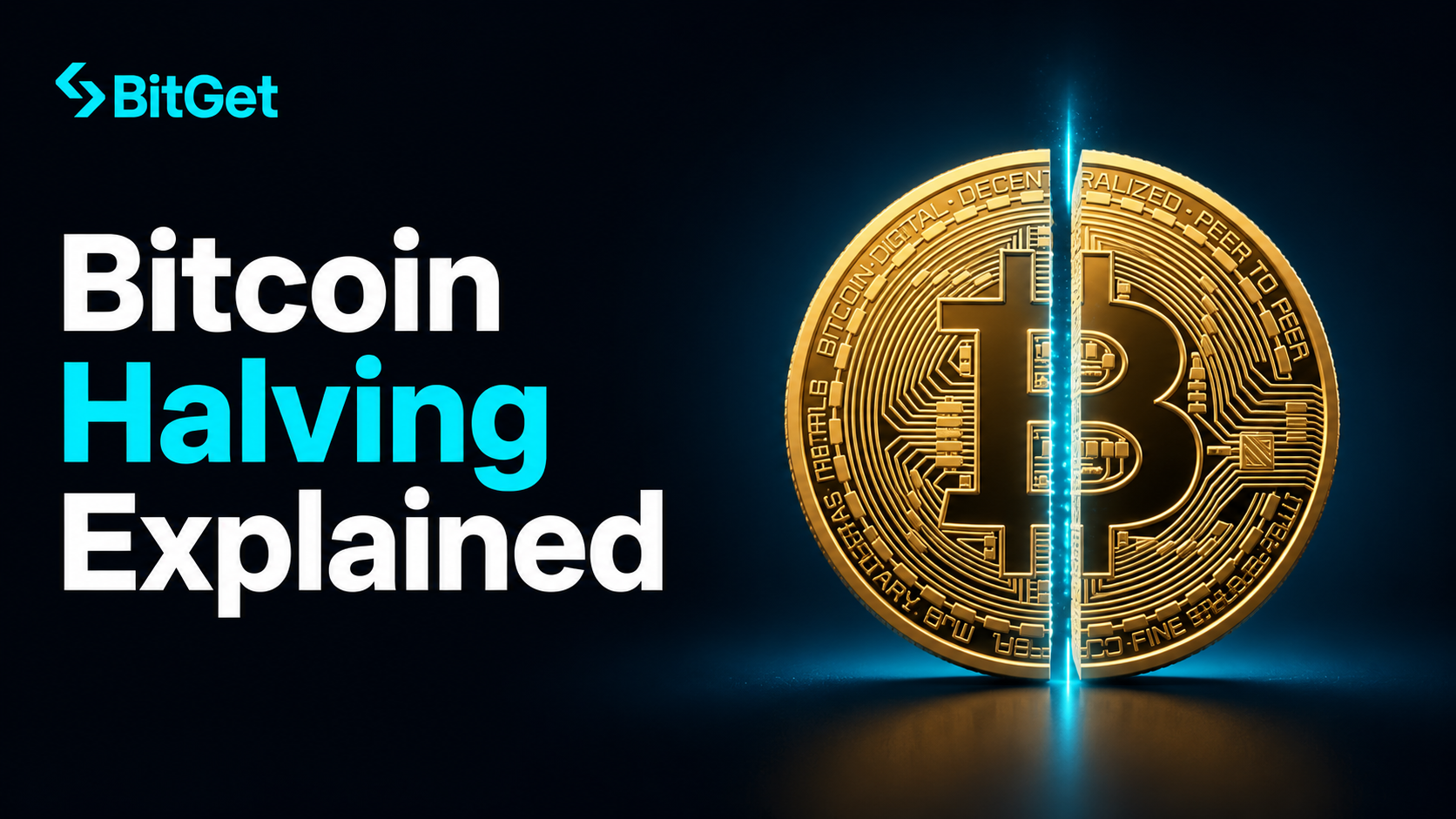
Short answer: Bitcoin halving is a programmed event that cuts the mining reward in half every 210,000 blocks (roughly every four years). It reduces the rate of new Bitcoin entering circulation. The last halving was in April 2024, when the block reward dropped from 6.25 BTC to 3.125 BTC. The next Bitcoin halving is estimated for April 2028, when the reward will drop again to 1.5625 BTC per block. The halving is hard-coded into Bitcoin’s protocol and cannot be changed.
Key takeaways
- Bitcoin halving happens every 210,000 blocks — roughly every four years.
- The current block reward is 3.125 BTC (post-April 2024 halving).
- The next halving is estimated for April 2028, dropping the reward to 1.5625 BTC.
- The halving exists to enforce Bitcoin’s 21 million supply cap.
- Every halving in history has been followed by a major price rally — but past performance is not a forecast.
- Miners feel the pain immediately. Investors usually see the effect 6–18 months later.
What Bitcoin halving actually is
Bitcoin halving is a built-in rule in the Bitcoin protocol that cuts the reward miners get for adding a new block to the blockchain. It happens every 210,000 blocks. Because Bitcoin produces a block every 10 minutes on average, that works out to roughly once every four years.
When Bitcoin launched in 2009, the block reward was 50 BTC. Every halving since has cut that number in half:
- 2009–2012: 50 BTC per block
- 2012–2016: 25 BTC per block
- 2016–2020: 12.5 BTC per block
- 2020–2024: 6.25 BTC per block
- 2024–2028: 3.125 BTC per block (current)
- 2028 onward: 1.5625 BTC per block (estimated)
This will keep happening until roughly the year 2140, when the final fractional Bitcoin gets mined and the block reward drops to zero. From that point on, miners will earn only transaction fees.
Why it matters
Bitcoin’s value proposition leans hard on scarcity. There will only ever be 21 million coins. The halving is the mechanism that enforces that cap by gradually choking the supply of new coins entering circulation.
Roughly 19.8 million BTC have been mined so far. That’s around 94% of the total supply. The remaining 6% will trickle out over the next century.
If you’re brand new to all this, read what is Bitcoin first. It’ll make this whole post hit harder.
When is the next Bitcoin halving
The next Bitcoin halving is estimated for April 2028.
The exact date can’t be pinned to the day because block times vary. The 10-minute average is just that — an average. Some blocks come in three minutes, others in twenty. The halving happens at block 1,050,000, and the network will get there when it gets there.
How to track the date yourself
Two sites do this well:
- CoinGecko’s Bitcoin halving countdown — clean, shows estimated date and current block height.
- Buy Bitcoin Worldwide halving clock — same data, with historical context.
Bookmark one. As the date approaches, the estimate gets more precise.
What the block height tells you
At the time of writing, Bitcoin is at roughly block 900,000. The 2028 halving triggers at block 1,050,000. So we’re about 150,000 blocks away. At 10 minutes per block, that’s about 1,041 days — call it 2.85 years.
The estimate tightens as we get closer. By a month out, it’ll be down to the hour.
Why halving exists (the 21M supply cap explained)
Satoshi Nakamoto designed Bitcoin with one number in mind: 21 million coins. That cap is the entire economic foundation of Bitcoin’s value proposition. If the supply could keep expanding forever, Bitcoin would be no different from fiat money — and the whole point would collapse.
The halving is the throttle that enforces the cap. If miners got 50 BTC per block forever, Bitcoin would have hit 21 million coins within about 13 years. By cutting the reward in half every four years, the supply curve flattens into a smooth asymptote that never quite reaches 21 million — it just gets infinitely close.
Bitcoin’s issuance schedule
| Period | Block reward | New BTC per year | Cumulative supply |
|---|---|---|---|
| 2009–2012 | 50 BTC | ~2.6M | 10.5M |
| 2012–2016 | 25 BTC | ~1.3M | 15.75M |
| 2016–2020 | 12.5 BTC | ~656k | 18.4M |
| 2020–2024 | 6.25 BTC | ~328k | 19.7M |
| 2024–2028 | 3.125 BTC | ~164k | 20.1M (est) |
| 2028–2032 | 1.5625 BTC | ~82k | 20.3M (est) |
By the time the halving in 2032 happens, 95%+ of all Bitcoin will already be mined. The remaining 5% will take another 108 years to fully release.
This is the part that makes Bitcoin maximalists giddy and economists shrug. Hard, finite supply meets unlimited demand. Or that’s the bet.
For a wider view on what makes Bitcoin tick, what is Bitcoin walks through the whole design.
The 4-year cycle pattern
Trading Bitcoin without knowing the cycle is like sailing without checking the tide. Every halving has been followed by a recognisable pattern:
- Halving event. Supply of new BTC drops 50% overnight.
- 6–12 months of consolidation. Price doesn’t move much. Retail forgets about it.
- Bull run. Price rallies 5–15x from the halving baseline over the following 12–18 months.
- Peak and crash. Price hits a new all-time high, then drops 70–85%.
- Bear market. 12–18 months of pain and accumulation.
- Next halving. Cycle restarts.
This isn’t theory. It’s happened three times. The pattern is so consistent that traders have built entire strategies around it.
Why the cycle works (probably)
The mechanism is part supply-shock and part psychology. The supply-shock part is real — when new issuance halves overnight, the same demand chases fewer new coins, and the price has to adjust. The psychology part is sentiment-driven — halving events get media coverage, that drives retail attention, that drives buying, that drives more attention.
There’s a third factor that’s harder to measure: institutional money. The 2024 halving was the first one to happen with spot Bitcoin ETFs already trading. That changed the demand side meaningfully. Bitcoin ETF explained covers what that means in practice.
Will the pattern continue?
Honest answer: no one knows. Three data points is not enough to call it a law. The 2024 cycle has so far been less explosive in percentage terms than previous ones — which is what you’d expect as the market grows up. A 10x rally on a $1T market cap is harder than a 10x rally on a $100B one.
But the structural setup is still there: a programmed supply cut, deep liquidity, and a maturing institutional buyer base. Whether the cycle plays out as it has before, or whether the pattern softens into something gentler, is the trade everyone is trying to figure out.
Historical halvings and price impact
Here’s what actually happened around each halving.
Halving 1: November 28, 2012
- Block reward: 50 BTC → 25 BTC
- Bitcoin price on halving day: ~$12
- Price 12 months later: ~$1,000 (roughly 83x)
- Peak of cycle: ~$1,150 (late 2013)
- Following bear market low: ~$170 (early 2015)
The first halving happened when almost no one was watching. Bitcoin was a curiosity, not a market. The rally that followed introduced Bitcoin to the world for the first time.
Halving 2: July 9, 2016
- Block reward: 25 BTC → 12.5 BTC
- Bitcoin price on halving day: ~$660
- Price 18 months later: ~$19,700 (roughly 30x)
- Peak of cycle: ~$19,700 (December 2017)
- Following bear market low: ~$3,200 (December 2018)
The 2016 halving kicked off the 2017 ICO boom. Bitcoin went from financial nerds’ hobby to dinner-table conversation. The peak ended in a brutal 84% drawdown.
Halving 3: May 11, 2020
- Block reward: 12.5 BTC → 6.25 BTC
- Bitcoin price on halving day: ~$8,600
- Price 18 months later: ~$67,500 (roughly 7.8x)
- Peak of cycle: ~$69,000 (November 2021)
- Following bear market low: ~$15,500 (November 2022)
The 2020 halving happened during the early COVID pandemic. The rally that followed was supercharged by stimulus money and remote-work boredom. The peak ended in another 77% drawdown, made worse by the FTX collapse.
Halving 4: April 19, 2024
- Block reward: 6.25 BTC → 3.125 BTC
- Bitcoin price on halving day: ~$63,500
- Price 12 months later: ~$84,000 (roughly 1.3x at the first anniversary)
- This cycle is ongoing as I write this in May 2026.
The 2024 halving was the first one with spot ETFs already running. Demand-side dynamics looked different from the start, and the post-halving rally has played out differently — slower and more grinding rather than the explosive arc of previous cycles.
What the pattern actually shows
Each halving cycle has delivered a smaller multiplier than the one before:
- Cycle 1: ~83x
- Cycle 2: ~30x
- Cycle 3: ~7.8x
- Cycle 4: still in progress
That’s exactly what you’d expect from a maturing asset. The early days had thin liquidity and tiny market caps — small inflows could move price massively. Now Bitcoin is a $1T+ market and the same buying pressure has less effect. The cycle is dampening, not dying.
CoinGecko’s historical price data is the easiest place to verify all of this yourself.
How halving affects miners
For miners, halving is a brutal cliff. The day before the halving they earn X. The day after they earn X/2. Their electricity bill doesn’t drop. Their hardware doesn’t get cheaper. Their rent stays the same.
What happens to the mining industry
Within weeks of every halving, the least efficient miners switch off. Their electricity cost per BTC has just doubled, and at current prices they’re operating at a loss. They either upgrade hardware, move to cheaper power, or shut down.
The network responds with a difficulty adjustment. Bitcoin’s protocol re-targets the difficulty every 2,016 blocks (about two weeks). When miners drop off, the difficulty drops, blocks come faster, the remaining miners earn more per block, and equilibrium returns.
It’s a Darwinian process. After every halving, mining concentrates further into:
- Operations with the cheapest power (Iceland, Texas, parts of Russia, hydropower regions of China before the ban, Paraguay)
- Operations with the newest, most efficient ASICs (S21, S21 Pro, Whatsminer M60 series)
- Operations with the deepest balance sheets to survive the squeeze period
The 2024 halving impact
After the April 2024 halving, network hashrate initially dropped 5–10% as inefficient miners switched off. It recovered within three months as price moves and difficulty adjustments restored profitability for survivors.
Publicly listed mining companies (Marathon, Riot, CleanSpark, Core Scientific) felt the squeeze but most made it through. The companies that struggled most were the ones with high debt loads from buying hardware on credit during the peak.
If you want exposure to the mining angle without buying rigs yourself, GoMining (affiliate) is one way to do it — they run the rigs and you buy tokenised hashpower. Covered in more detail in the GoMining review.
What does this mean for the network’s security
Less than you’d think. Even after halvings, the Bitcoin network’s hashrate has hit new all-time highs within 6–12 months. The economics shift but the network keeps growing.
How halving affects Bitcoin price
This is the question everyone really wants the answer to. Here’s the honest version.
The supply-side argument
Every halving cuts the new supply of Bitcoin entering the market in half. If demand stays constant, basic economics says price has to rise. New issuance after the 2024 halving was around 164,000 BTC per year — less than half the rate before.
For context, spot Bitcoin ETFs alone have absorbed multiples of that figure since launch. If ETF inflows continue at anywhere near their current pace, the post-halving supply just doesn’t keep up with demand.
The demand-side argument
But Bitcoin isn’t a pure supply story. Demand can dry up too. If macroeconomic conditions turn (rising rates, regulatory hostility, banking stress that forces forced selling), all the supply restriction in the world won’t stop the price from falling.
The 2018 and 2022 bear markets both happened on the back of halvings that “should” have driven prices up. They didn’t, because demand cratered first.
The realistic caveat
The honest answer for traders is this: the halving sets up favourable supply conditions, but it does not guarantee a price rally. Three out of four halvings have been followed by major bull markets. That’s encouraging. It’s not proof.
If you’re thinking about putting money in around a halving, the right mental model is: “I’m taking a position on a probabilistic setup, not buying a sure thing.” Read is crypto a good investment before you size your position.
The “stock-to-flow” model
You’ll hear about PlanB’s stock-to-flow (S2F) model. It’s a model that uses Bitcoin’s scarcity ratio to predict price. It nailed the 2020 cycle. It missed badly on the 2024 cycle so far. Treat it as one input, not gospel.
Strategies investors use around halving
There are roughly four approaches I’ve seen actually work, and one that mostly burns money.
1. DCA through the cycle
The simplest strategy. Buy a fixed dollar amount of BTC every week or month, ignore the price, hold for the full cycle. You’ll catch the rally and ride the crash. Over a four-year window, this strategy has outperformed most active traders.
If you want to automate this, the BitGet DCA bot handles it without you thinking about it. Set the schedule, fund the account, walk away.
2. Pre-halving accumulation, post-peak exit
Some traders front-load buying in the 12 months before a halving (when sentiment is still beaten down from the bear market), then trim into strength as the bull run unfolds. The risk is timing the exit — most people don’t and ride it all the way back down.
3. The “wait for the bear” strategy
This one’s controversial. Don’t buy near a halving at all. Wait for the post-cycle drawdown, when Bitcoin is down 70%+ from the peak, and buy heavily into the panic. This worked beautifully in 2015, 2018, and 2022.
The catch: requires patience, conviction, and the ability to buy when everyone says Bitcoin is dead. Most people can’t.
4. Mining stocks as proxy
If you don’t want to hold BTC directly, mining stocks (RIOT, MARA, CLSK) tend to move with Bitcoin but with higher beta. They can outperform in bull markets and underperform brutally in bears. Mining stocks were down 80–90% in the 2022 bear, then up 5x in the 2023–2024 recovery.
If you want to learn cycle trading properly, my honest recommendation is Trade Travel Chill (affiliate) — it’s the community I’m part of and the one structured education source I trust for retail traders. There’s a lot of garbage out there. Most “trading courses” are just affiliate funnels for whatever exchange the influencer is paid by.
5. The strategy that mostly burns money
Buying with leverage right before a halving expecting an immediate moonshot. The price almost never moves immediately. The rally typically starts 3–6 months later. Leverage positions get liquidated in the chop that comes first.
If you want to trade futures around halvings, BitGet (affiliate) has competitive fees and 125x cap — but read how to read crypto charts and crypto trading indicators first. Going in blind is the same as donating.
Where to buy and store BTC around halving
If you’re going to take a position before or around a halving, you’ll need two things: a buying venue and a storage solution.
Where to buy
For most retail traders, a centralised exchange is the simplest entry. I use BitGet for active trading because it has the deepest pair list, competitive fees (0.10% spot maker/taker), and a solid mobile app. Sign up to BitGet here (affiliate).
If you’re brand new to buying crypto, work through how to buy crypto first — it covers exchanges, P2P, and on-ramps. For Bitcoin specifically, how to buy Bitcoin walks step by step.
Want to compare options? Best crypto exchanges has the full ranked list.
Where to store
This is where most beginners get burned. If you’re buying BTC to hold through a halving cycle (12 months minimum), it should not stay on an exchange. Exchanges fail. FTX failed. Mt. Gox failed. Celsius failed. The pattern is consistent.
I use a Ledger Nano X (affiliate) for anything I’m holding longer than a few months. Hardware wallets cost £100–£150 and remove counterparty risk completely. Worth every penny. Detailed walkthrough in the Ledger Nano X review and the broader how to store crypto safely guide.
The rule I follow: any single exchange holds less than I’d be willing to lose to a black swan event. Everything else is in cold storage.
If you want to send BTC between wallets, how to send Bitcoin covers the basics.
GoMining angle for those who want exposure without rigs
If the mining side of the halving story interests you but you don’t want to buy ASIC hardware, GoMining (affiliate) is the route I’ve tested. They run the physical mining infrastructure and tokenise the hashpower. You buy NFTs that represent a slice of their fleet, and you earn BTC daily based on the network’s mining economics.
Full breakdown in the GoMining review. The summary: it’s not a get-rich-quick play, but it gives you exposure to Bitcoin’s mining economy without the capital outlay or operational headaches of running rigs yourself.
The catch with any tokenised mining product is that you’re trusting the operator. GoMining has been transparent about their hashrate, payouts are on-chain, and the model has held up across multiple halvings. But it’s a centralised counterparty, not self-sovereign Bitcoin. Read the review and decide where it fits.
TTC mention for cycle education
If you want to actually learn cycle trading — not just read about it on blogs — Trade Travel Chill (affiliate) is where I’d point you. It’s the community I’m part of. The members have traded multiple Bitcoin cycles, the education is structured rather than YouTube clip-bait, and the people there are real traders rather than influencers selling courses.
Why does it matter for the halving conversation? Because the difference between making money around a halving cycle and getting destroyed by it isn’t knowledge of the halving itself — that part is publicly available. It’s everything around it: how to read the cycle phases, when to size up, when to take profit, how to manage emotions when Bitcoin is up 200% and you’re tempted to gamble it on a memecoin.
The trading psychology piece is covered in crypto trading psychology. The strategy piece is covered in best crypto trading strategy. The community piece is what TTC adds on top.
Not a hard sell. Just where I’d send a friend asking.
Frequently asked questions
What is the next Bitcoin halving?
The next Bitcoin halving is estimated to occur in April 2028. The exact date depends on the network’s average block time and will be known precisely as we approach block 1,050,000. After this halving, the block reward will drop from 3.125 BTC to 1.5625 BTC.
How often does Bitcoin halving happen?
Bitcoin halving happens every 210,000 blocks, which works out to roughly every four years. Because block times vary slightly around the 10-minute average, the exact date can shift by a few weeks either way.
What is the block reward after the next halving?
After the 2028 halving, the block reward will be 1.5625 BTC per block. After the 2032 halving, it will be 0.78125 BTC. The reward keeps halving until roughly the year 2140, when the final fractional Bitcoin gets mined.
Does the halving guarantee a price increase?
No. Three out of four halvings have been followed by major bull markets, but past performance does not predict future results. The halving creates favourable supply conditions, but demand can still collapse for other reasons (macro stress, regulation, black swan events).
How does halving affect Bitcoin miners?
Miners earn half as much for the same work overnight. Inefficient miners with high electricity costs typically shut down. The network’s difficulty adjusts within 2–4 weeks to restore profitability for the remaining miners. Hashrate usually drops 5–10% short-term then recovers to new highs within 6–12 months.
Will Bitcoin halvings continue forever?
No. The halving schedule is programmed to continue until roughly the year 2140, at which point the block reward will round down to zero and all 21 million Bitcoin will have been mined. From that point, miners will earn only transaction fees.
When was the last Bitcoin halving?
The last Bitcoin halving was on April 19, 2024, at block 840,000. The block reward dropped from 6.25 BTC to 3.125 BTC.
What happens to Bitcoin when all coins are mined?
When the last Bitcoin is mined around the year 2140, miners will earn nothing from new issuance. They will still earn transaction fees from people moving Bitcoin around. Whether transaction fees alone are enough to secure the network is one of the long-running debates in Bitcoin economics.
Final word
The halving is the single most predictable event in crypto. The date is set, the math is fixed, the supply impact is guaranteed. What isn’t guaranteed is what the market does in response.
If I were starting again today, this is what I’d do around a halving cycle:
- Set up an exchange account and complete KYC well before the halving so you’re ready when prices move. Sign up to BitGet (affiliate).
- Get a hardware wallet. Move long-term holdings off exchanges. Get a Ledger (affiliate).
- Build a position with DCA across the 12 months before and after the halving — don’t try to nail the bottom.
- Define a profit-taking plan before the rally starts. Decide what percentage you’ll trim at what targets. Stick to it.
- Read the cycle pattern, but don’t trade as if it’s gospel. The macro overlay matters as much as the halving itself.
Three halvings, three bull markets, three brutal drawdowns. The fourth is in motion. The fifth is coming. Whether you make it through wealthier or wiser will depend on what you do before the moment, not during it.
Right — over to you.
Related posts
- Bitcoin vs Ethereum: Honest Comparison from a Trader Who Holds Both
- Bitcoin ETF Explained: What It Is and Whether You Need One
- How to Buy Bitcoin: The Step-by-Step Guide