My first margin trade on BitGet doubled my account in three days. My second margin trade halved it in six hours. The lesson wasn’t that margin is bad — it was that I’d accidentally been running cross margin when I thought I was on isolated, and one altcoin position liquidated my entire balance instead of just the collateral I’d allocated to it. That mistake cost me about £800 and a weekend of feeling stupid. This post is what I wish I’d read before opening that first margin trade.
Some links here are affiliate. I’ll mark them.
Heads up: Margin trading uses borrowed funds. A wrong-side move can wipe your collateral and leave you owing interest. If you’re new to crypto, start with spot trading first. The numbers in this article are examples, not promises.
Short answer: BitGet margin trading lets you borrow funds against your spot holdings to take larger positions, with up to 10x on spot margin. You choose cross margin (entire margin account as collateral, lower liquidation risk per position) or isolated margin (each position has its own collateral wall, higher per-position liquidation risk but contained losses). Interest is charged hourly on borrowed amounts. Margin trading is between spot and futures in complexity and risk.
Open BitGet margin trading → (referral link)
Key takeaways
- BitGet margin trading offers up to 10x on spot, with both cross and isolated modes per pair.
- Interest is charged hourly — the longer you hold a borrowed position, the more it costs.
- Cross margin shares collateral across positions; isolated walls off each trade.
- Margin sits between spot and futures: more upside than spot, but a hidden cost in interest that futures funding doesn’t replicate the same way.
- BitGet publishes its margin interest rates on the official fees page, with daily rates on major assets typically between 0.01% and 0.06% depending on supply and demand.
What is spot margin trading and how does it differ from futures or spot?
Spot margin trading is borrowing money to buy or short crypto. Your existing crypto (or stablecoins) acts as collateral. You buy or sell a position larger than your cash would normally allow. You pay interest on the borrowed amount until you close.
This is different from spot in two ways: you can short (sell what you don’t own and buy back later), and you can scale a position up to 10x your collateral. It’s different from futures in three ways: there’s no funding rate, no expiry, and the borrowing cost is interest paid hourly on the principal — a real loan, not a swap rate.
The maths is more like a stock broker’s margin account than a crypto perpetual. If you’ve used margin on Robinhood or Interactive Brokers, the mechanics are similar.
| Type | Leverage | Borrowing cost | Expiry | Best for |
|---|---|---|---|---|
| Spot | None | None | None | Buy and hold, simple trading |
| Spot margin | Up to 10x | Hourly interest | None | Short-term directional bets, shorting altcoins |
| Futures (USDT-M) | Up to 125x | Funding rate (8h) | None (perp) or quarterly | High-leverage trading, hedging |
If the difference still feels fuzzy, read the BitGet spot trading guide first to get clear on spot, then come back here.
What’s the difference between cross margin and isolated margin?
This is the single most important decision in margin trading. Getting it wrong is how accounts die.
Cross margin
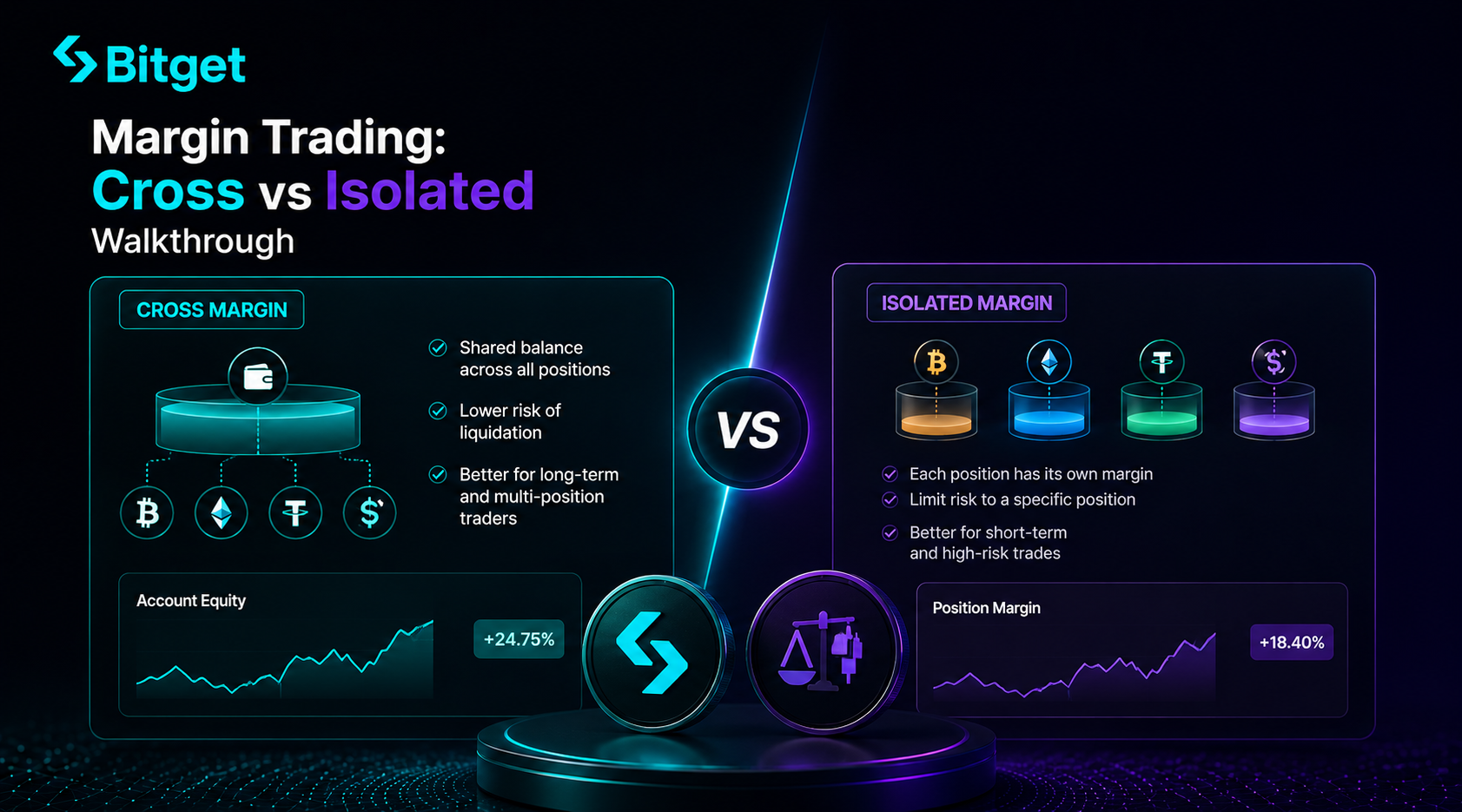
Your entire margin account balance acts as collateral for every open position. If one position moves against you, BitGet pulls from your full balance to keep it open. This delays liquidation — you can survive deeper drawdowns before any position closes.
The catch: when liquidation does hit, it can take everything. One catastrophic trade can wipe the entire margin account, including positions that were doing fine.
Isolated margin
Each position has its own collateral pool. You allocate, say, $500 to a SOL long. That $500 is at risk. The rest of your margin account is walled off. If SOL crashes, you lose the $500 (or less, after liquidation) and the other positions are untouched.
The catch: the position liquidates faster because it can only use its allocated collateral. No buffer from the rest of the account.
Side-by-side
| Feature | Cross margin | Isolated margin |
|---|---|---|
| Collateral | Entire margin balance | Allocated to that position only |
| Liquidation distance | Further (more buffer) | Closer (smaller buffer) |
| Liquidation loss | Up to full account | Up to allocated amount |
| Best for | Hedged pairs, correlated positions | Speculative single bets, learning |
| Default for beginners | No | Yes |
What I do
Isolated by default. Always. The mental model: each trade is its own bet with its own bankroll. If the bet fails, I lose the bankroll for that bet and nothing else. Cross margin is for traders who are running multiple positions that hedge each other or for pros who want every spare dollar of collateral working for them. For a retail trader running one or two positions at a time, isolated is the right choice.
What are BitGet margin fees and interest rates?
There are two costs to know.
Trading fees
Spot margin trades pay the same fee schedule as regular spot trades. Regular tier is 0.10% maker / 0.10% taker. Hold BGB and use it for fee payment — 20% discount. VIP tiers reduce this further.
Full breakdown in the BitGet trading fees post.
Interest on borrowed funds
This is the cost that catches people out. Every hour you hold a borrowed position, BitGet charges interest. The rate varies by asset and is based on supply and demand in the platform’s lending pool.
Typical daily rates as published on the official BitGet fees page:
| Asset | Approx daily interest |
|---|---|
| USDT | 0.025–0.05% |
| BTC | 0.01–0.025% |
| ETH | 0.01–0.03% |
| Small altcoins (when borrowable) | 0.05–0.5% |
Rates fluctuate. During high demand (volatile periods), interest on USDT can double overnight.
The maths to remember: 0.04% daily = roughly 14.6% annualised. If you’re holding a leveraged long with 10x leverage, you’re effectively borrowing 9x your collateral. So a 14.6% annual rate on the borrowed portion means about 130% effective annual interest on your collateral. Margin trading is not free money.
This is why margin makes sense for trades you’ll close in days, not weeks. The longer you hold, the more interest eats your edge.
How do you enable margin trading on BitGet?
Three steps. Takes about two minutes.
- Open a margin account. Go to the spot trading interface. Click the margin tab. The first time, you’ll be prompted to open a margin account — there’s a short risk acknowledgement to read and tick.
- Transfer collateral. Move USDT (or another supported asset) from your Spot account to your Margin account. Until you fund it, you can’t borrow.
- Select margin mode per pair. Each trading pair has a toggle for cross or isolated. Set it before you place the trade. You can’t switch with an open position.
Once you’re in, the trading interface looks identical to spot trading. The difference is the margin slider — instead of buying with your own balance, you set the leverage and BitGet auto-borrows the rest.
How do you place a margin trade step by step?
Walking through a real BTC long at 5x leverage.
- Open margin tab. On the BTC/USDT pair, switch from Spot to Margin (Cross or Isolated). Confirm Isolated for this example.
- Set leverage. Slider goes from 1x to 10x. Start at 2x or 3x your first time. We’ll use 5x for this example.
- Choose buy or sell. Buy (long) means you borrow USDT, buy BTC, and need price to rise. Sell (short) means you borrow BTC, sell it for USDT, and need price to fall.
- Enter amount. With $1,000 of collateral at 5x leverage on a long, you’re opening a $5,000 BTC position. BitGet auto-borrows $4,000 USDT.
- Place order. Limit or market. Limit is cheaper (maker fee), market is faster.
- Set stop loss. Mandatory. Use a bracket order. Without a stop, one bad weekend can liquidate you.
- Monitor liquidation price. The interface shows your liquidation price in real time. Watch the gap between current price and liquidation. If it gets thin, top up margin or close partially.
- Close and repay. When you close, BitGet auto-sells the position and repays the borrow. Interest accrued is deducted from your remaining balance.
That’s the mechanics. The hard part is the position sizing, not the buttons.
How does liquidation work in margin trading?
When your margin level drops below a threshold (usually around 110% on isolated, 105% on cross), BitGet triggers a margin call. If you don’t add collateral or close part of the position, the system force-closes at the liquidation price to recover the borrowed amount.
A few specifics:
Maintenance margin is the minimum equity you need versus the borrowed amount. If borrowing $4,000 against $1,000 collateral, your equity needs to stay above a calculated minimum (varies by asset).
Liquidation isn’t a clean close. The system can take a few percent in slippage and fees. So a 20% liquidation in theory often costs 22–23% in practice.
Insurance fund. BitGet runs an insurance fund that covers cases where the liquidation didn’t recover the full borrow (auto-deleveraging). In extreme flash crashes, profitable counterparty positions can be partially clawed back to cover the shortfall — same mechanism that exists on futures.
The simple rule: if your liquidation price is closer than 2x the typical daily range of the asset, you’re over-leveraged. Reduce position size or add margin.
What are the most common margin trading mistakes?
Five I see over and over, three of which I made personally.
Mistake 1: trading on cross when you meant isolated
This is the one that cost me £800. I assumed isolated was default. It wasn’t. One bad position took the whole margin account. Always check the mode before placing the trade.
Mistake 2: holding through interest drag
Margin trades are short-term tools. Holding a 5x position for two weeks at 0.04% daily interest costs roughly 5.6% of your collateral in interest. If the trade ends flat on price, you’re down nearly 6% before fees. Margin trades that need to be right within days, not weeks.
Mistake 3: shorting low-volume altcoins
The interest rate on borrowing a thinly-traded altcoin can spike to 0.5% or higher daily. That’s 180%+ annualised. Even if your short call is right, the borrow cost can eat the entire edge. Stick to majors (BTC, ETH, SOL, XRP) for short positions.
Mistake 4: no stop loss
Margin without a stop is a slow liquidation. Period. The interface lets you set bracket orders with stop and take-profit attached when you open. Use them every time. Setting them after is fine. Not setting them at all is how accounts die overnight.
Mistake 5: using margin to add to losing trades
Averaging down on a losing margin position multiplies your borrowed exposure right at the moment your conviction should be re-tested. If the original trade was wrong, doubling the bet with borrowed money is wrong twice. Close the bad trade. Take the loss. Reset.
If account security is also on your mind, I’d add a sixth: trading from public WiFi without a VPN. I use NordVPN on any device I trade from — public networks are where account takeovers happen.
Ready to try margin on BitGet?
BitGet’s margin interest rates are among the lowest of the tier-1 exchanges. Sign-up takes 90 seconds. KYC usually clears the same day.
Affiliate link. I may earn a commission at no extra cost to you.
When does margin make sense versus futures?
The real question every intermediate trader asks. Three frames.
Use margin when:
- You want to short an altcoin that doesn’t have a futures contract
- You want a position with no funding rate to worry about
- The trade horizon is under a week (interest stays small)
- You want simpler tax treatment (margin is spot-like in many jurisdictions)
- Position size is small enough that interest doesn’t dominate cost
Use futures when:
- You want leverage above 10x
- You want hedging on majors without paying daily interest
- The trade horizon is longer (funding is usually cheaper than interest)
- You need tighter spreads and deeper liquidity (futures order books are deeper)
- You want to use stop-limit, trailing stop, and conditional order types in their full form
In practice I use futures for 80% of my leveraged trading. Margin gets used when I want to short an altcoin that doesn’t have a perpetual contract, or when I’m running a short-term hedge against a spot bag without wanting to deal with funding flips.
For a closer look at the futures side, BitGet futures USDT-M covers perpetuals end to end. BitGet leverage explained covers the leverage maths in detail.
Where to learn margin trading properly
You’ll need three things: the maths, the platform, and the head.
The maths: understanding how leverage, interest, and liquidation distance interact. There are free resources on this — Investopedia’s margin trading primer is a solid starting point even though it’s stock-focused. The mechanics translate directly.
The platform: BitGet has demo trading for futures but not for margin. The closest you’ll get is opening a small isolated margin position with a tiny allocation ($50, 2x leverage) and going through the full lifecycle — open, watch interest accrue, close. Three of those and you’ll know the workflow.
The head: this is the bit nobody talks about. Margin trading is psychologically harder than spot because you can lose money while you sleep. Holding a position through bad nights, sticking to stops, not chasing losses — these are skills.
If you actually want to learn this, I’d point you at Trade Travel Chill — it’s the community I’m part of and the one structured education source I trust for risk-managed leveraged trading. The free YouTube content out there is mostly people showing wins and hiding losses. Structured education is the only thing that compresses the learning curve without the tuition fee coming out of your trading account.
For the full list of paid options, see best crypto trading courses.
Open a margin account on the platform I use
Start with isolated mode, 2x leverage, and a small position. Build up only after you’ve held three positions to close without panic.
Affiliate link.
Frequently asked questions
What is BitGet margin trading?
Margin trading on BitGet means borrowing funds from the exchange to open larger spot positions than your cash balance allows. You can long or short with up to 10x leverage. You pay hourly interest on the borrowed amount.
Is cross margin or isolated margin safer?
Isolated margin is safer for beginners. Each position has its own collateral pool, so a loss on one trade can’t drain your full balance. Cross margin is more capital-efficient but riskier — one bad position can wipe the whole account.
How much interest does BitGet charge on margin trades?
Daily interest rates typically run between 0.025% and 0.05% on major assets like USDT and BTC, and higher on small altcoins. That’s roughly 9–18% annualised on borrowed funds. Rates are published on the official BitGet fees page and update with market demand.
Can I short crypto on BitGet without using futures?
Yes. Spot margin lets you short by borrowing the asset, selling it, and buying it back later. This is one of the main reasons to use margin instead of futures — you can short altcoins that don’t have a perpetual contract.
What happens at liquidation on BitGet margin?
When your margin level drops below the maintenance threshold, BitGet force-closes the position at market to recover the borrowed funds plus interest. You lose your collateral (isolated) or part of your margin balance (cross). Liquidation can include slippage, so the actual loss can exceed the theoretical liquidation price.
Is margin trading better than futures?
Neither is universally better. Margin suits shorter-term trades on majors and altcoin shorting. Futures suit higher leverage, hedging on majors, and longer-term positions. Most active traders use both.
Is BitGet margin trading available worldwide?
No. BitGet is geo-blocked for US residents and restricted in several other jurisdictions. Check current availability before signing up.
Related posts
- BitGet Leverage Explained: From 1x to 125x
- BitGet Futures Trading: USDT-M Perpetuals Explained
- BitGet Trading Fees: Maker, Taker, and VIP Tiers
- BitGet Review: The Crypto Exchange I Actually Use