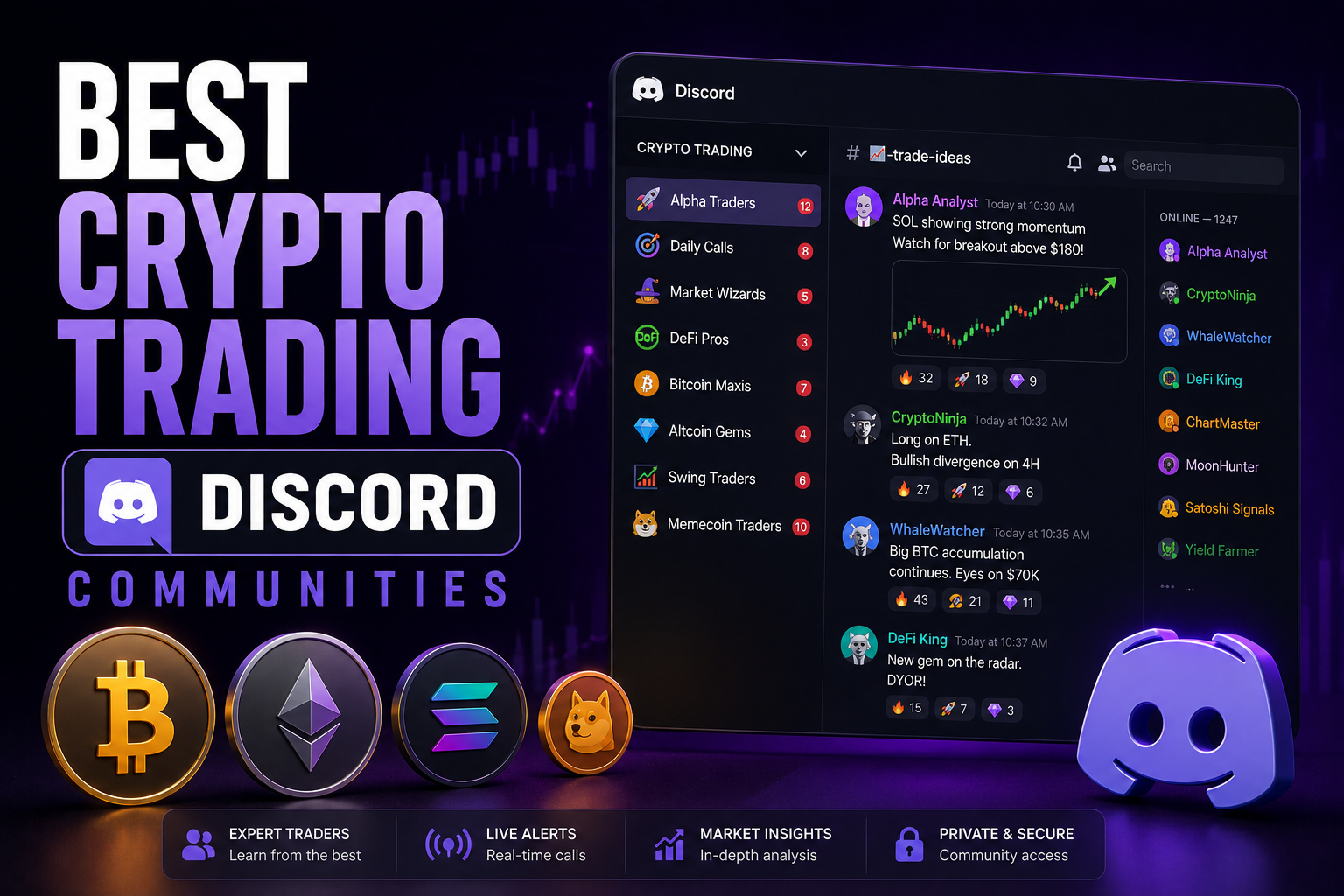
I joined my first crypto Discord in 2020 with the optimism of a Labrador walking into a vet’s office. By 2022 I’d been in roughly thirty of them — some free, some paid, some run by people I’m fairly sure didn’t own crypto. I lost money on tokens posted in three of them and learned almost nothing useful in twenty-six of them. The one Discord that actually changed how I trade is the one I’m part of today. This is the honest sort.
Short answer: The best crypto trading Discord is one that teaches a methodology, has a transparent founder, runs a money-back guarantee, and rewards engagement over hype. Free Discords are useful for news and sentiment but rarely teach you to trade. Paid Discords are worth the money only if they’re education-first, not signal-first. My pick is Trade Travel Chill — Annii Snelleksz’s crypto-only community with 1,000+ Discord members, the TBD System, and a 48-hour money-back guarantee.
See Trade Travel Chill → (referral link)
Key takeaways
- Free Discords are good for news, sentiment, and lurking. They don’t teach process.
- Paid Discords range from genuine education to outright pump-and-dump rooms. The filters in this post help you tell which is which.
- Signal-only groups are almost universally bad. Education-first groups with signals as a side dish are different.
- A money-back guarantee, a real founder identity, and a methodology you can articulate in one sentence are the three non-negotiables.
- The Discord I’m in is Trade Travel Chill — 1,000+ members, crypto-only, $88/month entry, 48-hour refund, 20% off if you pay in crypto.
TL;DR — the criteria that matter
Skip the rest if you just want the framework. A crypto trading Discord is worth paying for when:
- The founder is named, public, and has been doing this longer than a market cycle.
- The product is a teachable methodology — not “vibes” and not “calls”.
- There is a refund policy you can actually use.
- The community is bigger than the founder. People answer each other’s questions.
- The price is in line with what comparable real education costs (think $50–$200/month, not $5,000 one-off).
- You can articulate what you’ll learn in one sentence after looking at the sales page.
Anything missing more than one of those — keep walking.
Why Discord is the default crypto trading platform
When I started trading, Telegram was the standard. By 2022 most serious educators had moved to Discord. There are reasons.
Threading, channels, and roles. Telegram is one long firehose. Discord lets you split market chat, education, alerts, and off-topic into separate rooms. For a trader trying to find a signal in the noise, that matters.
Voice channels for live calls. Discord’s voice channels let traders run live sessions without a separate video platform. If your community offers live market analysis or a weekly Q&A, Discord makes it stupid-simple.
Moderation and search. Discord’s moderation tools are better. Search is faster. Bots can automate alerts. Telegram never caught up.
Identity friction. Discord lets a founder look like a person — profile, server, custom emoji, voice presence. Telegram founders are usually a username and a picture. The trust gap matters when you’re handing over $100/month.
That’s why “best crypto trading Discord” is now a real search query. Slack is for work, Telegram is for noise, Discord is where serious trading communities live.
What Discord doesn’t fix
Discord is a platform, not a guarantee of quality. A scam Discord is still a scam. A good Discord is good despite the platform, not because of it. The filter is the people, not the software.
Free Discord servers — what you actually get
Free crypto Discords are everywhere. Coin Bureau runs one. Crypto Banter runs one. Every halfway-popular YouTuber has one. Most exchanges have one. Most token projects have one.
What you get from a free Discord:
- News and market sentiment. A good free Discord tells you what’s happening before Twitter does.
- Vibe check. When the chat is panicked, the market is usually panicked. When the chat is euphoric, the market is usually about to top.
- Beginner-friendly definitions. Many free servers have FAQ channels covering what a wallet is, how an exchange works, what KYC means.
- Lurking value. You can read a free Discord for months without saying a word and pick up vocabulary, technical analysis basics, and the rhythm of how traders talk.
What you almost never get:
- Structured education. Free Discords don’t teach you a method.
- Accountability. Nobody is going to follow up on whether you took the trade you said you’d take.
- Real risk management coaching. “Use a stop loss” is repeated in every channel. Almost none of them explain position sizing properly.
- Continuity. Free Discords churn through admins. The good one in March can be the dead one in September.
Free Discords worth lurking in
A short list of free Discords I’ve found useful at different points:
- Coin Bureau Discord — solid for news, fundamentals, and crowd sentiment. The official server attached to the channel I’ve contributed work alongside. Heavy moderation, low spam.
- Crypto Banter Discord — busier, more reactive. Useful during volatile sessions. Crypto Banter is another channel I’ve worked with — their Discord skews more day-trader.
- CoinGecko Discord — surprisingly good for project-specific Q&A. Good for “is this token real?” sanity checks.
- Exchange Discords (BitGet, etc.) — useful for platform-specific questions, withdrawal issues, and feature rollouts. Don’t mistake them for educational.
The right way to use free Discords: pick two or three, lurk for a month, mute every channel except the one or two you actually read. Don’t try to keep up with all of them.
Paid Discord communities — the real value vs the scams
Paid crypto Discords occupy a strange space. The good ones are some of the best learning environments in retail trading. The bad ones are pump-and-dump rooms with a Stripe button.
Here’s the spread I’ve seen.
What good paid Discords offer
- Structured education channels. Lessons in a specific order, building from basics to advanced.
- Daily or weekly market analysis. A coach or experienced trader breaking down what they’re watching.
- Live trading sessions. Voice channels where you watch someone trade or analyse a chart in real time.
- Q&A access. Direct lines to the people running the community.
- Active member chat. Where most of the learning actually happens. Members teach each other.
- Indicator access and tools. Many paid communities bundle proprietary TradingView indicators.
What bad paid Discords offer
- “Calls.” Buy this. Sell that. With no explanation and no track record.
- Promised returns. “Members made 320% last month.” (They didn’t, and even if some did, you won’t.)
- An anonymous founder. “CryptoGuru420” with no real identity.
- No refund policy. Or one buried in terms you can’t find.
- Pressure tactics. “Only 12 spots left at this price.” Limited time. Lifetime deal. All the marketing flags.
The price spread runs from about $30/month at the bottom end to $500+/month for premium tiers with 1-on-1 access. Most legitimate paid Discords sit in the $50–$200/month range. Higher than that you’re paying for live mentor access, lower than that you’re usually buying access to a chat with no real education behind it.
For a longer breakdown on which paid courses and communities I’d recommend, see best crypto trading courses — that post covers the same question from the course angle.
Signal groups vs education groups — the critical distinction
This is the single most important call you’ll make. Get it wrong and you’ll burn through cash and never learn anything.
Signal groups
A signal group tells you what to buy and when. You’re paying for someone else’s trades. The promise is that they’re better at trading than you are, and that following them will make you money.
The problems with signal groups:
- Survivorship bias. Every signal group shows you their wins. Almost none show the full record including losses, fees, and slippage. The verifiable track records I’ve seen — the few that exist — usually look mediocre once everything is included.
- Execution drift. Even if the signal is good, by the time you’ve seen the alert, opened the app, and placed the trade, the price has moved. The actual returns to a follower are always lower than the headline returns.
- You never learn. Following signals teaches you nothing. The moment the signal group dies or you cancel the subscription, you’re back to square one. You haven’t learned to size a trade or read a chart.
- They’re often pump and dump. The smaller the token being signalled, the more likely the call is actually a coordinated dump on subscribers. I’ve seen this happen in real time.
Education groups
An education group teaches you how to trade. The promise is that after a few months you’ll have a process you can run yourself. The trades you take are your own. The signals — if any — are case studies, not commands.
Education groups make less money than signal groups, which is part of why there are fewer of them. They also produce real traders, which is why the few that do exist are worth their weight.
Trade Travel Chill is the second kind. Annii doesn’t run signals. The TBD System is a methodology — Trade by Design — that you learn, internalise, and apply to your own setups. The Discord exists so members can sanity-check each other’s analysis, not so Annii can tell people what to buy.
If you only take one lesson from this post: buy education, not signals. Signals expire. Education compounds.
Red flags in any paid Discord
These are the disqualifiers. If a paid Discord has any of these, don’t pay. Doesn’t matter how good the marketing looks.
1. Promised or implied returns
“Members averaged 40% gains last month.” “Our signal accuracy is 92%.” “Make consistent profits trading crypto.”
Any group that frames the offer as a return number is either lying or about to be sued. Real educators don’t promise returns because they know they can’t deliver them. Markets don’t care how good your course is — drawdowns happen, conditions change, win rates fluctuate. Anyone selling certainty in a market that runs on uncertainty is selling fiction.
2. No verifiable track record
Screenshots are not track records. A screenshot is something you can fake in MS Paint. A track record is a verifiable account history, an audited statement, or — the gold standard — an exchange-leaderboard position you can independently confirm.
If the only “proof” is screenshots and testimonials, treat the proof as non-existent.
3. Anonymous founder
If the founder is “Crypto X” or “Trader Z” with no real name, no real face, and no traceable history, walk away. Anonymous founders can disappear with subscriber money tomorrow and you have no recourse.
I’d extend this further. Even named founders are worth a quick Google. Has this person done any podcasts? Any interviews? Any conference talks? Anyone you trust ever mention them? If you can’t find evidence they exist outside their own marketing, that’s the answer.
4. No refund policy
Every legitimate paid product I’ve ever bought has had a refund window. TTC offers 48 hours. Some courses offer 7 days, some 14, some 30. If the founder is confident in the product they will give you a window to see it from the inside.
A “no refunds” policy on a $200/month subscription is a tell. They know that some percentage of buyers will hate the product, and they want to keep the money anyway.
5. Hard pressure marketing
“Only 12 spots left.” “Price goes up at midnight.” “Limited-time bonus.” The marketing doesn’t have to be subtle, but it should be honest. Constant manufactured urgency means the product can’t sell itself.
6. Discord is the whole product
If the entire offer is “access to the chat,” there’s nothing being taught. Real education involves modules, lessons, recordings, and a path through the material. A chat with no curriculum is just an expensive group chat.
Green flags — what good paid Discords look like
The opposite checklist. These are the things I look for before I’d consider paying.
1. Named, transparent founder
A real human you can find on LinkedIn, X, YouTube, and ideally in interviews or podcasts. Bonus points if they’ve been in the space through at least one full market cycle.
Annii Snelleksz is the founder of TTC. Dubai-based. Started trading in 2017. Built the TBD System over years of running it on her own account. You can find her on X (@tradetravelchil), her own YouTube, and she’s interviewed on various crypto podcasts. That’s the bar.
2. A teachable methodology
You should be able to write down what the community teaches in one sentence. “We teach the TBD System — a market-structure-based approach that uses liquidity sweeps and order blocks to find high-probability entries.” That’s a one-sentence description of an actual methodology.
If the answer to “what do you teach?” is “we trade together” or “we share calls,” there’s no method to learn. You’re paying for entertainment.
3. Money-back guarantee
48 hours is the minimum I’d accept. 7 days is comfortable. 30 days is generous. Use the window. Sign up, look at the modules, lurk in the chat, and decide before the clock runs out.
TTC offers 48 hours from purchase. That’s enough to spot-check the product and pull out if the vibe is wrong.
4. Real community engagement
Hop into the public preview or trial of any paid Discord and check the activity. Are members posting in education channels? Are people asking questions and getting answered by other members, not just admins? Is there a culture where being wrong is fine?
The Discord I’m in has rooms where members post their own setups for feedback. Other members critique them. The founder weighs in when it matters but doesn’t dominate. That’s healthy. The opposite — a single mod and 200 silent members — is a ghost town with a paywall.
5. Multiple coaches or experienced contributors
A community that depends entirely on one person is fragile. If the founder gets sick, goes on holiday, or burns out, the value drops to zero.
TTC has what they call the Cabin Crew — Annii plus Cajun Spice, Janet Hauiti, Cody Selby, and NRJ. Different time zones, different specialisms, different teaching styles. You can read more about each of them in the TTC Cabin Crew post. Multiple coaches means the lights stay on regardless of who’s online.
6. Time zone coverage
Crypto trades 24/7. A US-only community is asleep when half the world is awake. A community with members and coaches across multiple time zones means there’s almost always someone around when you need a sanity check.
TTC’s Cabin Crew spans Dubai, Doha, and elsewhere — which means market analysis runs through the Asia session, the European open, and the US session. That breadth matters more the more you trade.
The 5 paid communities worth knowing
I’ll keep this honest. There are more paid crypto Discords than I’ve ever joined. The ones below are either communities I’ve spent time in or ones I’ve heard credible things about from people I trust. Pros and cons are mine, based on what I’ve seen.
1. Trade Travel Chill — my pick
The community I’m part of. Run by Annii Snelleksz from Dubai. Crypto-only. 1,000+ Discord members. Signature methodology is the TBD System (“Trade by Design”) — a blend of forex precision and crypto market structure with a heavy focus on liquidity sweeps, market-maker traps, and defined entries.
Pricing: Business Class is $88/month or $899/year (self-paced, recordings only). First Class is $158/month or $1,610/year (live sessions, daily market updates, pro trader access). Pay in crypto and you get 20% off. 48-hour money-back guarantee.
Pros:
– Education-first. The TBD System is the through-line.
– Named founder with a verifiable history and public presence.
– Multi-coach team (the Cabin Crew) covering multiple time zones.
– Refund window. Pay in crypto for 20% off.
– Live sessions on First Class are really useful.
– 1,000+ hours of recorded material if you go self-paced.
Cons:
– Crypto only. If you trade stocks or forex, you’ll need something else.
– First Class price ($158/month) is higher than the average Discord subscription.
– Engagement-heavy. If you log in once a month, you won’t get full value.
I’ve written a longer Trade Travel Chill review if you want the full breakdown.
2. The price-action / market-structure communities
There are a handful of paid Discords that teach price action and market structure — concepts like smart money concepts, order block trading, and fair value gaps. Some are good, most are recycled material.
Pros:
– Teach a real methodology.
– Crossover from forex SMC traders means there’s a lot of material around.
Cons:
– Quality is highly variable.
– Many are run by anonymous founders.
– A lot of them teach the same material that’s available free on YouTube.
If you go this route, apply the green-flag checklist hard. Specifically the named-founder, refund-policy, and active-community filters.
3. The day-trading-focused communities
Communities focused specifically on intraday and scalping. Often run by traders who post live in voice channels through the US session.
Pros:
– Real-time exposure to how a day trader thinks.
– Voice channels can be useful learning environments.
Cons:
– Day trading is the hardest style for retail. Most members of day-trading communities are still net negative after a year.
– Time zone bias is heavy — most are US-focused.
– Burnout is real for both the trader running the room and the members trying to keep up.
If day trading is your thing, see how to day trade crypto for the unfiltered take before you pay anyone anything.
4. The “alpha” / DeFi farming Discords
Communities focused on finding early DeFi opportunities, airdrop farming, and yield strategies. Different category to trading-focused Discords.
Pros:
– Can be useful if you’re already trading and want a side stream of yield ideas.
– Members often share real-time on-chain insights.
Cons:
– These are not trading communities. Don’t expect to learn TA or risk management.
– DeFi-specific risks (smart contract exploits, rug pulls) are different to trading risks.
– Some “alpha” groups are just front-runs of public information.
Different need, different group.
5. The “signals” Discords I’d avoid
For completeness — there’s a tier of paid Discords whose entire offer is “follow our calls.” I’ve covered why these are usually a bad deal. I won’t name and shame, but you can spot them by the sales page focus on returns rather than education, and the absence of any structured curriculum.
If you find yourself looking at a paid Discord and asking “what will I actually learn here?”, and the answer is “you’ll see our trades,” that’s a signal group. Walk away.
Trade Travel Chill — what makes it the one I joined
I’ll go deeper on TTC because it’s the one I actually use. Skip this section if you’ve read the TTC review already.
The founder problem solved
Annii Snelleksz is a real person, based in Dubai, who started trading crypto in 2017 after a career in business. The reason that matters: she’s been through the 2017–2018 cycle, the 2020 bull run, the 2022 crash, and everything since. A trader who has only seen a bull market is a trader who has only seen half the job. Annii has seen both sides.
The TBD System (Trade by Design) is her own creation. It blends forex precision — proper market structure, defined invalidation, multi-timeframe context — with crypto-specific quirks like funding rates, liquidation cascades, and weekend volatility. The full breakdown is in TBD System explained.
The Cabin Crew (the multi-coach thing)
TTC has what they call the Cabin Crew — Annii plus four other coaches: Cajun Spice (Doha-based, global firms background), Janet Hauiti (no-nonsense judgement-free approach), Cody Selby (TBD specialist, runs Friday hangouts), and NRJ (ex-retail trader, now coach).
The reason that matters: when one coach is asleep, another is online. When one specialises in scalping, another covers swing setups. When you’ve connected with the teaching style of one of them, the others reinforce the same methodology from different angles. A single-founder community is a single point of failure.
The Discord — 1,000+ active members
This is the part that doesn’t translate to a sales page. The Discord is where the methodology gets pressure-tested in real time. Members post setups. Other members critique them. Coaches weigh in when it matters. People share journal entries, win and loss screenshots, and lessons learned.
The size is right — big enough to always have activity, small enough that you can become a recognised regular within a month if you’re posting.
The vibes are unusual for a paid Discord. Less pump, more process. Less hype, more “what’s your invalidation?” When someone posts a win, the next question is “where was your stop?” That culture is hard to build and harder to fake.
24/7 coverage across time zones
Annii is in Dubai. Cajun is in Doha. Other Cabin Crew and senior members span the US, UK, Australia, and Asia. Practically that means market commentary runs across the Asia open, the London open, and the New York session. You can ask a question at 3am UK time and someone is usually awake and answering.
For a retail trader who can’t watch charts all day, this matters. You can check Discord during your lunch break and find that someone has already broken down whatever the market did overnight.
The TBD Indicators
Members get access to a set of proprietary TradingView indicators built around the TBD methodology. The full set is covered in TBD indicators — they’re not magic, but they automate some of the chart annotations you’d otherwise do by hand, and they keep your workflow tight.
48-hour money-back guarantee
The refund window matters. You buy Business Class, log in, look at the modules, scan the Discord activity, sit in on a recorded call. If the vibe is wrong for you, you ask for your money back within 48 hours. That’s a real product confidence signal.
Pricing in plain English
- Business Class — $88/month or $899/year. Self-paced. All courses, recordings, TBD indicators, Discord access.
- First Class — $158/month or $1,610/year. Everything above plus live market updates 3× daily, live trading sessions, weekly Q&A hangouts, direct access to pro traders, mindset coach.
- 20% off if you pay in crypto. That brings Business Class annual from $899 to about $719, and First Class annual from $1,610 to about $1,288.
For most people, Business Class is the right entry. If you’re going to actively trade and want live mentorship, First Class is worth the step up. Don’t pay for First Class before you’ve engaged with Business Class material for a month or two — you’ll get more from the live sessions if you already know the foundations.
If you want the long version of “is it worth it?” see are crypto trading courses worth it.
Want a Discord that teaches process, not pumps?
TTC is the crypto Discord I’m part of. Annii’s TBD System, Cabin Crew of pro traders, 1,000+ members, 48-hour money-back. Pay in crypto for 20% off.
Referral link. I may earn a commission at no extra cost to you.
How to evaluate any Discord before paying
The checklist I’d run before sending money to any paid crypto Discord.
Step 1 — Find the founder
Open Google. Search the founder’s name plus “interview”, “podcast”, “talk”. Are there independent mentions of them? Have they done work outside their own marketing? Do they have a presence on X, YouTube, or LinkedIn that pre-dates the community?
If the founder is a username with no human attached — stop. Don’t pay. Whatever it costs you in opportunity cost, it’s less than losing your subscription to a person who can disappear.
Step 2 — Read the sales page slowly
What is the promise? Is it a return number? Is it an education outcome? Is the methodology named and explained, or is it vague?
A red-flag sales page leads with screenshots of profits and testimonials. A green-flag sales page leads with what you’ll learn and a structured curriculum.
Step 3 — Find the refund policy
Page through the terms. If you can’t find a refund policy in under a minute, treat that as no refund policy. Hidden terms are usually hidden for a reason.
Step 4 — Find independent reviews
Look on Reddit, Trustpilot, X, and YouTube for “is [community] worth it.” Read both the glowing reviews and the angry ones. Pattern-match — is there a consistent complaint? Is there a consistent praise?
Take both with caution. Some negative reviews are from people who never put in any work. Some positive reviews are paid. The signal is in the volume and the specifics.
Step 5 — Lurk before you commit
Many communities offer a free trial, a free preview channel, or at least a public discord server attached to the paid one. Spend a week reading before you pay. You’ll know within seven days whether the culture is for you.
Step 6 — Use the refund window
If you do pay, use the trial window like a job interview. Open every module. Read the Discord. Sit in on a call. Ask one or two questions and see how the response goes. If anything trips your gut — even something you can’t articulate — pull the refund within the window.
I treat the refund window the same way I treat a free trial of any software. It’s not a trick; it’s the product’s way of saying “we know not everyone is the right fit.” Use it as designed.
The 7-day money-back test
A practical drill for trialling any paid Discord. Works for TTC, works for anything else.
Day 1: Sign up. Read the welcome material. Get oriented in the Discord — find the education channels, the chat channels, the announcements. Mute everything you don’t actively want.
Day 2: Open the first module of the curriculum. Take notes. If the first module is well-structured and clearly explained, that’s a positive signal. If it’s a wall of bullet points or a 90-minute video with no notes, that’s a flag.
Day 3: Post in the Discord. Introduce yourself in the new-members channel. Ask a real beginner question in the help channel. See how long it takes to get an answer, and how good the answer is.
Day 4: Lurk in the analysis or setup channels. Read how members talk to each other. Are people respectful? Do they explain themselves? Is there a culture of journaling and learning, or is it all “BTC to 100k incoming”?
Day 5: Sit in on a live session if there is one (or watch a recent recording). Listen to how the coaches teach. Do they explain process, or do they shout calls? Are they comfortable being wrong on camera?
Day 6: Do one of the educational exercises if there is one. Walk through a recent setup using the community’s methodology. See if it produces a defensible thesis on a chart.
Day 7: Decide. If three or more of the above were positive, stay. If two or more were negative, refund.
For TTC specifically, the refund window is 48 hours, so collapse this into a faster sprint. Honestly, you’ll know within the first weekend.
Free vs paid — the honest middle path
I want to be balanced here. Not every retail trader needs a paid Discord. Some people really do fine with free resources.
When free is enough
- You’re in your first month of crypto and you don’t yet know what a stop loss is. Free is correct. Pay later when you know what you’d be paying for.
- You’re an experienced trader from another market (stocks, forex) translating into crypto. You probably need fewer fundamentals and more context, which you can get free on YouTube.
- You only want to dollar-cost-average into Bitcoin and Ethereum. You don’t need a Discord at all. See crypto trading vs investing for why.
- You have under $100 to start with. Spending $88/month on education when you’re trading $50 makes no sense. See how to start trading crypto with $100 for the lean playbook.
When paid pays for itself
- You’ve lost money trading already and you don’t know exactly why.
- You can place a trade but you can’t define your edge in one sentence.
- You’re managing a five-figure account and a single avoided mistake covers a year of subscription.
- You’ve consumed dozens of YouTube hours and you’re still not consistent.
For me, the second list is where I was in 2022. The maths was simple: my average losing trade pre-TTC was around £180. The annual TTC membership is paid off in two avoided mistakes. Real numbers, not marketing maths.
Where the exchange fits
Your Discord won’t trade for you. You still need an exchange to actually place trades. I use BitGet, which is covered in detail in the BitGet review.
The short version: BitGet is what I run for spot, futures, and the BTC/USDT bot. Liquidity is solid, fees are competitive, and it integrates with TradingView so the TBD Indicators work cleanly. You can open an account via my BitGet referral if you want to support the site.
The Discord plus the exchange is the setup. One teaches you what to do. The other lets you do it.
TTC vs free Discords vs other paid options — comparison table
| Trade Travel Chill | Free Discords (Coin Bureau, Banter) | Signal-only Discords | Other paid education Discords | |
|---|---|---|---|---|
| Cost | $88–$158/month (or yearly) | Free | $50–$300/month | $30–$500/month |
| Structured curriculum | Yes (TBD System) | No | No | Varies |
| Named, public founder | Yes (Annii Snelleksz) | Yes (channel owners) | Often anonymous | Varies |
| Money-back guarantee | 48 hours | N/A | Rare | Sometimes |
| Live trading sessions | Yes (First Class) | No | Sometimes | Varies |
| Multi-coach team | Yes (Cabin Crew) | No | No | Rarely |
| Time zone coverage | Multiple regions | Single channel | Often US-only | Varies |
| Methodology you can name | Yes (TBD) | No | No | Varies |
| Education vs signals | Education-first | News-first | Signals-only | Varies |
| Crypto-specific | Yes (crypto only) | Yes | Yes | Varies |
When NOT to join any paid Discord
The honest list:
- You can’t afford it. If $88/month is a stretch, you’ll resent the spend and bail before you’ve learned anything. Wait until the spend doesn’t sting.
- You won’t engage. Joining a community and never posting is a waste. Discord rewards participation. If you know you’ll lurk and never speak, save the money.
- You’re not actually going to trade. If you’re long-term holding Bitcoin and Ethereum and never selling, you don’t need a trading community. You need a hardware wallet and patience.
- You’re emotionally unprepared. If you can’t stomach watching a losing trade play out, no Discord will fix that. Work on crypto trading psychology first.
- You haven’t made the most common mistakes yet. If you’re brand new, you’ll get more value from a Discord after you’ve fallen into a few of the obvious traps. See crypto trading mistakes for beginners for what to expect.
The right time to pay for a Discord is when you’re already trading, already losing or breaking even, and ready to put in the work to actually change that.
Ready to stop guessing and start learning?
TTC is the crypto Discord I’m part of. $88/month gets you in. 48-hour refund if it’s not for you. 20% off if you pay in crypto.
Referral link.
How big is the paid crypto Discord market?
Worth a sanity check on the scale of this market. The crypto education and signal-group market is large — Statista has documented retail crypto trading volume in the trillions globally, and a meaningful slice of new traders pay for some form of community access in their first 12 months. CoinGecko’s industry reports and CoinDesk’s coverage of retail trading flows show the audience for paid education has grown alongside every market cycle.
The flip side, well-documented by sources like the Financial Conduct Authority, is that the majority of retail crypto traders lose money. Industry surveys repeatedly put the share of unprofitable retail traders at 70–85%. A paid Discord doesn’t change those base rates. What it can change is which side of that base rate you end up on — if you actually do the work.
That’s the realistic frame. Paid Discord isn’t a cheat code. It’s an accelerator. The work is still on you.
Frequently asked questions
What’s the best crypto trading Discord?
The best crypto trading Discord depends on your goals. If you want structured education, an active community, and a real methodology, I rate Trade Travel Chill — the community I’m part of. It’s crypto-only, founded by Annii Snelleksz, runs the TBD System, has 1,000+ members, and offers a 48-hour money-back guarantee. Business Class is $88/month or $899/year, First Class is $158/month or $1,610/year, with 20% off if you pay in crypto.
Are paid crypto Discords worth it?
Sometimes yes, often no. A paid Discord is worth it if it teaches a methodology, has a named founder, offers a refund window, and you’ll actually engage with it. It’s not worth it if it’s signal-only, has an anonymous founder, or you’re going to lurk silently. The break-even maths is simple — if the community helps you avoid one bad trade a year, it’s paid for itself.
Is Trade Travel Chill a good Discord?
In my experience, yes. I’ve been a member for over a year. The TBD System is a real methodology, the Cabin Crew of multiple coaches covers different time zones, and the Discord has a culture of process over hype. It’s not for everyone — if you want signals, look elsewhere. But for structured education with a community, I rate it as the best crypto trading Discord I’ve found.
What should I look for in a crypto Discord?
A named and traceable founder, a teachable methodology, a money-back guarantee, an active community where members answer each other’s questions, multiple coaches or contributors, time-zone coverage, and clear pricing. Avoid promised returns, anonymous founders, “no refund” policies, and hard-sell pressure marketing.
Are free crypto Discords any good?
For news, sentiment, and lurking — yes. Coin Bureau and Crypto Banter both run useful free Discords. For structured education and accountability — no. Free Discords don’t teach process. Use them for context and pair them with paid education or self-study if you’re serious about trading.
How much should I pay for a crypto Discord?
The range for legitimate paid Discords is roughly $30 to $300 per month. Most good ones sit in the $50 to $200 range. Anything more expensive should include 1-on-1 access. Anything cheaper than $30/month is usually either thin on content or a signals-only group. TTC sits in the middle at $88 to $158 depending on tier.
Is Discord better than Telegram for crypto trading?
For trading communities, yes. Discord’s channels, voice rooms, search, and moderation tools are all better suited to a structured education environment. Telegram is a single firehose, which works for news but doesn’t work for layered learning. Most serious trading educators have moved to Discord.
What’s the difference between a signal group and an education Discord?
A signal group tells you what to trade. An education Discord teaches you to trade. Signal groups make you dependent — when the subscription ends or the group dies, you’ve learned nothing. Education Discords build a skill you keep. If you can only afford one, choose education.
Final word
I lurked in a lot of bad Discords before I found one that taught me anything. The mistake I made early on was treating Discord as a place to get signals. The realisation that fixed me was treating Discord as a place to learn process — and signals, when they came up, as case studies.
The community I’m in now is TTC. It’s not the cheapest, it’s not the loudest, and it’s definitely not “join us and make 30% a month.” It’s a structured education product with a community around it, run by a named founder, with a methodology you can articulate in a sentence and a refund window that says “we’re confident you’ll stay.”
If you’ve read this far you’re already filtering. Apply the green flags. Use the 7-day test. Don’t pay for promises — pay for process.
Right — over to you.
Related posts
- Trade Travel Chill Review: Where I Actually Learned to Trade
- Best Crypto Trading Mentor: How to Pick Without Getting Scammed
- Are Crypto Trading Courses Worth It? An Honest Answer