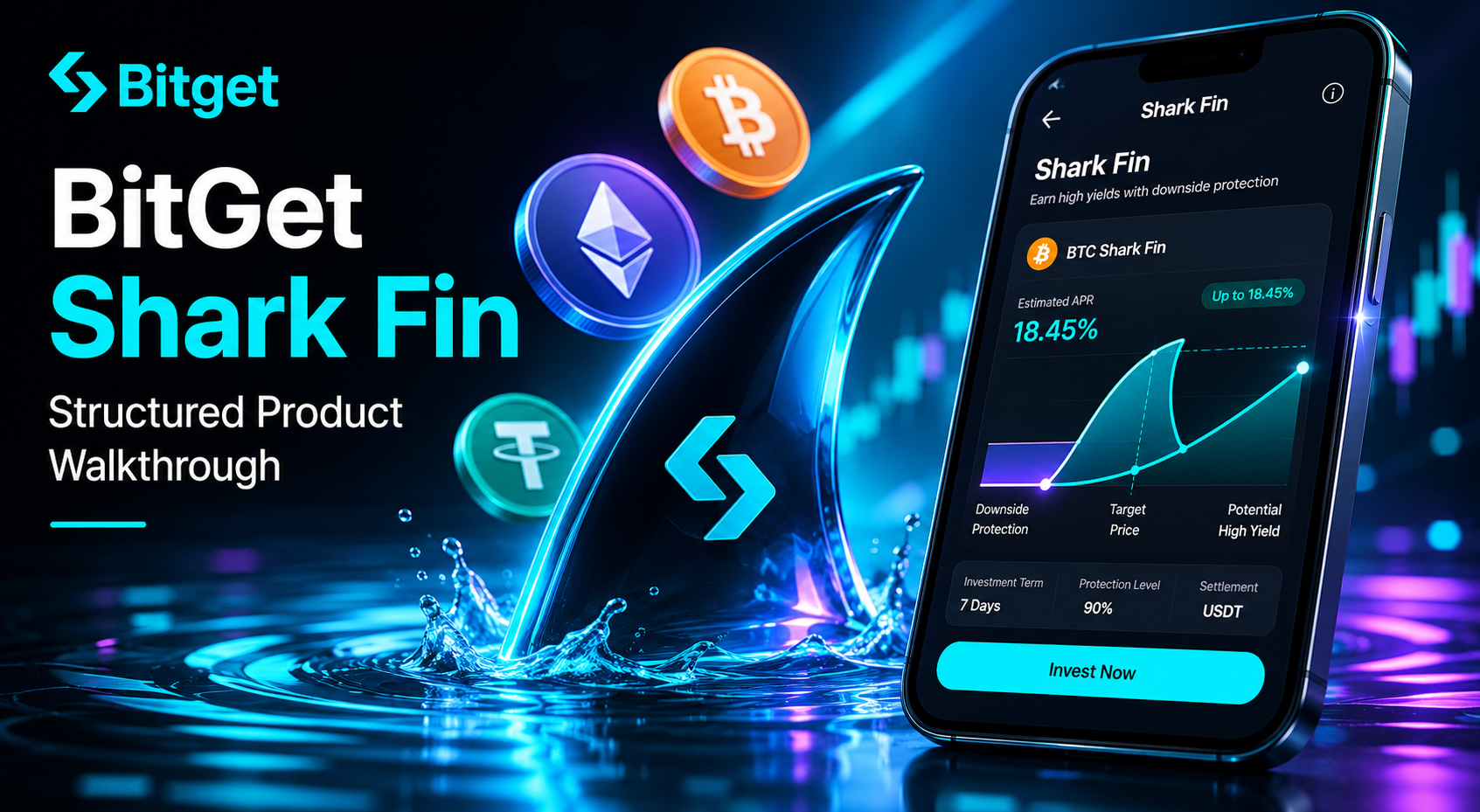
The product is called Shark Fin because the payoff curve looks like one. Sit at the back of any options desk and you’ll find a version of this trade running — it’s the structured product that institutional traders have been doing for twenty years, repackaged for crypto and bolted onto an exchange app with three taps. The headline is “capital protected” with a higher yield than flexible savings. The catch is in the fine print. This is the walkthrough — how it works, when it pays, when it pays nothing, and when you should not touch it. Some links here are affiliate. I’ll flag them.
Short answer: BitGet Shark Fin is a structured yield product where your principal is protected and your APY depends on whether the underlying asset’s price stays within a defined range during the term. You earn a high APY (typically 6–25%) if price stays in the range, a low base APY (often 1–3%) if it breaks out, and you never lose principal. Lock-ups are usually 7 to 30 days.
Open a BitGet account → (affiliate)
Key takeaways
- Shark Fin protects your principal — worst case you get a low base APY.
- Best case is the high APY, paid only if price stays in the defined range.
- Two variants: Bullish (you bet price rises within a range), Bearish (you bet it falls).
- Lock-up is firm. No early exit on most Shark Fin products.
- Better than Dual Investment for capital safety, worse for headline yield.
What Shark Fin is (structured product 101)
A structured product is a packaged trade. The packaging hides what’s actually going on under the hood, but every structured product is a combination of two simpler things: a bond (fixed yield) and an option (conditional payout).
Shark Fin specifically combines:
- A zero-coupon bond that returns your principal plus a small base interest.
- A call spread or put spread option that pays out only if the underlying stays in a range.
The product page calls this “capital protected with a chance of high yield.” That’s marketing. What it actually is: a bet on volatility. If volatility stays low and price stays in the range, you win the high APY. If volatility breaks the range, you win the base APY and your principal back.
Live products sit on the BitGet Shark Fin dashboard — terms and ranges rotate weekly.
The official mechanics are documented in the BitGet help centre, which is worth a read before you commit capital.
The payoff diagram (the “fin” shape explained)
This is the bit you need to picture in your head before pressing subscribe.
Imagine a graph. X-axis is the price of the underlying (let’s say BTC) at term end. Y-axis is your APY.
For a Bullish Shark Fin with a range of $100,000 to $115,000 and a base APY of 2% / max APY of 18%:
- BTC at $99,000 (below range): you earn 2% base APY.
- BTC at $100,500 (just inside range): APY ramps up sharply toward 18% as a linear function of how far into the range price has moved.
- BTC at $110,000 (mid-range): you earn the max 18% APY.
- BTC at $114,500 (just inside upper edge): still around the max APY band.
- BTC at $116,000 (above range): payout drops sharply back to 2% base APY.
Plot that and you get a shape that ramps up steeply on the left, plateaus across the middle, and drops off the cliff on the right. That’s the fin.
The honest mental model: you’re being paid to bet that price stays inside the range. The bet is asymmetric — your max upside is the high APY, your max downside is the base APY. Principal is always returned.
Bullish vs Bearish Shark Fin
Two flavours, different bets.
Bullish Shark Fin
Bet: the underlying will rise but stay within the upper range.
Example terms:
– Underlying: BTC
– Lock window: 7 days
– Range: $100,000 to $110,000
– Max APY (in range): 18%
– Base APY (out of range): 2%
You win the max APY if BTC closes the 7-day window between $100K and $110K. You win base if it ends below $100K or above $110K. Strange logic until you see the payoff diagram: the product pays you for being right about modest upside, not extreme upside.
Bearish Shark Fin
Bet: the underlying will fall but stay within the lower range.
Example terms:
– Underlying: BTC
– Lock window: 7 days
– Range: $90,000 to $100,000
– Max APY (in range): 16%
– Base APY (out of range): 2%
You win max if BTC ends between $90K and $100K. You win base if it ends below $90K or above $100K. Same logic, inverted.
The naming is counterintuitive at first. Bullish Shark Fin isn’t a leveraged long. It’s a bet that the asset rises modestly — too much rise and you lose the premium.
How yields are calculated (min APY, max APY, range)
Three numbers control every Shark Fin product. Internalise these and you can read any product page in 30 seconds.
Min APY (base APY). What you earn if price breaks the range. Typically 1% to 3% on stables-denominated products. This is essentially the bond component coming through — you get your principal back plus this small interest.
Max APY. What you earn if price stays in the range. Typically 6% to 25% depending on volatility and term. Higher implied volatility = higher max APY because the option premium is richer.
Range (price band). The window the price must close within. Wider range = higher probability you win the max APY = lower max APY on offer. Tighter range = lower probability = higher max APY. Risk-reward is priced in.
Worked example.
BTC spot at $105,000. BitGet offers a 14-day Bullish Shark Fin with range $100,000 – $112,000, max APY 14%, base APY 2%. You subscribe $10,000 USDT.
Two outcomes at day 14:
- BTC closes between $100K and $112K: you earn 14% APY × (14/365) × $10,000 = $53.70 interest. Principal $10,000 back. Total: $10,053.70.
- BTC closes outside the range: you earn 2% APY × (14/365) × $10,000 = $7.67 interest. Principal back. Total: $10,007.67.
Difference between the best and worst case: about $46 on a $10K deposit. Capital is never at risk. The bet is purely on volatility.
A real example with BTC
Let me run through a Shark Fin scenario I actually subscribed to, from start to finish.
Subscribed in the middle of a chop window where BTC was sitting around $103K. The product:
- Underlying: BTC
- Term: 7 days
- Range: $100,000 to $108,000
- Max APY: 12%
- Base APY: 2%
- Subscription: $5,000 USDT
My read: BTC was bouncing in a tight range. Implied volatility was elevated because options markets were pricing in a Fed meeting that turned out to be a non-event. I bet vol would mean-revert and price would stay range-bound through the week.
What happened:
- Day 1: BTC at $103K. In range.
- Day 3: BTC dipped to $101.5K. Still in range. I had a moment.
- Day 5: BTC popped to $106K. Back in the middle.
- Day 7 close: $104.8K. In range.
Outcome: earned 12% APY × (7/365) × $5,000 = $11.51. Total return: $5,011.51.
The honest reflection: $11.51 on a $5K capital lock for 7 days is not life-changing. The annualised number sounds great, the absolute number is modest. Shark Fin pays the volatility view, not the size of your bag.
When Shark Fin makes sense
Three scenarios where I’d consider it.
Scenario one: you have a strong range-bound view. The underlying has been chopping in a defined range for weeks, you don’t see a catalyst that breaks the range during the lock window, and Shark Fin’s max APY is materially higher than flexible Savings. The yield premium is the option premium you collect for betting on continued chop.
Scenario two: you’d be in stables anyway. If you’ve already decided to park USDT for two weeks while you wait for a setup, Shark Fin can earn you the max APY for the same opportunity cost as flexible Savings. The downside is the same as Savings (a few percent in interest), the upside is more.
Scenario three: you want capital protection during a bonus campaign. BitGet occasionally runs Shark Fin promos where the max APY is well above what the implied vol justifies — those are the moments to size up. The trick is recognising them. Usually a sign: max APY of 20%+ on a wide range during a low-vol regime.
When to avoid Shark Fin
Three scenarios where the product is the wrong call.
Scenario one: you need the capital before maturity. Most Shark Fin products do not allow early redemption. The lock is firm. If you might need the money for a trade, stay in flexible Savings.
Scenario two: the range is tight and the market has a catalyst coming. Fed meeting, ETF flows, regulatory deadline, anything that historically moves price 3%+ — narrow-range Shark Fin around an event is asking to win the base APY. Wider-range products fare better.
Scenario three: the max APY is barely above flexible Savings. If flexible USDT is paying 5% and the Shark Fin max APY is 7%, the option premium is thin. The opportunity cost of locking up capital for a 2% bump rarely justifies the lock. Reach for the products with a meaningful spread.
Shark Fin vs Dual Investment
Both are structured products. Both have a strike price logic. They differ in one critical place: principal risk.
| Factor | Shark Fin | Dual Investment |
|---|---|---|
| Principal protected? | Yes — worst case is base APY | No — principal converts to the other asset at maturity |
| Payoff shape | Range-bound (fin) | Strike-based (binary) |
| Max APY | 6% – 25% | 15% – 100%+ |
| Worst case | Earn base APY, get principal back | Forced buy or forced sell at strike |
| Best for | Volatility view with capital safety | Conviction on a strike level + willing to hold either side |
| Risk | Opportunity cost | Real downside if asset moves wrong way |
Shark Fin is the conservative version. Dual is the aggressive version. The labels on the BitGet app don’t make this distinction obvious, which is a problem — people pile into Dual thinking it’s like Shark Fin and find out the hard way it isn’t.
The BitGet Dual Investment sibling post covers Dual in full. Read it before subscribing to either product so you understand the difference.
For broader context across the structured product family, BitGet Earn products maps everything against risk and reward. The lower-risk siblings sit at BitGet Savings and BitGet PoolX.
The risks (capital lock and range break)
Shark Fin’s pitch is capital protection. That’s accurate but incomplete. There are three risks the marketing skips.
One: opportunity cost during the lock
Your capital is committed for the term. If BTC pumps 20% during the lock, you’re sitting in stables earning Shark Fin yield while the pump runs without you. The structured product pays you the option premium, not the price action.
Two: range break = base APY
If the price exits the range — even briefly on the close, depending on the product’s evaluation method — you forfeit the max APY and earn the base. Some products use a “knock-out” rule where touching the boundary once during the term triggers the base payout. Others evaluate only at expiry. Read the term sheet.
Three: exchange counterparty risk
Same as every BitGet Earn product. Your principal is a claim on BitGet’s balance sheet during the lock. Proof of Reserves and the Protection Fund help, but the risk is not zero. The BitGet Proof of Reserves page is the place to verify your balance is included.
If you want the wider context on counterparty risk and self-custody, how to store crypto safely, hot vs cold wallet and ledger nano x review are the relevant siblings.
For a hardware wallet to keep the long-term slice off any exchange, here’s the one I use: Ledger Nano X (affiliate).
Trader’s note: structured products are an options view in disguise
Here’s the bit nobody tells you. Shark Fin is selling you an option strategy packaged as a savings product. The market makers on the other side of your subscription are running a delta-hedged short volatility book. They make money when realised vol stays below implied vol over the term. You make money when price stays in range. Same bet, different framing.
Understanding why that matters: the better you get at reading implied volatility, the better you get at picking the Shark Fin products that are mispriced in your favour. Most retail subscribers click the product with the highest headline APY without checking what implied vol is doing. That’s the inefficiency you can sit on the right side of.
Learning to read options markets is a skill — and it’s not something a product page teaches you. If you want to actually learn how options pricing translates into reading structured products, Trade Travel Chill (affiliate) is the community I’m part of. Structured education across spot, futures, and the derivatives view that makes products like Shark Fin make sense.
Want to try Shark Fin?
Open a BitGet account, deposit USDT, and pick a live product. Capital protected — worst case is base APY back.
Affiliate link.
Tax treatment
Shark Fin payouts — both base and max — count as income at the time of credit in most jurisdictions. The treatment mirrors Savings interest: the value at the credit date is taxable income, recorded in your spot wallet at that moment.
What’s different: the conditional payout structure can complicate record-keeping. If the product matures and credits 12% rather than 2%, the higher amount is the income figure. Export the Earn rewards CSV from BitGet’s Reports section quarterly and feed it into your tax tool.
Authority reading: UK HMRC cryptoassets manual covers the UK treatment of structured product payouts. The IRS digital assets page covers the US side. The Koinly crypto tax guide is the cleanest plain-English summary for both.
My current Shark Fin approach
Transparency on how I actually use it.
- Light allocation, around 5–10% of stables float. Shark Fin isn’t core. It’s a satellite position taken when conditions are right.
- Bullish during chop, never around catalysts. I subscribe only when implied vol is elevated and I don’t see a known catalyst inside the term window.
- Range width matters more than max APY. A 10% range at 14% APY is usually a better bet than a 4% range at 22% APY. The probability difference outweighs the yield difference.
- Never on coins I’d want to hold. Shark Fin on BTC subscriptions are in USDT, not BTC. Locking BTC means missing pumps. Locking USDT means missing slightly better Savings rates. Easier trade-off.
The honest summary: Shark Fin earns me marginal alpha when I get the vol read right. It does nothing when I’m wrong. It’s never going to be the engine of a portfolio. It’s a small lever that you use when conditions favour it.
Ready to look at live products?
Open a BitGet account, browse the Shark Fin dashboard, and find the product with the range and term that fits your view.
Affiliate link.
Frequently asked questions
What is BitGet Shark Fin?
BitGet Shark Fin is a capital-protected structured yield product. You deposit USDT or another supported asset for a fixed term (typically 7 to 30 days). At maturity, you earn either a high APY if the underlying asset stayed within a defined price range, or a low base APY if it broke out. Principal is returned in both cases.
Is my principal really protected?
Yes, principal is returned at maturity regardless of price outcome — that’s the structural design. Counterparty risk applies (BitGet must remain solvent) but the structured product itself does not put principal at risk.
Why is it called “Shark Fin”?
Because the payoff diagram — APY plotted against the underlying asset’s price — has a shape that resembles a shark’s dorsal fin. Steep ramp up, plateau across the range, steep drop off outside it.
What’s the difference between Bullish and Bearish Shark Fin?
Bullish Shark Fin pays the max APY if price rises into a defined upper range. Bearish Shark Fin pays the max APY if price falls into a defined lower range. Both are bets on price ending inside a range, not on directional moves beyond it.
Can I exit Shark Fin early?
Most BitGet Shark Fin products do not allow early redemption. The lock is firm until maturity. Always check the specific product terms before subscribing.
Is Shark Fin safer than Dual Investment?
Yes — Shark Fin protects principal, Dual Investment converts your principal to the other asset at the strike price if the target is hit. The trade-off is Dual Investment offers materially higher max APYs.
Are Shark Fin payouts taxable?
In most jurisdictions yes, treated as income at the time of credit valued at the spot price. UK, US, EU and Australian tax authorities treat structured product payouts this way. Export the rewards CSV quarterly.
Final word
Shark Fin is the structured product that gets recommended to people who shouldn’t be touching structured products. The pitch is “capital protected, higher APY than Savings” and that’s accurate. What gets missed: the higher APY is conditional on a volatility view that most subscribers don’t realise they’re making.
Used well, Shark Fin is a satellite position that earns marginal extra yield during low-vol regimes. Used badly, it’s a way to lock up capital for two weeks to earn the same base APY you could’ve had in flexible Savings without the lock.
If I were starting on Shark Fin today, the playbook I’d run: open a small position to learn the product mechanics, only subscribe when the max APY meaningfully beats flexible Savings, never lock around a known catalyst, and always check the range width against your view of expected volatility.
That’s the short version.
Right — over to you.
Related posts
- BitGet Dual Investment: How It Works (and Risks)
- BitGet Savings: Flexible vs Fixed APY Compared
- BitGet Earn Products: Every Product Compared