Important: Anything resembling a forecast in this article is speculation. Meme coins are the most volatile asset class in crypto and most go to zero. Treat all commentary as opinion, not prediction. Past performance does not predict future results.
95% of meme coins go to zero in under six months. That’s not a slogan — it’s what you’ll find if you scroll through the all-time list on any Solana DEX aggregator. Charts that ripped 1000% on day one and now sit at fractions of a cent with zero liquidity.
I’ve traded Solana memes through two cycles. Made decent money. Got rugged once for a meaningful amount. Watched friends turn $500 into $50,000 and then back into $200 because they couldn’t take profit. This post is the brutally honest framework I use now — what to buy, what to avoid, and the rules I follow to stay solvent in the most degenerate corner of crypto.
Some links here are affiliate. I’ll flag them.
Short answer: The best Solana meme coins fall into three surviving categories — dog category (BONK, WIF), anthropomorphic memes (POPCAT, GIGA), and meta-political (BOOK, MOTHER). The vast majority of pump.fun launches die within weeks. Position sizing matters more than picking. Never risk more than 1% of your portfolio on any single meme.
Open a BitGet account → (affiliate link)
Key takeaways
- 95%+ of Solana meme coins go to zero in under six months. Most die in days.
- The survivors cluster in three categories: dog memes, anthropomorphic, and meta-political.
- Pump.fun launches over 30,000 tokens per day at peak, per public on-chain data. Almost all die.
- Your position size matters more than your token pick. Never more than 1% of portfolio per meme.
- The exit is the trade. Most retail loses by holding past the obvious top.
Honest opener: 95% of memes go to zero in under 6 months
I want this to be the first thing you read because every other meme post will hype you up.
If you go to Dexscreener and filter Solana tokens by all-time data, you’ll see something brutal — the overwhelming majority of tokens launched in the last cycle have lost over 95% of their peak value. Most are at zero liquidity. Many were rugs. Many were just bad ideas.
That’s the base rate. When someone tells you their cousin made $40,000 on a meme, what they’re not telling you is the other 99 people who lost everything. Survivorship bias is the whole meme-coin industrial complex.
If you accept that 95%+ of these go to zero, you can play them sensibly. If you don’t accept it, you’ll find out the hard way.
This post is for traders who already accept the maths and want to maximise the small edge that’s left.
Why Solana is the memecoin chain
Memes happen on Solana because the friction is low.
Three reasons:
Fees. A transaction on Solana costs fractions of a cent. On Ethereum, just trying to buy a meme can cost $20-50 in gas during peak times. You can’t day-trade memes on Ethereum unless you’re moving five figures.
Speed. Block times on Solana are well under a second. You can sell into a pump before the chart even updates on Twitter. On Ethereum you’re waiting for the next block, and the bots are faster than you.
Tooling. Pump.fun, Phantom, Jupiter, and the broader Solana DEX ecosystem make launching and trading a token frictionless. The Solana memecoin culture exists because the rails make it possible.
These advantages also create the dark side — anyone can launch a token in 90 seconds, and most do. According to DefiLlama, Solana has consistently been a top-five chain by DEX volume largely because of this meme activity.
If you want a primer on Solana itself, how to buy Solana covers the basics.
The 3 categories of Solana memes that have survived
In two cycles of watching this sector, only three meme categories have produced multiple tokens that survived past the first major drawdown. Most of the rest are noise.
Category 1: Dog memes
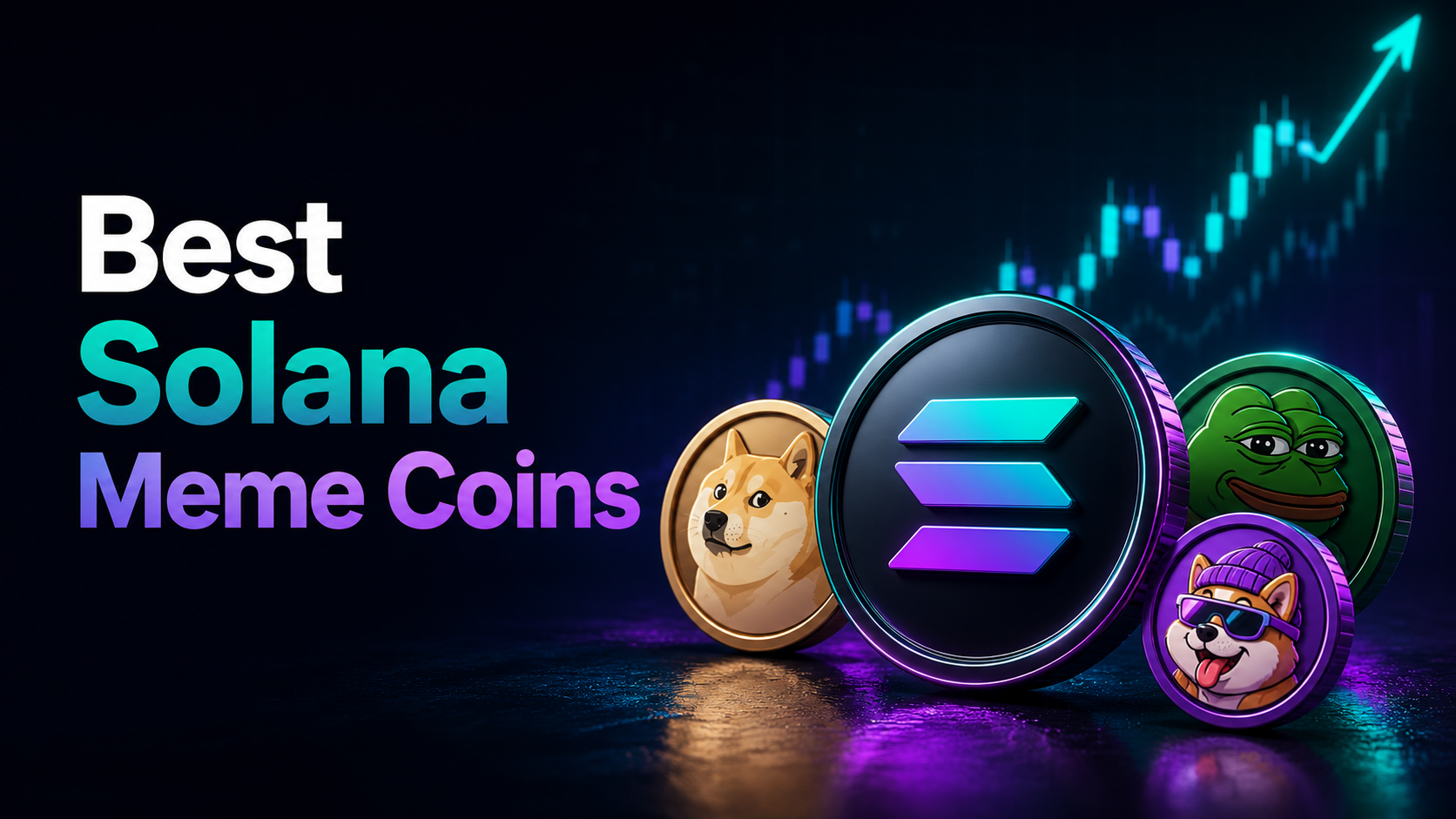
Dogecoin set the template. Shiba Inu copied it. Bonk did it on Solana. WIF (dogwifhat) made it cleaner. The pattern is consistent — anything with a dog (or shiba-style dog) avatar has cultural staying power that crosses the entire crypto retail audience.
Why? Probably because Dogecoin made retail comfortable with the idea of “dog coin = good.” That cultural shortcut now extends to any dog meme on any chain. Solana captured the post-Doge market because the fees made it tradeable.
Category 2: Anthropomorphic memes
POPCAT (cat opening and closing its mouth). GIGA (gigachad). MEW (cat). The pattern is a clear, recognisable character with strong visual identity. These memes spread because the image is the meme — you don’t need to know the lore to get the joke.
These tend to do best when the character image is shareable on Twitter. Anything that meme-ifies well into reaction images has natural distribution. Anything that requires explanation dies.
Category 3: Meta-political memes
BOOK of MEME, MOTHER (Iggy Azalea’s coin), MUMU, and the various political memes that ride news cycles. These have shorter half-lives than dog or animal memes — they pump hard and fast when relevant, then fade.
The meta-political category has the highest variance. Some 100x. Most die when the news cycle moves on. Hardest to time, biggest swings.
Real examples: BONK, WIF, POPCAT, BOOK, GIGA
Let me walk through the actual tokens. None of this is a recommendation — these are the tokens you’ll see in every meme conversation and you should understand them.
BONK
The first big Solana meme. Launched in late 2022 as a community airdrop when SOL was in the gutter post-FTX. The narrative: revive Solana. Distribute to actual users. Make trading fun.
It worked. BONK rallied from sub-penny prices to a multi-billion market cap at peak. It survived multiple cycles. The team built integrations across Solana DeFi. It’s now closer to a “Solana ecosystem token with meme branding” than a pure meme.
Per CoinGecko, BONK is among the largest Solana-native tokens by market cap. The distribution event got it onto every Solana wallet at launch, which created the cultural moat.
WIF (dogwifhat)
The cleanest meme on Solana by a margin. WIF is a Shiba Inu wearing a knit hat. The chart said top of the dog meme category through a full cycle. According to CoinMarketCap, WIF held a top-three position among meme coins for sustained periods.
The lesson from WIF: a clean image plus zero pretence of utility was the optimal combination. The team never claimed it was anything other than a meme. That honesty (paradoxically) gave it durability.
POPCAT
A cat. Opening and closing its mouth. That’s it. POPCAT became the dominant anthropomorphic meme on Solana through pure meme energy on Crypto Twitter. The visual is the product.
The chart was vertical for a stretch — multi-thousand percent gains in weeks. Then drawdowns of 80%+. Standard meme behaviour. Holders who took profit at 5-10x got rich. Holders who didn’t are still holding.
BOOK (Book of Meme)
BOOK was the first major meme to ride the pump.fun launch wave and graduate. The pitch was “memes-as-NFTs” — a token where memes themselves were stored on-chain. Whether the tech worked or not didn’t matter. The narrative ripped.
BOOK demonstrated the meta-political template — a meme about memes. Reflexive. The price reflected the narrative reflecting the price.
GIGA (Gigachad)
The chiselled-jaw stoic figure that ironic crypto Twitter has been posting for years. GIGA captured the existing meme energy and converted it into a token. Strong run, big drawdowns.
The pattern across all five: massive launch run, eye-watering drawdown, occasional revival on news, eventual fade. Some of these will return. Most will not. None of this is a recommendation to buy — it’s context for understanding the category.
Pump.fun and the meme-launch industrial complex
You can’t talk about Solana memes without talking about pump.fun.
Pump.fun is a token launchpad on Solana that lets anyone create a meme coin in roughly 90 seconds. There’s a bonding curve mechanism that prices the token automatically. When a token’s bonding curve fills up, it “graduates” to Raydium (a Solana DEX) and gets a real market.
The numbers are wild. At peak, Dune Analytics dashboards have tracked pump.fun launching over 30,000 tokens per day. That’s one new meme coin every 3 seconds, all day, every day.
Of those 30,000 tokens, the vast majority die before graduating. Most never see more than a handful of buyers. Maybe 1-2% graduate to Raydium. Of the ones that graduate, most still go to zero within days.
The economic reality:
– The vast majority of pump.fun creators lose money.
– A tiny percentage of buyers make money.
– The platform itself makes a fortune in fees.
If you’re going to play pump.fun, treat it as a casino. Position size accordingly. Most “successful meme coin sniping” stories you read online are survivors out of a much larger pool of losers.
The smart play I see from traders who actually make money in this sector: wait for tokens to graduate to Raydium with at least a few days of trading history. Skip the bonding curve phase entirely. You miss the 1000x but you also miss the 99% rug rate.
Red flags: how to spot a rug
If you’re going to trade memes, you need to spot rugs faster than the chart. Here’s the checklist I run.
Red flag 1: Anonymous team with no track record
Most memes have anon teams — that’s normal. What’s not normal is a team that’s never launched anything before, no online presence, no social proof, no other projects.
Anon-but-known (e.g., a Twitter handle that’s been active for years) is fine. Anon-and-fresh is a rug waiting to happen.
Red flag 2: No liquidity lock
When a token launches, the team typically pairs it with SOL or USDC in a liquidity pool. If that liquidity isn’t locked (or burned), the team can pull it out at any time — taking your money with it.
Tools like DEX Screener and RugCheck will show you the liquidity status. If liquidity isn’t locked for at least 6 months or burned outright, treat it as a probable rug.
Red flag 3: Fresh wallets sniped the launch
If you look at the top holders and the wallets are all 5-30 minutes old at launch, those are bots — and they’re going to dump the moment the token finds real buyers. You can check this on Solscan.
A healthy distribution looks like: hundreds of small holders, some medium holders, no single wallet holding more than 5-10% of supply, and the wallets aren’t brand new.
Red flag 4: The website looks AI-generated
Most rug projects spin up a website in an hour using a template. They look identical. Stock images, generic copy, no real social proof. If the website could be any token, it probably is.
The cultural memes that survive (BONK, WIF, POPCAT) had distinctive identity from day one. The rugs all blur together.
Red flag 5: Team holds large supply with no vesting
If a single wallet holds 10%+ of supply with no vesting schedule, that wallet is the price. When they sell, the chart dies. Always check the team allocation and vesting before you buy.
If you want a deeper background on how to evaluate any token’s supply and economics, market cap explained is the foundation read.
Position sizing rule: never more than 1% of portfolio per meme
This is the section that will save you the most money.
Memes are not investments. They are short-duration, high-variance bets. Sizing them like investments is how people blow up.
The rules I follow:
- Maximum 5% of total portfolio across all memes combined. This is the cap.
- Maximum 1% in any single meme. Even one I have strong conviction on.
- No averaging down on memes. Ever. If it goes against me, I’m out, not buying more.
- Take profit at 2x, 5x, 10x. Trim a third each time. The last third runs free.
Why 1%? Because the win rate on memes is low. If 9 of 10 memes go to zero and 1 in 10 does a 20x, you’re break-even before fees. Sized at 1%, a string of losses is survivable. Sized at 10%, the first two losers wipe most of the bag.
The traders who survive in memes long-term are not the best pickers. They’re the best risk managers.
If you want the structured education that taught me to actually run sizing rules instead of going with my gut, Trade Travel Chill is the community I’m part of. See TTC → (affiliate link)
The “graduation” pattern from pump.fun to Raydium
This is the technical bit that matters if you want to actually trade memes.
When a pump.fun token’s bonding curve fills, it “graduates.” That means:
- The liquidity from the bonding curve gets moved to a Raydium pool.
- The token now has a permanent market on the Solana DEX layer.
- The price discovery shifts from the bonding curve to organic supply and demand.
The graduation moment is often a local top. The bots that sniped the bonding curve dump into the new liquidity. The chart spikes and then crashes within minutes.
The smart entry isn’t at graduation — it’s 24-72 hours after graduation, once the bot dumps have cleared and you can see whether there’s real organic interest. If there is, the token has a chance. If not, it’s dead.
This is the single most profitable timing edge in Solana memes right now and most retail ignores it because they’re chasing the launch pump.
Storage: Phantom and Solflare for trading, Ledger for survivors
You need a wallet to trade Solana memes. Two camps.
Hot wallets for trading
Phantom is the default. Solflare is the alternative. Both are browser extensions plus mobile apps. They connect to Jupiter, Raydium, pump.fun, and basically every Solana dApp.
For active trading, these are fine. You’re moving in and out of memes constantly — cold storage friction kills the workflow.
But there’s a risk: hot wallets get drained when you sign a malicious transaction. The pattern: scam project, fake airdrop, you connect to claim, you sign without reading, your wallet empties.
Rule: a trading wallet only ever holds what you’re actively trading. The moment a meme position becomes meaningful, you move it elsewhere.
Cold storage for survivors
If a meme actually moons and you’re sitting on a meaningful bag — whatever “meaningful” means to you — that bag belongs on a Ledger Nano X (affiliate link). The Nano X supports Solana via the Ledger Live app and pairs with Phantom.
The workflow:
1. Trade the meme on a hot wallet.
2. When the position is up enough to matter, send the survivors to a Ledger-controlled Phantom address.
3. Disconnect the Ledger when you’re not actively touching it.
I’ve seen people lose six figures in meme coins because they kept everything on a hot wallet that got drained. Don’t be that person. Read how to store crypto safely for the full playbook.
TTC angle: cycle awareness for meme trading
Memes are deeply cyclical. They run hot in two phases of every crypto cycle: the late-stage bull when retail piles in, and the recovery phase after a major drawdown when traders rotate back into risk.
In between, they’re dead. Charts flat. Volume gone. New launches fizzle.
If you’re trading memes without understanding which phase you’re in, you’re going to chase tops in the late-stage bull (everyone’s doing it, must be easy money) and capitulate at the recovery phase low (this sector is dead, never coming back).
Both are wrong moments. The right moment to look at memes is when the broader market has had a 30-50% correction, sentiment is dead, and the few survivors are quietly grinding higher.
This kind of cycle awareness is what separates traders who survive multiple cycles from traders who blow up on their first one. The TTC community is where I learned to actually map cycles instead of reading vibes. See Trade Travel Chill → (affiliate link)
For the broader context, crypto market cycle and bitcoin dominance are foundational reads. Memes pump hardest when BTC dominance falls.
The exit strategy: most retail loses by not selling
I’ll say it again because it bears repeating: the exit is the trade.
In memes, the price action goes vertical. Holders make 10x, 20x, sometimes 100x on paper. Then the chart rolls over and they ride it all the way back down because:
- They think “this could be the next [Doge / WIF / BONK]”
- They’ve already mentally spent the money
- They convince themselves the pullback is “healthy”
- They miss the exit and now they’re trapped at the top
The honest truth about meme trading: most retail loses not because they pick wrong but because they don’t sell.
My rule: pre-commit to profit-taking levels before you buy. Write them down. Sell at the levels regardless of vibes.
- At 2x: trim 25% (your original cost is now off the table on those coins)
- At 5x: trim another 25%
- At 10x: trim another 25%
- The last 25% runs to wherever it goes — if it dies, it dies.
This rule doesn’t maximise upside on the rare 100x. It does mean you actually realise profit on the 90% of memes that pump and dump in a week.
If you don’t have a sell plan, you don’t have a trade. You have a lottery ticket.
How to buy Solana memes on BitGet
Most major Solana memes (BONK, WIF, POPCAT, FLOKI on multiple chains) are listed on BitGet spot. The newer pump.fun tokens won’t be — those you have to buy directly on Solana via Jupiter or Raydium.
The BitGet route for established memes:
- Open the BitGet sign-up page. (affiliate link)
- KYC + 2FA. Same flow as any exchange. Mine cleared in under 20 minutes.
- Deposit. Send USDT (TRC-20 cheapest) or SOL from another wallet.
- Find the spot pair. Search the ticker. Watch for fake tickers — only buy the verified listing.
- Limit order. Memes have wide spreads. Market orders cost you.
- Withdraw to Phantom for on-chain trading. Or to Ledger for cold storage.
If a meme is too new to be on BitGet, you’ll need a Solana wallet and direct on-chain trading. The how to buy Solana post walks through getting SOL onto Phantom. From there, Jupiter is the default DEX aggregator.
For broader context on getting into crypto trading at all, how to buy crypto is the starting point.
Comparing with other meme categories
Solana isn’t the only place memes happen. Quick comparison.
| Chain | Fees | Speed | Meme volume | Best for |
|---|---|---|---|---|
| Solana | <$0.01 | <1s | Very high | Active trading, pump.fun launches |
| Ethereum | $5-50 | 12s | Medium | Established memes (SHIB, PEPE), high-conviction holds |
| Base | $0.01-0.10 | 2s | Medium-high | Emerging memes, lower friction than Ethereum |
| BNB Chain | $0.10-0.50 | 3s | Medium | Older meme audience, less active now |
For comparison, how to buy Dogecoin covers the OG meme on its own chain. DOGE pre-dates everything we’re talking about here.
Ready to trade Solana memes the smart way?
BitGet lists the established Solana memes (BONK, WIF, POPCAT). Sign-up takes 90 seconds, KYC clears same day.
Affiliate link. I may earn a commission at no extra cost to you.
Frequently asked questions
What is the best Solana meme coin?
Among survivors of multiple cycles: BONK and WIF have the strongest track records. POPCAT is the dominant anthropomorphic meme. None of these are recommendations — they’re the tokens with the most cultural staying power.
Can you actually make money trading Solana memes?
Some traders do. Most don’t. The win rate is low and the timing requirements are brutal. The traders who profit consistently size small, take profit aggressively, and skip 95% of launches. The ones who lose chase every pump and never sell.
How does pump.fun work?
Pump.fun is a Solana token launchpad with a bonding curve. Anyone can create a token in roughly 90 seconds. When the bonding curve fills, the token graduates to Raydium with permanent liquidity. Most launches die before graduating.
What’s the safest way to trade Solana memes?
Use a separate trading wallet that only holds what you’re actively trading. Move profitable positions to a Ledger-controlled wallet. Never sign transactions you don’t understand. Position size at 1% of portfolio max per meme.
Are Solana memes regulated?
Memes are generally not registered securities anywhere. The regulatory status varies by jurisdiction and could change. Treat them as high-risk speculative assets that may have no legal protection if things go wrong.
Which wallet should I use for Solana memes?
Phantom is the default — best UX, widest dApp support. Solflare is the alternative. For any meaningful position, transition to Ledger Nano X paired with Phantom. Hot wallet for trading, cold for holding.
How do I know if a Solana meme is a rug?
Check liquidity is locked or burned. Check holder distribution isn’t concentrated in fresh wallets. Check the team has at least some online history. Use tools like Dexscreener and RugCheck. If anything looks wrong, skip — there’s always another meme tomorrow.
Why do most meme coins go to zero?
No utility, no revenue, no holders beyond speculators. When attention moves to the next meme, liquidity leaves and the price collapses. Memes are pure attention economy assets — when attention dies, value dies with it.
Final word
Solana memes are the most degenerate corner of crypto and that’s why they pay. Three rules will keep you alive:
- Never more than 1% of portfolio per meme.
- Take profit in tranches. The exit is the trade.
- Skip 95% of launches. Wait for the graduation chart to settle.
Pick by category — dog, anthropomorphic, meta-political — and ignore the rest. Most of what’s launched on any given day is destined for zero. The few survivors will reveal themselves over weeks, not minutes.
That’s the short version.
Right — over to you.
One more thing: Buying a token doesn’t mean it will go up. Most altcoins underperform Bitcoin over long enough timeframes — meme coins underperform by an even wider margin. Only buy what you can afford to lose, and never put your rent money in crypto. If a YouTuber tells you a meme will 100x — they’re guessing too.
Related posts