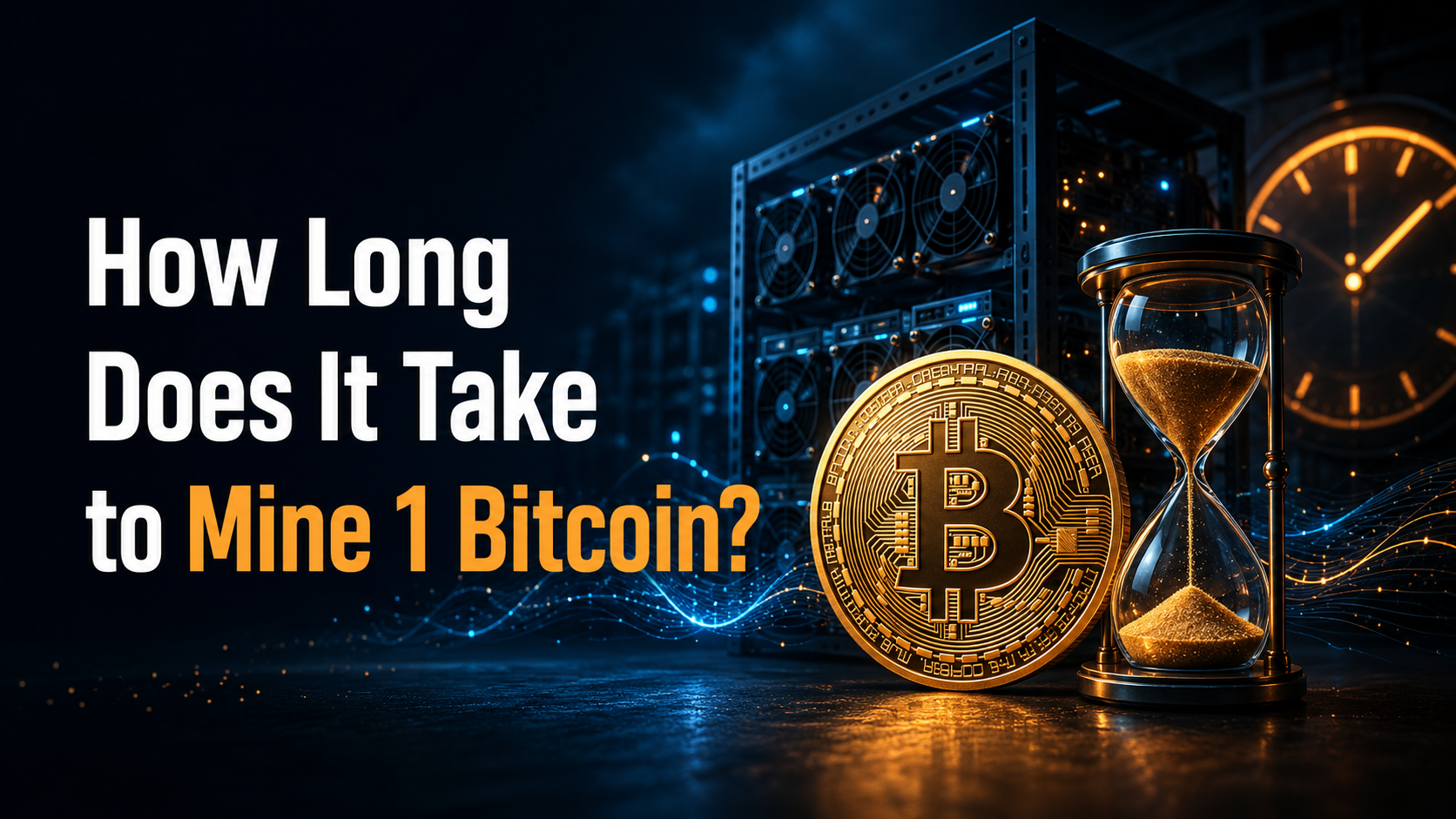
When people ask me how long it takes to mine one Bitcoin, they expect a single number. There isn’t one. There are three numbers — the network answer, the solo answer, and the pool answer — and they range from 10 minutes to “the heat death of the universe” depending on which one applies to you.
I’ve owned mining hardware, run a pool account, and bought tokenised hash rate through GoMining. This is the honest breakdown of what 1 BTC of mining actually takes in 2026 — and whether mining still makes sense for retail at all.
Short answer: At the network level, the Bitcoin protocol produces a new block every 10 minutes — currently containing 3.125 BTC of block reward. For a single miner to mine 1 BTC solo, the time depends entirely on their hash rate share of the network. A modern home-grade ASIC (200 TH/s) has roughly a 0.00004% chance of finding any given block, which works out to mining 1 BTC alone on average every ~5–7 years statistically — and most home miners never find a block at all. Pool mining pays daily but at fractional amounts; expect roughly 0.0002–0.0004 BTC per day per modern ASIC at current difficulty.
Try tokenised mining with GoMining → (referral) — the way I get mining exposure without running hardware.
Key takeaways
- The Bitcoin network produces one block every 10 minutes on average. Each block currently pays 3.125 BTC to the miner who finds it (post-April 2024 halving).
- Solo mining 1 BTC with a single home-grade ASIC is statistically a multi-year proposition with massive variance.
- Pool mining pays small daily amounts proportional to your hash rate contribution. A modern S21 ASIC earns roughly $5–$15 per day in BTC at current difficulty, depending on electricity costs.
- Hardware costs run $3,000–$5,000+ per modern ASIC, plus electricity (which is often the kill switch for retail mining profitability).
- GoMining-style tokenised mining lets you buy hash rate without running a rig. Buying spot BTC outright often beats both home mining and tokenised mining over multi-year periods.
Short answer: the three different “how long” questions
People asking “how long to mine 1 BTC” usually mean one of three things. Each has a different answer.
1. How long until the next block is mined on the Bitcoin network?
About 10 minutes on average. The Bitcoin protocol targets a 10-minute block time. Difficulty adjusts every 2,016 blocks (~2 weeks) to keep the average block time at 10 minutes regardless of how much hash rate is online. Each block currently pays 3.125 BTC to the miner who found it.
2. How long until I, solo mining with a home rig, mine 1 BTC?
Statistically, years — usually decades — and most home miners never find a single block. A 200 TH/s ASIC has a roughly 0.00004% chance of finding any given block at current network hash rate. With 144 blocks per day, that’s ~0.000058 expected blocks per day, or one block every ~17,300 days (47 years) on average. Each block pays 3.125 BTC, so 1 BTC solo would average ~15 years. But variance is brutal — half of solo miners would take longer than this, with no payouts in between.
3. How long until pool mining accumulates 1 BTC for me?
At current difficulty, a single modern ASIC running 24/7 in a pool earns roughly 0.0002–0.0004 BTC per day. To accumulate 1 BTC at 0.0003 BTC/day, you’d need roughly 3,300 days — about 9 years of continuous operation, before deducting electricity costs.
That’s the headline. Below is why the numbers look like that, and what to do about it.
How Bitcoin mining actually works
Skip this section if you already know. Read it if “block reward” and “difficulty” are vague to you.
The block reward
Every ~10 minutes, the Bitcoin network produces a new block. That block contains all the recent transactions, packaged into a cryptographic record. The miner who finds the block receives:
- A block subsidy — currently 3.125 BTC per block. This is the new BTC being created.
- Transaction fees — fees paid by users to get their transactions included. Currently averaging 0.1–0.5 BTC per block depending on network congestion.
Total miner revenue per block: roughly 3.25–3.6 BTC at current conditions. Multiply by 144 blocks per day and the network produces ~450 BTC of new supply per day. According to Glassnode on-chain data, daily miner revenue varies between $30M and $80M depending on price and fees.
The mining race
Finding a block isn’t a calculation — it’s a guessing game. Miners run hash functions on block candidates billions of times per second, trying random values until one produces a hash below a target. The first miner to find a valid hash wins the block.
The probability of finding any given block is proportional to your share of total network hash rate. If you control 1% of network hash rate, you find roughly 1% of blocks on average. If you control 0.000001%, you find 0.000001% of blocks. The maths is brutal at low hash rates.
Difficulty adjustment
Every 2,016 blocks (about every 14 days), the network adjusts the difficulty target so the average block time stays at 10 minutes. If more miners come online and blocks are being found faster than 10 minutes, difficulty goes up. If miners leave and blocks slow down, difficulty drops.
Current network hash rate is in the hundreds of exahashes per second (EH/s). Difficulty has roughly doubled in each of the last three years. The bitcoin halving explained post covers the broader supply schedule.
Network mining vs solo mining vs pool mining
These three are completely different things and people mix them up constantly.
Network mining
“The network mines 1 BTC every X minutes.” That X is a fraction of the block time, not a useful number for an individual.
The Bitcoin network as a whole produces 3.125 BTC every ~10 minutes (block subsidy alone), or roughly one BTC of subsidy every 3 minutes 12 seconds. Add transaction fees and the rate is closer to one BTC of total miner revenue every 2.5–3 minutes.
This number is useless for you personally unless you control a meaningful percentage of network hash rate.
Solo mining
Solo mining means you mine on your own. You connect your hardware directly to the Bitcoin network, run your own node, and try to find blocks alone. If you find one, you keep the entire 3.125 BTC plus fees. If you don’t find one, you earn nothing.
The maths is unforgiving for retail. Network hash rate as of 2026 sits in the range of 600+ EH/s. A single Antminer S21 produces 200 TH/s — that’s 200,000,000,000,000 hashes per second. Sounds enormous. Compared to 600 EH/s (600,000,000,000,000,000,000 hashes per second), it’s 0.00003% of network hash rate.
At that share, expected block finds per day = 144 blocks/day × 0.0000003 = 0.0000432 blocks/day. That’s roughly one block every 23,000 days (63 years) on average for a single S21. And that’s the average — variance means the actual time could be five years or two hundred years.
This is why solo mining at home stopped making sense in 2014.
Pool mining
Pool mining is what almost every miner actually does. You connect your hardware to a mining pool — a coordinated group of miners that combine hash rate and split block rewards proportionally. The pool finds blocks frequently, and each miner gets a share of the reward in proportion to their contributed hash rate.
The result: instead of irregular 3.125 BTC jackpots once every 60+ years, you get a small but consistent payout every day. Smoother income at lower variance, minus a small pool fee (1–3% typically).
This is the way to mine if you want predictable income from hardware. Major pools include Foundry USA, Antpool, F2Pool, ViaBTC, and Slush Pool.
Current block reward: 3.125 BTC (post-April 2024 halving)
The block reward is the headline number. It halves every ~4 years.
| Year | Block reward (BTC) | Effective annual BTC supply |
|---|---|---|
| 2009–2012 | 50 | ~2.6M |
| 2012–2016 | 25 | ~1.3M |
| 2016–2020 | 12.5 | ~650k |
| 2020–2024 | 6.25 | ~325k |
| 2024–2028 | 3.125 | ~165k |
| 2028–2032 (projected) | 1.5625 | ~82k |
The April 2024 halving cut the block reward from 6.25 BTC to 3.125 BTC. That immediately halved miner revenue from block subsidies overnight. Many miners running older hardware became unprofitable and shut off. Network hash rate briefly dipped, then recovered as efficient miners scaled up.
According to the Cambridge Bitcoin Electricity Consumption Index, total Bitcoin network electricity consumption sits around 150 TWh per year — comparable to the annual electricity use of countries like Argentina.
Solo mining math: what it actually takes to find a block
If you want to understand why solo mining is brutal, the math is worth seeing.
The variables
- Network hash rate (H_n): total hash rate across all miners.
- Your hash rate (H_y): your own hardware’s hash rate.
- Blocks per day (B): ~144.
- Block reward (R): 3.125 BTC plus fees.
Expected blocks per day formula
Expected blocks per day = (H_y / H_n) × B
For a single Antminer S21 (200 TH/s) on a 600 EH/s network:
(200 × 10^12) / (600 × 10^18) × 144 = 4.8 × 10^-5 blocks/day = 0.000048 blocks/day
Expected days to find one block
1 / 0.000048 = ~20,800 days = ~57 years on average
Each block pays 3.125 BTC. So solo mining 1 BTC = ~57 × (1/3.125) = ~18 years on average.
But variance is wild. The probability of finding a block in any given day with this hash rate is so low that 50% of miners would take longer than 14 years to find their first block. 10% would take longer than 132 years.
What hash rate would actually be needed
To find a block per month on average solo: roughly 4.2 PH/s — 21 modern Antminer S21s running 24/7. That’s a small commercial mining farm, not a home setup. Cost: ~$80,000+ in hardware, plus a serious industrial electricity contract.
To find 1 BTC per month solo: roughly 1.3 PH/s — about 7 modern S21s. Still a small commercial operation, not a home rig.
The maths is what it is. Solo mining at home is statistically gambling.
Pool mining: realistic payouts per day per hash rate
Pool mining is the only way home and small commercial miners earn predictable income. Here’s what it actually pays.
Typical payouts at current difficulty
Using rough numbers for a modern Antminer S21 (200 TH/s, ~3,500W power consumption):
| Hardware | Hash rate | Daily BTC | Daily $ (at $100k BTC) |
|---|---|---|---|
| Antminer S19 XP (140 TH/s) | 140 TH/s | ~0.00021 BTC | ~$21 |
| Antminer S21 (200 TH/s) | 200 TH/s | ~0.00030 BTC | ~$30 |
| Antminer S21 Pro (234 TH/s) | 234 TH/s | ~0.00035 BTC | ~$35 |
| Antminer S21 XP (270 TH/s) | 270 TH/s | ~0.00041 BTC | ~$41 |
These are gross figures before electricity costs and pool fees. Power consumption is the killer.
Time to mine 1 BTC at pool mining rates
Using the S21 at 0.0003 BTC/day:
1 / 0.0003 = 3,333 days = ~9.1 years per ASIC.
Run two S21s: ~4.5 years. Ten S21s: ~333 days — but you’re now running a small commercial farm with $35–$50k in hardware costs.
This is the “honest” mining math. Pool mining is real income, but small income per unit of hardware.
ASIC hardware costs
If you’re going to mine, you need to know what the rigs cost.
Current entry-level options
- Antminer S19 XP — 140 TH/s, 3,010W. Used market: ~$1,500–$2,500.
- Antminer S21 — 200 TH/s, 3,500W. New: ~$3,500–$4,500.
- Antminer S21 Pro — 234 TH/s, 3,510W. New: ~$4,500–$5,500.
- Antminer S21 XP — 270 TH/s, 3,645W. New: ~$5,500–$6,500.
- Whatsminer M60S — 186 TH/s, 3,441W. Often slightly cheaper than equivalent Bitmain.
Hidden costs
- PSU and cables — most newer ASICs ship with the PSU integrated, but older models need a separate $200–$400 PSU.
- Cooling — ASICs run at 60–80 dB, basically a vacuum cleaner. A typical home garage can’t cool a multi-rig setup. Industrial setups need immersion cooling or air-conditioned facilities.
- Networking — reliable internet, plus power monitoring hardware.
- Replacement parts — fans burn out, hash boards fail. Budget 5–10% of hardware cost per year for maintenance.
Lifecycle
ASIC hardware has a useful life of 3–5 years before next-gen models make it unprofitable. Difficulty grows, electricity costs don’t fall, and an older miner that was profitable on day one becomes a paperweight by year four.
Electricity costs: the kill switch
Electricity is where most retail mining attempts die. The math is unforgiving.
The break-even calculation
A 3,500W miner running 24/7 consumes 3.5 kW × 24 hours × 365 days = ~30,660 kWh per year.
At different electricity rates:
| Electricity rate (per kWh) | Annual electricity cost |
|---|---|
| $0.05 (industrial / cheap region) | $1,533 |
| $0.10 (US average) | $3,066 |
| $0.15 (UK average) | $4,599 |
| $0.25 (EU peak) | $7,665 |
| $0.35 (UK peak) | $10,731 |
An S21 at 0.0003 BTC/day = ~0.11 BTC/year. At $100k/BTC, that’s $11,000/year gross.
- At $0.05/kWh: profit ~$9,500/year. Hardware pays back in ~6 months.
- At $0.10/kWh: profit ~$8,000/year. Hardware pays back in ~7 months.
- At $0.15/kWh: profit ~$6,400/year. Hardware pays back in ~9 months.
- At $0.25/kWh: profit ~$3,300/year. Hardware pays back in ~18 months.
- At $0.35/kWh: profit ~$300/year. Hardware never meaningfully pays back.
These numbers swing wildly with BTC price and difficulty. A 50% BTC price drop with a 30% difficulty rise can flip an $0.10/kWh miner from profitable to unprofitable overnight.
Why most home mining doesn’t work
Most UK and EU electricity is at $0.20–$0.35/kWh. At those rates, home mining is barely profitable on a brand-new top-tier ASIC and becomes a loss as soon as difficulty climbs. You’re mining at a loss to accumulate BTC — which means you’d have been better off just buying BTC.
The miners who make money are in Texas, rural China, Kazakhstan, Iceland, and other regions with $0.04–$0.06/kWh electricity. Home miners in suburban Europe or US coastal cities are paying retail prices and competing against industrial operations.
GoMining: the tokenised alternative
If you want mining exposure without running hardware, tokenised mining is the option that exists in 2026.
What GoMining actually is
GoMining sells digital miner NFTs that represent hash rate in their commercial mining facilities. You buy an NFT, the underlying hardware runs in their facility, and you receive daily BTC payouts proportional to your hash rate share — minus an electricity cost paid in BTC.
The mechanics:
- Buy a miner NFT — choose hash rate and energy efficiency. NFTs cost a one-off fee.
- Daily BTC payouts — credited to your account each day.
- Daily electricity fee — deducted in BTC each day.
- Sell the NFT — secondary market exists for early exit.
According to GoMining’s published statistics, they operate hundreds of MW of mining capacity across multiple facilities.
The math compared to home mining
The simple comparison: GoMining handles hardware, cooling, internet, maintenance, and electricity contracts. You skip the operational headache. In exchange, the profit margin is thinner than running your own efficient operation in a cheap-electricity region.
For UK and EU users where electricity costs make home mining unprofitable, tokenised mining can be competitive — because GoMining sits on industrial-rate electricity contracts you can’t access at home.
My honest take
GoMining is the only way I’d recommend mining exposure to most retail readers. Running ASICs at home in a suburban UK garage is a fast way to lose money on electricity. Tokenised mining lets you accumulate BTC at industrial economics without buying hardware. Full review in GoMining review.
Buy a GoMining miner → (referral link) — they pay daily BTC into your account.
Buying BTC vs mining BTC: the brutal comparison
Mining 1 BTC is a multi-year project for most setups. Buying 1 BTC takes about 90 seconds on an exchange. Here’s the comparison.
What buying 1 BTC actually involves
- Open a BitGet (or similar) account.
- Complete KYC.
- Deposit fiat or crypto.
- Buy 1 BTC on the spot market. Pay ~0.1% in fees.
Time invested: ~15 minutes. Capital required: 1 BTC’s spot price. Done.
The full setup is in how to buy bitcoin.
What mining 1 BTC actually involves
- Research hardware. Choose ASIC.
- Purchase ASIC ($3,000–$6,000 per unit).
- Set up location with adequate power, cooling, and networking.
- Configure pool account. Connect ASIC.
- Pay electricity for 9+ years at home, or industrial rate at a hosting facility.
- Replace failing parts every few months.
- Eventually accumulate 1 BTC, by which point the ASIC is obsolete.
Time invested: years of running and managing hardware. Capital required: hardware costs plus electricity over many years. Operational headache: real.
When does mining beat buying?
Mining beats buying when:
- Your electricity is actually below $0.06/kWh.
- BTC price is in a sustained uptrend (mining accumulates at the average price; buying locks in a single entry).
- You have a tax setup where mining income is treated more favourably than capital gains.
- You’d otherwise hold cash, and mining gives you forced BTC accumulation discipline.
In every other scenario, buying spot BTC is the simpler, faster, and usually more profitable path. The passive income crypto post covers the wider range of BTC accumulation strategies.
Want mining exposure without running rigs?
GoMining sells tokenised hash rate. You buy a miner NFT, they run the hardware, you get daily BTC paid into your account.
Referral link. I may earn a commission at no extra cost to you.
Understanding mining in the context of accumulation strategies
Mining is one way to accumulate BTC. It’s rarely the most efficient way for retail. But the way mining works informs how you should think about BTC accumulation in general.
What mining teaches you
The supply side of Bitcoin is rigid. The block reward halves on schedule, miners can’t speed it up, and difficulty adjusts to keep block times constant. New supply is predictable, declining, and finite. The 21 million cap is real and will hit roughly in the year 2140.
The implication: BTC accumulation is a long game. Whether you mine, buy on DCA, or stack via Earn products, the underlying thesis is the same — limited supply, growing demand, multi-year horizons.
Accumulation strategies I actually use
Across cycles I’ve used a mix of:
- Spot DCA — weekly buys on BitGet, no thinking required. Covered in how to buy bitcoin.
- Profit rotation — take alt profits back into BTC during late markup.
- Grid bot accumulation — a BTC/USDT grid bot that buys dips and sells rallies inside a range, slowly stacking BTC over time.
- Tokenised mining — small allocation through GoMining for the forced-accumulation discipline.
The framework that ties it all together is the crypto market cycle framework. Knowing which phase of the cycle you’re in tells you whether to accumulate aggressively or wait.
If you want to understand cycle accumulation properly, Trade Travel Chill (affiliate) is the community I’m part of. Their accumulation framework — and the discipline of when to add and when to step back — is what helped me stop chasing entries and start stacking systematically.
For storage, anything you accumulate long-term should leave the exchange and live on cold storage. How to store crypto safely covers the playbook.
Frequently asked questions
How long does it take to mine 1 Bitcoin solo?
For a single home-grade ASIC (200 TH/s), solo mining 1 BTC is statistically a 15–20 year average proposition, with massive variance. Most home solo miners never find a single block. The maths only works for operations controlling a meaningful percentage of network hash rate.
How long to mine 1 Bitcoin with a pool?
A modern ASIC (200 TH/s, like an Antminer S21) running in a pool at current difficulty earns roughly 0.0003 BTC per day. That works out to ~9 years per ASIC to accumulate 1 BTC, before deducting electricity costs.
Can you still mine Bitcoin at home in 2026?
Technically yes. Profitably for most retail, no. Home electricity rates in the UK, EU, and most of North America make home mining unprofitable against industrial operations sitting on $0.04–$0.06/kWh contracts. Cold storage of bought BTC is usually a better strategy for retail.
How much does a Bitcoin miner cost?
Modern ASIC miners cost $3,000–$6,500 new, depending on hash rate and efficiency. Used previous-generation ASICs (S19 series) sit around $1,500–$2,500. Hardware costs are the easier part — electricity is the bigger ongoing expense.
What’s the most profitable Bitcoin miner?
Top-tier ASICs as of 2026 include the Antminer S21 XP (270 TH/s), Antminer S21 Pro (234 TH/s), and Whatsminer M60S/M66S. The most profitable miner depends entirely on your electricity rate. Lower W/TH (joules per terahash) efficiency wins when electricity is expensive.
Is GoMining legit?
GoMining has been operating commercial mining facilities since 2018 and pays daily BTC to NFT holders. The model is real — they operate the hardware, you own the hash rate via NFT. Returns depend on BTC price and difficulty. Treat it as a higher-risk, higher-return alternative to buying spot BTC, not as guaranteed yield.
How many Bitcoin are left to mine?
Roughly 1.4 million BTC remain to be mined out of the 21 million total supply. Current supply sits around 19.6 million. All BTC will be mined by approximately 2140, after which miners will earn only transaction fees.
Can I mine Bitcoin on my laptop?
No. Laptop CPUs and GPUs are not competitive with ASIC miners. Mining Bitcoin on consumer hardware would earn fractions of a cent per year while damaging your hardware. For laptop-friendly crypto earning, look at DePIN products or staking.
The honest answer for most readers
If you want BTC, buy it on BitGet and store it on a Ledger. If you want mining exposure without the operational pain, use GoMining. Skip the home ASIC unless your electricity is dirt cheap.
Affiliate/referral links.
Final word
The textbook answer is 10 minutes per block. The real answer is years for solo mining, multi-year for pool mining with a single ASIC, and “you’d have been better off buying BTC” for most home mining setups in expensive-electricity countries.
That doesn’t make mining useless. It makes it specific. If you have access to cheap industrial electricity, or you want forced-accumulation discipline via tokenised mining, mining works. If you’re sitting in a UK suburb with $0.30/kWh electricity, the spot market is going to win every time.
The best mining-adjacent move for most retail in 2026 is one of two things: tokenised mining through a platform like GoMining, or just buying spot BTC on a regular schedule. Either gets you BTC exposure. Neither requires you to listen to a 75dB ASIC scream in your spare bedroom.
Right — over to you.
Related posts